-
This is Tolkien’s world
It’s exactly 20 years since I stood in line to see a film I had dreamed about since I was a little boy. Ever since I had first turned the pages of J.…
This is Tolkien’s world -
Maria Gerber: How a Pentecostal Missionary Became an “Angel of Mercy” During the Armenian Genocide

This Week in AG History —December 4, 1915 By Darrin J. RodgersOriginally published on AG-News, 09 December 2021 An estimated 800,000 to 1,500,000 …
Maria Gerber: How a Pentecostal Missionary Became an “Angel of Mercy” During the Armenian Genocide -
Anglican Tidbit: Once in Royal David’s City (Cathedral of St. John the Divine)
Word WST-9021-LP (1964)
People who were brought up in the “Old High Church” (Episcopal) will find themselves flooded with memories of Christmas past with this classic from the Cathedral of St. John the Divine, with their choir led by Alec Wyton, Organist and Master of Chorister. As was the case, the only instrument allowed was the pipe organ. Although this limited the accompaniment (and some of the pieces are a capella) in the hands of Wyton the organ’s considerable arsenal of resources were in full evidence.
This is a very nice rendition of a genre of Christmas music that, sadly, has fallen out of favour and our culture.
Note on the label: Although other sources reveal that the album was put out by Word, the famous gospel music label from Waco, Texas, which would spawn so many labels of the “Jesus Music” era, there is absolutely no reference to it on the cover (although it may be on the edge.) Evidently, as I say often on my blog, the Episcopal snobs didn’t want their masterwork associated with those impecunious rednecks after all!
The songs:
- The Prophecy-A Plainsong Hymn
- The Prophecy-A German Carol
- Organ Prelude
- The Annunciation-A Basque Carol
- The Nativity-Once in David’s Royal City
- An English Carol-Away in a Manger
- Fanfare and O Come All Ye Faithful
- The Epiphany Organ Prelude We Three Kings: Alec Wyton
- The Epiphany We Three Kings: Robert Martin, Charles Cole, George Brooker
- The First Nowell
-
Book Review: “Aquinas and the Cry of Rachel”

Aquinas and the Cry of Rachel: Thomistic Reflections on the Problem of Evil. By John F. X. Knasas. Washington, DC: Catholic University of America …
Book Review: “Aquinas and the Cry of Rachel” -
1928 Book of Common Prayer with the Original Lectionary
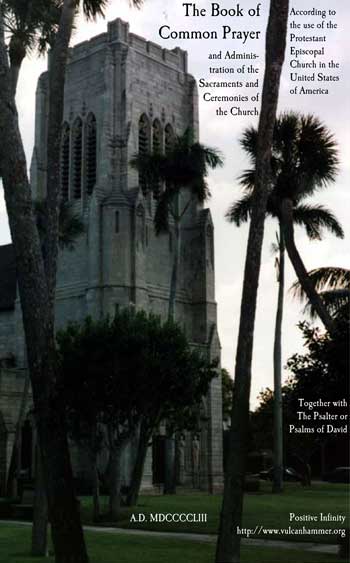
The cover of the 1928 Book of Common Prayer, as it’s been offered on Positive Infinity since it was uploaded in December 2003. The church, of course, is Bethesda-by-the-Sea in Palm Beach, the webmaster’s home church, and a suitable backdrop for this prayer book. A little while back I posted The Episcopal Church My Mother Raised Me In Shorted The Scriptures, where I discussed the fact that the 1928 Book of Common Prayer (which has been available on this site for a long time) changed its lectionary for the worse in 1945.
Not one to simply complain about things, I found and am offering for download a scanned copy of the 1928 BCP with this original lectionary. It’s a little rough in spots but has the “book” feel with opposing pages on one spread. It comes from Charles Wohlers’ excellent prayer book site.
I know it’s better to use a real book, but if you have older copies you want to preserve, it’s a good way to do it. (In any case, 1928 BCP’s tend to be expensive, which should tell you something…)
I have a bulletin from the late 1930’s where this edition is used; the pagination is a little different in the later part of the book.
Download the 1928 Book of Common Prayer with the Original Lectionary
-
Anglicanism: Reformed Catholicism, Protestant and Catholic

The question that continues to vex Anglicanism (perhaps since the time of the Reformation but even more so over the last 200 years) is whether she is…
Anglicanism: Reformed Catholicism, Protestant and CatholicThis is one of the more intelligent treatments of this complicated subject. I think there are two core problems here.
On the Protestant side, I think the tendency now is to equate “Protestant” with “Reformed,” which is certainly not the case. It marginalises some post-Reformation theological threads such as the Wesleyan one, which has its roots in Anglicanism. (It even marginalises Lutheranism!) The episcopacy and Article XVI (if nothing else) put paid to Anglicanism being a truly “Reformed” church. If you want a Reformed church, the Church of Scotland and its progeny are the place for you. I tried to explain this to Robin Jordan but to no avail.
As far as the Catholics are concerned, most who veer in that direction believe that the ultimate goal is union with Rome. They haven’t figured out that churches which have valid apostolic succession but are not in union with Rome (and in no hurry to get there) are still valid. Some Anglo-Catholic people are aware of this but even the current Occupant of the See of St. Peter can’t dissuade them from their idea.
-
Anglican Tidbit: Music of the Episcopal Church
Word WST-9001-LP (1958)
There was a time when the “music of the Episcopal Church” was a very definite quantity with a very distinct sound. As the sleeve notes point out:
“The Anglican Communion (which includes the Protestant Episcopal Church in the United States of America) draws its music from many sources including the great medieval plainsong hymns, the chorales of the Lutheran Church, and the hymns of Wesley and Methodism. This record, however, is concerned only with music which is peculiar to the Anglican Communion from the time of the English Reformation onwards. It represents an almost unbroken evolution in musical style from the Tudor composers to the present day and if the 18th and 19th centuries seem to be sparsely represented, it is because at the Cathedral the emphasis is upon 16th and 17th century music and 20th century music, with the occasional use of what is felt to be best in the centuries in between.”
So what we have here is a slice of that sound. It reminds one of the afternoon performances that high churches would put on outside of the liturgy, it’s almost more of a specialty classical music concert than a church event. Some of the music is performed a capella, others with the accompaniment of the organ. The Gloria Patri gets a workout in this production, although that’s true of the 1928 Book of Common Prayer worship in general. I would be less than honest to admit that it’s not my favourite, but in the genre it is very well done.
Note on the record label: it’s put out by Word, the Gospel music label from Waco, Texas, complete with the “Bible and sword” logo. I suppose that, once the Episcopal snobs figured out what that was all about, they made some changes, for although the Cathedral’s 1964 “Once in Royal David’s City” album was put out by Word, no evidence of that is on the cover!
The songs:
- O Lux Beata Trinitas Composed By – Robert Fayrfax
- Praise Ye The Lord Ye Children Composed By – Christopher Tye
- Nunc Dimittis From The ‘Short Service’ Composed By – William Byrd
- Fauxbourdons To The Magnificat Composed By – Thomas Morley
- Thou Knowest, Lord, The Secrets Of Our Hearts Composed By – Henry Purcell
- The Sacrifice Of God Is A Troubled Spirit Composed By – Maurice Greene
- (2) Psalm 23 Composed By – John Goss
- Nunc Dimittis From The Service In B Flat Composed By – Charles Villiers Stanford
- Oculi Omnium Composed By – Charles Wood
- (4) Oh How Amiable Are Thy Dwellings Composed By – Ralph Vaughan Williams
- Sanctus and Benedictus From The ‘Missa Cantauriensis’ Composed By – Edmund Rubbra
- The Nicene Creed Composed By – Alec Wyton
- Benedictus Es Domine In B Flat Composed By – Leo Sowerby
The sleeve notes describe the performers:
“Alec Wyton has been organist and master of the choristers at the Cathedral and headmaster of the Choir School since 1954. He studied in England at the Royal Academy of Music and at Exeter College, Oxford, and became organist of St. Matthew’s Church, Northampton, England after which he was appointed to Christ Church Cathedral in St. Louis immediately preceding his appointment to New York. He is a member of the faculty of Union Theological Seminary in New York and the National Executive and Examination Committees of the American Guild of Organists.
The choir consist of 40 boys and 18 men. The boys live in the resident Cathedral Choir School on the Close of the Cathedral of St. John the Divine where they are educated on a scholarship basis in return for their singing. They sing the Daily Offices of Morning and Evening Prayer, with a Eucharist on Saints’ Days and Sundays, on every day of the week excepting Monday. Their repertoire includes every school of composition used in the Church from plainsong to the music of contemporary composers.” - O Lux Beata Trinitas Composed By – Robert Fayrfax
-
The Fact that Kristin du Mez Won’t Explain Anything Explains Everything
And she takes her time about doing it too, I’ll reproduce just a snippet:
Do I personally affirm “the church’s teaching that homosexuality is sinful?” Which church? My own church (local & denomination) is actively reexamining this issue in light of tradition, interpretation, history, & science. I’m participating, but as a historian, not a theologian.
This reminds me of a line from the British television show The Prisoner, where #2 can’t get a straight answer about whether there was a plot to kill him. He finally realises the truth and says, “The fact that you won’t explain anything explains everything.”
To start, her church, like every other Evangelical church (and most non-Evangelical ones too) isn’t in a position to come to an authoritative position on anything. I explain this problem in my post Authority and Evangelical Churches. If she had the wit to take this position, a lot of the authoritarianism, patriarchy, etc. she dislikes would be sent to the bottom. But getting rid of authority isn’t the game here; it’s transferring it from one place to another.
Second, the position of Scripture on the issue at hand isn’t difficult to state, adhere to or break away from. The fact that she isn’t doing any of the above is either duplicitous or indecisive, and my quote from The Prisoner should tell you what I think is most likely.
Third, ambiguous responses like this were the main reasons why I left the Episcopal Church. It wasn’t that their answers were right or wrong, but that they didn’t really say anything or mean anything. You can’t build a life with real meaning from that kind of ambiguity. The whole recent history of the Anglican/Episcopal world, complete with “Anglican fudge,” is a testament to the results of trying to make that work.
As the French would say, plus de change, plus la même chose…
-
Pentecostal Pioneer Katherine Voronaev Escaped USSR 61 Years Ago, Revealed Horrors of Persecution

Mugshot of Katherine Voronaev during her imprisonment in Soviet slave labor camps, circa 1930s This Week in AG History —November 27, 1960 By Darrin J. RodgersOriginally published on AG-News, 24 November 2021 Ivan and Katherine Voronaev, pioneer Assemblies of God missionaries to the Soviet Union, were exiled to Siberian prison camps in the 1930s and […]
Pentecostal Pioneer Katherine Voronaev Escaped USSR 61 Years Ago, Revealed Horrors of Persecution -
More Laud than Baxter: the Protestantism of 1662

“And the Church of England is Protestant too” – William Laud, then Bishop of St. David’s, later Archbishop of Canterbury. Before the mid-19th century…
More Laud than Baxter: the Protestantism of 1662
Sailing the Last Voyage with Newton and Pascal
 Positive Infinity