-
Don’t Tell People to “Come to the Table” Unless They Really Do–Or Should
Today is the Sunday of Christ the King, or the Sunday Before Advent, depending on which liturgical calendar you’re using. (So let’s dispense with the term “the liturgical calendar” as if there is only one.) It’s the last Sunday of the liturgical year, and as was the case with 2019-20 it’s been a long one, glad we’ve made it to the end. Hope the next one is better.
So much for one pet peeve. If we’re going to discuss pet peeves in this liturgical year, it’s now or never. So let me bring up a phrase that is a leitmotif among Affirming Catholics: “Come to the Table,” presumably meaning the table of the Lord (as the opening track in The 10:15: Making Tracks sings about.) There’s a lot of sentiment loaded into this phrase, some of which implies that most of the rest of us aren’t really coming to the table, or are not doing so in a meaningful manner.
I’ll start by mentioning the devotees of Bill Clinton’s Eucharistic Theology: It Depends on What ‘Is’ Is, namely the Evangelicals in general and the Baptists in particular. When they get out the big trays, they also obviate the need to come to the table: communion is served to them, they don’t come or go anywhere. With their Eucharistic theology, it probably doesn’t make any difference whether they come to a table or not, which is one reason why places like C4SO are getting refugees from this kind of church.
As I keep reminding people, I grew up in the Old High Church, and we had an altar rail where people came to kneel and receive Communion. Since a permanent altar rail would render the area around the altar inaccessible, part of the altar rail was a gate, which before the actual Communion I might find myself as an acolyte closing, and opening thereafter.
The late ACNA troublemaker Thomas McKenzie made the observation that the altar rail is in reality a table that we come to. If he’s right it’s the closest thing to people “coming to the table” out there. Coming to a table implies the intimacy of a shared meal, and for that to happen everyone (or as many as possible) must be at the table at which the meal is served. So that’s an interesting defence of the use of an altar rail.
Unfortunately those who implemented the changes following Vatican II had a completely different idea about the altar rail and the table. The altar rail, they said, was exclusionary: it was a barrier to keep people from “the table,” which in turn was torn out from its pride of place at the wall and set at the centre of the altar area so that the priest could celebrate the Mass ad populum. This was the state of affairs I found when switching from the Old High Church to the Novus Ordo Missae one.
The problem with this is that, with all of the changes, people really don’t “come to the table” in Roman Catholicism either. The priest certainly does; so do the deacons and the extraordinary ministers of the Eucharist, and depending upon the parish other interlopers might do the same. But most people don’t: they line up in front of the altar area and receive the Body of Our Lord Jesus Christ one by one. My own church’s attempt to improve on that didn’t have a better result.
The only place that came close to that in my years as a Roman Catholic was my experience in the Newman Association, where we had a relatively small, intimate group. That size of a group echoes the ultimate “coming to the table,” namely the Last Supper. But it’s worth noting that, even in a group like that, there were those whose major fault was not when they came to the table but when, how and why they left.
In an attempt to get to a better place, I’ll start in a crude way. When my father wasn’t exhorting his children to “get with the program,” he would tell us to “come to the party.” Coming to parties is an obsession with Americans these days, but that’s not what he had in mind. What he was trying to say is that we should align our attitude with what was right. In Biblical terms it meant the following:
Therefore, whoever eats the bread, or drinks the Lord’s cup, in an irreverent spirit, will have to answer for an offence against the Lord’s body and blood. Let each man look into his own heart, and only then eat of the bread and drink from the cup. For the man who eats and drinks brings a judgment upon himself by his eating and drinking, when he does not discern the body. That is why so many among you are weak and ill, and why some are sleeping. But, if we judged ourselves rightly, we should not be judged.
1 Corinthians 11:27-31 TCNTIf we consider the aforementioned “coming to the table” at the Last Supper, we see the consequences of not having “come to the party” in the first place. And that’s my pet peeve with the “coming to the table” crowd: they more often than not short the need for prior regeneration and repentance. It’s an observation I made in my piece Book Review: William Palmer Ladd’s Prayer Book Interleaves, and I won’t repeat it here. All of my observations about the inconsistencies in the way we receive Communion, and how even with all the liturgical changes we really don’t “come to the table,” are only ways of showing that our outward formalities cannot “close the loop” and obviate the need for inward transformation.
So now I’ve said it. IMHO the “come to the table” people have not only failed to grasp the difficulties of how it’s done at the present; they have also put the cart before the horse by not putting the emphasis on repentance and preparation before receiving the Body and Blood of Our Lord Jesus Christ. Who knows, perhaps this liturgical year will be one where some churches at least will set things aright, in which case “coming to the table”–no matter how it is done–will be something of real celebration.
-
Anglican Tidbit: Church Divinity School of the Pacific: Liturgy is You
LP-RPRT-101 (1968?)
This album occupies a curious place in the “Jesus Music” era in that, in a time when so many albums were self-produced or done on obscure (or not so obscure labels) that disappeared, this one is an official production of the denomination. It was commissioned by the Executive Council of the Episcopal Church in collaboration with the Joint Commission on Church Music. The purpose of the album was to introduce parishes to the liturgical changes that were afoot in the church, specifically the trial liturgy published in 1966 and encouraged by the 1967 General Convention (GC 1967.) This Convention began a series of trial liturgies that would end with the publication of the 1979 Book of Common Prayer. This wasn’t the first time that the Episcopal Church had used the vinyl medium to promote its vision of how the Prayer Book was to be celebrated, but it heralded a new era for many Episcopalians.
And how does it come off? That depends on how you look at it. From the standpoint of the Episcopal Church, it definitely pushed things forward, to the distaste of many in the pews, just as many of the changes going on in the church did in the 1960’s and 1970’s. From the standpoint of the “Jesus Music” era, like most Episcopal productions of the era (such as The Winds of God from across the San Francisco Bay) it’s conservative. There’s the usual acoustic guitar and light percussion in the background but there’s the venerable pipe organ too. It’s the only album of the era I am familiar with that features the Thrice-Holy Hymn or Trisagion, much beloved of the Orthodox (without, I should be quick to add, the additions of Peter the Fuller which raised John of Damascus’ blood pressure so severely.) In spots it echoes albums like Leo Nestor’s Sons of the Morning (another West Coast production) but it lacks the professional musicianship evident in that production.
Today the album (with adaptations) would be a nice Mass in a Catholic parish, better than many that are in use. It’s not the kind of production that brings tears to the eyes of devotees of the “Old Folk Mass,” but it’s not bad either.
Note on the date: the album has no definite date on it, either on the cover or in the booklet that came with the album. Same booklet, however, quotes a book dated 1968 and so that’s as good of a guess as we can do. That puts it, however, with the early productions of the Episcopal student group God Unlimited, which means that, for all their good efforts, things really had left the station long before it was published.
The Songs:
- Brightest and Best
- Kyrie Eleison (2 versions)
- Holy God (3 versions)
- The Lord Be With You (Sunday Proper Preface)
- The Lord Be With You (Advent Proper Preface)
- As Our Savior Christ Has Taught Us, Christ Our Passover
- Alleluia, Christ Our Passover
- Alleluia, Alleluia, Alleluia
- Alleluia, Sing to Jesus
- The singers:
- Lo Rayne Brown
- Robert Clifton
- George Fleming
- Tom Kennedy
- Nora Laurence
- Margaret Sipple, soloist
- Peter Sipple, soloist
- Instrumentalists:
- Allen Grant, drums
- Normal Mealy, organ
- Robert Sisk, guitar
-
Word of God/Servants of the Word: Rise Up O Men of God
Word of God W/G 8019 (1980)
One of the interesting aspects of life in Catholic Charismatic covenant communities was the residential sub-communities. The communities were not in general residentially communal; this mode of life was generally for single people. The sub-community of the Word of God here, the Servants of the Word, is described on the album cover as “an ecumenical brotherhood of over forty Christian men living single for the Lord.”
This is an all men’s group. The Word of God’s usually subdued instrumentation is especially subdued; about the only instrument that appears on the album is an acoustic guitar, making the album virtually a capella. That being said, it comes off better than one might think. It’s a charming album and is, in some ways, a throwback to albums such as Leo Nestor’s Sons of the Morning (if the material isn’t quite as adventurous.) With a capella music more in style now than then, it’s aged well.
The music is a mix of traditional Protestant hymns and the Word of God’s own favourites and compositions, some of which are newer than most of the other albums posted on this channel. It’s a nice addition to the Word of God’s representation on this channel, which has become one of its highlights.
The songs (the lyrics and cover appear during the album):
- Rise Up, O Men of God
- The Lord Reigns
- Blessed Be the Lord My Rock
- Blessing and Glory
- Go Forth in Great Confidence
- Psalm 130: Out of the Depths
- Psalm 96: O Sing a New Song
- For All the Saints
- Worth is the Lord/Glory to God
- Let the Righteous Be Glad
- One Thing I Ask For
- Psalm 4: When I Call
- Song of Simeon
-
Anglican Tidbit: Rejoice! Music for the Worship of God in the Twentieth Century
Mace M(S) 10030 (1966)
Seminary groups–or better, groups of seminarians–had a significant impact on the “Old Folk Mass” the Roman Catholics celebrated, both before and after the institution of the Novus Ordo Missae. The best known of these are the Dameans, but the St. Mary’s seminarians made their contribution as well.
This one comes from the Episcopal Church and antedates them both. It comes from the General Theological Seminary in New York, under the direction of Eastman-trained H. Bruce Lederhouse and advised by the Rev. H. Boone Porter, Jr. (later editor of The Living Church.)
The sleeve notes (which are shown on the later part of the video) repeatedly references them as a “hootnanny.” That’s not entirely inaccurate, because in addition to the harmonies of the seminarians they have only two instruments to accompany them: an acoustic guitar and a banjo. The latter gives a “bluegrass” feel to the performance, although there’s nothing particularly country about the melodies they sing to. This isn’t the only Episcopal album to draw inspiration from Scots-Irish folk music: Ian Mitchell also draws inspiration from this well, unlikely given the Episcopal Church’s demographics.The album is divided into two parts. The first is the “Mass” part, with the usual Kyrie, Sanctus, etc. Contrary to most albums with this and other material on it, this is the stronger part of the album. Although the seminarians (or at least whoever wrote the sleeve notes) is proud of the folk, “hootnanny” feel of the performance, and the vocals are excellent, one longs for a better instrumental backing and arrangement. Early “folk Masses” frequently lacked these but it wasn’t long before groups such as the Berets (of Mass for Peace fame) or Peter Scholtes would ramp that up, and this Mass could use some of their skill in doing that.
The second part is a collection of hymns from the 1940 Hymnal. As was also the case with Frederick Gere and Milton Williams out in San Francisco, they picked two of the oft-performed modern hymns in the book: “They Cast Their Nets” and “In Christ There Is No East Or West.” (I heartily dislike the first.) The quality of these and the others illustrates an important difference between Episcopal and Catholic folk musicians and composers. The Episcopalians started out with a hymnody which didn’t transition well to folk performance. The Catholics started out with virtually nothing and thus their composers and performers had more creative leeway, which they pursued with vigour.
This is a good album, better than many of its contemporaries, but a genre whose most creative days were ahead of it.
The songs:
- 01. Kyrie Eleison
- 02. Nicene Creed
- 03. Sanctus
- 04. The Lord’s Prayer
- 05. Agnus Dei
- 06. Gloria In Excelsis
- 07. Come Holy Ghost
- 08. A Great & Mighty Wonder
- 09. They Cast Their Nets
- 10. O Sons & Daughters
- 11. In Christ There Is No East Or West
- 12. I Walk The King’s Highway
-
Anglican Tidbit: Bulletin for the Twenty-Third Sunday After Trinity
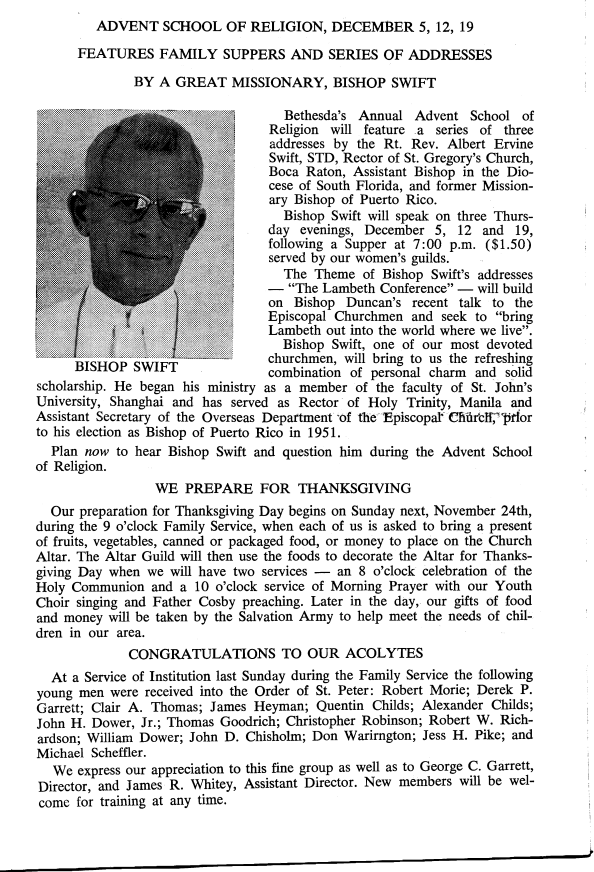
Another Anglican Tidbit, in this case the bulletin from Bethesda-by-the-Sea Episcopal Church for the Twenty-Third Sunday after Trinity, 1968.
Some interesting notes:
- The liturgy is 1928 BCP/1940 Hymnal, for those of you who are looking for help in using this for current liturgical practice.
- The two main services are Morning Prayer (they also had Evening Prayer as noted,) the only celebration of the Holy Communion was at 0800. So much for “Communion every Sunday,” at least at this point.
- The bulletin notes the induction of several acolytes into the Order of St. Peter, whose “manual” is here. For me it was, in some ways, too late in the game: I was regularly at Bethesda for less than a year after the induction before going away to prep school.
- The emphasis on Jamaica–and the mission thereto–is interesting to me personally because I ended up in a church which is very big in Jamaica, and not only on the island but in immigrant communities in the U.S., Canada and the U.K. How they rolled the Anglican Church of the West Indies would be an interesting study; it’s too bad that my high school chaplain, who spent time in the Caribbean, didn’t give much thought to this.
-
The Bourgeois Church of Spectators and the Crisis of Morale in the Priesthood

“What does the word bourgeois actually mean? … The word designates a spiritual state, a direction of the soul, a peculiar consciousness of being.” “The bourgeois, even when he is a ‘good Catholic’, believes only in this world, in the expedient and the useful; he is incapable of living by faith in another world and refuses to […]
The Bourgeois Church of Spectators and the Crisis of Morale in the PriesthoodThe “bourgeois church” is the #1 reason I am no longer Roman Catholic.
-
Anglican Tidbit: Music of the Liturgy in English According to the Use of the Episcopal Church
Columbia ML-4528 (1952)
This fascinating record is really two albums in one. The first, directed by Ray F. Brown, is a “Plainsong” rendition of the 1928 Book of Common Prayer Holy Communion and Evening Prayer. The “Plainsong” is what we would generally call Gregorian Chant (or in the style of Gregorian Chant.) It’s well done but how it comes across depends on how well you like Gregorian Chant, which these days is a subject tied up in the Traditional Latin Mass and all of the controversy that swirls around that. Suffice it to say that, if your parish is interested in attracting TLM people who feel they’re being run out of their own Church (and a case can be made that this is the case) then this Mass, properly executed, should go a long way to making TLM exiles happy.
The second, directed by Harold W. Gilbert with Andrew Tietjen at the organ, features Anglican Chant. For me it’s of more personal interest, having been raised in the “Old High Church.” Anglican Chant is polyphonic, as is the case with that of Orthodox churches. It’s well done and brings back many memories. Anglican chant has gotten the short shrift in the liturgical changes of the last half century, but it deserves better.
The song lists below refer to the 1940 Hymnal.
The songs:
SIDE 1: PLAINSONG — Students of the General Theological Seminary
of New York, directed by Ray F. Brown.THE HOLY COMMUNION
- Kyrie, from Missa Marialis, Mode I. (Hymnal 719)
- Christmas Collect
- Creed, Mode IV (Hymnal 720)
- Sursum Corda (Hymnal 734)
- Christmas Preface
- Sanctus, from Missa Marialis, Mode V. (Hymnal 721)
- End of Canon • Lord’s Prayer (Hymnal 722)
- Agnus Dei, from Missa Marialis, Mode V. (Hymnal 723)
- Gloria, from Missa Marialis, Mode VIII. (Hymnal 724)
EVENING PRAYER
- Preces • Psalm 15, Tone III A 5. (Plainsong Psalter)
- Magnificat, Tone VIII 1, solemn form (Hymnal 658)
- Nunc Dimittis, Tone I 2. (Hymnal 673) • Creed • Lord’s Prayer
(Monotone) • Suffrages • Collects for Peace and Aid against
Peril
SIDE 2: ANGLICAN CHANT AND MERBECKE – Mixed Choir directed by Harold W. Gilbert
MORNING PRAYER
- The Festal Preces (Hymnal 602) • Antiphon and Venite (Tomlinson — Hymnal 607)
- Te Deum laudamus (Monk-Croft — Hymnal 613-617)
Benedictus es Domine (Turton — Hymnal 623) - Benedictus Dominus (Turtle — Hymnal 634)
- Jubilate Deo (Elvey — Hymnal 644)
- Suffrages and Lord’s Prayer (Hymnal 602)
THE HOLY COMMUNION (John Merbecke, 1549)
- Kyrie Eleison (Hymnal 702)
- Credo (Hymnal 703)
- Sanctus (Hymnal 704)
- The Lord’s Prayer (Hymnal 705)
- Agnus Del (Hymnal 706)
- Gloria in Excelsis (Hymnal 707)
-
Today’s Goat is Tomorrow’s Goat Too
Samford University has uninvited Pulitzer Prize-winning historian Jon Meacham from inauguration ceremonies for the school’s new president after student protest…
However, in a letter Wednesday, Beck Taylor, who became university president in July, wrote that due to objections, including from “elements of Samford’s Student Government Association,” the university had decided to reschedule the talk, as first reported by Baptist News Global.I’ve written disparagingly about Jon Meacham before, and my opinion has not changed. I’m inclined to think that sleeping through his address would have been the best form of protest, but conservative activists, like their liberal counterparts, thought differently. Obviously the administration thought that a speaker like Meacham would not be a triggering event, but everyone gets triggered these days.
This is where we’re at: the only way conservatives think they can fight back against leftist cancel culture is to do some cancellation themselves. It’s really not a pretty picture, certainly not for free speech, but it’s where we’re at now.
Meacham’s 2010 piece on Easter prompted the following observation:
Pieces like this weren’t so much a challenge to traditionally religious readers as a declaration of war. Why not just put a bullet in the Easter Bunny while you’re at it?
Looks like his opponents have shot back.
A note about the title: today the “GOAT” is the “Greatest of All Time,” but my Arkansas native mother used the term “goat” for someone like the barnyard animal who wasn’t very popular. Meacham can now claim he’s gone from one to the other.
-
Reinventing the English Reformation

In twenty years’ time, Anglican enthusiasts will mark the bicentennials of three nineteenth-century libraries: the Wycliffe Society Library, the …
Reinventing the English ReformationIn spite of all of the issues that the last century and this one dumped on the Anglican/Episcopal world–WO, the social justice issues, the sexual identity and practice issues, you name it–one that continues to bedevil it like no other is the Evangelical/Anglo-Catholic divide. Even those of us who have tried to take a (somewhat) even-handed approach to this find ourselves in the crosshairs of partisans of one side or the other (in my case, the Evangelical side.)
I think in this case two observations need to be made:
- The problem of “Evangelical vs. Anglo-Catholic” is to some extent wrapped up in the beginnings of the Church of England itself. It’s probably one of the messiest and least pleasant tales to come out of the Reformation. The English opted to retain the Episcopate (not to the taste of the Calvinists) and the liturgy (not to the taste of the radicals) which led to many conflicts and to some extent the English Civil War itself. Any attempt to claim to be the “sole heir” of this mess requires a great deal of “papering over” and the North American Anglican article on the subject describes some of that.
- The Anglican/Episcopal world was influenced by those around them, and in some ways imported the divide from outside a strictly Anglican context. The Evangelicals were certainly impressed by the progress the Methodists and Baptists did in getting people saved. (Had they been more receptive to the Wesleyan revival, they might have been the Joneses rather than having to keep up with them!) The Anglo-Catholics were impressed by the continuity and doctrinal clarity (on some issues) that Rome seemingly provided. This turned into a tug of war that has plagued the Anglican/Episcopal world to this day.
If Anglicanism wants to be something else than a way station to somewhere else, it needs to establish its own identity. That may involve altering the Reformation era dialectics (such as the Eucharist) that don’t mean the same thing now as then. This would be a good time to do this, esp. with the current Occupant in Rome. But I’m not holding my breath.
Sailing the Last Voyage with Newton and Pascal



 Positive Infinity