-
For a New Year: Isaiah 43
It’s a New Year, and with each new one we seem to need more fortifying than ever. This classic comes from Canada, and it’s a cover of Cathy Zawaki’s moving “Isaiah 43.”
The entire album where the Word of God recorded this is here:
Happy New Year!
-
The Why and How of Translating Elevations on the Mysteries
Translating Elevations on the Mysteries has been a major project for me, now it is done. Some explanation as to why I did it and how I did it is in …
The Why and How of Translating Elevations on the Mysteries -
How science has been corrupted
When I was small, my father would conduct experiments around the house. When you blow across the top of a wine bottle, how many modes of vibration are there? How do you get the higher notes? Another time, the matter under investigation might be the “angle of repose” of a pile of sand, as in…
How science has been corrupted -
A Thirteen Year-Old Opines on Christmas
The thirteen year-old was me, and I wrote this for the Palm Beach Day School’s student newspaper the Portfolio Flyer, Volume II Issue X dated 18 December 1968:
1,972 years in the past, in a little Israeli town called Bethlehem, probably one of the most important events in the history of the world occurred. Mary and Joseph had inquired of the local innkeeper as to the number of rooms for rent. Unfortunately, there were no rooms. They went to the outskirts of the town and found a manger. There, Mary had a baby whom she named Jesus.
Jesus grew up in Nazareth. He preached his message of love and compassion to all his fellow men. But the existing status quo disliked his preaching so they nailed him to the cross.
Today, many people disregard his teachings as obsolete and out of date. This thesis is incorrect. For the teachings of the Lord were not meant for about 1500 years, but for all eternity.
There’s a lot to unpack with this, but probably the biggest lacuna is the lack of any reference to the resurrection. Some of that is due to space limitations: the Flyer was packed, that’s all the space I got, probably had to cut it down considerably. But another reason was that, either in spite of the fact that I was raised at Bethesda or because of it, I was unclear as to the bodily resurrection of Jesus. That would have to wait 3 1/2 years until I read Augustine’s City of God, and by then I was on my way to a Tiber swim.
Really, though, the fact that Our Lord bucked the “existing status quo” was a strong reason for me to follow him, and that’s something that hasn’t changed.
-
Deconstructing Santa Claus
A little while back I posted The Bad Little Bunny: An Easter Tale, where I made my teacher hopping mad at my refusal to go along with the conventional wisdom. (Another Chattanoogan, Jon Meacham, got accused of putting a bullet in the Easter bunny, so maybe my incident needs some re-evalulation.) Evidently there’s something about this place and bunnies that doesn’t work.
Growing up in Chattanooga was cut short by something else that didn’t work: my health, brought down by endless allergies and childhood diseases. Before we left for Palm Beach–with its own challenges–I managed to send another childhood dream to the bottom, a bubble that most American parents have to burst sooner or later.
I deconstructed Santa Claus.
Let me stipulate here that, IMHO, there were few places better for a kid to live in a fantasy world than Lookout Mountain, TN/GA. For one thing the place is seriously elevated and isolated from the rest of the community; that elevation difference is more formidable in its own way than Lake Worth was for Palm Beach. On the Georgia end it gets worse: we have the Fairyland subdivision complete with Red Riding Hood Trail and Cinderella Road, Fairlyand School, the Fairyland Club, and the place that gave it its fantasy character, Rock City, full of gnomes and dwarves as the mines of Moria before the balrog showed up.
In spite of this, somewhere around the time I was seven I reached a critical moment. I’m not sure what led up to this. I suspect that my abiding interest in geography triggered my questions. The whole business of Santa mounting a sleigh pulled by reindeer and delivering presents to millions of children across several continents in one evening probably triggered a moment of cognitive dissonance, or, as my father used to say, “I’ve got a no-fit going here.”
One day, while making the long trip from the mountain to my paediatrician on the far side of Missionary Ridge, I must have unloaded all of this on my mother. While passing the National Cemetery (where my in-laws await the resurrection) she finally broke down and admitted the truth: there was no Santa Claus. However, Southerner she was, and she made this revelation with one condition: that I wouldn’t tell other children for fear of upsetting them. The solicitousness for not directly offending others is a hallmark of this culture that has, unfortunately, spread to the society in general.
But I was happy. As long as the presents showed up at their appointed time, I was good with this situation. Such belief probably wasn’t going to stick around much longer because, when we moved to South Florida, the whole idea of someone coming down the chimney was pretty stupid.
Today we have hordes of “exvangelicals” who are “deconstructing” their faith. To be honest I’ve been a part of the Pentecostal/Evangelical world long enough to understand that most of these people don’t have the intellectual mindset to deconstruct much of anything. They’re led by a vanguard of M.Div.’s, D.Min.’s and the occasional PhD, and most of them don’t have the mindset to deconstruct anything either. But all of these people have been led to believe in a Santa Claus, and that they too have a “no-fit going here.”
That “Santa Claus” is the belief that you can be a serious Christian and expect all of the things the world has to offer come your way at the same time. That speaks to the topic of renunciation that I’ve discussed in the past, but it also includes things like The Sad Lessons of Carrie Prejean. Any serious reading of the New Testament would have let the cat out of the bag, but this is the same mentality that led to Bill Clinton’s Eucharistic Theology: insist that it’s literally true until we get to the important part, then say it isn’t.
What’s happened is that our culture has reached the point where it refuses to accept people who are serious Christians in general and who hold to the Christian sexual ethic in particular. The reality of that has sunk in, and now the careerists are in a state of panic. What do we do to fix this problem? That depends on what you think the problem is. For those who think the problem is moving up, you deconstruct what you know to be true in order to construct a reality that is suitable for the outside world. Given that same outside world is really good at keeping the goalposts moving, that’s not a good strategy.
If you think the problem is coming into an eternity with God, you stick with the truth and take the consequences as they come. But we have a generation of Evangelicals which has been drilled on the importance of “engaging the culture” and making it in this life. It’s too late for that accommodation. The balrog has showed up, and Gandalf is telling us to flee.
-
Nicene Theology and Patristic Exegesis Go Together
I never thought I’d live long enough to read this statement:
I realized that if classical theism was to be retrieved, it was necessary to defend the superiority of patristic exegesis, a project I undertook in Interpreting Scripture with the Great Tradition: Recovering the Genius of Premodern Exegesis (2018). By the time I published my original project on the doctrine of God, Contemplating God with the Great Tradition (2021), I realized that a third volume would be needed, one that dealt with metaphysics. This work, Doing Metaphysics with the Great Tradition, is underway. The goal of this trilogy is to recover the exegetical, theological, and metaphysical resources that are necessary for practicing sound theology in and beyond modernity.
I’ve made my own contributions (or at least tried) to this debate, specifically My Lord and My God: A Layman Looks at the Deity of Christ and the Nature of the Godhead. Although my objective was to get past some of the limitations which Greek philosophy has (specifically regarding subordinationism) the idea was to set forth a God-honouring model which would expand on the use of Greek philosophy, not repudiate it altogether.
Unfortunately it’s true that large swaths of Christianity–including most Evangelical and Pentecostal churches–have jettisoned the Apostles’ and Nicene Creeds as authoritative statements of faith, and the philosophical and logical underpinnings that go with them. The result of this has seeped even into parts of Christianity where these creeds are supposed to be normative, with sorry results, which I discuss in my piece Why Sydney Anglican Subordinationism is Lame.
But it takes a really bold person to call for the revival of Patristic Biblical exegesis. I agree that truly Nicene Christianity depends upon it, but the rest of Christianity has gone in one of two directions:
- Uncritical (or semi-critical) acceptance of the German techniques developed in the nineteenth century, which led in part to the corrosion of the faith in places like Episcopal seminaries; or
- Hyper-literalism, where the Old Testament and the New are set on the same level as each other, and no serious attempt is made to put the understanding Bible into any kind of reasonable order. This has resulted in an exegetical mess with things like synthetic Judaism and the running problems we have with the theodicy issue.
It’s going to be an uphill battle to unseat both of these creatures from their thrones, but if we don’t do it, we’re going to end up in a bigger mess than we have now. I’m not one to say that we should re-adopt the Patristic method without some thoughtful consideration, but given the alternatives we need to do something, and soon.
-
I Wonder…How Many of these ACNA Exvangelicals Still Believe in Eternal Security?
There’s no doubt that the “exvangelicals” that have populated places like C4SO have made a splash in the Anglican Church in North America. What kind of spash…that’s another story. When the ACNA started, some of us thought an influx of same would breathe some new life into North American Anglicanism. Now I think we’re having second thoughts. There are two problems: a) exvangelicals have migrated into Anglicanism to get away from the relentless push to be evangelists, and b) in spite of their idea to get away, evangelicals tend to be very “deep into their own stuff,” their culture, the way they were brought up, the things that were drilled into them from the nursery upwards.
Some people think that this is an ACNA novelty. It isn’t. Our society has changed greatly, but “exvangelicals” have been migrating upward (in a socio-economic sense) for many years. It could be argued that efforts like this (in this case from 1952) were early attempts by the Episcopal Church to “show the ropes” to the newbies. But for me this is personal: my mother came out of a Baptist background, and only formally converted in her 40’s, the year before I was confirmed. My mother was a very complicated person, but her Baptistic roots came through in many ways.
One of those was an aversion to infant baptism. As noted here, I wasn’t baptised until I was 10, and that at my own initiative. She always told me that my health when I was born wasn’t very good, so she put it off. Ten years is a long time. Today I don’t believe that story.
But that’s a good introduction to another Evangelical belief she never shook off: eternal security. Some explanation of this is necessary.
The high view of predestination that Reformed people have has as its logical corollary the unconditional perseverance of the saints. In a truly Reformed frame of reference, that makes sense as it is coupled with the unconditional election of…well, the elect. The Baptists have not been univocal on the issue of predestination and election. The Southern Baptists (and their Missionary and Independent counterparts) have, as Bill Leonard pointed out many years ago, effectively combined an Arminian view of election (it’s a choice) with a Reformed view of perseverance. Hence the Baptistic view of “once saved/always saved.”
Doing this results in some interesting effects. One of those is the total lack of penitential life in Baptist churches. That throws people from Anglican and Catholic traditions, but thanks to their theology it’s a feature, not a bug. It even seeps into churches (such as those in the Wesleyan tradition like the Methodist, Holiness and Pentecostal churches) which do not share unconditional perseverance. Another thing is that it puts ethics in a new light, and I discuss this in my post The Baptists, Their Doctrine and Their Nasty Politics.
In the Anglican world, for those who believe that there is a difference in possible eternal destinations, this has never been the case. (Where do you think the Wesleyan churches got it from?) I discuss this from a liturgical standpoint in my post What I Learned About Approaching God From the 1928 Book of Common Prayer.
But serious question: how many of these “exvangelicals,” fleeing the Baptistic (and Baptistic adjacent) world, still believe that, once you’ve made a profession of faith, you’re in for good? Given the rapid influx of these people, that’s not a stupid question. And, as we see, that can have some profound effects on people, up to and including changing their mind on serious issues and thinking they can get away with it based on a salvation experience long ago, in a youth camp far away…
In the later years of our time on earth together, I was shocked to discover that my mother had not only tenaciously held on to eternal security, but that she expected that, in spite of liturgical proclamations to the contrary, I would come around to it. I didn’t even come around it in my 2 1/2 years in the Baptist church: far from it, it made me want to flee it even more!
That’s just one of many strange things that exvangelicals bring to “the table” in the ACNA. The survivors of the war with the Episcopal Church need to wake up to things like this.
-
Anglican Tidbit: Bulletin for the Third Sunday in Advent
Another bulletin from Bethesda-by-the-Sea Episcopal Church, this time from 1965:
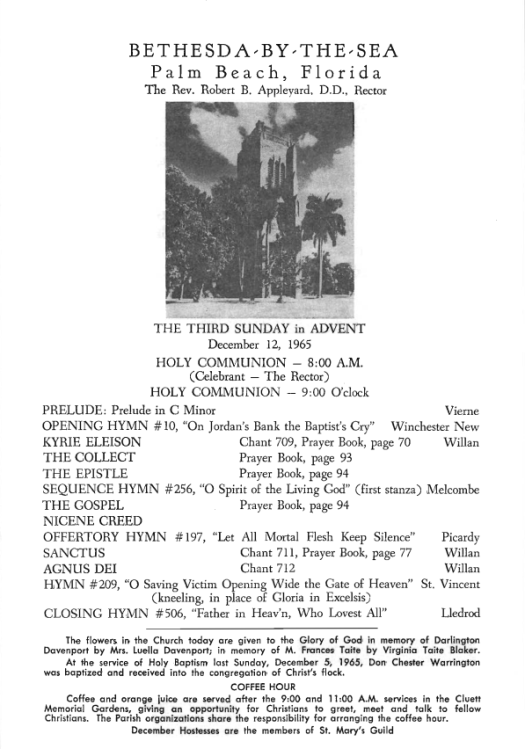
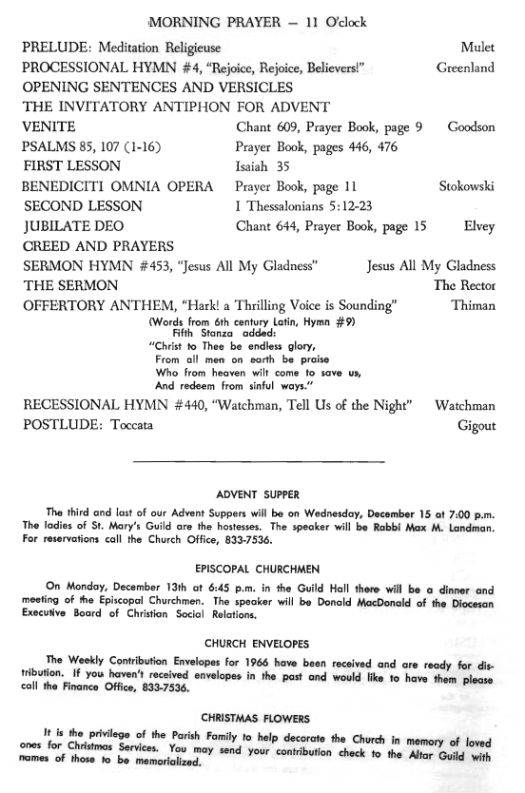
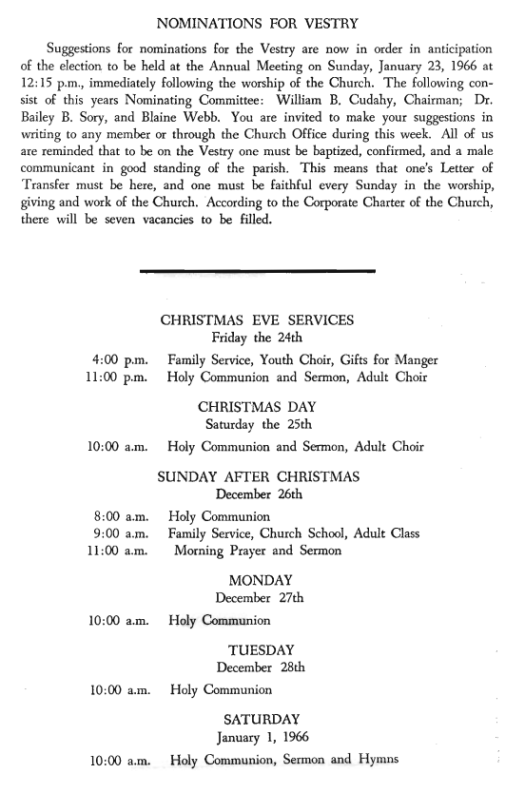
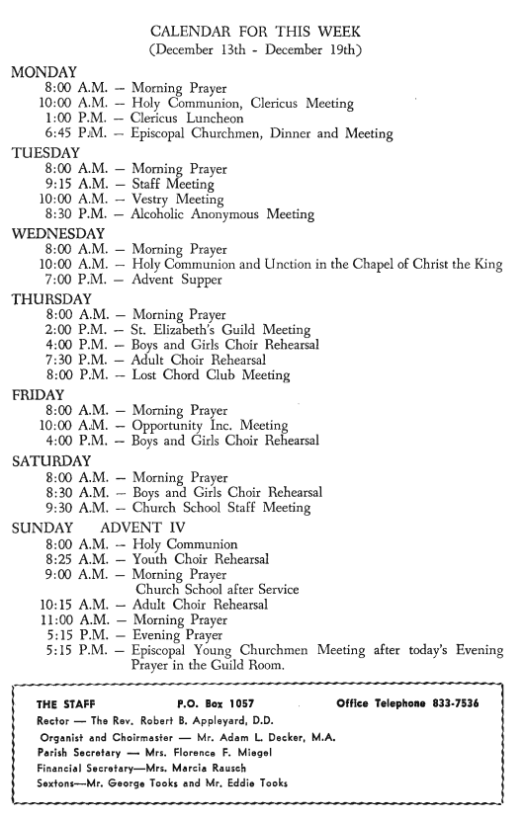
- As usual, the 1928 BCP/1940 Hymnal was being used.
- Holy Communion was at 0800 and 0900 but not at 1100. Generally for the latter two services it was done once a month.
- The Rector was Robert Appleyard, who went on to be Bishop of Pittsburgh and performed the first two authorised ordinations of women in the Episcopal Church the following decade.
- Question for long-term readers of this blog: note the baptismal announcement on the first page. There are several things that are “funny” about this, care to note them?
- St. Mary’s Guild (also announced on the first page) was the guild my mother was a member of. In 1967 their confrontation with the Vestry led to starting the Church Mouse, Palm Beach’s premier resale shop.
Sailing the Last Voyage with Newton and Pascal
 Positive Infinity