-
Those Needy Pentecostals
One of the things I heard frequently as a NOM (Novus Ordo Missae, as opposed to a Trad or Rad Trad) Catholic was the phrase “your needy people.” This was generally rolled out when same needy people were about to “come to the table” (which they really didn’t.)
And yet…somehow, the whole concept of “needy people” didn’t strike a chord. Almost all of the Catholic parishes I haunted were nice, middle class places where the people around me didn’t look too needy, even though Roman Catholicism wasn’t an upper middle class WASP ghetto like the Episcopal Church. The only time I detected serious neediness was when our prayer group leader, under attack by their own church for being Charismatic, admitted that they couldn’t afford to send their eight kids to Catholic school. That incident ultimate broke my relationship with the Catholic Church and its whole obsession with “social justice.”
All that changed when I married and joined a Pentecostal church. It’s true that the one I’m going to is somewhat “privileged” because the educational level of the congregation is higher than most Pentecostal churches. (The congregation is also well endowed with educators from kindergarten to graduate school, which guarantees the income doesn’t match the education.) Even with that, for the first time I found myself going to church with people who were either poor or who had come up from poverty.
And that’s where things get interesting. One thing that has irritated me for a long time about our ministers is the constant message–usually implicit, occasionally explicit–that the purpose of our gathering on Sunday is to get enough “victory” to get us through to the next Wednesday or Sunday, at which point we’ll be recharged again. Coupled with a focus on getting from God what we need to get from now until then, it’s a fairly short-term focus on what I always thought was a long-term deal from where we are to eternal life. People who adhere to this are truly “needy people.”
To illustrate this, about twenty years ago I co-authored a book entitled Ministering at the Altar. In the last chapter I took on this issue, starting as follows:
Our Lord Jesus Christ taught us to be persistent in prayer. He said: “In a certain town there was a judge who neither feared God nor cared about men. And there was a widow in that town who kept coming to him with the plea, ‘Grant me justice against my adversary.’ For some time he refused. But finally he said to himself, ‘Even though I don’t fear God or care about men, yet because this widow keeps bothering me, I will see that she gets justice, so that she won’t eventually wear me out with her coming!’“ And the Lord said, “Listen to what the unjust judge says. And will not God bring about justice for his chosen ones, who cry out to him day and night? Will he keep putting them off? I tell you, he will see that they get justice, and quickly. However, when the Son of Man comes, will he find faith on the earth”? (Luke 18:2-8). Unfortunately some people, in the course of their persistence, come to the idea that all of God’s blessings are so transitory that they can only get enough at one time for a short period.
Ministering at the AltarMy approach was through this classic quotation from Hebrews, followed by a brief history of salvation:
Therefore, since the promise of entering his rest still stands, let us be careful that none of you be found to have fallen short of it. For we also have had the gospel preached to us, just as they did; but the message they heard was of no value to them, because those who heard did not combine it with faith. Now we who have believed enter that rest, just as God has said, “So I declared on oath in my anger, ‘They shall never enter my rest.’” And yet his work has been finished since the creation of the world. For somewhere he has spoken about the seventh day in these words: “And on the seventh day God rested from all his work.” And again in the passage above he says, “They shall never enter my rest.” It still remains that some will enter that rest, and those who formerly had the gospel preached to them did not go in, because of their disobedience (Hebrews 4:1-6).
I thought this was a sound approach, but my co-author had a hard time understanding this. I ended up rewriting it (with a nifty closing quote from Bossuet) but the lesson was learned: this transitory view of the blessings of God is deeply ingrained in the mentality of Pentecostal churches.
Now I’m sure that many (especially the Reformed types) will say that it is because of our bad doctrine. But ministers of all types, if they want to communicate the truth they have, will aim their message to their audience. I think that the Pentecostal view of the persistence of God’s blessings comes from our ministers’ understanding (and in many cases their own experience at the margins of society) of life from a secular point of view. They know instinctively that their congregations are made up of people who live on the edge of disaster, that they couldn’t get through anything else.
Such a mentality is not a product of our own times or even those just before us. Consider this in France of the ancien regime:
Fear and insecurity were the experience of everyone: fear of the dark, of solitude, or unknown places, of death, of evil spells, of the devil’s work, of marauders and beggars in this world…Who could feel secure when the vital harvests were subject to the ravages of storms, and plagues were still endemic?…Living so close to the breadline, people were callous, fatalistic and yet highly strung, their emotions were more volatile and, on the evidence of literary texts, tears flowed more easily than in our culture today.
Peter Robert Campbell, The Ancien Regime in FranceIt’s sad but true that much of our world’s population lives in a state not as much advanced from this as we would like to think. Getting through the week is a major chore; a religion that makes its appeal on this basis is bound to be attractive.
So how do we proclaim Christ’s work as finished in a credible way to people who don’t think much of anything is finished, other than them? I’m not sure I’ve got a good answer to that. I think an emphasis on discipleship (which is just about becoming a must in our post-Christian culture) would go a long way, even though the process is a “nine yards and a cloud of dust” business. That’s ongoing in my denomination at least; I’m glad to say that, in my last years at the denomination’s men’s ministry, we shifted towards a more discipleship-based ministry model.
But wait: why is it that, in a country where church is as class stratified as it is here, that only the churches for “them” have to change? We have to deal with two facts:
- Churches with people with a higher socio-economic level find a more static approach to life and life with God easier to understand, but…
- It hasn’t been that long since these same churches understood that life was an uncertain business, something COVID has taught us with a vengeance.
As an example, consider this part of the Litany from the 1928 Book of Common Prayer:

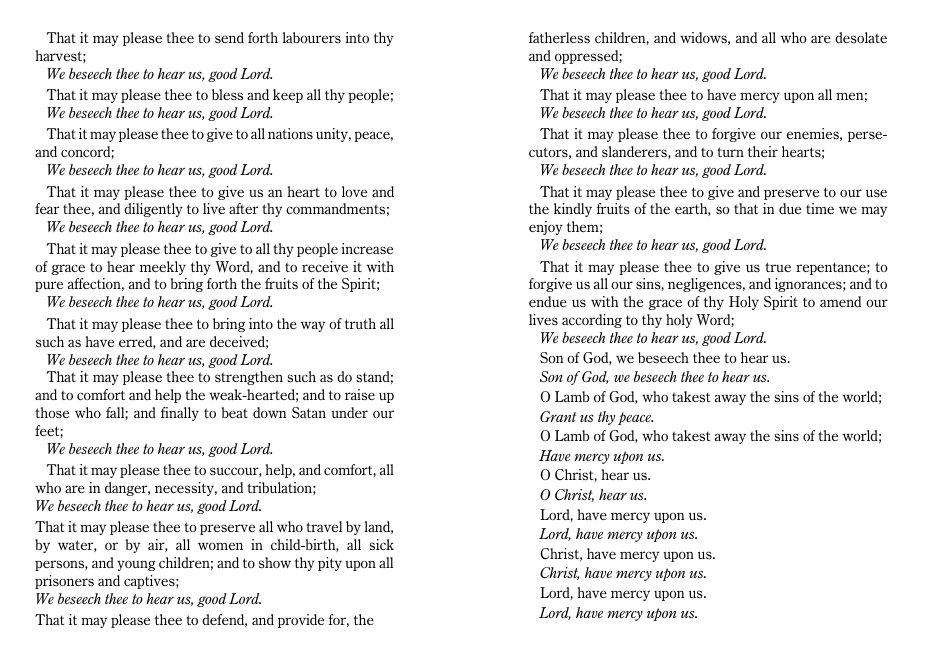
One thing’s for sure: a church which beats Satan down under its feet is more likely these days to be Charismatic than to be a part of the Anglican/Episcopal world.
I think some “meeting in the middle” is in order here. Doing that would go a long way to bringing us together again and also back to reality. And perhaps we wouldn’t have so many “needy people” as we have now.
-
The Passage from Jerome that Landed @bethallisonbarr in a Mess
It’s this one, from Jerome’s Letter 108, his panegyric to Paula at the time of her death:
Inflamed by their virtues she thought more and more each moment of forsaking her home. Disregarding her house, her children, her servants, her property, and in a word everything connected with the world, she was eager — alone and unaccompanied (if ever it could be said that she was so)— to go to the desert made famous by its Pauls and by its Antonies. And at last when the winter was over and the sea was open, and when the bishops were returning to their churches, she also sailed with them in her prayers and desires. Not to prolong the story, she went down to Portus accompanied by her brother, her kinsfolk and above all her own children eager by their demonstrations of affection to overcome their loving mother. At last the sails were set and the strokes of the rowers carried the vessel into the deep. On the shore the little Toxotius stretched forth his hands in entreaty, while Rufina, now grown up, with silent sobs besought her mother to wait till she should be married. But still Paula’s eyes were dry as she turned them heavenwards; and she overcame her love for her children by her love for God. She knew herself no more as a mother, that she might approve herself a handmaid of Christ. Yet her heart was rent within her, and she wrestled with her grief, as though she were being forcibly separated from parts of herself. The greatness of the affection she had to overcome made all admire her victory the more. Among the cruel hardships which attend prisoners of war in the hands of their enemies, there is none severer than the separation of parents from their children. Though it is against the laws of nature, she endured this trial with unabated faith; nay more she sought it with a joyful heart: and overcoming her love for her children by her greater love for God, she concentrated herself quietly upon Eustochium alone, the partner alike of her vows and of her voyage. Meantime the vessel ploughed onwards and all her fellow-passengers looked back to the shore. But she turned away her eyes that she might not see what she could not behold without agony. No mother, it must be confessed, ever loved her children so dearly. Before setting out she gave them all that she had, disinheriting herself upon earth that she might find an inheritance in heaven.
As J.N.D. Kelly notes in his biography of Jerome:
If the rhetoric seems overdone, it remains a fact that the break she was making with home and family cut far deeper than any sacrifice of his (Jerome’s.)
-
“Getting to Know You”: My Profile for UTC’s College of Engineering and Computer Science
It’s not often that someone else does a write-up about me, but where I teach (at the University of Chattanooga’s College of Engineering and Computer Science) they did a profile of me in their series “Getting to Know You.” You can read it all here.
-
Beginning of the Persecutions of the Child Jesus
These elevations concern Jesus’ escape into Egypt from Herod’s clutches, the massacre of the Innocents, and his return to Galilee. In the process …
Beginning of the Persecutions of the Child Jesus -
Further Thoughts on the Elizabethan Settlement

Being a bishop and a parish clergyman, I basically do not have that much time for systematic research, so many of the things that I find out come to me accidentally. For example, earlier this week I was looking for something on the Württemberg Confession and Google produced an article entitled “Lutheran Influences on the…
Further Thoughts on the Elizabethan SettlementIt’s worth noting that one Catholic who have the settlement a reserved “thumbs up” was Bossuet, which he expressed in Variations of the Protestant Churches.

Sailing the Last Voyage with Newton and Pascal
 Positive Infinity