-
The Real Reason Space Colonization Will Fail
It is a utopia, and you do not need to be a scientist or expert researcher [to understand what will pass]. You just sit back, twiddle your thumbs, enjoy your beer, and wait until it fails. [Space colonization] will fail.
My explanation is a little more mundane in explanation, if not in concept. My mind goes back to a story I heard long ago about a woman who went on a cruise. She was talking with a man who figured out very quickly she wasn’t happy.
“I left my husband, I left my home, I left my city, I left my family, I left everything behind,” she told the man. “All of these things were making me miserable.”
“So why aren’t you happy?” the man asked her.
“Because I brought myself,” she replied.
I always think of my mother when I hear this; she took a Caribbean cruise after she divorced my father and wrested the family business from him. Her subsequent course in that business–and with the rest of us–wasn’t a very happy experience for anyone.
But in reality, as long as we carry our sinful, self-centred natures with us, utopia will remain just that, and our colonization of other planets will have the same result–or worse–than our colonization of the one we live on.
-
Book Review: Richard Niebuhr’s The Social Sources of Denominationalism
It’s another pet peeve of mine: Americans can’t bring themselves to discuss the effects of class differentiation in the life of the church, let alone the life of the nation. They’ll talk about just about every other type of differentiation, especially those related to race or gender. But class? Off the table. That applies to both sides of our “debate” these days.
It wasn’t always that way, as I discussed in my informal review of Charles and Mary Beard’s The Rise of American Civilisation. Before World War II people were certainly willing to discuss this. Another historian of note that took up the subject was Richard Niebuhr, and while his Social Sources of Denominationalism, first published in 1922, isn’t all about that, he’s prepared to discuss the impact on class differentiation, among other types of things that divide the human race, on the church and its organization in the United States.
Decrying the ethical failure of denominational Christianity, he begins by making a distinction between a church and a sect:
The primary distinction to be made here is that between the church and the sect, of which the former is a natural social group akin to the family or the nation while the latter is a voluntary association. The difference has been well described as lying primarily in the fact that members are born into the church while they must join the sect.
That distinction is distasteful to a wide swath of Evangelical Christianity, but it gets worse:
In Protestant history, the sect has ever been the child of an outcast minority, taking its rise in the religious revolts of the poor, of those who were without effective representation in church or state and who formed their conventicles of dissent in the only way open to them, on the democratic, associational pattern.
You’d think that Evangelicals would revel in this social justice identification of their origins, but subsequent felt demands of respectability have forced them to hide this fact, or obscure it in self-serving rhetoric. One thing Niebuhr observes that fans of revivalistic Christianity will agree with is that sects can maintain this for only one generation. His subsequent narrative undercuts that to some extent, but it is why Evangelicals are still obsessed with “the Revival.”
He then goes on to identify another division in denominational Christianity: the churches of the disinherited vs. the churches of the middle class. Broadly sects serve the needs of the former while churches serve the needs of the latter. He goes into some detail on the course of the churches of the disinherited in Europe before their movement to these shores; the most interesting narrative is that of the Wesleyan revival in England. Wesley’s initial appeal was to the poor with a sprinkling of those above. He emphasized the need for lifestyle reform over that of social action or revolution (like the French.) He was painfully aware that, as the better lifestyle that Christianity afforded led to upward mobility, that the upwardly mobile would forget what got them there. That prophetic utterance has been fulfilled again and again in the history of American Christianity. The Wesleyan pattern has been repeated in modern Pentecost, which makes sense given Pentecost’s Wesleyan antecedents.
Once things got going in the U.S., there were two divisions that were to further fracture the denominational scene. The first was the frontier; our first frontier was the Midwest and what was called the “Old Southwest” (TN, KY, AL, MS, LA and AR, and later TX.) The sects, mostly the Baptists and Methodists, took advantage of the frontier conditions. That led to an interesting observation that, even with economic growth and prosperity on the frontier, the Christianity of the disinherited prevailed. That juxtaposition, even when mitigated by the migration of some of the sectarians to the churches, explains the unique character of American Christianity and of the country itself, and should be considered in our “Red State/Blue State” divide.
The other division was that of race, and in particular the black people. His history of black-white relations before the Civil War is an interesting read, and his documentation of the separation of black and white churches after it is likewise interesting. Before the Civil War the whites in these biracial churches used the church to keep the black population content with its lot, and he observed the following:
Hence the association of white and black Christians in the various churches prior to the Civil War is scarcely to be regarded as a demonstration of the Christian principle of brotherhood and equality. On the contrary, the church relationship was in most instances designed to enlist the forces of religion in the task of preserving the civil relationship between masters and slaves…The segregation of the races into distinct churches was not, therefore, wholly a retrogressive step, involving the decline of a previous fellowship. Sometimes it was a forward step from an association without equality, through independence, toward the ultimately desirable fellowship of equals.
That separation came back to haunt the white churches in the civil rights movement in the 1960’s and continues to do so to this day. He also says the following:
The causes of the racial schism are not difficult to determine. Neither theology nor polity furnished the occasion for it. The sole source of this denominationalism is social; it demonstrates clearly the invasion of the church of Christ by the principle of caste…Negroes have apparently taken the initiative in forming separate churches, but the responsibility lies with their former masters in the North and South.
Caste systems inevitably involve economic differentiation in addition to social. It’s ironic that many immigrants from the British Isles, themselves trying to get away from the class-stratified society they left, would turn around and create yet another one, but that’s the way it was in the “Old South.”
He has two other topics of interest. One is “Nationalism and the Churches.” Writing as he was in the immediate wake of the great immigrant waves from the Civil War to World War I, he does not consider the white population to be an undifferentiated whole, which is a key assumption of current Critical Race Theory. He even calls out the Scots-Irish (he refers to them as the Scotch-Irish) as a distinct ethnic group, something they’ve been working hard to bury ever since. The nationalism he discusses is that of Europe and the way that European churches reflect their national divisions. His discussion of Orthodoxy and its national divisions is certainly relevant to the current situation in the Ukraine and indeed for the war it has in part caused.
The other topic is the immigrant churches. Again he writes at the end of a great immigration wave; many of his observations, such as those about assimilation and language, are relevant to our immigrant churches of today.
At the end he explores ideas for fixing the whole problem of denominationalism. My general impression is that he cannot figure out how to square the circle of social involvement with the purity of a called-out church, and subsequent events have shown this to be a continuing problem. He does not deal with the issue that those who rise in society must by necessity be more interested in maintaining worldly status, something that has plagued the Anglican-Episcopal world for some time.
So how did class (to say nothing of the Scots-Irish as a distinct ethnic group) get expunged from the debate? Niebuhr cites Charles and Mary Beards’ work more than once, and this, from my discussion of their work, bears repeating:
I said that the whole economic bent of the Beards’ viewpoint–one which they shared with their classical Marxist counterparts (as opposed to the cultural kind we have these days)–got to the point where it didn’t sit well with Americans, so they rejected it. The “point” was World War II. It’s hard to convince a generation to go, fight and in some cases die for a country that is primarily an “economic arrangement.” The Beards themselves saw this kind of backlash during World War I and the push towards teaching “Americanism” in schools, and the wake of World War II, especially with the Cold War, this went on steroids. Americans came to prefer a more “America as an ideal construct,” which went in a number of directions that we now know are seriously at cross-purposes with each other.
Beyond that, an economic view won’t sit well with those who are left behind. One of the major lacunae of the Beard saga is the South after the Civil War, which just about falls off of the radar screen. Southerners had to face the hard question, “How did we get left behind?” Instead of focusing on the weaknesses of their own cultures–planter and Scots-Irish together–they changed the subject to things such as states rights, or their problems with the black people, or whatever. Needless to say those who were on the wrong end of their way liked it even less, which is why we had the civil rights movement sixty years ago and Black Lives Matter today.
It’s interesting to note that one of the Beards’ main detractors was Forrest McDonald, who with Grady McWhiney came up with the “Celtic South” hypothesis, which I have discussed at length on this blog. While that explains many things that the Beards don’t, it doesn’t change the simple fact that those who do not properly apply themselves to economic advancement are eventually going to be left behind, something that bears repeating in these days of uninformed ideology.Until we stop being in denial about the realities of our problems, we (on both sides of the debate) will never solve them. Social Sources of Denominationalism is a good step to address the issue. We cannot face the truth because we cannot handle it.
-
Energy Puritans Enable Enemies of Democracies — Science Matters

Russian President Vladimir Putin and Swedish climate activist Greta Thunberg (Reuters) Western media has stirred up a puritanical revulsion against carbon-based energy, resulting in calls for prohibition of fossil fuels. Leaders in western democracies responded with regulations and constraints punishing companies either producing energy or operating supply infrastructure. This empowers market dominance by sovereign energy […]
Energy Puritans Enable Enemies of Democracies — Science Matters -
Anglican Tidbit: Bulletin for the First Sunday in Lent
In another installment of this series of “Bulletins from Bethesda,” here is the First Sunday in Lent, 1967.
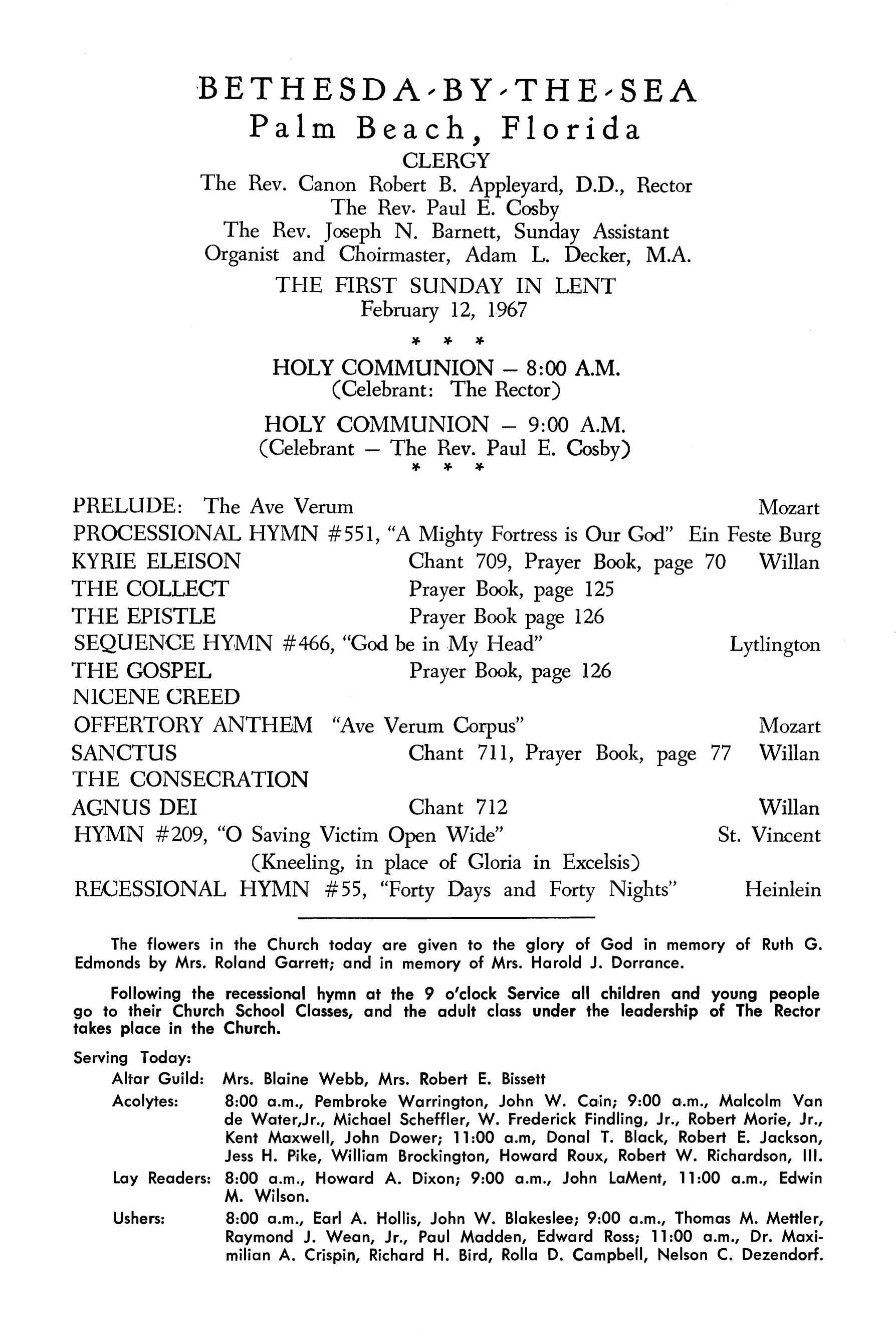
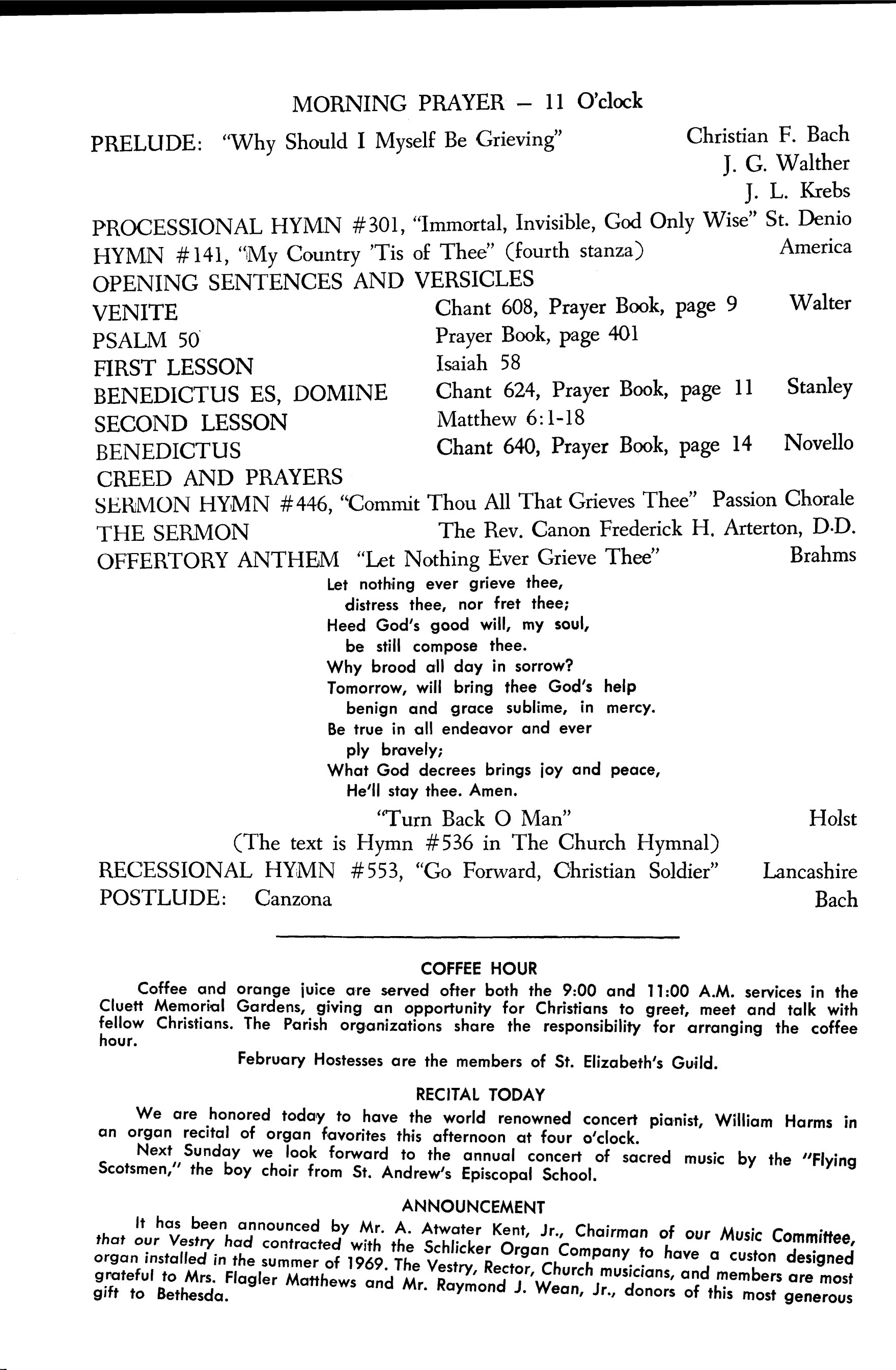


There are quite a few interesting observations to be made about this bulletin:
- As was the case at the time, the Holy Communion was celebrated consistently at 0800. This was the appointed (second) Sunday for the Holy Communion at 0930; Morning Prayer was celebrated at 1100.
- Healy Willan’s well known Communion service was used; it was a favourite.
- My brother was listed as an acolyte at 0800; I was still in the youth choir. The youth choir rehearsals are noted at 0830 Saturday (which I well remember) and 0825 Sunday (which kept me busy while my brother was an acolyte.)
- The coffee hour–that time-honoured institution in the Anglican/Episcopal world–was held in the Cluett Memorial Garden, which is a very nice subtropical setting. The coffee hour was later to get me into trouble with Kendall Harmon’s elves. The Cluetts were the leading family in the church; their butting heads with St. Mary’s Guild led to the establishment of the Church Mouse resale shop.
- The following Sunday would see a visit by the “Flying Scotsmen” of St. Andrew’s School, where two years later I would end up a boarding student.
- The announcement was made for the design, construction and installation of a new organ for the church. It was an all-star committee: A. Atwater Kent Jr. was the son of the radio magnate, Jean Flagler Mathews was the granddaughter of Henry Morrison Flagler, the railroad tycoon who built the Florida East Coast Railroad and what is now the Flagler Museum; and Raymond J. Wean, Jr., the industrialist who was also a major figure at Palm Beach Day School (now Academy.)
- The Vestry meeting was scheduled at 1000 Tuesday, which tells you the work schedule of the members of the Vestry.
- The Bulletin duly notes that the Lay Readers are licensed by the parish.
- A Lenten series is noted, but in Palm Beach Lent was a dreadful inconvenience because it took up a large part of the social season, which may explain why Lent was not observed at Bethesda with the affected solemnity we see in other liturgical churches.
- The reason why this bulletin was saved was that it notes my Confirmation. In my class was Daniel Appleyard, the Rector’s son. A friend of my brother’s, one of his famous sayings was “My father’s a Canon, and I’m a son of a gun!” He was, went on to the Episcopal ministry and is retired in the Diocese of Missouri.
-
Penitential Rite, from the 1928 Book of Common Prayer
It’s needed now:
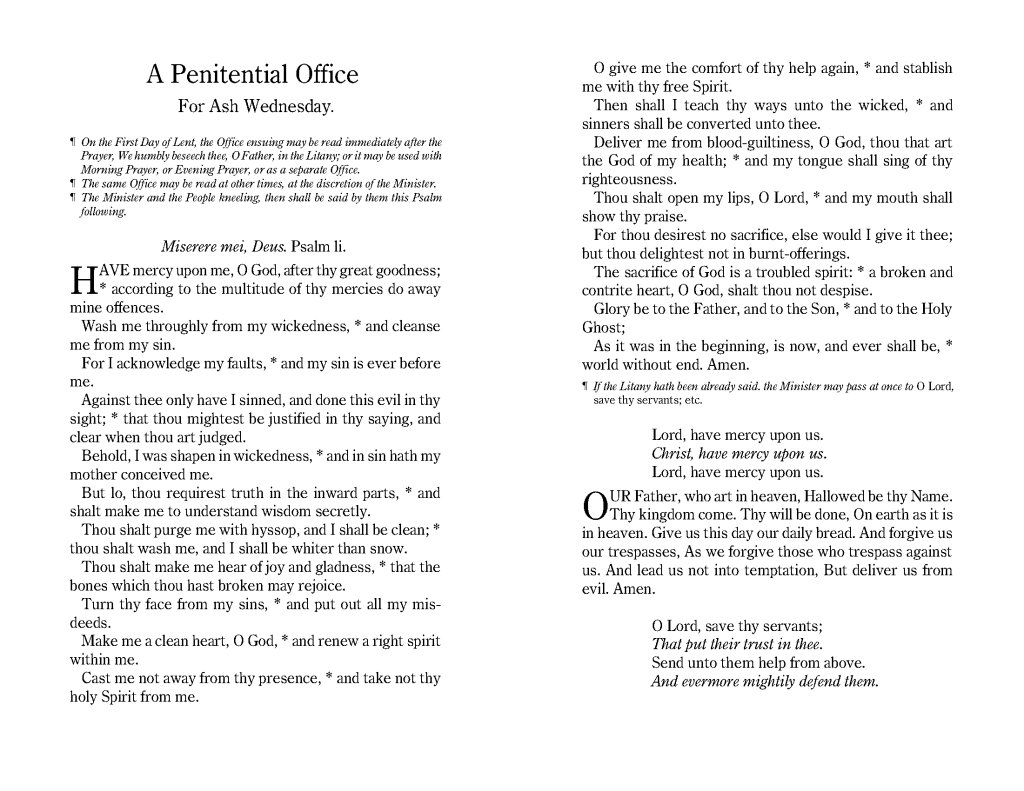

One thing that always struck me about this and so many other penitential rites in the Anglican liturgy (like this one) is that God always is ready to forgive and have us back. That’s missing in many of the moral systems that are being imposed on us these days.
-
The Hidden Life of Jesus Until His Baptism
This section of the Elevations concentrates on Jesus’ growing up years, and specifically the one incident that is recorded in the Gospel: his visit to Jerusalem, his separation from his parents, his time in the Temple with the Jewish sages, and his reunion with his parents. The weeks are as follows: The hidden life of […]
The Hidden Life of Jesus Until His Baptism

Sailing the Last Voyage with Newton and Pascal


 Positive Infinity