-
D025: The Tragedy and the Gift
The Episcopal Church House of Bishop’s passage of Resolution D025–affirming gay and lesbian people in all parts of the life of the church, including all levels of ministry–is both a tragedy and a gift, depending on how you look at it.
As it represents the final repudiation of the Christian sexual ethic, it’s a tragedy. But it’s one that’s been a long time coming.
As it brings clarity to the situation, it’s a gift. TEC has obfuscated and fudged on this issue for years, even though the sense of much of the church has been obvious. It’s been frustrating to reappraiser and reasserter alike.
And, from a purely political standpoint, it’s a gift to the newly formed ACNA. For the remnant in TEC who doesn’t agree with this idea, it sends a definitive signal, and ACNA parishes will be the beneficiaries of this. It vindicates the whole GAFCON organisation and process.
Finally, it will force Rowan Williams and the Church of England to “fish or cut bait” on this issue, and also of communion with ACNA, which is rumbling through the synod process. It will be interesting to see whether this will come to pass, and if the government opts to cut it off at the pass.
-
The Church Where Getting a Straight Answer is Next to Impossible
Many of you wonder why I, now holed up in a Pentecostal church, take so much interest in the Anglican/Episcopal world. Much of that answer is here, but there’s the opposite question: with that interest, why did you leave the Episcopal Church to start with?
One lesson from teaching is that a worked example is excellent pedagogy, and this one–from the liberal Anglicans Online–illustrates the problem perfectly. I’ll reproduce it in its entirety, since they change the front page every week:
Not long ago, a person came to Sunday service at our parish, seeking. He came from a Pentecostal background, and seemed very pious, but he said he wanted to explore Anglican worship. He’d been attending various Anglican churches and this week it was our turn.
After the service, we approached him at the coffee hour, and he peppered us with questions. His first question was ‘Why are Anglican churches all so different? If I go into a Baptist church, or a Presbyterian church, or a Methodist church, or an Assembly of God, I know pretty much what to expect. I know the music, I know what’s going to happen as the service progresses. But the worship service at every Anglican church I’ve been to has been really different from the others. Why is there so much diversity?’
We gave him a relatively vague answer based on history and the role that an established church had played in society, and the spread of Anglicanism to the colonies. It probably wasn’t a satisfying answer, but he went away seeming happy.
Some weeks later, he was back, and at coffee hour he had another question for us. He asked ‘In more than one Anglican church I have heard and read things that make me think the church believes a person must be baptized to gain eternal life. Is that true?’
No easy questions here. We referred him to the catechism section in the Book of Common Prayer, and a listener referred him to Mark 16:15-16. A nearby lawyer pointed out that Mark does not say that one who is not baptised will not be saved. We asked our inquiring visitor if he would be back next week, and planned to discuss the question with others.
Which we did. The various answers were too long and thoughtful to put here in their entirety, but here are some snippets:
‘The Anglican Church definitely does not teach that one must be baptized in order to attain eternal life. God chooses whom he chooses; his grace is freely bestowed and he is not limited to or by the sacraments or the Church. The sacraments bring us into community with other Christians and with the risen Lord. They are means of grace — Christians believe they are specific means God has designated to give us the benefits of his unconditional love and care. They nourish us, strengthen us, bind us closer to God, and help us to grow into the persons God intends us to be.’
and
‘If someone is in a community of faith over a period of time, trying to be a committed disciple, and knows what baptism is, and yet chooses not to be baptized, then I have to wonder about their receptivity to grace. In that sense I think it is “necessary” for believers.’
and
‘I believe a sacrament is an outer and visible sign of an inner and invisible grace. Only the spirit knows which comes first in any given case.’
and
‘What doesn’t get taught, but should be is that the Church recognizes baptism in three forms: ritual baptism with water in the name of the Trinity; baptism by blood – martyrdom; and baptism by desire. For the last, there’s nothing about when the desire is expressed, and nothing to preclude it happening after death. The third is those “whose faith is known to you alone.”‘
The last comment that we got tied it all together. The advice came from a thoughtful priest whose faith is powerful despite having suffered extraordinary hardship:
‘Why don’t you just give him all of the answers that you’ve gotten, without trying to reconcile or combine them, and tell him that this is what he’d get himself into if he ended up becoming an Anglican. Every answer is different, none definitive or unequivocal, except agreeing that Baptism is a sacrament of salvation and grace and that God is sovereign.’
And that brought us right back to the first question, about why there is such diversity in Anglican churches. It’s a mystery. How very Anglican.
And how very frustrating. When wrestling with the greater questions of life as a teenager (in an Episcopal prep school, no less), what I found was that the answers I got from the church I was raised in were not wrong as much as an endless fudge, hopelessly uninformative and useless for either understanding the world around me or building a life upon. So I left.
Evidently, in their quest for “red letter Christianity,” (i.e., only the direct words of Jesus count, not the whole NT) they forgot this:
“Let your words be simply ‘Yes’ or ‘No’; anything beyond this comes from what is wrong.” Matthew 5:37, TCNT.
-
“Schism is not a Christian act.” Tell That to Henry VIII.
Episcopal Presiding Bishop Katherine Jefferts Schori fires a shot across the bow at the Church of England (HT bb):
She urged Archbishop of Canterbury Rowan Williams to remember the “pain of many Episcopalians in several places of being shut out of their traditional worship spaces, and the broken relationships, the damaged relationships between people who have gone and people who have stayed.”
“Recognition of something like ACNA is unfortunately likely only to encourage” further secessions, she said, reminding the Church of England that “schism is not a Christian act.”
That shows a wilful ignorance of Anglican history.
The Church of England was created by nationalising the Roman Catholic Church in England and breaking the institutional relationship between Rome and Canterbury/York. That’s schism. Without it the Episcopal Church would have never come into existence.
Irrespective of the merits of the result, Henry VIII and those who came after him (such as Cranmer, Ridley, Latimer and ultimately his daughter Elizabeth I) believed that they were restoring the church to a more authentically New Testament state than it was in before. (And I’m inclined to agree with them on that score.) That’s the justification for schism; that’s the idea behind the ACNA. It’s in the Anglican DNA, and Jefferts Schori cannot simply wave her Affirming Catholic hand and ignore that.
If she’s really interested in ending schism, she should begin negotiations with the Roman Catholic Church to reunite with them. But then she’d experience another form of schism: she’d be out of a job and on the dole.
-
Palm Beach: Around the Island
Palm Beach Day School
Above: the opening ceremony during Field Day at Palm Beach Day School, 20 April 1968. For intramural competition the school was divided into two teams, the “Pelicans” (blue uniforms) and “Flamingoes” (yellow uniforms.) Both my brother and I were in the latter. (View the video in QuickTime/iTunes format.)
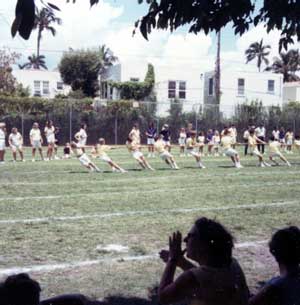
Right: A “tug of war” during Field Day. This wasn’t the only competition to be lost at Palm Beach Day School; the students were never shy about reminding me that I was on the bottom of the social scale as well. Few things belie the whole “compassionate” nature of liberalism more than their sloth in dealing with students persecuting their fellows whom they think are inferior, “anti-bullying” programs notwithstanding. Being on either the receiving or the giving end of this kind of thing is a lifelong lesson that most in our society don’t want others to learn.
Postscript: evidently little has changed since our “tug of war.” Thirty years later, a friend coached a lacrosse team up the coast. The one school they would not allow their kids to eat lunch at was Palm Beach Day School, on account of the harassment by the “home team.” PBDS kids would even shout obscenities at the visitors as they got on the bus to leave.
Note also the closeness of the buildings behind the field. Palm Beach’s real estate is expensive and used very efficiently, more so now than when we lived there.

“There’s a hole in my bucket…” Fourth graders at Palm Beach Day School perform a satire on “hillbillies” called “Appalachian Legend” during Stunt Night 1969. Attitudes from the “coasts” about “flyover country” in the U.S. have been deep seated for a long time; stage productions like this only reinforced that. It’s fair to say that, if the “Religious Right” had fully grasped the contempt they were held in when the movement first got going in the late 1970’s they would not have started the Moral Majority: they would have started a revolution. Other Items

Right: Our home in Palm Beach. It was located on the old “Dodge Estate,” one of the last of the large estates to be broken up (Donald Trump’s Mar-a-Lago is an example of one that is still intact.) Built in the late 1950’s, it survived the hurricanes that were reasonably frequent during the years we lived in Palm Beach (we experienced two the first summer we lived there.) All of the windows were fitted with shutters (as shown here) or had a metal shield that could be fitted for a blow. This obviated the need to strip forests for plywood every time a hurricane arrived.
Note also the ficus hedge running along the street. Using a hedge to both close in the yard and to obscure the view of the property (they’re generally higher now than they were then) is fairly common in Palm Beach. After living with this, being forced into the “open yard” mould so common in the U.S. (especially in the South) just doesn’t quite cut it.

Left: The back of the house. Note that the driveway actually slopes upwards. This is unexceptional in most places but in flat South Florida it is worthy of note. Our street sloped upward from the ocean end to the lake end. The reality is that most of the “barrier islands” in South Florida are on top of a coral ridge, as opposed to being just sand spits. Much of Palm Beach is at least five metres above sea level, and it is the closest point on the U.S. coast to the Continental Shelf, which helps to mitigate storm surge. All of these make parts of Palm Beach a reasonable place to ride out a storm if you can stand the loss of power (ours was out four days after the first hurricane we went through.)
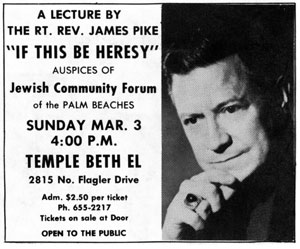
The advertisement on the right for James Pike’s “If This Be Heresy” appeared in the Saturday, 2 March 1968 issue of the Palm Beach Daily News. It appeared directly below the ad for Bethesda-by-the-Sea Episcopal Church, and would have effectively precluded attendance at their Evening Prayer service.
In holding his lecture in West Palm Beach, Pike was invading what was for him “enemy territory.” In an article in the July 2006 issue of Chronicles magazine, author Tom Landess reminded us of the following:
In 1966, a group led by Henry I. Louttit, bishop of the Central Archdeanery of South Florida, demanded that Pike be tried for heresy.
John Hines, Presiding Bishop of the Episcopal Church, met with Louttit and a small delegation in New York and told them he had polled key figures in the mass media, who had declared unanimously that a heresy trial would severely, disastrously damage the Church’s image.
Most of the bishops agreed. The Bishop of New York expressed the feelings of the majority: “Of all the methods of dealing with Bishop Pike’s views, the very worst is surely a heresy trial! Whatever the result, the good name of the church will be greatly injured.”
Hines asked Louttit and his cohorts to allow an ad hoc committee to address the problem more informally, less visibly. Louttit reluctantly agreed. Members of the committee met, engaged in a great deal of hand-wringing, and came back with a report that said in part:
It is the opinion that this proposed trial would not solve the problem presented to the church by this minister, but in fact would be detrimental to the church’s mission and witness…This heresy trial would be widely viewed as a “throw back” to centuries when the law in church and state sought to repress and penalize unacceptable opinions…it would spread abroad a “repressive image” of the church and suggest to many that we were more concerned with traditional propositions about God than with the faith as the response of the whole man to God.
At Wheeling, West Virginia, the House of Bishops adopted this statement by an overwhelming vote, though they also agreed to “censure” Bishop Pike – a small, dry bone tossed to Christian orthodoxy. In the above passage, two phrases — “acceptable opinions” and “repressive image” – revealed what was really going on.
Henry Louttit was a frightful bore from the pulpit, but he was right: it was heresy, and frankly it still is. People such as Pike detonated the jerk to the left that caused the Episcopal Church to lose a third of its membership in the 1970’s. Once again the Pharaohs on the left are making their move and once again God’s children are forced into exodus. But now there is a Promised Land.
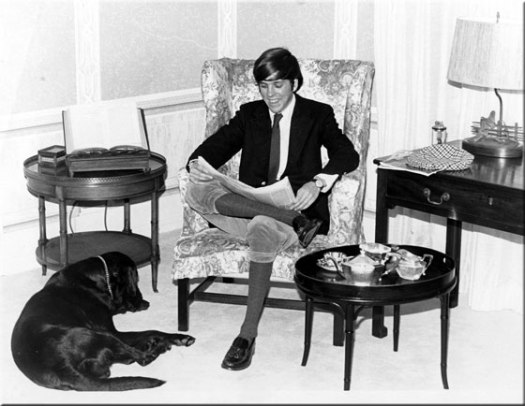
Below: Ah, the good life: Palm Beacher Fred Tod Ketcham relaxes in style. It’s an affectation for many, but Tod was the real article. A scion of the du Ponts, he attended Palm Beach Day School and graduated from St. Andrew’s in Boca Raton with me. I saw him once after gradation in Edinburgh, Scotland, while I was on the way to this experience. He was a superb photographer (he took my photo which I used for my novel The Ten Weeks‘ web page.) But alas, the good life was fleeting: Tod struggled with asthma, finally succumbing in death in 1981 at the age of 26.
-
Inside a Russian Military Factory
I posted this on YouTube recently: a “tour” of a Russian military factory, taken in 1994.
The operation produced pile driving equipment for railroad troops.
Having spent a good deal of time in machine shops, factories and foundries, what struck me was the scale of the operation and the vertical integration of the production. The plant was well organised and clean (not a given in Russia) and the automatic inventory system was not unique but certainly ahead of what my own company employed.
-
Episcoplaians, Katherine Jefferts Schori, and Evangelicals: The War is Now Declared
Gary l’Hommedieu has it right, regarding TEC PB Katherine Jefferts-Schori’s declaration that individual salvation is heretical:
This week the Presiding Bishop declared holy war on heresy, and that’s news. Which heresy? “That we can be saved as individuals, that any of us alone can be in right relationship with God.” This heresy must be stamped out with an inquisitorial zeal. “[Such an] individualist focus is a form of idolatry, for it puts me and my words in the place that only God can occupy.” “My words” here refer to the “sinner’s prayer” or equivalent, where an individual prays to initiate a saving relationship with Jesus Christ and has the gall to believe the Lord hears that prayer.
The Episcopal Church is now in open ideological war with American evangelicalism and the myriad of denominational structures that espouse it. Most notable among them is the Anglican Church in North America (ACNA), an overtly evangelistic and mission oriented Province that celebrated its official inauguration in Dallas-Fort Worth two weeks ago.
The blunt truth is that this war has been going on for a long time, but it no longer a cold war.
Whether they like to admit it or not, a “view from the pew” is that the Episcopal Church, since at least the Second World War, has sold itself as an alternative to revivalistic evangelicalism, with all that goes with that. People who didn’t want a church with too rigid of doctrines, whose sensibilities complemented their upward social mobility, and who liked the aesthetic of the church became Episcopalians. That fuelled the growth of the church during the 1950’s and early 1960’s, that growth only to collapse with the chaos of that decade. TEC rebuilt itself somewhat after that catastrophe, only to repeat the feat after Vickie Gene Robinson’s consecration pushed things too far in 2003.
I don’t think they’re going to get a third chance.
In any case, what Presiding Bishop Jefferts Schori has done is to canonise the war doctrinally. By taking a leaf from Roman Catholic communitarianism (another one of those “Affirming Catholic” moments) she has made abjuring individual salvation an official church practice. It’s a big step, but it isn’t without a preceding undertow in the life of the Episcopal Church.
In some ways, I find this opinion amusing. Many non-evangelicals feel that Evangelicalism is too individualistic and not sufficiently solicitous of the need to become a part of the Body of Christ. But, after years hearing Evangelical preachers beat on “forget not the assembling of yourselves,” I know for a fact that evangelical churches have a sense of community that is sorely lacking in others, especially Roman Catholic churches. The core problem of Evangelicalism isn’t excessive individualism but institutional fragmentation, which cannot be papered over by Gothardian authoritarianism.
Jefferts Schiori has also given soulwinners the weapon they’ve been waiting for. Now they can say that, if you want a personal relationship with God, you need to get out of the Episcopal Church, and that the Presiding Bishop agrees.
-
A Royal Visit: Prince Alexandre de Rethy’s Visit to Palm Beach
One of the long running relationships of our family business was with the Nilens firm in Belgium. This family concern manufactured pile driving and other construction equipment. In January 1965 we were expecting a visit from their principal, Willy Nilens. What we got was a call from New York telling us that he, his colleague George van de Velde, their wives and Belgian Prince Alexandre de Rethy were arriving in Palm Beach in a few days. Needless to say, this was an “all hands on deck” kind of situation for us. In addition to a fishing trip and other activities, we organised a proper reception for the Prince–the half brother of then King Baudoin–at the Colony. (The Prince’s own family story is fascinating; a summary is at the end of the post.)
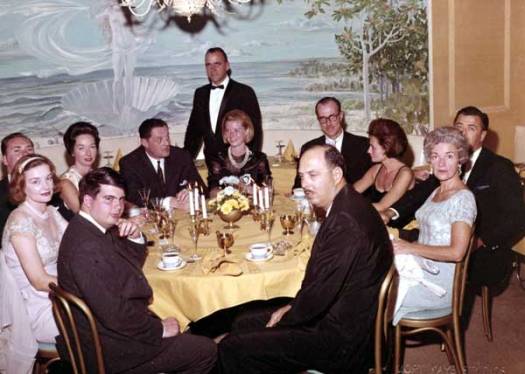
The reception at the Colony. Prince Alexandre is in the foreground, to the left of the “gap” in the table. clockwise from the Prince is my mother Mrs. Vernell Warrington, Mr. Willy Nilens, Mrs. Wiggs, Mr. Georges van de Velde, Mrs. Rolande Nilens, my father Mr. Henry Warrington, Mrs. Marguerite van de Velde, Mr. Earle Evans (my father’s sales manager,) Mrs. Lee Evans, and Mr. Ken Wiggs, whose construction company built our offices and plant in Florida. Standing in the back is “Van,” the Colony’s maitre d’ and a Belgian himself. (Photo by Mort Kaye Studios, Palm Beach) The Prince also came to our home. Knowing what a pair of troublemakers my brother and I (11 and 9 at the time) could be, at the appointed time we were summoned from our rooms, introduced to His Highness, and sent immediately packing for the duration.
The suddenness of this royal visit invites comparison to the most important upcoming royal visit of all–the return of our King, Jesus Christ, to the earth. In the meanwhile, for me the concept of royalty in the subtropics has been something impossible to forget, a combination well documented in The Island Chronicles.
Prince Alexandre (Alexander) de Rethy
In 1935 Queen Astrid of Belgium died during a trip to Switzerland, leaving King Leopold III with three children. Her death devastated her husband. His mourning was complicated by the German invasion and occupation of Belgium in 1940; he remained while the government went to London to set up a government in exile. In the meanwhile Leopold met and fell in love with Lilian Baels, daughter of a prominent Flemish attorney, businessman and governor of West Flanders. They were married in the Catholic church 11 September 1941, but not in civil ceremony until 6 December 1941. Putting the religious ceremony first won Leopold the enmity of the secularists (the same people who banned Muslim headscarves and large crosses from French schools.)
Alexandre was born on 18 July 1942 while his parents were virtual prisoners of the Nazis in their own palace in Brussels. In 1944 the family was forcibly moved to Germany, where it lived until the end of the war.
Leopold’s return to reigning as King was complicated by the controversy that surrounded both his and Princess Lilian (and her family’s) relationship with the Germans during the war. In 1950 a referendum confirmed that the majority of Belgians wanted Leopold to continue as King, but the divisions were both deep and complicated by the linguistic division that always makes things messy in Belgium. Later the same year Leopold abdicated in favour of his son Baudoin.
In 1957 Alexandre underwent heart surgery. That experience caused his parents to become lifelong patrons of cardiac medicine. In 1991 he married Lea Wolman.
Update, 1 December 2009: Prince Alexandre passed away 29 November 2009 at the age of 67.
-
A State of Being

Helene Tuchbreiter Portrait by Antonio Sereix Photo Reproduction by John Haynesworth Helene Tuchbreiter was one of Palm Beach’s most prominent socialites in her time. She made an impact both on the social scene and on the people immediately around her.
My own recollection of her, however, was more prosaic: she was one of my mother’s best friends during the years we lived in Palm Beach. This was made more real by an experience they both shared: the founding of the Church Mouse thrift shop.
Both of them were members at Bethesda-by-the-Sea Episcopal Church and also members of the St. Mary’s Ladies’ Guild. (or circle, as it’s called in some churches.) Each year the guild had a “Rummage Mart” at the church to raise money for its charitable activities. Helene was the Guild’s president. In the Spring of 1968 the Vestry of the church informed the Guild that it wasn’t right to have the sale on church property. In support of their position they cited such Bible verses as “Jesus went into the Temple Courts and began to drive out those who were selling, Saying as he did so: “Scripture says–‘My House shall be a House of Prayer’; but you have made it ‘a den of robbers.’” (Luke 19:45-46) This didn’t sit well with the ladies of the Guild, who thought all along they were doing something good. The Vestry, flush with its new found knowledge of the Scriptures (they probably really wanted to keep the riff-raff off of the church grounds) stuck to its guns. So the Guild had to find an alternative.
Helene, unwilling to be sidetracked in the mission to do good (and probably unwilling to be outdone by sellers of shirts), took the initiative and led the Guild to start a thrift shop off of the church grounds. The Rector, Dr. Hunsdon Cary, was sceptical about the concept; he told Helene that they would probably end up poor as church mice. Beyond the absurdity of anything in Palm Beach experiencing such poverty, this doubtless spurred Helene and the others to make it work.
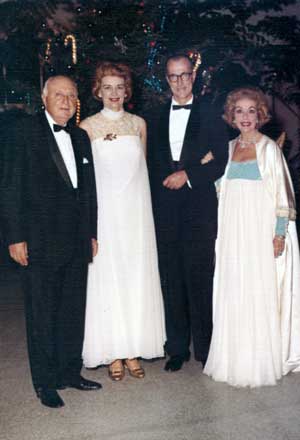
Left to right: Roy Tuchbreiter, my mother, father, and Helene, at a Christmas fête in Palm Beach in the late 1960’s. (Photo courtesy Bert and Richard Morgan, Palm Beach) Note: Some of the information for this article was taken from Helene Tuchbreither’s own copy of The Bulletin of Bethesda-by-the-Sea, 9 April 1991, complete with her own tart comments. Dr. Cary’s quip also gave the enterprise its name; in March 1970 the Church Mouse thrift shop opened. It was soon forced to move because the building was being torn down for the Publix market in Palm Beach (that was another great controversy as well.) It moved to its second location at 101 North County Road. My mother kept the books for the Church Mouse during its early days.
In 1987 it moved to two locations, one at 374 South County Road and the other in West Palm Beach. The store was and is to this day a success, as good example of any of taking lemons and making lemonade.
Years later, while we were preparing for my mother’s estate sale, the portrait reproduction above was found in my mother’s things. The individual who was organising the sale asked me the question, “What did she do?” My response to him was, “In Palm Beach, it isn’t a matter of what you do, it’s what you are,” and went through the story you have here.
This state of affairs, however, is not unique to socialites. When God called Moses to lead his people out of bondage, Moses asked the obvious question:
“Behold, I am going to the sons of Israel, and I shall say to them, ‘The God of your fathers has sent me to you.’ Now they may say to me, ‘What is His name?’ What shall I say to them?” And God said to Moses, “I AM WHO I AM”; and He said, “Thus you shall say to the sons of Israel, ‘I AM has sent me to you.’” And God, furthermore, said to Moses, “Thus you shall say to the sons of Israel, ‘The LORD, the God of your fathers, the God of Abraham, the God of Isaac, and the God of Jacob, has sent me to you.’ This is My name forever, and this is My memorial-name to all generations.” (Exod 3:13-15 NAS)
This abstract sounding answer had then and has now an important point. We as human beings have a habit of defining everyone and everything by what they do. The gods of ancient peoples were a reflection of that; every one of them had a speciality task. But the God who commissioned Moses and later sent his own Son is beyond that: he is not defined by what he does, but by what he is and moreover that he exists: “For in him was created all that is in Heaven and on earth, the visible and the invisible–Angels and Archangels and all the Powers of Heaven. ” (Col 1:16) Jesus himself underscored his own nature and that of his Father when “Jesus said to them, ““In truth I tell you,” replied Jesus, “before Abraham existed I was.”” (John 8:58 NAS)
Our habit of defining ourselves and others by what we do is worse than ever in this performance based world we live in. Helene Tuchbreiter — the preacher’s kid from Montgomery, Alabama, who went on to Palm Beach — has gone on for the last time to meet the great “I Am.” Of the results of this encounter, we do not know, but we do know that before we do anything else we must follow God through his Son Jesus Christ, and then what we are will far surpass anything we can do — in this life and the life to come.
For more information click here.

Sailing the Last Voyage with Newton and Pascal
 Positive Infinity