-
On His Level

Buff. Behind him is the sliding glass door where he met disaster. Readers of this blog have seen the antics of our Applehead Siamese Cat, Buff, who in his day braved both photographers and the high seas. Shortly after we left Palm Beach for Boynton Beach he taught us yet another important life lesson, and as usual he did it the hard way.
Florida living has some unique benefits. One of those is those screened in porches (screened to keep the mosquitoes out) with access from the house through sliding glass doors. The climate makes sitting out on them a delight. We didn’t have them in our house in Palm Beach but we certainly did in Boynton Beach.
We bought the house new, so my mother (recovering from back surgery) had to decorate it. One of the things you do with sliding glass doors is to purchase these “peel and stick” appliqués and put them about eye level so people won’t run into the door. (The alternative is to keep the door so dirty no one can miss them, but…) She did this, but she didn’t take into account everyone in the house.

Looking back through the same door. An appliqué can barely be seen on the left edge of the photo. Buff had the delightful habit of running through the house, making a thundering herd kind of noise (this is amazing for animals known for their stealth.) His vision, as is common with Applehead Siamese cats, wasn’t the best, so he didn’t always know where he was going. One night we were sitting around listening to the thundering herd when we heard an unsatisfying thump on the sliding glass door. It seems that Buff, not seeing or caring about the door, had careened into it. He staggered away; he wasn’t himself for several days thereafter.
This incident made its point, so my mother got yet another set of appliqués and put them towards the bottom of the door so Buff could see them before he had another wreck.
In communicating a message to someone, it’s important to deliver it in a way that they can understand and benefit from it. It’s called sometimes “getting down on their level.” That’s what we had to do for poor Buff; appliqués placed high up didn’t do him much good.
When God wanted to redeem people from their sins and make them into the children he intended them to be in the first place, he himself — he did not send someone or something else — came down to be on our level, in Jesus Christ his Son, “Though the divine nature was his from the beginning, yet he did not look upon equality with God as above all things to be clung to, But impoverished himself by taking the nature of a servant and becoming like men; He appeared among us as a man, and still further humbled himself by submitting even to death–to death on a cross!” (Phil 2:6-8) “Jesus, in the days of his earthly life, offered prayers and supplications, with earnest cries and with tears, to him who was able to save him from death; and he was heard because of his devout submission.” (Hebrews 5:7)
Some religions tell us that it was not worthy that God come down and live with us, as his Son or otherwise. But the truth remains: the best way to make an alliance between God and people is for God himself to come down on our level, where we could not only behold his glory (John 1:14) but that he could both share and transcend our condition and make a way for us from this life into eternity.
Click here to see how this works
All New Testament quotations taken from the Positive Infinity New Testament. -
Remembering the Anti-Moon Luddites
Today, of course, is the fortieth anniversary of Neil Armstrong’s first steps on the moon–“one giant leap for mankind,” to be sure. It was a great accomplishment and deserves to be remembered.
It’s easy to forget, however, that at the time there were many–especially on the left–who believed that the whole enterprise was a mistake, that the money we spent to put Armstrong, Buzz Aldrin (and of course, Michael Collins, commemorated the following year by Jethro Tull in their album Benefit) would have been better spent on feeding the poor and rectifying social injustices. The fact that the following month many of this idea gathered on Yasgur’s Farm for Woodstock underscores the fact.
If we look back on the last two score, we see the trillions spent on what are called “entitlements.” They have become the mainstay (and eventually the undoing) of the Federal budget. Compared to that the money we have spent on the space program (to say nothing of more mundane productivity enhancers such as transportation) doesn’t amount to much. Today we’re towards the end of the shuttle program; we’re sending old tubs into space held together by bailing wire. The future for going to Mars, let alone back to the Moon, is uncertain, muddied by the same kind of luddites that decried our original effort.
 The space program had many technological spinoffs that enhanced life here on earth. But when we have the same old “zero-sum” mentality about this, we’ll end up getting nowhere, and in the long run shortchanging those we profess to help.
And where was I when the first step was taken? In Palm Beach, of course. Behind the balcony of our house (right) was my brother’s room, where we witnessed history on his black and white television.
-
Reply to Jonathan CHM to his Endless Rant on the Blasphemy of the Holy Spirit and Speaking in Tongues
Those of you who keep up with this blog have noted the numerous posting of “Jonathan CHM” on my post Charismatic Anglicans: The Missing Link against things that go on in “Charismatic” churches. I’ve let him have space on this blog, and now it’s time to reply.
First: I’ve received “heads-up” from another one of his victims that he is in fact a spammer, and repeats his rant on blog after blog. The blog that gave me the heads up isn’t, AFAIK, a “full Gospel” kind of place, strictly speaking. The truth is that, if Jonathan CHM is as positive as he says he is about these things, he should start his own blog and rant on, trackbacking the rest of us.
I have more patience than many with this kind of behaviour, but it has its limits. So be forewarned!
In spite of his annoying delivery method, he’s raised some serious issues. Unfortunately, he shares one common fault with many Pentecostal and Charismatic ministers: he thinks that, the longer he goes on, the more he proves his case. It can and will be shown that precisely the opposite is true, that the longer he goes on the more often he contradicts himself.
Let’s start with the big issue: his contention that Charismatic churches blaspheme the Holy Spirit by doing things in God’s name that aren’t from God. Anyone with any hermeneutical sense knows that he has turned the whole business of the blasphemy of the Holy Spirit upside down. The Pharisees contended that Jesus had done his miracles by the power of Satan, and Jesus’ response was to elucidate the blasphemy against the Holy Spirit and the unforgivability of same. The blasphemy against the Holy Spirit is attributing the works of God to the Evil One, and once you’ve done that, there’s no recovery. But Jonathan CHM is saying just the opposite, which is absurd.
One thing that needs to be mentioned is this: too much that goes on in Pentecostal and Charismatic churches is automatically said to come directly from the Throne Room when in fact it may or may not. In years past, revivalists like Charles Finney were able to actually advance their methods (and win souls in the process) without having to attribute everything they did as a direct command from heaven. But we live in a different era now. Personally I think this is dangerous, and have discussed this issue relative to prophecy. But blasphemy against the Holy Spirit? Hardly.
As I mentioned before, a stronger case can be made that resisting the operation of the spiritual gifts is blasphemy against the Holy Spirit, especially if the resisters are brazen enough (and many are) to attribute these works to the Evil One. But that possibility doesn’t seem to have crossed Jonathan CHM’s mind. Neither does it cross his mind that, in denying the present reality of the spiritual gifts and the miraculous, he is calling for a change in dispensation from the days of the original apostles, which in turn undermines the completeness of what Jesus Christ did for us on the Cross.
The best way to fix this problem is to get away from “self-validating” leadership in any form. On the day of Pentecost, Peter said that Jesus was accredited with the signs and wonders that he did. The New Testament speaks of the importance of multiple witnesses to a wide variety of important things. Just because someone says they’re a prophet, or have gift X, doesn’t mean they actually do. But that’s an issue of discernment and pastoral wisdom. To throw out the idea of the miraculous wholesale—as Jonathan CHM and many others advocate—just because we have structural deficiencies in our churches is absurd.
But back to the rant. After, to his own mind, establishing that Charismatic churches routinely blaspheme the Holy Spirit, criticises them for “their non-repentance.” But why should they? The blasphemy against the Holy Spirit is unforgivable! According to Jonathan, they’re toast in eternity! Such a contradiction makes one wonder just how serious he is about this.
Turning to the issue of the nature of the tongues, he undercuts himself by citing 1 Corinthians 14:2. But this is a mistake on his part. If a tongue is only known to God, then it can’t be a human language, because someone down here knows it. I don’t know the state of foreign language education in the mysterious Orient from which Jonathan rants, but just because we don’t know a foreign language doesn’t mean it’s only known to God. That sounds like the lame brain excuses we here on this side of the Pacific on why Americans are so challenged in their foreign language education and skills. I expect better from a part of the world where primary and secondary education is on the whole better and more cost-effective than it is here.
Turning to the issue of tongues and interpretation, I’m a member of the oldest continuing Pentecostal church in North America, and we have tongues and interpretations of same on a regular basis. Just because some churches aren’t doing this on a Biblical basis doesn’t change the Biblical basis.
As far as prophecies of the end times, all of us know that it isn’t ours to know the date of the end. People who set forth specific times are simply wrong. But this isn’t restricted to Charismatic churches, and in fact Charismatic churches aren’t the worst offenders in this regard (just consider the Jehovah’s Witnesses.)
The one good thing that has come out of this is that it has given me an opportunity to address some significant issues that go the core of the modern Pentecostal movement. But, unless Jonathan CHM finds a better delivery method for his endless rant, he’ll find (and probably has elsewhere) that the rant will in fact come to an end.
-
Evangelicals and Catholics Together: A Letter to Keith Fournier
Background
In the fall of 1994 Regent University dedicated its Law and Government Building. At the time the exective director of the American Centre for Law and Justice (ACLJ)–which is housed in this building–was Keith Fournier, a major figure in the Catholic Charismatic renewal. Fournier was passing out copies of his then new book, A House United? Evangelicals and Catholics Together. This subject was too intriguing to let lie so, after returning from the dedication, I wrote a long letter to him on the subject of the Catholic Church. Since this issue is a very real “burr in the saddle” to many, I have chosen to include it on this site. Originally written in 1994, I first posted it in 2006.
The letter pretty much speaks for itself, although familiarity with the book is helpful. I have done some editing to make it suitable for an online, public forum and either incorpoarted or eliminated the footnotes. I added the hyperlinks, as many of the issues the letter alludes to are covered elsewhere on the site.
Fournier never answered this letter. The letter poses some difficult questions that most Catholic apologists don’t like to deal with. However, things are never simple with this institution; both syncophancy and blind hostility obscure the real nature of the Catholic Church, its strengths and its weaknesses.
One item anticipated in the letter that has already taken place is the death of John Paul II and the election of Benedict XVI as his successor. John Paul’s stacking of the College of Cardinals with conservatives headed off election of a real liberal. And since he is elderly, how long his papacy will last–and thus the time to the next conclave, when the nail biting begins again–is a serious question.
The Letter
It was a real pleasure for my wife and I to meet you during the recent dedication of the Law and Government Building.
One of the items we received was a copy of your book, A House United? Evangelicals and Catholics Together. In addition to setting forth an agenda for cooperation that is long overdue, it was especially relevant for me because I have been on both sides of this divide and have given a lot of thought concerning its meaning. I hope that the following is helpful to you in perhaps another view of this situation.
There should be no question that people who profess Jesus Christ as Lord and Savior should be able to work together on questions of public policy. If we as Americans are not committed to establishing a state church of any kind, then we should have no difficulty in promoting a common agenda. Your book is a forthright affirmation of that and you have verbalized many things that many people are afraid to say, and moreover things that many Protestants wouldn’t say for a variety of reasons.
In the course of your book, you brought up many things about your experience that for me brought back a lot of memories. I was raised in the Episcopal Church; however, as a senior in prep school, I converted to the Roman Catholic Church. This began an eleven year (with one important break) spiritual adventure, which led me to the Baptism in the Holy Spirit through the Catholic Charismatic renewal. It also led me into a difficult situation with the Church because of both indifference and hostility to this renewal. After going through the split of our prayer group (over devotions to Mary; this was started by a classic Pentecostal who believed that Mary was the Holy Spirit,) the tremendous experience of our youth group with the three trips to the Youth Conference in Steubenville, and the agony of the attack on the youth, the Church had, to paraphrase Pascal, put my patience to the limit in all areas. So when the opportunity came, I welcomed the chance to escape this situation.
I don’t view this departure as a “bridge burning” act, and over the years I have reflected extensively on my experience as a Roman Catholic, and I would now like to pass on some of those reflections, certainly not for a polemic but as an alert for difficulties that are a) common to both Catholics and Protestants and b) especially important in view of the internal situations that Catholics face in their Church.
The first one is liberalism. In 1982 Ralph Martin wrote an excellent book entitled A Crisis of Truth, which documented the encroachments of liberal and pagan thinking and methodology in the Catholic Church. I don’t think that matters have improved much since then. But there are two important observations that I want to make about this situation.
The first concerns the present Pope, John Paul II. He has done more than anyone to check liberalism’s spread in the Catholic Church. As long as he presides in Rome, liberalism’s possibilities of taking over Roman Catholicism are limited, although local situations are another matter. But when he goes to be with the Lord the situation becomes dangerous. Every conclave since Vatican II has been a white knuckle event in this regard. The next one will be no exception. Most Protestants don’t understand this situation.
The second concerns the possibility of responding to this kind of thing on a local level. In some Protestant denominations (the Southern Baptists come to mind,) people concerned about this have campaigned vigorously to change their church. In the Catholic Church, and especially in the U.S., there is a reticence to attempt such a campaign. For me, the greatest disappointment of the Catholic Charismatic renewal was its unwillingness to really pursue the matter of liberalism after such a strong statement as A Crisis of Truth. In 1983, I attended the Leadership Conference in Steubenville; I think that this book was brought up only once during the whole conference.
In retrospect, the reason for this unwillingness was rather simple. Most of the leadership of the renewal were also leaders of covenant communities. In their communities they had spent a lot of time instilling a Gothardian view of authority into the members , and they were in turn unwilling to challenge the leadership of the Church. But such things are the stuff of history; the present question is, what will evangelical Catholics do when they are faced with the choice between truth and authority again? And how will such choices impact their work and cooperation in matters of public policy and engaging the culture?
My second point is probably best illustrated by a chapter of French history. King Louis XIII had a disturbed personality which made for a fear filled and unloving life. Now, as you know, the Catholic Church has taught for the longest time that, to be in a state of grace, one must be truly contrite. Central to true contrition is the fact that the believer loves God, in accordance with Jesus’ express command. A frequent precursor to contrition is attrition, which is the state where the believer simply fears God and the punishment of hell without loving him. Although attrition can be a necessary step in a person’s road to God, it is not sufficient; only contrition, and with it loving God, is enough for an individual to be in a state of grace and to have a) their sins truly forgiven and b) to have Christ really indwelling in him or her.
Needless to say, Louis XIII had a hard time with contrition. So his chief political advisor, Cardinal Richelieu, simply told him that attrition was sufficient to obtain grace. The King’s confessor, Fr. Caussin, was outraged at this, and was rewarded for this by being exiled to Quimper in Brittany. Many others were outraged too, and it was this last group that became the main protagonists in the Jansenist movement, a movement formally begun by a Belgian bishop named Cornelius Jansenus who wrote a book called the Augustinus. On the other side were the Jesuits, some of whom were busy coming up with their opinions probables concerning such things as how late one could come to Mass without committing mortal sin, how it could be justified to kill another in a duel to preserve one’s honour, etc..
The Jansenist movement took deep root in France with its emphasis on moral conduct and a higher walk with God. Pascal underwent a dramatic conversion experience;there were others, and miracles on top of that. Pierre Goubert tells us in his Louis XIV and Twenty Million Frenchmen:
When historians discover and examine the catalogs belonging to libraries of the period they are continually surprised at the amount of space allotted to the devotional and doctrinal works of the Jansenists. Even Saint-Cyran and the Bible de Port-Royal might be found among the merchant’s books, along with the Ordonnance du Commerce and handbooks on practical accounting…Jansenism…had become one of the greatest currents of French thought. It had moved out from its close, Parisian circle to take root in the remotest provinces and even to make contact with the great mass of the faithful. Such a success was acceptable neither to the Jesuits nor the king’s Government…
…and so these last two, through a long campaign of intimidation and brute force (even the Janesnists’ center at Port-Royal des Champs was physically flattened and the ground plowed up,) the movement was suppressed.
In your book, you make frequent mention of the French Revolution and its atheistic objectives. It is my belief that, if Janesnism and other movements of personal renewal were allowed to flower in France, the French Revolution would either have never have taken place or have been more like the American in nature, in other words more centered around the Creator and not around the creation. The American Revolution was preceded by the Great Awakening, but such a movement in France had already been dispatched.
But now I must get to the bottom of my second point. The central purpose of the Jesuits’ opinions probables were done to make Catholic morality acceptable to a wider variety of people, and especially those at the top of society such as Louis XIV. Pierre Nicole, in his introduction to Pascal’s Provinciales, put it this way, in words which are chillingly prophetic of the relativistic ways of our own time:
It is known that, strictly speaking, the main objective of the Jesuits is neither to corrupt the morals of Christians nor is to reform them; but to attract everyone by presenting an accommodating way of life. Because people have all kinds of personalities, they are obliged to have maxims of all kinds to satisfy them; on account of this they end up with different rules of conduct for different people, and so they are forced to change the true rule of morals, which is the Gospel and the tradition, for both of these are in the same spirit. For this they substitute another rule which is flexible, diverse, satisfactory to everyone, and which can take any shape, and this is what they call the doctrine of probability.
One of the difficulties in working within the Catholic Church is having to battle people whose main objective is to “go with the flow” and make Catholicism as acceptable to many people (and especially important people) as possible, whether what they are saying is in accord with either the Word of God or with the traditional teaching of the Church. The Catholic Church claims the truth lives in the Catholic Church;the important question is, is she now or will she shortly be under house arrest? This relates to the matter of liberalism as well.
Having made these two distressing points, let me say that most Protestant critics of Catholicism would not put it in this way. If we go past ignorance, the main reason they don’t is because both of these conditions are routinely replicated in Protestant churches. Protestants have fought and in many cases lost the battle with liberalism. Playing to the lowest common denominator–a powerful force behind the spread of liberalism–is not restricted to the Catholic Church; it is a part of our human condition. This last point is especially serious in the Roman Catholic church because the Catholic church is very large and influential. Additionally, serious Catholics have a high view of the authority of the Church and feel the need to follow it wherever it goes (as was the case with the leaders of the Catholic Charismatic renewal in the late 1970’s.)
I have spent a lot of time on these matters;let me make a few specific comments about the book.
- I am really glad to see that Thomas Aquinas’ place in Christian theology is being affirmed by Catholics and Evangelicals alike. In college I spent a lot of time on the side wading through his Disputed Questions on Truth and Summa Theologiae. Thomas’ analytical skills and common sense are desperately needed in Christian theology these days.
- It would be a worthwhile project to define a universe of Christian writers and thinkers edifying to Catholics and Evangelicals alike. I would get into this in more detail but it would be too long a business for this letter.
- In the statement itself, it states that one of the standing differences between Catholics and Evangelicals is “The Lord’s supper as Eucharistic sacrifice or memorial meal.” It seems to me that the statement has (perhaps in the interest of brevity) conflated two questions into one, namely a) whether Christ is really present in the elements of the Eucharist and b) whether the Eucharist is a sacrifice. These are separate questions and need to be considered as such.
- As far as people such as Dave Hunt are concerned, perhaps the best advice comes from Pope Leo the Great. About 450 he wrote a letter to Rusticus, a bishop in what is now southern France. Rusticus was having quite a lot of trouble with many of his church people who, unhappy with his performance, were hounding him with their mouths. Rusticus was ready to quit, but Leo responded with the following:
But I am surprised, beloved, that you are so disturbed by opposition in consequence of offenses, from whatever cause arising, as to say you would rather be relived of the labors of your bishopric, and live in quietness and ease than continue in the office committed to you. But since the Lord says, “blessed is he who shall persevere unto the end,” whence shall come this blessed perseverance, except from the strength of patience? For as the Apostle proclaims, “All who would live godly in Christ shall suffer persecution.” And it not only to be reckoned persecution, when sword or fire or other active means are used against the Christian religion;for the direst persecution is often inflicted by nonconformity of practice and persistent disobedience and the barbs of ill-natured tongues: and since all the members of the Church are always liable to these attacks, and no portion of the faithful are free from temptation, so that a life of either of these nor of labor is devoid of danger, who shall guide the ship amidst the waves of the sea, if the helmsman quit his post? Who shall guard the sheep from the treachery of wolves, if the shepherd himself be not on the watch? Who, in fine, shall resist the thieves and robbers, if love of quietude draw away the watchman that is set to keep the outlook from the strictness of his watch? One must abide, therefore, in the office committed to him and the task undertaken. Justice must be steadfastly upheld and mercy lovingly extended. Not men, but their sins must be hated. The proud must be rebuked, the weak must be borne with;and those sins which require severer chastisement must be dealt with in the spirit not of vindictiveness but of desire to heal. And if a fiercer storm of tribulation fall upon us, let not be terror stricken as if we have to overcome the disaster in our own strength, since both our Counsel and our Strength is Christ, and through him we can do all things, without him nothing, who, to confirm the preachers of the Gospel and the ministers of the mysteries, says, “Lo, I am with you all the days even to the consummation of the age.” And again he says, “these things I have spoken unto you that in me ye may have peace. In this world ye shall have tribulation, but be of good cheer, because I have overcome the world.” The promises, which are as plain as they can be, we ought not to let any causes of offense to weaken, lest we should seem ungrateful to God for making us his chosen vessels, since his assistance is powerful as his promises are true.
- You discussed the situation in Eastern Europe. Having spent some time in Russia, this is a topic that needs discussion which is independent of our situation here. The basic problem in Eastern Europe and the former Soviet Union is that the general concept of religious freedom hasn’t advanced since the days of Avvakum .
- You mentioned the appearance of the King of Finland at the Vatican. Finland is a republic, and has been since its independence from Russia in 1917. The Lutheran Church is certainly the state religion in Finland and is supported by tax Finnish marks.
Finally, attached to this letter is an article I wrote for the National Forum of the Phi Kappa Phi. It was my contribution to the engagement of the culture. Unfortunately it suffered in severe editing and adverse reactions in a fraternity that is heavily larded with educators.
Well I think that I have gone on long enough. I wrote this neither to condemn nor to depress but to educate and edify, and I pray that it has done both. We appreciate very much the hard work that you and the rest have done at the ACLJ and believe that your work will reap rewards in this life and in eternity. May God richly bless you and we look forward to seeing you again when we come to CBN.
-
Czerwono-Czarni: Msza Beatowa–Pan Przyjacielem Moim
(Muza XL 0475) 1968?
One of the genres of Mass music that never quite got off the ground was the “rock Mass.” Part of the problem was that rock Masses aren’t very participatory in the sense that people can easily sing along with the music; it’s more of a “spectator sport.” But the other problem was that many of the rock Masses weren’t very good–either as rock or as Masses.
This album is an exception. Czerwono-Czarni (the “Red-Blacks”) started in a club in Gdansk, where the Solidarity movement that was instrumental in ending Communism in Poland also began. They were named after the colours of the club. They were Poland’s first rock band of note.
This Mass was written by Katarzyna Gartner and first performed at St. Christopher’s Church in January 1968. It’s a pity that the reaction of the congregation wasn’t recorded, because this album is a veritable tour de force of 1960’s rock genres (the title means “Beat Mass.”) Sometimes it sounds like a 1960’s James Bond movie, which is especially appropriate since it came from an Iron Curtain country. It’s sung entirely in Polish, although you can tell from the Latin titles where most of them fit into the Mass.
One notable piece is the Gloria, a notoriously difficult part to set to music. This group gets around that by “rapping” it. They mix things up all over, sparing nothing in stylistic changes, from bells and chants to…well, you’ll just have to listen to it yourself.
 The songs:
- Introitus
- Kyrie
- Gloria
- Graduale
- Credo
- Sanctus
- Agnus Dei
- Communio
- Koleda
- Chwalcie Imie Pana
- Przyjaciele Moi
- Historia O Bozym Narodzeniu
-
Does It Really Take Half an Hour to Walk Half a Mile?
Tom Dugan of Chattanooga’s mass transit authority thinks so:
CARTA Executive director Tom Dugan told authority members Thursday that up to one-fifth of the people working at the new Volkswagen plant may opt to ride buses to work, rather than driving their own vehicles.
That’s because the parking lot for the new plant is huge, he said, and “the last ones to arrive may have a half-hour walk just to get to the plant . . . Its a half mile from the end of the parking lot to the plant entrance . . . We would transport right to the door.”
This, of course, is absurd.
I think it’s great that CARTA will provide good bus service to the new Volkswagen plant, especially considering it isn’t in a downtown area. But it doesn’t take most people 30 minutes to walk half a mile (about 800 metres, for those of you in the rest of the world who are doubtless ROFL at this point). If it does, they’re probably handicapped, in which case they’ll get the specially marked places nearer the building.
But it may just scare some people here. Chattanooga doesn’t have an employer with a grade parking lot this large; the downtown employers use parking buildings and on the whole aren’t this big. But that’s the price of progress. And it’ll be a great corporate exercise programme for those who need it (and they’re numerous in this part of the US).
-
Cominsky Field? Maybe Barack Obama Would Rather Have Alinsky Field? And Then There’s Engels Stadium…
Out of the abundance of the heart the mouth speaketh…

“I do think that there’s a different quality to what used to be Cominskey Field vs. Wrigley,” President Obama told Bob Costas during an interview that aired during Tuesday night’s MLB All-Star Game.
Or so Chairman Barack opines. In communist countries, it was common to change place names for radical heroes. So we morph, from “Comiskey” to “Cominsky” to his community organising hero “Alinsky Field.”
Here in Chattanooga, TN, where I live, we have “Engel Stadium,” named after Joe Engel, the famous baseball promoter. If the transition is complete, it would take even less to rename the place “Engels Stadium,” after the co-author of The Communist Manifesto.
The slippery slope to socialism gets slipperier all the time. Next thing–and I saw this in the Soviet Union–we’ll have propaganda posters in dry cleaning establishments.
Better dry cleaning through communism?
-
Called Out of the Pews: An Experiential Reflection on the Role of the Laity
The summer before I graduated from prep school, we left Palm Beach. My mother had had back surgery and we needed to live in a single level house. We didn’t move far, just to Boynton Beach, about 50 km down the road.
A New Church…A New Parish
I had started attending the Catholic church in Palm Beach just a few months before that, the same church that Jack Kennedy attended when he visited the family compound there. My parents weren’t too thrilled with this decision, but I did it anyway. Moving however required me start attending another parish. That lasted for a few weeks; they then announced that a new parish was starting less than a kilometre from where we lived, and that we should go there.
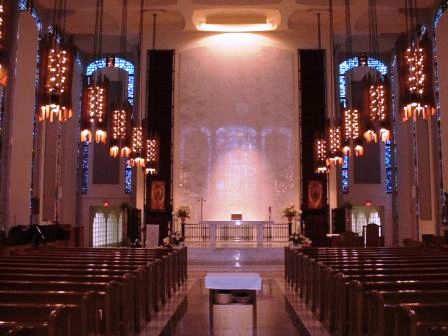
South Florida is well known for fast growth. The major seminary for the Archdiocese of Miami was located in Boynton Beach, so they impressed the use of the seminary’s chapel for the new parish. (Photo below.) The church certainly had its own pastor but they also impressed seminary professors to say Mass (some acted like they had forgotten how it was done!)
I took a low profile going there, because I wasn’t sure what I really wanted to do in Roman Catholicism. That wasn’t difficult at first because this parish, like most, didn’t have a lot of social interaction amongst the parishioners. But that changed abruptly one Sunday morning at Mass.
I came in as usual and sat down towards the back, minding my own business, when someone came from behind the altar and asked me to be the lector for the Mass. The lector is the person who is reads with the first two appointed selections of the Bible for the Mass (plus the Responsorial Psalm when it isn’t sung.) I was surprised at this but I went on back and met the parish priest. He asked me, “Have you ever been a lector before?”
“I’m not even Catholic,” I replied.
“We’ll take care of that later,” he answered. So he gave me a crash course in lectoring, we ascended to the altar of God and I lectored my first Mass. I was instantly a regular lector at the church, which not only involved me in the life of the parish but also did wonders for my public speaking. Before the year was out I formally converted to Roman Catholicism and began the greatest spiritual adventure of my life.
The Role of the Laity
A Protestant minister and a Catholic cardinal were having a discussion and the minister asked the cardinal, “What is the role the laity in the Catholic Church?”
The cardinal decided he would have a little fun with this, so he replied, “The role of the laity in the Catholic Church is threefold: to know when to kneel, to know when to stand, and to know when to reach for their wallet.” In Evangelical terminology, this is “pray, pay and obey,” although more elegantly put. The reality is, however, that Roman Catholicism historically has had a large gap between the laity and the clergy, to the point that a lot of Catholic thought basically says that only the clergy — and by this those in religious life are included — are the only real Christians. It was only with Vatican II that the Roman Catholic Church really began to tackle the whole problem of the role of the laity in the church. Now of course we see lay people very prominent in all kinds of activity, lectors included.
Protestant churches were supposed to have “solved” this problem with Martin Luther proclaiming the “priesthood of all believers.” But the record is decidedly mixed. The history of non-Catholic churches shows that, where there is an organizational structure, the tendency is to concentrate both the power and the activity of the church in the hands of its leadership.
The New Testament, however, does not encourage this trend. The believer is not only saved and redeemed from their sins; they are made new creatures in Christ (1 Cor 5:17). Moreover they are given the Spirit and commanded to do greater works than Jesus did (Jn 14:12). Moreover the New Testament does not create an elite group of people; this authority and the gifts of the Spirit are distributed throughout the Body of Christ (1 Cor 12). Churches that plan to be faithful to the New Testament — and successful — need to activate the laity in the life of the Church. In other words, they need to call their people out of the pews to do what God intended them to do, perhaps as my parish in Florida did so long ago.
As for myself, I lectored in most every Catholic parish I was a part of until the last one, which required that all lectors go through training before they became a lector. My travel schedule did not permit me to attend any of these classes; moreover, I thought it strange that they would require such of an experienced lector such as myself. The disconnect from parish life created by that void made it a lot easier to leave Roman Catholicism for the last time.

Sailing the Last Voyage with Newton and Pascal

 Positive Infinity