-
Atheism Isn’t Self-Evident From a Scientific Education
In describing a “camp for atheists” (that’s not an entirely accurate generalisation, but it’s close) Ruth Gledhill notes the following:
At Camp Quest, children will be led to believe that science, which forms the main substance of their instruction, is incompatible with religion and religious beliefs, not because a scientific education makes this fact self-evident but because children at Camp Quest ‘learn about science, the scientific method, critical thinking’ alongside ‘world religions and church-state separation’, a correspondence which is normally avoided and criticised by atheists and mainstream educational establishments, rather than encouraged, even if it is to discredit links between the two spheres. (emphasis mine)
That, in a nutshell, is one of atheism’s biggest problems.
I’m one of those people who’d like to see hard science and math education become the “core” education in our schools, as opposed to the arts or social sciences, which is the case now in the Anglophone world in general and the U.S. in particular. Looking at the end result of such an emphasis would lead to engineers and scientists at the top of our society (as is the case in China) rather than the lawyers. The reason why this isn’t so is complicated, from cultural factors to the systemic problems our public schools have in retaining science and math teachers to the fact that excelling in any scientific educational track is hard work.
Many Christians might think that this would lead to a diminishment of faith in our students. But I know better. And so do the atheists, which is why, at places like Camp Quest, they have to lard a curriculum in scientific discovery with materialistic philosophy to get their point across.
The fact that a scientific education doesn’t make atheism self-evident per se is a serious problem for the purveyors of anti-theism.
-
Around South Florida at the Turn of the Unix Era
People who grow up in what used to be called the “Gold Coast” (Palm Beach, Broward and Dade Counties) take for granted their natural surroundings. From the standpoint of most of the rest of the country, South Florida is an exotic paradise. Growing up in that “paradise” has been a defining event for me: it’s moulded the way I look at life and the way I express that, especially with stuff like The Ten Weeks.
But that paradise is also fragile. The basic problem is that it is a victim of its own success; too many people agree with this, so they move there. The result has been development that has exceeded the ability of the region’s natural resources to support it properly.
These photos come from an earlier era in South Florida history, and hopefully will remind people of what the placed used to look like. The Unix Era started 1 January 1970; that should give you an idea of the vintage of these photographs. I took some of them but not all. Enjoy!
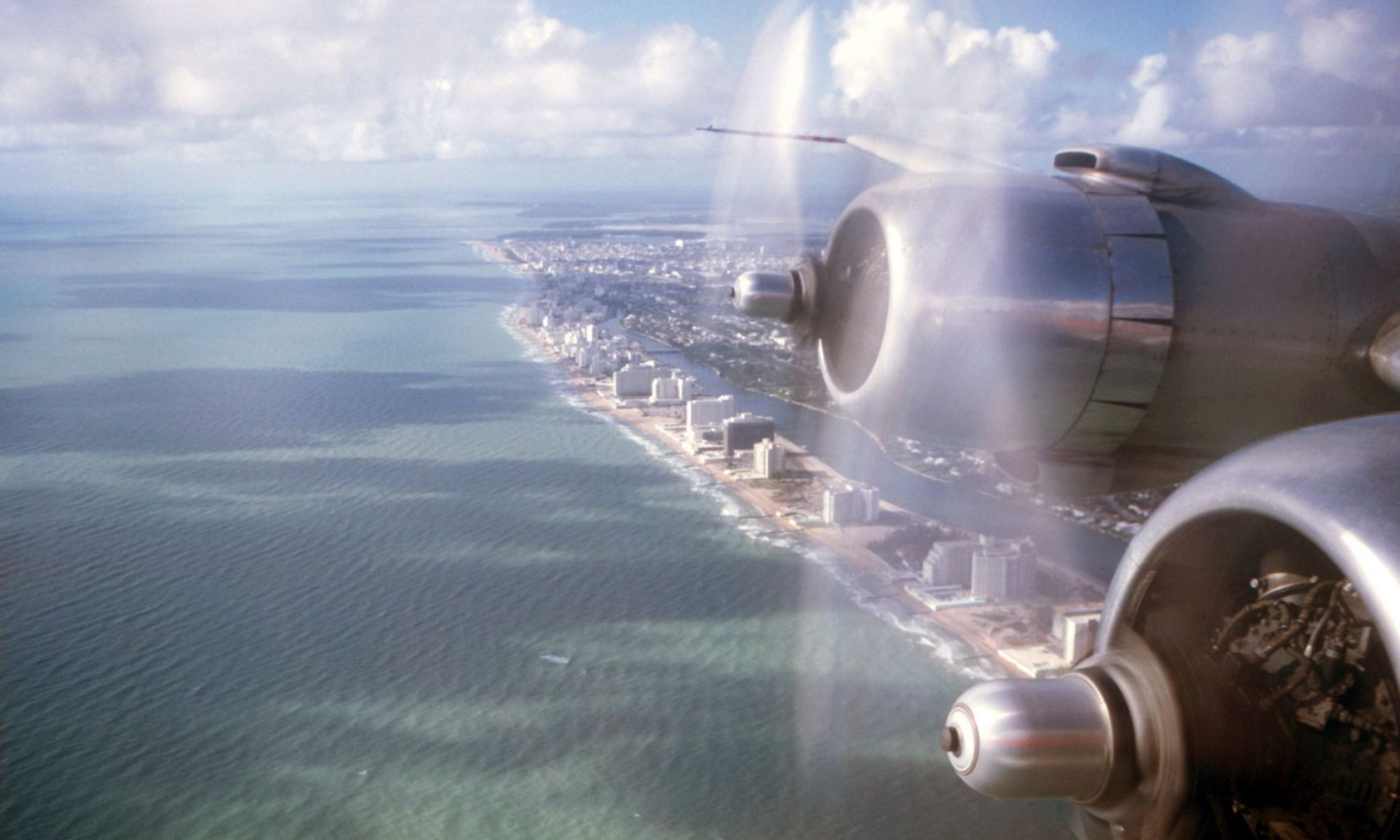
Below: A “bird’s eye” view of Miami in 1962. The main inlet is Government Cut; the large sandy island on the south side is Dodge Island, being transformed from a natural island (such as Fisher Island, at the top right corner of the photo) to a man-made creation. Man-made islands fill the north end of Biscayne Bay, as you can see to the left of Dodge Island. In the back is Miami Beach, better known today for its “South Beach,”, the diet and the exposure that results therefrom. (Photo courtesy of Aerial Surveys Inc., Miami)

A nautical chart from 1966 showing the same area.

From another viewpoint: driving pile to construct the first bridge to Dodge Island, with downtown Miami in the background. This was commissioned by my family business, who furnished the pile driver. Two years after this photo we relocated the headquarters of the business to West Palm Beach and moved to Palm Beach.One of the better shots of its kind, I used it in another publication, the vulcanhammer.info Guide to Pile Driving Equipment II.

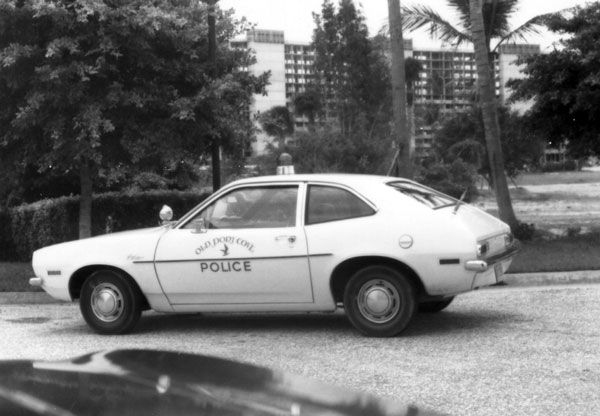
No high speed chases here: Old Port Cove, the large marina and condominium facility north of West Palm Beach, employs the use of a Ford Pinto to patrol the premises, as shown in this 1974 photo. With its 1.6 and 2.0 litre engines, the Pinto wasn’t very speedy to start with, but with its particularly explosive rear gas tank, it was a gamble to ride in. (For another Pinto photo in South Florida, click here.)
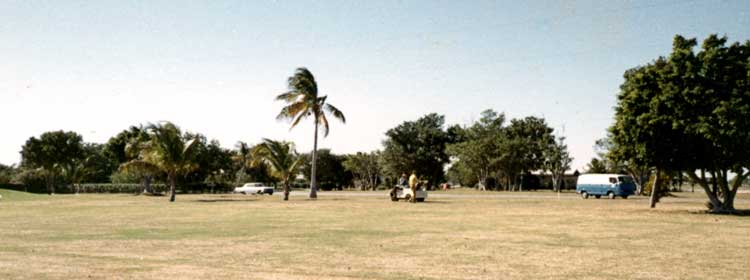
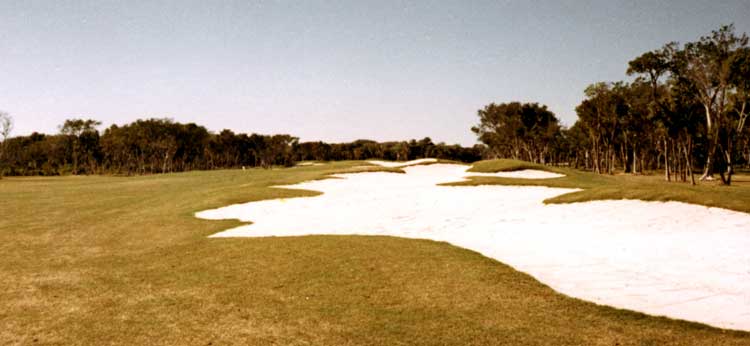
Above and below: a view of South Florida’s vegetation from a golf course, in this case the Ocean Reef course on Key Largo, in 1970. Note how brown the fairways are. South Florida usually averages about 55″ of rain a year, but the late 1960’s and early 1970’s represented a time of drought. The Everglades burned, and people started thinking about what was really happening to the region.
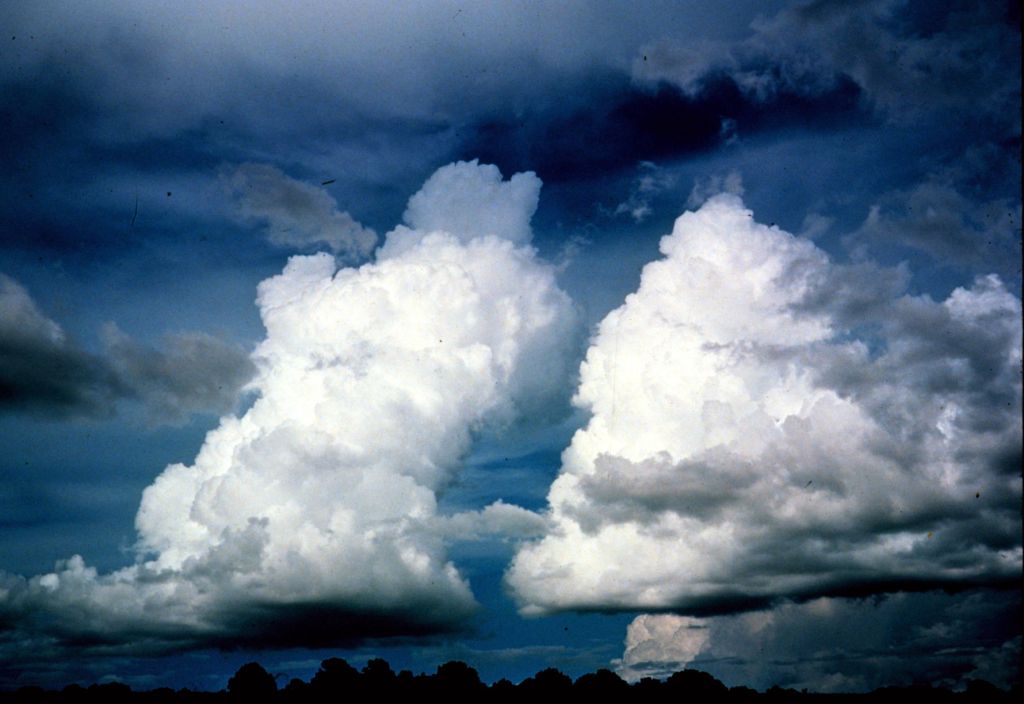
Nasty weather coming up over Coconut Creek, August 1978. Those afternoon showers (especially in the summer) are a part of South Florida life–when the rain is normal. Photo courtesy of NOAA.
Looking for more nasty weather: a hurricane hunting plane flies over Ft. Lauderdale on its way to the Bahamas, September 1964. Photo courtesy of NOAA.
More construction: installing the foundation for an expansion to the Cadillac Hotel, Miami Beach. This photo ended up in my family business’ literature.

Below: a “back forty” in Boca Raton, 1972. The slash pine scrub dominated much of Palm Beach County on both sides of Florida’s Turnpike until development swallowed it up. The irony is that much of the scrub was made possible by the drainage done by what was then called South Florida Flood Control, which converted it from the Everglades with canals like the ones you see in the photo. It is also interesting to contrast this with the Ocean Reef photos to show that a region that one would think is “homogeneous” in terrain is so varied in its flora.

One use of slash pines was their sap; it forms a very hard resin that is useful for caulking wooden ships. Unfortunately, if you park your car below one (as we see above,) you’ll end up with rock-hard drips of the sap on the car, which are next to impossible to remove.
Some issues just won’t go away: A St. Andrew’s School sophomore points out the obvious Confederate flag on the wall of a dorm room while his classmates (one American and one Bahamian) have a good laugh at his expense. This appeared in the 1971 Tartan (St. Andrews’ yearbook.) It is doubtful that this product of a very liberal (then and now) school would pass muster anywhere in the U.S. today.

More scrub, this time on Powerline Road, August 1973. Starting in Broward County, it extended into Palm Beach County, but only as far as Boca Raton Road. This was probably taken close to that ending. All of this, of course, is now developed.

The rapid change in the region was probably a spur to me as a Christian; faced with a landscape that developed so relentlessly make me think of something that was more permanent and eternal.
Some of the human landscape: Grace’s Food Store, on the corner of NW 20th St. and NW 2nd Ave., Boca Raton, 1973. Their specialty was great Cuban sandwiches, brought by the hard-working refugees from Fidel Castro’s Cuba. South Florida was and is ethnically diverse, but the lack of community generally resulted in a juxtaposition of groups that basically didn’t like each other rather than a region united in its variations.

 Left: Looking outward: a view of the Palm Beach Inlet from the Port of Palm Beach, mid-1970’s. At the time the Port was mostly for freight, which our business used to ship its product (sitting on the dock) throughout the world.
While loading the product on a ship, a view of a South Florida landmark now gone: the smokestacks at the Port of Palm Beach’s FPL power plant. Lacking a lighthouse, the smokestacks were a useful aid to navigation for those who preferred (or had) to look at where they were going rather than at their GPS. But the oil fired plant was replaced, and the smokestacks were demolished in June 2011.

Pompano Fashion Square, August 1973. Shopping malls were especially useful in South Florida due to the hot, rainy and humid climate. In the back is J.C. Penney’s, itself a survivor of the many upheavals that have taken place in American retail.

A spectacular South Florida sunset. Boynton Beach, 1974.

More on Palm Beach and South Florida:
-
To Leave TEC, or Not to Leave TEC: That Is the Question StandFirm Doesn’t Want in its Threads
Everyone who has been commenting any length of time here is well aware that we don’t allow comments exhorting people to leave TEC or stay in TEC, nor do we allow comments castigating either decision…
But for ourselves, we are so determined to have a blog with a larger message and a varied and, shall we say, somewhat larger audience, that we will begin immediately banning without warning those who violate this well-known and long-standing commenting policy.
Valiant in reporting the vagaries of the Anglican/Episcopal world, Sarah Hey is enigmatic to the point where, on one thread, the commenters traded back and forth speculations as to why she wouldn’t join an Anglican church in the event she herself left TEC. I’m sure she found our guessing game amusing, to say the least.
As a practical matter, telling people they need to leave their church is, in most cases, counterproductive. People join various churches for various reasons. As with most churches, there has been a wide variation in the degree of orthodoxy on a local level that has allowed conservative Christian people to remain in TEC. It’s better to set forth the truth, convince people of same and let them decide for themselves (or better ask God for his direction) whether they’re in the wrong church or not. That’s the advice I give my Evangelical counterparts concerning Roman Catholics, and it applies as well to TEC or any other Main Line church.
But any reasserter in TEC needs to know one thing: your church does not love you any more. They’ve proven that in spades, especially the last triennium. And that hurts.
-
Making Science Into a Religion, and the Nomination of Francis Collins to the NIH
This had to happen sooner or later, and it did in Sam Harris’ op-ed piece for the New York Times:
One can only hope that these convictions will not affect his judgment at the institutes of health. After all, understanding human well-being at the level of the brain might very well offer some “answers to the most pressing questions of human existence” — questions like, Why do we suffer? Or, indeed, is it possible to love one’s neighbor as oneself? And wouldn’t any effort to explain human nature without reference to a soul, and to explain morality without reference to God, necessarily constitute “atheistic materialism”?
Francis Collins is an accomplished scientist and a man who is sincere in his beliefs. And that is precisely what makes me so uncomfortable about his nomination. Must we really entrust the future of biomedical research in the United States to a man who sincerely believes that a scientific understanding of human nature is impossible?
Ever since my slow-motion intellectual boxing match with Citadel astrophysicist Saul Adelman, it’s always bothered me that the end game of secularists in the pure and applied sciences is to make practical atheism a “litmus test” for practitioners of the scientific/engineering craft (to steal a term from Masonry and Wicca.) Sam Harris can’t quite bring himself to throw the traditional secularist fit over Collins’ nomination, in part because he knows Collins’ achievements as a scientist would make that look rather stupid. So he shadow boxes around the issue, even in an outlet as agressively secular as the New York Times.
I can’t resist answering his question, “Why do we suffer?” From a purely materialistic standpoint, the simple answer is “why does it matter?” But if he wants to delve into this further, he might start by looking in the mirror. With his pig-headed dogmatism, many of the rest of us are sure to suffer if he succeeds in shoving his idea down everyone else’s throat. Just listening to these people induces pain.
But, as my differential equations/complex analysis professor in graduate school used to say, onward…
-
On the Water: Palm Beach, Yachting, And…
It’s generally true that “champagne tastes and caviar dreams” involve a yacht somewhere. Today most of them are fibreglass creations, but as soon as he could see his way clear, my father got us into the era of “iron men and wooden ships.” Well, at least the wooden ships…

Before we got there: the course to Palm Beach (and the Bahamas for that matter) was navigated first by my grandparents, who first started to come to South Florida in the early 1930’s as part of my grandfather’s aviation activities.
Below are two shots of my grandparents’ yacht Courier, a Grebe, at the West Palm Beach Marina during the Christmas of 1948. They eventually moved to Palm Beach in 1957, with us following seven years later. In the background of the upper photo is the Flagler (Royal Poinciana) Bridge, which is in the process of being replaced; behind it (rather washed out) is the Biltmore Hotel.


Below: our first boat, a 36′ Chris Craft, docked at Bimini in 1963. Since we were living in Chattanooga, TN at the time, it had TN registration. It cruised both the Tennessee River and and the waters of Florida and the Bahamas.

Bimini is the closest Bahama island to the U.S., and it’s good we chose it to start, as packing four people into a 36′ yacht (?) wasn’t fun then and now. Note the two flags flying from the bridge: the Bahamian colonial flag and our family burgee.
Our second yacht, a 51′ classic. Here it’s decked out for Christmas at Ocean Reef in 1965.

Cruising the Little Bahama Bank between West End and the Abacos, the summer before. Not a visually appealing boat, and dreadfully slow (it cruised at 10 knots,) it was a good in the high seas, which was about to be tested here. It’s practical virtues got another test when we almost sent it to the bottom off of Eleuthera, as I describe here.

After that near disaster, we felt it wise to have our boat checked out “stateside” to make sure everything was all right under the water line. This video shows the boat at drydock at Rybovich and Sons Boat Works in West Palm Beach, Florida, along with its relaunching.
 Right: our cat Buff, a faithful companion on the water, acting as a welcoming committee of one for our second yacht. Domestic cats have a reputation for hating the water, but as long as he didn’t actually end up in it (and the seas weren’t too rough) Buff loved a good cruise. As long as his final destination wasn’t the vet, travel was definitely his “bag,” as they said in that day.
Our last yacht leaving the Palm Beach Inlet, with Singer Island in the background. 65′ long, attractive and comfortable, it nevertheless wasn’t the best craft for a storm, as we found out the hard way. Note that the sea just in front of the beach is a different (brown) colour from what our craft is going through. This is because Lake Worth was badly polluted at that time; when the tide went out, the foul water went with it. The line between the lake effluent and the ocean was usually very crisp, as one can see above. (Photo by Bernice Ransom Studios, Palm Beach.)

 A fine crew: the larger the yacht, the larger the crew; our last one usually required two. Elmer “Bud” Curless (left) and Captain James North pose in their dress uniforms. True to form, we had khaki ones for normal duty. It’s fair to say that many people who go into yachting do so to create their own “navy” (or in our case our own coast guard.) Such a pose gives an HMS Pinafore aspect to the whole thing, with one notable exception: both the crew and their employer were not shy about using a “big, big D.” (Photo by Bernice Ransom Studios) (Click here for another view of our bridge, albeit in a “working” mode.)
 A boy and his cat: that’s me holding ours as we prepare to take to sea. Although Buff was pretty good about having “sea legs,” if the motion got rough enough, he’d either get someone to hold him or he’d throw his front paws around my mother’s neck. In this case we were still in harbour, and the cat expressively signals that the restraint is, well, premature at least.
 Slightly overloaded: on our last yacht, we had two dinghys. The smaller of the two is shown at the left. Called a “Dilly Boat,” it was an 8′ long, cathedral hull fibreglass boat, not really suitable for all of the three people occupying it in this photo, taken at the Ocean Reef Resort on Key Largo.One of the things that has changed dramatically since our years on the water is the engine horsepower that propel ships of all sizes in the water. For me, it’s still hard to believe the power that’s put into boats now, large and small, and the speeds they routinely achieve. However, this craft took slow to a new level. The outboard motor driving this small craft was only a 3 hp Johnson with a self-contained fuel tank.
 -
The Importance of Being Abroad
Shortly after my family moved to Palm Beach, my mother visited the Embassy Travel Bureau to make some arrangements to go to Europe. The Bureau was owned by Nigel and Yvelyne “Deedy” Marix (Deedy was later Mayor of Palm Beach.) Nigel, a very proper Englishman, asked my mother, “Have you ever been abroad?”
“All my life,” was my mother’s response.
-
Safe in the Harbour (Barely!)
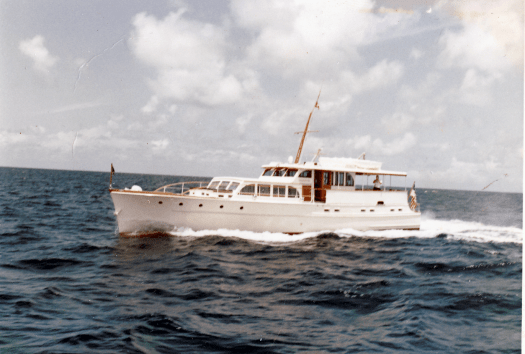
My father always maintained that, when buying yachts, you could never go smaller when purchasing a new one; you always had to go larger. That’s the way he bought our boats; first it was a 36′, then the 51′ (the one we hit the reef with.) Our less than stellar navigation notwithstanding, that boat was a seaworthy craft; it rode out a storm well and didn’t draw too much water, which was good in the shallow inlets and harbours of the Florida Keys and the Bahamas. Best of all for my mother, she had it fixed the way she wanted it.
Well, that never stopped my father from doing anything; we discovered one day that he had purchased a 65′ yacht. The pretence was that the old boat had dry rot. It was hard to tell the new one was an improvement; it would not pass marine inspection and it was filthy. After the marine items were attended to and my mother scraped the dirt off of the boat, we were back to yachting again.
Probably our most memorable episode in that boat was on a return from the Bahamas. We were at the Chubb Cay resort, then in its infancy, canned bread and all. Our plan was to leave Chubb Cay, pass north of the Bimini Islands and end up at Port Everglades, the port at Ft. Lauderdale, and then return to Palm Beach via the Intracoastal Waterway.
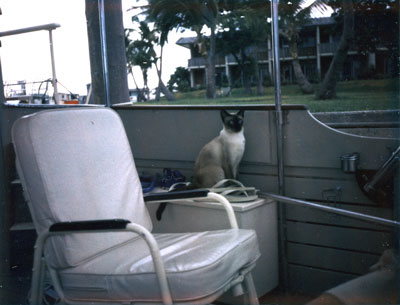
The cat, in a happier moment on the boat. This was a pretty clear course; unfortunately, we encountered probably the worst storm we had ever gone through in our years in yachting. At this point we were reminded of one of our fine boat’s uninspiring traits: its habit of severely rolling in any sea, especially the 6′-8′ (2-2.5m) one we were in. Everything that wasn’t tied down ended up on deck or somewhere else. We weren’t ones to get seasick but we were close — even the cat “turned green”.
We got through all of that but, as we entered Port Everglades, the steering wheel of the boat became useless. We realized then that the steering cable, having frayed badly during the storm, snapped close to shore. Since we had dual propellers, we were able to use the two engines to get us to dock; had we had to do this during the storm, we probably would have overheated the engines and lost both power and what control of our course we had left, ending up on a reef in a more permanent way than the last time.
In the ancient world, one of the symbols Christianity adopted was the anchor. It was good not only because it incorporated the cross but also because it symbolised a safe entrance into the harbour. Sea and lake storms were familiar: Jesus calmed the storm on Lake Galilee (Luke 8:23-25) and the apostle Paul endured one during his last journey to Rome (Acts 27). Arriving safe in the harbour meant that the destination had been achieved.
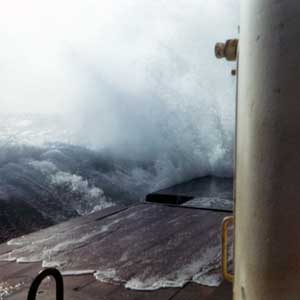
But the harbour isn’t the only destination we should be aiming for; storms at sea aren’t the only crises we face either. Many of us careen through life from one disaster to another, wondering when it will all stop. For some of us our steering cable has snapped and we cannot get out of our situation. For others, like us at Port Everglades, we’ve barely scraped through another disaster, knowing that the next one won’t be as pretty unless we repair our lives and that somehow, someone has kept our steering cable intact long enough to prevent a complete disaster.
We, however, who go through storms in life need to understand that we do have a God that cares for us through the storms but can’t do much for us unless we decide to put him first. As long as we are content to cross our fingers and hope our steering cable won’t snap in the middle of a crisis, we are only asking for trouble. When we put God first and let him keep things fixed, our cruises through life — both in the rough seas and the smooth ones — will go a lot better. Best of all, when it’s all over we can safely enter the harbour of eternity — and not just barely either.
Click here for more on reaching the safe harbour
-
When You Need a Native Guide
One of the pleasures we enjoyed during our years in Palm Beach were our travels in our family yachts. Our family has a long history of power boating going back to the latter years of the nineteenth century. From South Florida our favourite destination were the Bahama Islands, at the time making their transition from a British colony to an independent nation.
In 1965 (the same year Thunderball was made, also in the Bahamas) we cruised from Palm Beach Inlet to West End on Grand Bahama Island and then proceeded through the Abaco Islands, as you can see in the video below.
We finally left the Abacos at the Hole in the Wall and proceeded south towards North Eleuthera Island and our destination, Spanish Wells.

Our yacht, at anchor in the harbour at Hope Town, Abaco, Bahamas, shortly before its fateful encounter In reading the books on cruising the Bahamas and listening to my father, one theme emerged: the charts of the waters of the Bahamas were unreliable, both because the surveys weren’t very complete and because the coral reefs were complex with underwater rocks and outcroppings turning up in places you weren’t looking for them. In such instances it was recommended to seek a native guide to help guide one through the waters, someone who had lived there all his or her life, knew all of the underwater dangers and could guide one to safe harbour. Nevertheless, my father go the idea that he could pick his way through the reefs north of Spanish Wells.
Late afternoon we came up on Big Egg Island and started our way through the shallow waters (it was nearly low tide when we did this) when we heard an uninspiring thud in the hull of the ship. We realized that we had hit a reef! My father and the crew scrambled down to the bilge to see if we were taking water on; they discovered that we weren’t, but that we’d better get to port and get some repairs done soon. So we radioed Spanish Wells and got a native guide out. He led us through the reefs and safely into the harbour. We spent the weekend there while the ship was being repaired, which was tricky because our yacht was nearly too big for the dry dock.
We eventually got back to Florida from this adventure, but there’s more to this than just an error in navigation. Self-sufficiency in life is something many of us are raised to achieve. We feel compelled to be our own master and make our own way. We feel it beneath ourselves if we have to ask help for anything. But, like on the Bahamian reefs, we all eventually get to the point where the demands of life — and the consequences of our own mistakes — are just too much for us to handle. We can fake it for a while, but sooner or later things will catch up. Our boats, so to speak, will fill up with water and we will find ourselves at the bottom, never able to recover.
It is in times like these that we need a native guide to help us along, to get us through the dangers and difficulties of life and bring us to safe harbour at the end. That native guide is Jesus Christ, who as God commands the spiritual realms and as man endured and ultimately triumphed over the difficulties of this life and ultimately death itself. He knows the way through the reefs and other dangers of life and can bring us to the safe harbour of eternal life with him at the end.
If you realize that it’s time to stop hitting the reefs of life and get the native guide for eternity, click here. It’s a decision that you will never regret.

Sailing the Last Voyage with Newton and Pascal


 Positive Infinity