-
Palm Beach Golf Classic
A major part of the season in Palm Beach is the system of charity balls. A socialite can make–or break–his or her reputation on how well or poorly a charity ball is hosted. On the other side, drawing up the lists of invitees is an exercise in diplomacy. For those who are invited, making “the grand entrance” properly is likewise an important exercise.Along the same lines–although not quite as rigid in protocol–are charity golf tournaments. One such was the Palm Beach Golf Classic; we show a few shots from the 1974 Classic, played in March of that year at the Breakers in Palm Beach. Leading the field were four well known professionals: Jack Nicklaus, Sam Snead, Ben Crenshaw and Dave Marr. We show some shots of them below. 
Above: The field, caddies and gallery behind them, wait to proceed. In the upper left hand corner, barely visible above the palm trees, is the spire of Bethesda-by-the-Sea Episcopal Church.

Showing how it’s done before teeing off. The golfers, right to left: Dave Marr, Jack Nicklaus, Ben Crenshaw.
 Sam Snead, waiting to putt. Raised in Virginia mountain poverty (which explains his reputation for thrift,) “Slammin’ Sam’s” swing was one of the smoothest ever in professional golf, and watching him play was a joy.
 Jack Nicklaus admiring (?) his iron shot. Jack learned what every member at the Breakers knew all too well: the Breakers wasn’t a long course, but the narrow fairways demand accuracy. It’s an easy matter to find yourself two fairways over after a drive.
 Above: Snead conferring with an official. Below: a close-up with his signature straw hat.
 Bill Arnold, the Breakers’ club professional during the late 1960’s and early 1970’s. As with a charity ball, hosting a golf tournament was a great deal of work; Bill was busy and on the move keeping the tournament running properly.
Other Golf Photos

More checked pants: touring pro Tom Shaw gets ready to tee off at the Delray Dunes Pro-Am tournament at the Delray Dunes Golf and Country Club in February 1974. The tournament was and is headed up by fellow pro (now Senior Tour) Bob Murphy.


In the drink: the photo sequence of Paul “P.B.” Dye, son of golf course designer Pete Dye, inserted in the 1973 Tartan, the yearbook of the St. Andrew’s School in Boca Raton, Florida. P.B., of course, is continuing the golf course design work of his father (which includes the Delray Dunes course shown above.) Going into a water hole on a Pete or P.B. Dye course will never be the same after this…

Right: Swing analysis, 1970’s style. This sequence of photos was taken using a special Polaroid® camera which was set up both to take a series of photos in rapid sequence and to record them on one piece of Polaroid® “film.” The analysing professional was then able to, within a few seconds, develop the photos and use them to improve (hopefully) the golfer’s swing.High speed sequential photography has been with us since the end of the nineteenth century, but with digital technology, it’s just too easy…too bad a good golf swing isn’t! -
The Hard Sciences Aren’t Hard on Religion
I made a statement recently that some of my Christian friends may not have appreciated much:
I’m one of those people who’d like to see hard science and math education become the “core” education in our schools, as opposed to the arts or social sciences, which is the case now in the Anglophone world in general and the U.S. in particular. Looking at the end result of such an emphasis would lead to engineers and scientists at the top of our society (as is the case in China) rather than the lawyers. The reason why this isn’t so is complicated, from cultural factors to the systemic problems our public schools have in retaining science and math teachers to the fact that excelling in any scientific educational track is hard work.
Many Christians might think that this would lead to a diminishment of faith in our students. But I know better. And so do the atheists, which is why, at places like Camp Quest, they have to lard a curriculum in scientific discovery with materialistic philosophy to get their point across.
Atheist WayPastSoccerMom thought otherwise, in part:
It’s great to read that you think hard science and math education should be at the forefront. But, there is a big reason why so many scientists are non religious.
College students who major in the social sciences and humanities are likely to become less religious, while those majoring in education are likely to become more religious.
But students majoring in biology and physical sciences remain just about as religious as they were when they started college.
Note, people, that the hard sciences include the biological ones, the home of the evolutionists.
My first position is my story and I’m sticking to it.
This tidbit from the study is also interesting:
Our results suggest that it is Postmodernism, not Science, that is the bête noir of religiosity. One reason may be that the key ideas of Postmodernism are newer than the key scientific ideas that challenge religion. For example, religions have had 150 years to develop resistance or tolerance for the late 19th century idea of Evolution, but much less time to develop resistance or tolerance for the key ideas of Postmodernism, which gained great strength over the course of the 20th century.
It’s interesting to note that education majors become more religious as they go along. That’s interesting in view of the enforced secularism in our public schools. But if the lack of discipline and other ordeals of public education for the teacher doesn’t teach one to pray, nothing else will.
Until, that is, they nationalise health care…
-
In The Picture: An Applehead Siamese Cat Shows Off

Everyone wants family pictures. To get past the usual studio shots, my mother brought out Bernice Ransom, portrait photographer of socialites, to make some of my brother and myself at our home.In her advertisements, Ransom claimed that “children…pets…home sittings…our special ‘cup of tea’!” What she didn’t tell everyone was that, with a cat, the first challenge was to get them to sit! As you can see below, it went downhill from there.
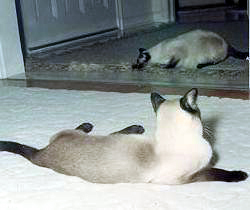
Valentine can’t tell the difference between the grass in the yard and the fringe on the rug. Buff is already tired of this photo shoot. 
Getting your subject to look in the right direction is one of the challenges of successful portrait photography. Looks here like Bernice Ransom has met her match. 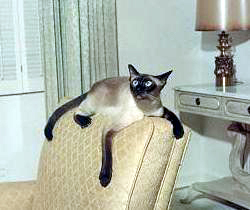
Bernice Ransom tries yet another pose. Buff shows yet another direction to look in. 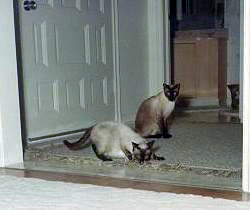
Valentine still can’t figure out what the fringe in the carpet is all about. This time though Buff looks on from the other direction.

Buff in the foreground, expressing his mood perfectly. In the background is Valentine, the stray Siamese we found on February 14. Even the stray cats are a cut above in Palm Beach. 
Don’t call me late for dinner: Buff shows how to tough adversity out for the important things in life. Just before Christmas he tore a claw in his left rear paw. The vet (not Buff’s favourite person) fixed him up a “cast” (actually a bandage wrap) on his paw while it healed. In the meanwhile, he continued life with his two favourite activities: travelling (this shot was taken while he was “on the road” at Ocean Reef, down the coast from Palm Beach) and eating.Buff didn’t always like what we fed him, and to express his displeasure he turned 180ø from the pose you see, shook his back leg in rapid succession against the bowl, and walked away without turning back. In this regard he was Biblical:
- “If no one welcomes you, or listens to what you say, as you leave that house or that town, shake off its dust from your feet.” (Matthew 10:14)
- “But Jesus answered: ‘No one who looks back, after putting his hand to the plough, is fitted for the Kingdom of God.’” (Luke 9:62)
About our Siamese Cat

Cat breeds are like most anything else; they come and go in fashion. Although they’re not as popular as they used to be, in the 1960’s Siamese cats were the breed to have. Applehead Siamese cats were almost a lost breed but they’ve come back in the last few years.
But for two boys who needed a playmate who had enough personality to be fun but wasn’t smart enough to win, Buff was perfect. (Photo at right illustrates what we’re talking about.) He brought love and warmth into an environment that sometimes came up short of both.
In a sense, he defined a home as much as he brought joy to it. The year he died, my parents began their divorce, my brother got married and I graduated from college; our home as we knew it was at an end.
Before his departure, Buff taught us many interesting life lessons: some of these are as follows:
-
Let the Laity Arise: “People are starving, and you want us to wait for a meeting of the Standing Committee?”
This from Anglican Mainstream, showing that ecclesiastical bureaucracies are frequently part of the problem and not the solution:
So, the following Tuesday, the Women of Purpose met for a fund-raising. From within their Fellowship they raised 2.6 million shillings. When they approached one of the clergy at All Saints’ Cathedral, Kampala, about making an appeal in church, they were told that such an appeal would need the approval of the Standing Committee.
Nevertheless, the following Sunday, on 12th July, between the 7.30 a.m. and 9.30 a.m. Sunday worship services, the Vicar of the Cathedral, Rev. Diana Nkesiga, prevailed upon the Provost to allow the Women of Purpose to stand outside the Cathedral doors to collect funds from those who wanted to contribute. She implored, “People are starving, and you want us to wait for a meeting of the Standing Committee?”
That Sunday, the Women of Purpose collected 3.1 million shillings from members of All Saints Cathedral. The following Sunday, 19th July, they added another 3 million shillings. Vivian Igundura, Chairperson of the Women of Purpose Kampala Fellowship said, “It really brought to life the story of the Feeding of the Five Thousand. The contributions from members of All Saints more than doubled the contributions from the Women of Purpose. God did a miracle; He multiplied the little that we had.”
And note, Pentecostals, that the miraculous isn’t confined to our churches. Let the laity arise indeed!
-
Katharine Jefferts Schori Needs to Take the Money and Run
In a recent address on this subject, TEC Presiding Bishop Katharine Jefferts Schori reveals the biggest problem in her position on the property:
I will continue to uphold two basic principles in the work some of us face in dealing with former Episcopalians who claim rights to church property or assets. Our participation in God’s mission as leaders and stewards of The Episcopal Church means that we expect a reasonable and fair financial arrangement in any property settlement, and that we do not make settlements that encourage religious bodies who seek to replace The Episcopal Church.
Pragmatically, the latter means property settlements need to include a clause that forbids, for a period of at least five years, the presence of bishops on the property who are not members of this House, unless they are invited by the diocesan bishop for purposes which do not subvert mission and ministry in the name of this Church.
The second reason is, IMHO, one of the stupidest things I have ever seen a centralised church do regarding its property. (And I work for a centralised church.)
TEC has a declining membership on account of its demographics. TEC’s strategy of attracting the more secularised segments of our society through a message that is indistinguishable from that secularised segment (the LGBT community comes to mind first) is an unproven method of church growth. (I think it’s a recipe for failure, but I digress.)
With both of these facts on the table, TEC needs to build a war chest, even with the substantial amounts of endowed money it has at its disposal. Although most seceding Anglican parishes would find buying out their own church distasteful, chances are a good number would do it rather than go through litigation. Both sides would be saved much acrimony and legal fees and TEC would end up the richer financially.
KJS’ insistence on the first condition has legal justification in most jurisdictions. Her second condition is a petty, short-sighted control freak’s idea of victory. Given the reality of the situation, it’s a luxury that TEC can’t afford, especially as several of their officials dedicated to the development of the church (evangelism, lay ministries, etc.) are now redundant.
Besides, she’s admitting that a bunch of “bigots” and “homophobes” have more appeal and viability than her own “enlightened” organisation does. And that’s quite an admission.
-
Microsoft’s Long Decline. Another High Five for the Mac World.
Apple has always only competed in the middle-to-high range of the computer market. But it was never the case, historically, that Apple sold a majority of middle-to-high-end computers. Even given that NPD’s numbers represent only retail sales, is there any reasonable doubt that Apple’s share of the non-retail market for $1,000+ computers is also growing?
Apple’s strong growth in this segment is a sign that the market is turning against Windows. If for no other reason than that Apple has never entered the low-cost computer market, it’s always been the case that the most budget-conscious computer buyers were Windows users. But the converse wasn’t true — not all Windows users were cheapies.
Today, though, Microsoft is increasingly left only with customers whose priority is price.
(You may not care for some of the language he uses in this piece.)
And if Linux (or a variation thereof) ever really gets traction, the low end of the market is in trouble too.
-
Join the Club. Maybe Not! A Strange Tale of Two Worlds in Palm Beach
Originally written and posted March 2005. Since that time, Bernie Maddoff has made one of the clubs featured in this piece famous (if impecunious,) so I’ve rewritten it a bit. The following year I got to play golf at the Ridgeway Country Club, a formerly “Jewish country club” in Memphis, TN, which opened its membership to Gentiles. I also have a much more active relationship with my old home town now than then.
If you’ve spent a lot of time in my Palm Beach material on this blog, you’ve probably figured out that most of this material comes from a long time ago. You also probably figure a lot of it has changed. And indeed much has changed in South Florida in the years since Buff roamed the overgrown back yards of this exclusive place, searching for rodents and other wildlife.
Every now and then I get to catch up on the news from Palm Beach, and I find out that, for some things, “plus de change, plus la meme chose” (more change, more of the same thing.) One of those concerns Palm Beach’s private clubs. The fact that they’re exclusive isn’t surprising; that’s the nature of the place. And, since we are on U.S. soil, the freedom of association (under attack by our courts, but still there) make it possible for private clubs to admit whom they want and to exclude whom they don’t. But there’s one rather insidious practice that hasn’t changed even with all of the other social changes we have experienced here in the U.S., one that has survived the coming and going of many of us.
Anyone who lived on the north end of the island had to pass the Palm Beach Country Club, with its well manicured course and pristine clubhouse, to go anywhere. As we passed this place time and time again, I (a kid of nine or ten) wondered, “Why do we pass this place up to go to another club?” I grew up in a family where it wasn’t wise to ask too many questions, but eventually I was told that it was the “Jewish Country Club,” and since we were Gentiles, we belonged elsewhere. (That “elsewhere” was the Breakers.)
This segregation was strictly enforced. There were “Jewish clubs,” there were “Gentile clubs,” and n’er the twain met. This enforcement could be brutal. In the early 1960’s a member of another of Palm Beach’s exclusive clubs (the Everglades Club) made the mistake of bringing her Jewish friend for lunch. She was asked to resign her membership.
I never fully understood this state of affairs. It made sense to me to pass the synagogue to go to Bethesda, but the club? My puzzlement was reinforced by another fact of life: the private clubs were segregated by Jew and Gentile, but the private schools were not. All through my years in school in South Florida, Jewish and Gentile kids were together. I had many Jewish friends and classmates. Sometimes things didn’t go according to plan. My brother made the mistake of calling a Jewish classmate a “Jew boy,” and same son of Abraham, Isaac and Jacob responded by fracturing his jaw. (That’s one way to deal with anti-Semitism!) Both the valedictorian and saludictorian of my Episcopal prep school graduating class were Jewish. As the valedictorian gave her speech, her father listened with his concentration camp number tattooed on him, a reminder that he (and many other Jews) did well to be there at all.
This was all during the period when the public schools were being desegregated, a process which was challenging enough on its face but which was compounded by the way the Palm Beach County school system went about it. I am sure that at least some of the judges which ordered desegregated schools went to “segregated” clubs. Couldn’t someone have “connected the dots” on this issue? Couldn’t the elites have led by example, even if there was and is no legal compulsion to change? Evidently not.
Today we have over forty years of civil rights legislation under our belts, along with all of this “diversity” and “tolerance” business. But even today the clubs of Palm Beach–and many elsewhere in South Florida and beyond–are still divided between Jew and Gentile. Some clubs in other places have opened up on this matter. But dear old Palm Beach is “sticking with tradition” on this one. If the “Blue State” elites are really serious about maintaining their dominance, they can start by “leading by example” on an issue like this.

Sailing the Last Voyage with Newton and Pascal
 Positive Infinity