-
More Than One Peter?
A very different look at a a very important part of the Bible
“Now when Jesus came into the district of Caesarea Philippi, He began asking his disciples, “Who do people say that the Son of Man is?” And they said, “Some say John the Baptist; and others, Elijah; but still others, Jeremiah, or one of the prophets.” He said to them, “But who do you say that I am?” And Simon Peter answered and said, “Thou art the Christ, the Son of the living God.” And Jesus answered and said to him, “Blessed are you, Simon Bar-jona, because flesh and blood did not reveal this to you, but My Father who is in heaven. And I also say this to you that you are Peter, and upon this rock I will build My church; and the gates of Hades shall not overpower it. I will give you the keys of the kingdom of heaven and whatever you shall bind on earth shall be bound in heaven, and whatever you shall loose on earth shall be loosed in heaven.” (Mt. 16:13-19)
Few passages in God’s Word have provoked more action — and reaction — than this one. An entire religious system has been built on it; many have been built to oppose it. But Our Lord made the declaration — what did he mean by it?
One very early interpretation comes from the great Egyptian teacher and theologian Origen. His Commentary in Matthew is the oldest existing commentary on this book; it is uncluttered by the issues that cloud our understanding of this today. The following is an adaptation of the part of the Commentary that deals with this subject.
WHO DO MEN SAY THAT I AM?
Jesus began the dialog by asking his disciples the question, “Who do men say that I am?” He had two purposes in doing this.
- To bring to the surface the various opinions that people had about Him. In doing this Jesus was turning his small group of followers into a “focus group,” to find out what people were thinking. This not only included the people around them — primarily the Jews — but also the disciples themselves.
- To get the disciples to consider the impact that other people’s thinking would have on them and their mission. This was not to get the disciples to bend their mission to what was around them but to get them to have a response to it, both to what was for them and what was against them.
Any such search for people’s opinions will get some strange and frankly erroneous answers. This one was no exception. The disciples had certainly “kept their ear to the ground” and they were prepared to reproduce the rumour mill will. People’s guesses about Jesus had led them to believe a number of things about Jesus’ identity:
- Jesus was John the Baptist. Herod the Tetrarch had noised this guess to his servants, “This is John the Baptist, he has risen from the dead, and that is why miraculous powers are at work in him.” (Mt 14:2)
- Jesus was Elijah, either having been born a second time, or living from that time in the flesh, and appearing at the present time.
- Jesus was Jeremiah. This prophet had said about Christ, “See, I have appointed you this day over the nations and over the kingdoms, to pluck up and break down; to destroy and to overthrow, to build and to plant.” (Jer 1:10) This was not fulfilled in the prophet at that time, but was beginning to be fulfilled in Jesus, a prophet to the Gentiles to whom He proclaimed the word.
- Jesus was one of the prophets. Those that supported this conceived this opinion concerning Him because of those things which had been said in the prophets as unto them, but which had not been fulfilled in their case.
Obviously there was no unity of opinion as to Jesus’ real identity. People were engaged in guessing. But Peter, not as a disciple of “flesh and blood,” but as one fit to receive the revelation of the Father in heaven, confessed that He was the Christ. With the background of people’s conjectures, Peter’s statement was indeed a great thing, but beyond that he confessed Him to be “the Son of the living God.” Peter not only proclaimed Jesus to be the Son of God but the Son of the living God, the God who had life absolutely and who could give life to those who would participate in His absolute life. For He had said through the prophets, “I live,” (Jer 22:24) and “They have forsaken Me the fountain of living waters,” (Jer 2:13) as from the Father the spring of life — and Jesus is life also, who said, “I am…the life.” (Jn 14:6)
PETER’S ANSWER – OUR PROMISE
We know what Peter’s confession was. But if we say “Thou art the Christ, the Son of the living God,” and we say it not by flesh and blood revealing it unto us, but by the light from the Father in heaven shining in our heart, we too become as Peter, being pronounced blessed as he was, because that the grounds on which he was pronounced blessed apply also to us, by reason of the fact that flesh and blood have not revealed to us that Jesus is Christ, the Son of the living God, but the Father in heaven, from the very heavens. We also say this so that our citizenship may be in heaven, (Phil 3:20) revealing to us the revelation which carries up to heaven those who take away every veil from the heart, and receive “a spirit of the wisdom and revelation” of God. (Eph. 1:17) And if we too have said like Peter, “Thou art the Christ, the Son of the living God,” not as if flesh and blood had revealed it unto us, but by light from the Father in heaven having shone in our heart, we become a Peter, and to us there might be said by the Word, “you are Peter,” etc. For a rock (or a Peter, which means rock) is every disciple of Christ of whom those drank who drank of the spiritual rock which followed them, (1 Cor 10:4) and upon every such rock is built every word of the church; for in each of the perfect, who have the combination of words and deeds and thoughts which fill up the blessedness, is the church built by God.
But if you suppose that upon that one Peter only the whole church is built by God, what would you say about John the son of thunder or each one of the Apostles? Shall we otherwise dare to say, that against Peter in particular the gates of Hades shall not prevail, but that they shall prevail against the other Apostles and the perfect? Does not the saying previously made, “the gates of Hades shall not overpower it,” hold in regard to all and in the case of each of them? And also the saying, “upon this rock I will build My church“? Are the keys of the kingdom of heaven given by the Lord to Peter only, and will no other of the blessed receive them?
But if this promise, “I will give you the keys of the kingdom of heaven,” be common to the others, how shall not all the things previously spoken of, and the things which are subjoined as having been addressed to Peter, be common to them? For in this place these words seem to be addressed as to Peter only, “whatever you shall bind on earth shall be bound in heaven,” etc; but in the Gospel of John the Saviour having given the Holy Spirit unto the disciples by breathing upon them said, “Receive the Holy Spirit. If you forgive the sins of any, their sins have been forgiven them; if you retain the sins of any, they have been retained.” (Jn 20:22-23). Many then will say to the Saviour, “Thou art the Christ, the Son of the living God,” but not all who say this will say it to Him, as not at all having learned it by the revelation of flesh and blood but by the Father in heaven Himself taking away the veil that lay upon their heart, in order that after this “with unveiled face reflecting as a mirror the glory of the Lord” they may speak through the Spirit of God saying concerning Him, “Lord Jesus,” and to Him, “Thou art the Christ, the Son of the living God.”
And if any one says this to Him, not by flesh and blood revealing it unto Him but through the Father in heaven, he will obtain the things that were spoken according to the letter of the Gospel to Peter, but, as the spirit of the Gospel teaches, to every one who becomes such as that Peter was. For all bear the surname of “rock” who are the imitators of Christ, that is, of the spiritual rock which followed those who are being saved, that they may drink from it the spiritual draught. But these bear the surname of the rock just as Christ does. But also as members of Christ deriving their surname from Him they are called Christians, and from the rock, Peters. And taking occasion from these things you will say that the righteous bear the surname of Christ who is Righteousness, and the wise of Christ who is Wisdom. (1 Cor 1:24) And so in regard to all His other names, you will apply them by way of surname to the saints; and to all such the saying of the Saviour might be spoken, “you are Peter, and upon this rock I will build My church; and the gates of Hades shall not overpower it.“
But what is the “it”? Is it the rock upon which Christ builds the church, or is it the church? For the phrase is ambiguous. Or is it as if the rock and the church were one and the same? This I think to be true; for neither against the rock on which Christ builds the church, nor against the church will the gates of Hades prevail; just as the way of a serpent upon a rock, according to what is written in the Proverbs, (Prov 30:19) cannot be found. Now, if the gates of Hades prevail against any one, such an one cannot be a rock upon which Christ builds the church, nor the church built by Jesus upon the rock; for the rock is inaccessible to the serpent, and it is stronger than the gates of Hades which are opposing it, so that because of its strength the gates of Hades do not prevail against it; but the church, as a building of Christ who built His own house wisely upon the rock, (Mt. 7:24) is incapable of admitting the gates of Hades which prevail against every man who is outside the rock and the church, but have no power against it.
-
The Archbishop of Canterbury’s Concept of Hell, and a Note on Women Bishops
I’m surprised he even has one, but…
When asked if hell exists and what it is like, he said: “My concept of hell, I suppose, is being stuck with myself for ever and with no way out.
“Whether anybody ever gets to that point I have no idea. But that it’s possible to be stuck with my selfish little ego for all eternity, that’s what I would regard as hell.”
There are many in TEC who are guffawing at anyone who believes in hell or even eternal existence. I’m not really positive if KJS believes in any afterlife, let alone heaven or hell.
The key problem with hell is not who you’re stuck with but who you’re stuck without, i.e., God.
The key problem with Rowan Williams is that many in the Anglican Communion are beginning to realise that hell is being stuck with him as ABC.
As for women bishops, a favourite topic of his and mine:
Asked why the Church of England is still struggling to admit women bishops long after Britain had its first female Prime Minister, he said: “The Church has got to solve this on its own terms and yes that does take longer and it can be embarrassing sometimes.
“You look at society and you realise people don’t fully understand why the church is taking so long, and what the terms are in which the church is trying to sort it out.”
If TEC, for example, would get around to ordaining a bishop on the order and thinking of Margaret Thatcher, it would have gone a long way to fixing this problem. But (with the possible exception of Geralyn Wolf) TEC has produced a procession of flaming liberals for its women bishops, either belligerent (like Barbara Harris and Katharine Jefferts Schori) or sappy.
And that, BTW, is a “shot across the bow” for my COG friends who support women in ministry. You want to use Deborah as a role model? Support one for the job when the time comes.
-
The Anti-Moon Luddites March On
The dear old Miami Herald reports the following:
NASA doesn’t have nearly enough money to meet its goal of putting astronauts back on the moon by 2020 — and it might be the wrong place to go, anyway. That’s one of the harsh messages emerging from a sweeping review of NASA’s human space flight program.
The Human Space Flight Plans Committee, appointed by President Barack Obama and headed by retired aerospace executive Norman Augustine, has been trying to stitch together some kind of plausible strategy for America’s manned space program. The panel has struggled to find options that stay under the current budget and include missions worthy of the cost and effort.
It’s interesting to note that the 40th anniversary of the first Moon landing and Woodstock are within a month of each other. They reflect the two threads of the 1960’s: the advance of technology and science on the one hand, and the “naturalistic/Luddite” reaction to it on the other. As I noted last month, at time time many people thought we should scrap the moon program and concentrate on problems here, the entitlement waste and technological spinoffs of the space program notwithstanding.
But the Luddites have the upper hand these days, even with someone at the helm who was still a child during Woodstock. There’s no talk of expanding NASA’s budget. As one commenter to the article noted, we can drop $3 billion in “Cash for Clunkers” but can’t increase funding for the space program. And that doesn’t consider the other entitlements whose improvements of productivity are dubious. (We can’t even get our transportation system past a near failing grade from ASCE!)
What’s galling is that these ninny New Atheists are so happy the “fundies” are out of power they can’t see the real quality of what has replaced them. While “science as a religion” advances, real science and technology take a back seat.
But not to worry: if we don’t do it, someone else will.
-
Is It Legitimate to Leave a Church Because of the Coffee?
One of the rude awakenings I received recently on Titusonenine was that it was the policy of the blog that “…comments requiring, encouraging or intimating that other readers must or should leave or join a particular church are well known to be against T19 comment policy.” I was aware that this was StandFirm’s policy, and commented on same, as they had elucidated this for all to see. When I had the bad taste to point out that StandFirm had made this clearer and thought that TitusOneNine should do the same, my comment was deleted, at which point I decided to take my leave–for a while at least–from Titusonenine.
That may prove a tactical error, given that the Diocese of South Carolina–where Kendall Harmon is no less than Canon Theologian–has become the focus of attention in the Anglican/Episcopal world. Or maybe not: some of what I’ve had to say in the past hasn’t sat well with a few in the Diocese, and I’ve got problems aplenty here. Whatever the Diocese (and their Bishop Mark Lawrence) does is just about guaranteed to make no one happy, and their position is unenviable.
Now I think that any blog or website has the right to set its own terms and conditions. But I also think that those terms and conditions should be spelled out in a “permanent” (to the extent that anything on the Internet is permanent) way, as I do here. But I have to admit that the Elves stretched their credibility to the limit when they stated that “…comments such as the following would be problematical…you must join church B because they have nicer liturgy, vestments, taste, more poor people, fewer poor people, women priests, male priests, better coffee…”
Better coffee? That brings up several points.
- I’m a part of a church of coffee hounds. That in part is because our people are not allowed to drink alcohol, something that has never stood in the way of progress (?) in the Episcopal Church. (As my Episcopal priest second year Latin teacher used to say, when four “Whiskeypalians” get together, there’s always a fifth.) The morning coffee is a ritual for many of our ministers and lay people alike. So I agree that coffee is important.
- It’s not easy to spend a lot of time in a place where the coffee is deficient. At the ministry I work at, I have to deal with the fact that my superior is a Dunkin’ Donuts fan, which means we’re forced to imbibe that on a regular basis. When I’m on the road with him, his GPS is programmed to find the nearest Dunkin’ Donuts, and that’s no fun for this Starbucks fan either. When Leonard Sweet came to speak at our department’s General Assembly function, it wasn’t easy to admit to the author of The Gospel According to Starbucks that our ship was captained by a DD addict.
- Alcohol notwithstanding, the “Sunday morning coffee” is a central ritual in the life of most Anglican/Episcopal churches. Evangelical churches have traditionally tended to concentrate the joe in Sunday School, but Episcopal churches use the coffee (usually after service) to greet new visitors. So its quality and blend are critical to the church’s growth. I think that Episcopal Churches have many more pressing reasons for their decline, but given the seriousness of the situation I wouldn’t rule anything out.
- Some churches have appropriate types of coffee. For example, cowboy churches should have cowboy coffee. Cowboy coffee, as a friend of mine from the Hill Country (of Texas) explained, is made by dumping the grounds in the bottom of a deep pan and hitting same rapidly with boiling water. It’s good to the next to the last drop.
These and other weighty considerations lead me to three conclusions.
First, although I can’t say that I’d pass up a church because of the coffee, good joe is an important part of a church’s presentation to those who visit, and shouldn’t be overlooked in these times. (And that not only includes the brand, but avoiding bad habits such as allowing the stuff to be boiled down to the grounds in the coffeemaker, etc.)
Second, StandFirm and TitusOneNine may not want to broach the subject of changing churches, but I do. So comment away along these lines; I only ask that you be sweet. In fact, one of the most popular pieces on this site is Think Before You Convert, which weighs the virtues of Anglican vs. Roman Catholic churches. So their loss is my gain.
Third, IMHO the Elves need to lighten up on the subject of coffee. Personally I’d love to see a good comment volley over coffee, as opposed to a lot of the things we see on Anglican blogs. But as long as the Elves “hang tough” on these issues, we’ll just need to sip our joe in peace.
-
Kairosingers: Of One Accord, and A Kairos Moment for Texas Catholics
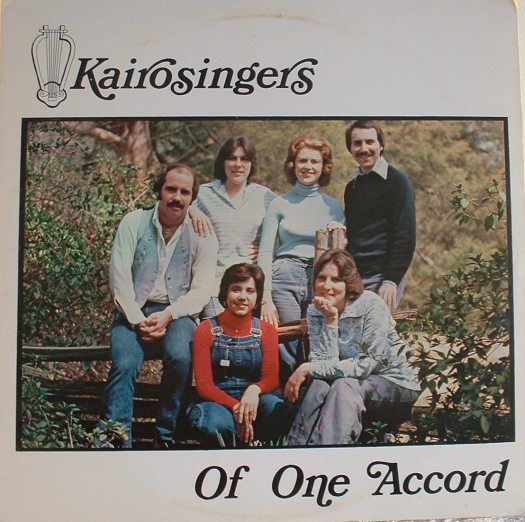
Kairosingers
Of One Accord (1978)
Texas isn’t normally regarded as a “Catholic state,” but the Catholic Church has always had a lively presence there. (More about that below.) This group, from Port Arthur (the home of Janis Joplin) and down the road from Beaumont (the home of Johnny and Edgar Winter) produced one of the more interesting Catholic albums from the 1970’s amidst the oil refineries and chemical plants that dominate the “Golden Triangle.”It’s a nice mix of folk and light pop, and its theological breadth (it has a distinctly Protestant bent in spots) is matched by a stylistic one. Similar in some ways to Corpus Christi produced Who Shall Spread the Good News, it’s livelier and less liturgical in some ways but more serious in others (especially “Cross of Shame.”) It can also be compared to the early Maranatha albums (especially Maranatha 2.)
Although it’s wasn’t the easiest album to adapt to worship and liturgy (which may explain its obscurity,) it’s a great album just to kick back, listen to, and be challenged by, which is more than can be said for a lot of post-Vatican II Catholic music.
In response to that review of the album, performer Charlie Balsam (now Director of the Jason’s Deli Leadership Institute)responded as follows:
I am from Houston, but went to Lamar University, where I got involved with campus ministry. That is where the group met each other….the core quintet: me, Debbie, Nancy, Russ and Peggy were originals: Pam came soon after; Debbie & Nancy were sisters, and later their other sister Lisa joined us for a while, as did a second flutist when Pam moved on. Russ (on the right side of the cover) died in 1993. Usually a sextet, sometimes seven voices…WE only printed @ 1000 of the albums, sold all of them. I am not sure where the original master tapes are, but I and others have transferred the vinyl to CD I am sure.The Kairosinger “sound” was partly shaped by the Kea sisters, who had sung from childhood, and whose dad was a solid Baptist. So that may be where a protestant flavor seeped in. But the group was 100% Catholic. However, the overarching sound was shaped by my fascination with the 60s rock/vocal group The Association. So the vocals always had a layered quality about them. You should have heard us do the Wedding Song. There are places on the album where you can “hear” James Taylor guitar-style influence (In the Spirit) and the Byrds/Dan Fogelberg (Living Water).Another reason the album may have seemed protestant is that most of the songs are personal rather than congregational or liturgical; two exceptions – Praise & Thanks to Yahweh (a responsorial psalm) and His Love Endures Forever, with a strong refrain. Our concerts, similar again to the Association, were often an eclectic, versatile selection of songs, depending on the venue. One of our last concerts included a Peter Paul and Mary song (The Unicorn Song), the late John Stewart (Some Kind of Love), John Michael Talbot’s Holy Is His Name and Behold Now the Kingdom, and two Doc Watson arrangements: Summertime (from Porgy & Bess) and Any Old Time (Jimmy Rodgers ragtime tune). Both were enhanced by Debbie’s clarinet and Lisa’s sax. We also had a nice, a capella arrangement of How Great Thou Art. There are several other original pieces we performed as well…Our sound was also shaped by Houston’s Keyhole singers (early 1970s), and a Christian folk music coffeehouse affiliated with the evangelical but still Anglican (at the time) Church of the Redeemer, off Telephone Rd in central east Houston. I believe Betty and Graham Pulkingham were involved at the time.Catholic guitar-based praise/worship and liturgical music matured over the next 20 years with John M Talbot, the St. Louis Jesuits, and United Church of Christ musician Marty Haugen from Minnesota, and various other artists.
- Songs (with writers, for individual download:)
- Songmaster (Barb Fawvor)
- Praise and Thanks to Yahweh (Deborah Kea Prihoda)
- Living Water (Charlie Balsam)
- His Love Endures Forever (Charlie Balsam and Deborah Kea Prihoda)
- Cross of Shame (Deborah Kea Prihoda)
- Good News (Deborah Kea Prihoda)
- Simon Peter (Deborah Kea Prihoda)
- Let Your Face Wear a Smile (Pam Fazio)
- In the Spirit (Charlie Balsam)
- Simple Prayer (Deborah Kea Prihoda and Sharon Odom)
- Of One Accord (Charlie Balsam)
- Other Credits
- David Campbell: bass and percussion
- Other musicians: Russ Mazzagate, Nancy Guarnieri, Peggy Risher
- Floyd Badeaux: engineer
- Beth Balsam: album design and photography (back cover can be seen here)
- Recorded at the Musik Faktory in Port Arthur, TX
A Kairos Moment for Texas Catholics
The album cover defines the Greek word kairos as “a time when conditions were right for the accomplishment of a crucial action: the opportune and decisive moment.” It’s used frequently by many of the newer thinkers in Evangelical Christianity (like Leonard Sweet.) Catholicism in general in the 1970’s and Texas Catholicism in particular were facing a “kairos moment” in the wake of Vatican II. In Texas there were three influences that impacted the life the the church and Catholics:
- The influence of Cursillo, the Spanish retreat movement. The first Cursillo in the U.S. took place in Waco in 1959, and the first U.S. Cursillo in English took place in San Angelo in 1961. Cursillo is the ancestor of just about all of the retreat systems in place today such as New Cor, Search, Tres Dias, the Encounter, etc. It produced an introspective form of Christianity that challenged Catholic tendencies to regard their church life as a “business deal with God,” as my first parish priest put it.
- The influence of the Evangelical world around it. Although Texas Catholicism was more substantial relative to the general population than in most other Southern states (Louisiana excepted,) the influence of Baptist and other like churches was strong on many Catholics. This comes out on the album in places, especially regarding the second coming, making it an interesting Catholic/Protestant fusion. It also resulted in incidents like this.
- The influence of the Charismatic Renewal, which is well documented on this site.
This “kairos moment” made being Catholic in Texas at the time an exciting proposition.
Today one out of ten Americans regard themselves as ex-Catholics. It’s easy to say that this is because of the church’s dogmatism, but the reality is that many left Roman Catholicism because it could not harness the energy of the “kairos moment” it faced after Vatican II. This is a reminder that it’s just as important to know how to harness the energy of spiritual success as it is to initiate it.
- Songs (with writers, for individual download:)
-
Emmanuel
Emmanuel was the name of two groups who composed, performed and led worship music in the Catholic Charismatic Renewal during the late 1970’s and early 1980’s. In the course of events, the two groups (one in Ohio, the other New Mexico) “came together” and their music, to some extent, merged.
This page features four albums between the two Emmanuels. As with much of the legacy of the Charismatic Renewal, it deserves to be remembered and disseminated, and we are pleased to do so.
Notes:
- More music by Jim Cowan and John Flaherty (both of whom are featured on this page) can be obtained from International Liturgy Publications, and my thanks to Vince Ambrosetti for letting me know.
- This page has taken something of “life of its own” since it was first posted. The Steubenville covenant community which produced most of these albums ended up in the “Sword of the Spirit” group until a 1991 episcopal visitation put an end to it. Some from this community discuss these times in the Facebook group Covenant Community: The Good, the Bad, and the Ugly. My heartfelt thanks to John Flaherty for his support of this page and his work in forwarding the discussion concerning this part of modern Pentecost.
 God, You Are My Refuge (EM001) 1977
People who attended any of the conferences (youth and leaders) at the Catholic Charismatic (and Franciscan) University of Steubenville in the late 1970’s and early 1980’s will remember the group Emmanuel, the music ministry of the Servants of God’s Love community. God, You Are My Refuge was their first album.
John Flaherty, a guitarist on all of the Ohio group’s albums, tells us the following:
I attended the College of Steubenville from 1974 to 1978. I played with the original Emmanuel group at the Thursday night prayer meetings in the chapel. We also played the first Steubenville Conference in 1975 for the Priests and Deacons.
The songs are as follows:
- Come Praise Him
- Song of Thanksgiving
- He Is Our God
- Lord, You Know Me
- God, You Are My Refuge
- Medley: Eyes of Jesus/Jesus, I Love You/Psalm 23
- My Child
- Bless Your Holy Name
- Healing of Nations
Below: Emmanuel, at the time of God You Are My Refuge.
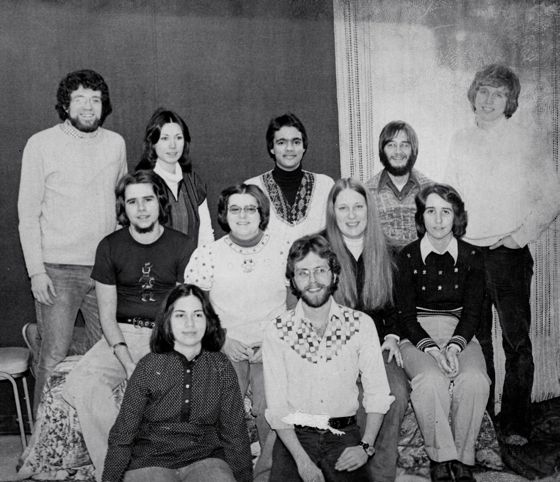
Back row standing: Bob and Mary Ledyard, Tony Corasanitti, Tim Slowiack, John Flaherty
Middle row: Mark Koslick, Cindy Teynor, Barbara Venhaus, Betty Jo Thompson
Front row: Mary Crlenjak, Michael Clark.Emmanuel was always a “cut above” many of their Catholic Charismatic counterparts. They used their own compositions, many of which have artistic value (especially the “Eyes of Jesus” medley) and made a deep impact on those who attended their conferences.
 Yahweh in the Morning (EM002) 1979
This was their second album. The people involved were as follows:
- Emmanuel Members
- Mike Clark
- Tom Cramer
- Mary Crlenjak
- Dave Fatula
- John and Barbara Flaherty
- Julia Norton
- Cincy Teynor
- Betty Jo Thompson
- Producer: Martin Leifeld
- Director: Elsie Luke
- Recording Engineer: Henry Root
The songs:
- Our God is Our King
- Come Praise the Lord
- Great is the Glory of the Lord
- He Lives
- Spirit
- Yahweh in the Morning
- Praise to You Lord Jesus Christ
- Jesus, You are the Way
- Clap Your Hands
- Only You Are God
- You Will Find Your Life in Mine
John Flaherty explains this album as follows:
I have to point out that YAHWEH IN THE MORNING was mostly organized and created by Betty Jo Thompson (later Gilloon.) Betty Jo created what I consider to be the unique, crisp and rhythmic “Steubenville Strum.” Her style of leadership was such that she allowed all members to contribute in a fair and impartial manner. Her guitar and song-writing abilities made her the natural leader of the group, but she never attempted to exert that control. It was always fun to play with Betty Jo as a guitarist. It was fun to be a part of Emmanuel as a whole.
The music is an advance from their first effort, more consistent in composition and performance.
 In The Beauty of His Holiness (Dove JL-01) 1977
Meanwhile, in a Massachusetts studio, another Emmanuel emerged, consisting of Jim and Mary Cowan. Jim, a recent convert to Roman Catholicism, put out what has to rate as one of the most primitively beautiful and moving productions to come out of the Catholic Charismatic Renewal. Its cover, designed by Chip and Kathy Schad and showing two children gazing at the New Jerusalem, pretty much reflects the whole feel of the album.
More of Jim Cowan’s music can be found here.
Its performers are as follows:
- James Cowan (vocals, guitar, keyboards and synthesiser)
- Mary Cowan (vocals)
- Chuck Denison (vocals on “Jesus I Need You,” lead guitar and harmonica)
- Schuyler Scribner (guitar on “Praise Ye The Lord”, also the recording engineer)
 The songs for individual download:
- Psalm 128
- Come to Me
- Root of Jesse
- Praise Ye the Lord
- Open the Door
- Wherever You Go
- How Lovely is Thy Dwelling
- God is Coming Back for Me
- Breathe on Me Breath of God
- Jesus I Need You
- Transcendance
- Receive Our Prayer
Schuyler Scribner, the recording engineer, recalls the production of the album as follows:
I recorded that 1977 album for Jim in a stone chapel in the woods of Hamilton, Mass, while they were attending Gordon College…
After mixing there were a lot of problems with the pressing. I’ve always wished that I could get the master tapes back & remix, as much was lost in the pressing process. That album was recorded on a 4 track Teac 3340, and we used an Octave Cat monophonic synthesizer…one of the first, to get all the orchestral sounds. The guitar track on “Praise Ye the Lord” was played at 1/2 speed, with tape rolling at 1/2 speed as well, much like the Chipmunks do, to get that sound.
The idea of the whole album was to use as much technology as was available at the time (primitive by today’s standards) to make everything sound as natural & orchestral as possible. Jim was a little overwhelmed by the whole thing, but had a lot of faith, and liked what he was hearing. He really is quite a special artist. We all had a lot of fun.
Come to Me (1655) 1983
Back in Steubenville, after a four year hiatus (and a name change of the community to the Servants of Christ the King) Emmanuel produced another effort, the tape Come to Me (I don’t think it was ever in vinyl, thus the lack of cover art.) With Martin Leifeld’s promotion to Director of the Christian Conference Office, Jim Cowan came from the “New Mexico Emmanuel” to become the group’s director and composed most of the music for the tape
Members of the group for this work were as follows:
- Michael Clark–Vocal, Tambourine
- Jim Cowan–Vocal, Guitar, Piano
- John Flaherty–Vocal, Guitar
- Joe Pino–Vocal
- Matt Senecal–Vocal, Mandolin
- Carol Cuomo–Vocal, Cello
- Charlotte Dausch–Vocal
- Betty Jo Gilloon–Vocal, Guitar
- Eileen Hanley–Vocal
- Pam Minto–Vocal
- Nancy Schreck–Vocal, Flute
You can download the songs individually:
- Come to Me
- Wherever You Go
- Celebrate (supposed to have been on Yahweh in the Morning)
- Emmanuel
- Harden Not Your Hearts
- Jesus I Need You
- As For Me And My House
- Sing A New Song
- You Alone Are Holy
- Open the Door
- Song of Victory
Come to Me‘s compositional quality remained high, but lacks the spontaneity of the three other “Emmanuel” albums. John Flaherty comments on this as follows:
COME TO ME is the first Steubenville product that Jim Cowan was involved in creating. Most of the music was written by him, except CELEBRATE, which was Betty Jo’s and HARDEN NOT YOUR HEARTS which I wrote. Many members of the group were new as, by 1983 we had been assimilated into the Sword of the Spirit. The rigid rules governing men’s and women’s roles had caused some members of Emmanuel to move on and others to retire to “baby making.”
Cowan’s music on this albumn has a folksier feel to it than his later works…But like most music that we’ve been writing in our heads most of our life, when it is finally put to paper in our youth, it is very, very sweet indeed.
In 1985 and 1987 I would work with Jim in producing the O Worship the King series, Vol’s 1 and 3. Jim did a volume 2 mostly on his own.
View Emmanuel on Video
This video was taken on Friday, 29 July 1983, during the opening service of the National Catholic Charismatic Conference of Young People and Youth Ministers at the University of Steubenville, OH. It features Jim Cowan and Emmanuel, for the most part the same group that produced Come to Me.
The video isn’t the best quality, and is taken from the back, but AFAIK it’s the only one I know of around from this era at this conference and of this group.
For more music click here
-
We May Not Be a Church After All
 In September 2000 the Vatican issued its encyclical Dominus Iesus to, in its words, “to set forth again the doctrine of the Catholic faith in these areas (on the unicity and salvific universality of Jesus Christ and the Church), pointing out some fundamental questions that remain open to further development, and refuting specific positions that are erroneous or ambiguous.” (Click on the flag to the left or here to view this document.)
As is the case with most encyclicals, this one contains some good substance wrapped in complicated prose (these documents inspired the term “pontificate.”) There is a lot of good stuff here, especially on the unique and universal nature of the salvation done for us by Jesus Christ. Many people today have the idea that there are many ways to God but such a position is untenable.
Many Protestants, however, have taken offence at the following statement:
On the other hand, the ecclesial communities which have not preserved the valid Episcopate and the genuine and integral substance of the Eucharistic mystery, are not Churches in the proper sense; however, those who are baptised in these communities are, by Baptism, incorporated in Christ and thus are in a certain communion, albeit imperfect, with the Church.
It’s understandable why this statement should kindle anger in many of us who are in churches described herein. But anger doesn’t add to understanding of the position of the Catholic Church or of the rest of Christianity. We need a serious analysis to find out just what the problem is.
The term the New Testament uses for the church is ekklesia, the “called out ones.” Implicit in this is the idea that the church is made up of the people who have been called out, the “Body of Christ,” if you please. Such a concept is commonly expressed in Evangelical churches (it’s hard to figure out what the liberals are called out from) but is not unknown in Roman Catholicism. The Second Vatican Council spent some time on it and of course Liberation Theology has used it as well.
But Roman Catholicism has another concept of church: an organization, whose leadership is the direct successor of the Apostles (and the head of this organization being the direct successor of Peter,) and which was established and empowered by Christ to dispense grace through the sacraments and truth through its authoritative teaching. Such a church is in reality a mediator between man and God. To back this up Roman Catholicism teaches that the establishment of such an authoritative institution was high on Christ’s agenda while He was here. Roman Catholicism is not alone in this; the Orthodox churches have the same high view of themselves, the Anglican ones to a lesser extent.
The whole history of Protestantism has been an attempt to get past this concept of church and re-emphasise the unique meditative role of Christ Himself. One of the reason Reformed theologians are so adamant about their Augustinian theology of sovereign grace and absolute election is because it completely cuts out any apparent need for an institution to dispense grace. Fortunately 250 years of Wesleyan-Arminian theology at work in churches such as most Pentecostal ones have made it obvious that it’s unnecessary to take away man’s free will to save him from terminal institutionalism.
This dichotomy of the concept of church throws the encyclical’s statements on this subject into plain view. We may not like the Vatican telling us we’re not a church, but if we look at their definition of church, then we can’t avoid the conclusion that, using their definition, we probably aren’t! And shouldn’t be either; part of our providing a viable alternative to Roman Catholicism is to emphasise our direct relationship with Jesus Christ as people. Although the church’s mission is to communicate the Gospel, it is counter-productive for it to take the place of Christ in order to fulfil His mission.
This of course leaves an obvious question to be answered: did in fact Jesus Christ intend to establish a church such as the Roman Catholic one as a central part of His mission on earth? Looking at our Lord’s own relationship with the religious authorities of this day isn’t encouraging to the Catholic position. Judaism in Jesus’ day was developing into what we now know as “rabbinic Judaism,” where the rabbis were able to develop their interpretation of the law into authoritative teaching enforceable within Judaism. The Pharisees were the “leaders of the pack” in this regard, and Jesus’ opposition to the Pharisees at virtually all levels is well known.
Moreover the religious authorities within Judaism made the crucial decision to have Jesus put to death. They did so for two reasons: 1) Jesus posed a political threat to the Romans, who would have (and eventually did) destroy them in the event of an insurrection and 2) Jesus’ continual threat to their authority by his actions and words. (They continued the same campaign against the apostles, whose “successors” are supposed to be embodied in Roman Catholicism.)
Jesus’ primary mission, however, was not a political one; even Pilate (before he knuckled under to pressure) recognized that. His mission was to set men free through the rebirth that he offers. How such a mission is to be consistently accomplished when the main emphasis is obedience to a visible power structure is hard to see, especially considering the way the power structure in Jesus’ day reacted to him.
But such is the rub of ecumenical politics. Many people of good will bemoan the division of Christianity into the many organisations that exist today. If we want to fix the problem, a good place to start is to define a proper definition and role of the church more in line with the life and teachings of its Founder.
-
Running Rusty
 Sometimes I think some people in my generation were raised on the moon. They get up and talk about the United States, how in years past we had a good, decent moral country where none of the evils we see now were anywhere to be found.
While there’s no doubt our civilization isn’t what it used to be, growing up in South Florida was a lesson in just how unidyllic life in these United States could be. It was (and is) a region fully equipped with the vices of the day — including all kinds of gambling such as jai-alai, harness racing and of course the dog track. The only people who seemed to suffer for running gambling operations were the poor Cubans who tried to run a bolita operation; after spending years of jailing immigrants trying to make a living, now the state of Florida does well with its own.
 Across the lake from us was the Palm Beach Kennel Club. We never went but when we watched the news every night we’d see Buck Kinnaird’s sports broadcast on Channel 5. Dog races don’t take too long, so the film clip of that night’s race went by pretty fast. (In truth, I think they always used the same film clip every night.) The track operated a steel rabbit named Rusty. When the race began Rusty was started just ahead of the dogs. The dogs would race while chasing Rusty, and it was the objective of the track to keep Rusty just ahead of the dogs. They usually succeeded in doing so; their occasional failure resulted in the inglorious end of the race.
I suppose this is fine for dog racing but unfortunately too much of life for too many of us has turned into a dog race where whomever we feel is in control of our situation is “running Rusty” in front of us. From youth onward we’re motivated — pushed and shoved in some cases — to achieve goals which we may have had nothing to do with formulating and which we really feel we neither want nor are able to accomplish. If and when we reach these goals it seems that success is more elusive than ever because the “track owner” is moving Rusty faster than we can keep up by either making new demands or enticing us with new things to go harder for. This is called “being challenged” and of course has its upside but in many cases it’s manipulation, pure and simple.
One of the promises of technology was to enable us to have more leisure time and more control over our lives. Sad to say the real result is to turn our lives in to a 24/7 “on demand” race where there’s no escape from anything. The more productive we become with our technological tools the faster “Rusty” is run and the more fatigued we get.
Fortunately the real “track owner” of this world never intended to run people in a perpetual dog race. Jesus told us “Take my yoke upon you, and learn from me, for I am gentle and lowly-minded, and ‘you shall find rest for your souls’; For my yoke is easy, and my burden is light.” (Matthew 11:29-30) His race is rather simple:
- There is only one really important objective: “What good will it do a man to gain the whole world, if he forfeits his life? or what will a man give that is of equal value with his life?” (Matthew 16:26) Our main objective is eternal life.
- He has promised he will give us the strength to run the race: “Why, then, do you now provoke God, by putting on the necks of these disciples a yoke which neither our ancestors nor we were able to bear? No, it is through the loving-kindness of the Lord Jesus that we, just as they do, believe that we have been saved.” (Acts 15:10-11)
- He has run the race and won, so can we: “Seeing, therefore, that there is on every side of us such a throng of witnesses, let us also lay aside everything that hinders us, and the sin that clings about us, and run with patient endurance the race that lies before us, our eyes fixed upon Jesus, the Leader and perfect Example of our faith, who, for the joy that lay before him, endured the cross, heedless of its shame, and now ‘has taken his seat at the right hand’ of the throne of God. Weigh well the example of him who had to endure such opposition from ‘men who were sinning against themselves,’ so that you should not grow weary or faint-hearted.” (Hebrews 12:1-3)
Jesus Christ sets before us a simple race to run, a clear objective and a straightforward way to get there. And that’s a lot more than people and institutions can claim these days.
All New Testament quotations taken from the Positive Infinity New Testament.

Sailing the Last Voyage with Newton and Pascal
 Positive Infinity
