-
Community of the Cross: Outpouring
Outpouring (Community Of The Cross) 1979
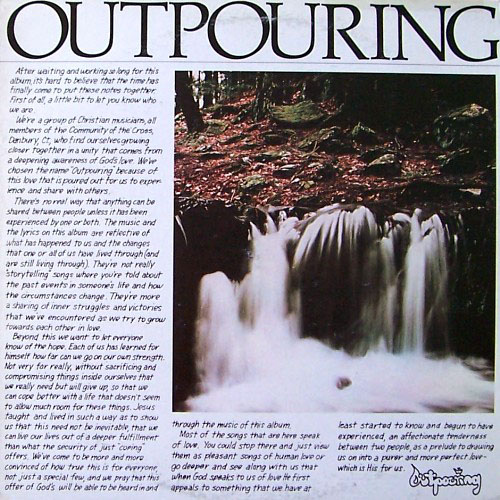
When I was first introduced to “Jesus Music” in the 1970’s, one of the first frustrations I encountered is that too much of it sounded alike. (The fact that some of it had a C&W sound didn’t help either!) It took some time but I found that there was some genuinely creative stuff going on.
It’s too bad that this album was one of those things I missed. But this production by the Community of the Cross in Danbury, CT, is like nothing else from the era. To start with, it is from the Northeast, which was unusual. Beyond that, the reach for artistry–which is evident at several points in the album–was sorely lacking in the genre. Perhaps this last was pushed by the fact that this album (from a compositional standoint) is very much the “Italian Hour” for Jesus Music. This group (especially in “Never Be Alone Again”) leads contemporary Christian music into realms that Protestant WASPS/Celtic worthies were (and are) reluctant to take it to.
This album was a ground breaker in many ways. Outpouring performed and made two more albums until they disbanded in 2000. (One of them is here.)

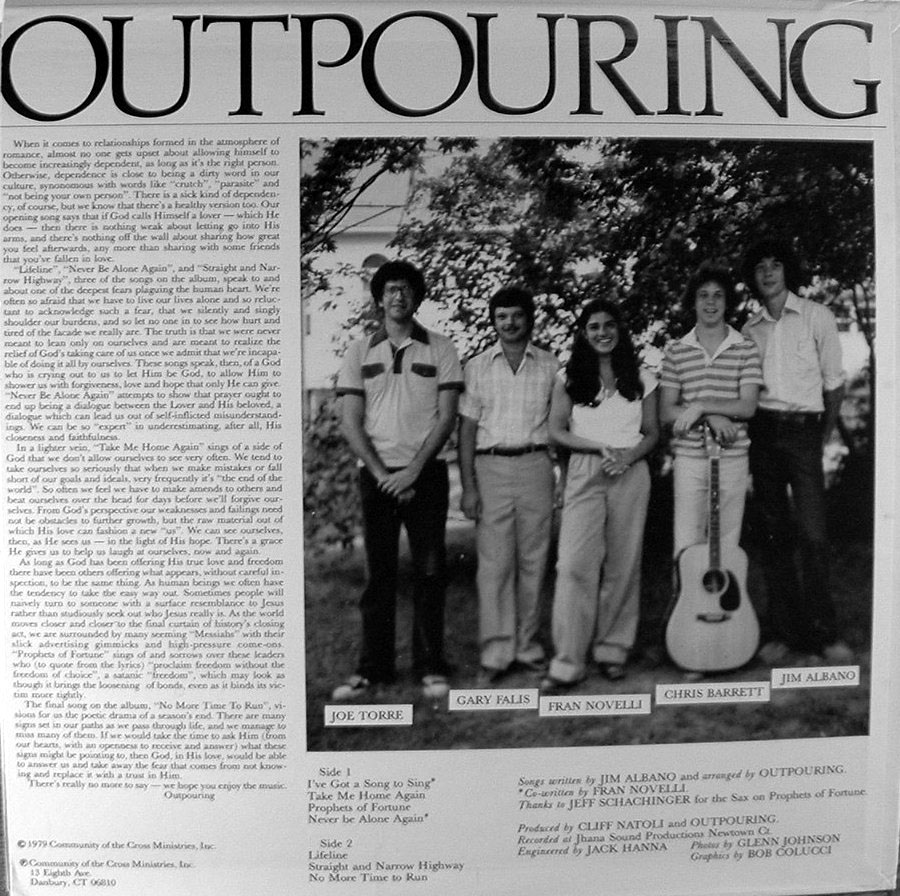
Outpouring, left to right: Joe Torre, Gary Falin, Fran Novelli, Chris Barrett, Jim Albano. Jeff Schachinger performed sax on “Prophets of Fortune.”
The songs:
- I’ve Got a Song to Sing*
- Take me Home Again
- Prophets of Fortune
- Never be Alone Again*
- Lifeline
- Straight and Narrow Highway
- No More Time to Run
All songs by Jim Albano except those marked * which are by Jim Albano and Fran Novelli.
Produced by Cliff Natoli and Outpouring.
Recorded at Jbana Sound Productions, Newtown, CT. Engineered by Jack Hanna. Photos by Glenn Johnson, graphics by Bob Colucci.
Note: many of the ministries that were beind the music offered on this site are no longer in existence. That’s not the case with this one; the Community of the Cross is still active in Danbury, CT. They operate the Community Coffeehouse, which features many Christian musicians (perhaps the next Outpouring?) Thanks to Chris Barrett for keeping me up to date on this.
-
The President’s Forum on the Future of the Southern Baptist Convention: Albert Mohler, Jr.
This is a fascinating video, especially for someone like myself who spent 2 1/2 years in an Southern Baptist church.
http://www.sbts.edu/resources/wp-content/mu-plugins/flash-video-player/mediaplayer/player.swf
-
Letter from Maj. Henry Winslow, aide-de-camp to Confederate Gen. Leonidas Polk, Shortly After Polk’s Death
Marietta, June 19th
Morning
Dear Son = On yesterday all day we had heavy fighting on the left. Walker’s (Maj Genl William Henry Talbot Walker, KIA Atlanta July 22, ’64)) division suffered a good deal the 53 & 54 Geo had a good many killed wounded but none from Fort Valley. Mrs Mims had a grandson named (Piney)? who lost an arm, I found him in the hospital and took the best care I could of him until he was sent off last night – he said he had not eaten a mouthful for 24 hours – I gave him coffee bread & butter & (….)? all of which he was glad to get. The Committees are doing much good. Dr Evereth (?) spent the night with us and went to the front this morning.
We are (3)? miles form our advance lines. Any hour may bring forth a general engagement or it may not take place for sometime my own opinions are unchanged as to the army falling back to the Chattahoochie for if Sherman presses Johnson until he sees a decided advantage will drop back gradually. I was up until 12 last night finding the wounded and sick and carrying them on stretchers to the cars to be sent off to Atlanta – it is a sad sight to see the mutilation of our poor fellows in the rear of our quarters in what is called the dead house for all considered mortally wounded are brought here. I helped to bring them in this morning and was told 10 or 12 died last night – some shot through the head with their brains running out, some thru the bowels and some thru the lungs and other parts it is horrible to see. We have had rain for the last 36 hours constantly and every thing is wet & drenched and consequently much sickness. Our Committees are doing much good as well as others and really is an important aid to the army and men is reduced to (….)? systems and all the Counties assisted a vast deal more of benefit would be derived from it. Many apple (cutrins)? are made when if, for four which it cannot relieve as only the sick wounded can be cared for, but it is hard to refuse a soldier wet and worn down
from the battlefield asking for food and saying he has had nothing for hours. I find the hard floor a very solid resting place but am doing much good and that (….)? the hardship. You will communicate to some member of the committee at home, the news I write to inform rest, and tell them that their contributions are a source of great comfort to all and that do not how soon some of family may receive the articles they send. I do not think there is any need for them to send cabbage and (….)? of any kind. Squashes – Potatoes – turnips – Beets – Vinegar – Whiskey – Wine – Light bread – Butter – molasses – Cakes & Biscuits – Hams are all good. By keeping the different vegetables separate and pack all while cold they will keep better and if the hams are wrapped up each separate even in paper it is better – all our boxes except six in use have been sent back & I hope have reached Fort Valley, 12 ock m – I have just seen Dr (Mathers)?son, from the front he is not hurt.
Young G W Hollingshaw (?) very slightly wounded also young Mims, not sufficiently severe to cause them to leave the lines – Murray also slightly wounded at the (….)(…)? as the others by spent balls – young Mathers(?)
Was supplied with such articles as he required – he has been sick but will return to his company tomorrow. Nine others from F.V. are injured. Our folks had better send up at least 3 on their next relief & at that time I will return if not driven off. While I have been writing a perfect storm of rain is falling and a fair prospect of continuing all day. At the same time we hear very heavy cannon (going up)? on the left, it is quite sharp and I think an extensive engagement is going on – if any thing turns up interesting I will put it down tonight. Do not write unless it is important except by some (. . . . . . . .) I send by private hand to Macon.
Love to the children & yourself
H Winslow
6 PM Rain Rain & heavy skirmishing on right center & left. Iverson’s Cavalry (BG Alfred Iverson of Wheeler’s Cavalry Corps) said to have been forced back on the left by a heavy force of infantry & cavalry. The result of all the fighting not known, further than our forces as gradually falling back on all our lines entrenching as they fall back.
Tell the people to make (cheese)? bisquits thin that (…)? Put much lard in them
-
A Time for Everything
 One of the centrepieces of the spiritual life of the Texas A&M Newman Association was its “New Cor” retreats, held once every semester. These were usually held at the Fort Parker State Park near Mexia, Texas. Although the park wasn’t that far from the campus, to make transportation easier the Association would secure a school bus to take most of the people there and back again. The usual procedure to get a driver was to pick one of the students, who would obtain his chauffeur’s license the Friday afternoon we were supposed to leave. Armed with this license, the bus would be loaded up and the participants and staff taken for a weekend of spiritual transformation. (And they wonder why there are Aggie jokes…)
My response to this? I took my own car. So did some others.
Sunday afternoon came, the retreat ended and everyone returned to College Station in like manner as they came. I was driving my car back, following a friend of mine who had a girl with him from the University of Texas who had bravely joined us for the weekend. He was weaving all over the road, wandering from the shoulders to the centreline. Fortunately the traffic was light and the road was wide in usual Texas style. We got back to the student centre, but my curiosity was aroused.
“Why were you wandering all over the road?” I demanded.
He looked at me and replied, “It’s very hard to drive and read the Bible at the same time.” Turns out he was sharing the Word with this girl, so he had to thumb through its pages and try to drive all the while. Evidently the combination of God’s authoritative revelation and his driving did the trick; she did get saved. (She also ended up marrying an Aggie, but that’s another story…)
There are a lot of things about this story that are sure to astonish. One of them is that it took place in the context of Roman Catholicism. The truth is, though, that the Catholic church has always had a concern for the eternal destiny of its adherents. The problem is how to do it; the church, in common with many other Christian institutions, has placed excessive confidence that the “system” (both sacramental and educational) would lead people to a knowledge of God that would in turn lead to eternal life. There is nothing inherently “non-Catholic” in the concept that, somewhere along the way, an individual needs to make a conscious decision whether he or she has a real relationship with God and whether his or her life is either oriented towards God or is pointed in another direction.
Beyond this, my friend’s driving is a reminder to everyone that our life is measured out in a finite way, and that it can be cut short long before we expect it to. “Listen to me, you who say ‘To-day or to-morrow we will go to such and such a town, spend a year there, and trade, and make money,’ And yet you do not know what your life will be like to-morrow! For you are but a mist appearing for a little while and then disappearing.” (James 4:13-14) The general increase of life expectancy on the earth only masks its transience. But events such as 11 September 2001 and the 2004 Sumatran tsunami only underscore the fact that it can be taken away from us very rapidly.
“And as it is appointed unto men once to die, but after this the judgment: So Christ was once offered to bear the sins of many; and unto them that look for him shall he appear the second time without sin unto salvation.” (Hebrews 9:27-28) Everyone needs to answer the question: where am I going after this life is over? Like the journey to and from Fort Parker, the road to eternity has a definite course. So how are you getting there?
New Testament references from the Positive Infinity New Testament. (Note: subsequent to this tale, I came to work for a ministry that specialises in personal evangelism. This ministry requires that people memorise the important Scripture references before sharing the Gospel.)
-
Roger Smith, Michael Howell and the New Commitment: Who Shall Spread the Good News
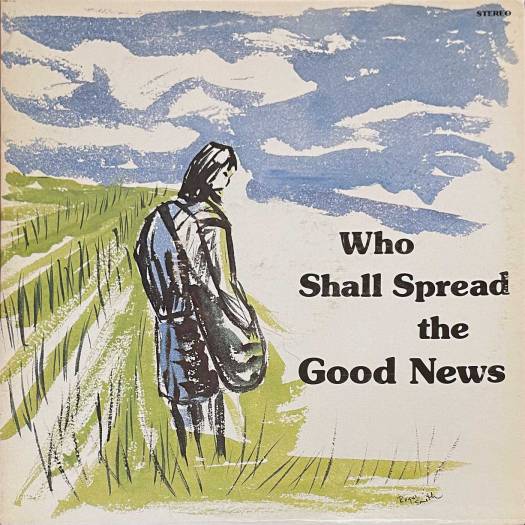
VerMir ACA-6647/8 (1976)
Who Shall Spread the Good News? was brought to reality by Roger Smith and Michael Howell, through their group the New Commitment. Roger Smith, a Catholic priest from Corpus Christi, TX, also performed on albums for North American Liturgy Resources. This music was connected with the “Search” retreats which are still ongoing for Texas Catholic college students.
In our opinion, Who Shall Spread the Good News? is an outstanding–maybe the outstanding–example of the music that came out of the “Catholic Liturgical” movement of the 1960’s and 1970’s. Especially notable are their rendition of De Profundiis (“If You, Oh Lord”) and “As the Rain.”

The songs:
- Who Shall Spread the Good News?
- Song of Revelation
- If You, Oh Lord (Psalm 130)
- Lift your Voice
- The Lord is My True Shepherd (Psalm 23)
- Did You Ever Wonder Why?
- Praised be the God and Father (Ephesians 1)
- Jesus
- Holy, Holy, Holy
- Anaphora/Acclamation
- Doxology/The Lord’s Prayer
- Lamb of God
- As the Rain
For more music click here
The Performers:
- Conrad Hayden — Acoustic and Electric Guitar, Vocals
- Mary Ann Edel — Piano
- Matt Walsh — Bass Guitar
- Russel Buenteo — Vocals
- Janie Gillespie — Vocals, Guitar
- Kay Vorhies — Tambourine, Vocals
- Michele Brinkman — Vocals
- Gary Henneke — Flute
- Serge Timecheff — French Horn
- Therese Edel — Organ
Some history behind this digitisation:
I have been a fan of this album for a long time. It was one of the first albums I digitised, back in the late 1990’s. Unfortunately what I worked from was second-hand; one copy was “low-fi” and the other had a terrible pinch warp, which was noisy and make it skip.
When I posted it the first time I had to make my own album artwork. Now that I’m starting from a regular copy, I have the true album artwork and you can see from and back covers here.
In spite of the limitations of what they furnished me, my thanks again to John and Tracy for this music.
-
Family of God: Honor, Wisdom, Glory and Praise
 Honor, Wisdom, Glory and Praise (FG-1001) was the first (and possibly the only) album of the Family of God Christian Community in Fort Worth, Texas. The community described itself as a “charismatic, ecumenical fellowship in Fort Worth, Texas. Our membership is ecumenical, though largely Catholic.” The album was produced in 1981.The music is very much in line with Catholic charismatic music of the era, with the emphasis on acoustical guitars, light vocals and very light percussion. But, as the credits indicate, there is a variety of instrumentation to keep things interesting. The community drew broadly from its membership to produce this album. All of the compositions are original.
- Singers
- Jim Boehm
- Marlo Crowley
- Gary Geurtz
- Jeff Hensley
- Susan Hensley
- Dorthy Hutcheson
- Mary Kouba
- Betsie Pendarvis
- John Pendarvis
- Teresa Pewitt
- Theresa Ridenour
- Mary Schad
- Bob Sobey
- Celeste Ste. Marie
- Don Ste. Marie
- Phil Ste. Marie
- Paul Terry
- Tony Voulo
- Simon Wrzesinski
- Instrumentalists:
- Guitars: John Pendarvis, Don Ste. Marie, Mike Maulsby, Jim Boehm, Andrew Wulf
- Bass: Andrew Wulf
- Keyboards: Dorthy Hutcheson, Betsie Pendarvis, Andrew Wulf
- Flutes: Teresa Pewitt, Bettsie Pendarvis
- Trumpet: John Pendarvis
- Accordion: Phil Ste. Marie
- Mandolin: Andrew Wulf
- Percussion: Gary Geurtz, Betsie Pendarvis, Dorothy Hutcheson, John Pendarvis, Paul Terry
- Producer: John Pendarvis
- Arrangements: Betsie Pendarvis, Andrew Wulf, Dorothy Hutcheson
- Choral Direction: Teresa Pewitt
- Cover Design: Mary Ann Bridges, Jeff Hensley
- Photography: Leon Dodd
- Engineer: James McAlister
- Recorded at Prism Studios, Arlington, Texas
The songs:
- Praise the Lord in His Holy Dwelling
- But As For Me
- Wind Song
- Unless the Lord
- I Go to Prepare a Place for You
- Do Not Lose Hope
- Wherever Your Spirit Leads
- Honor, Wisdom, Glory and Praise
- Christmas Song
- Were You There
- Take My Life
- Do Ye Like the Birds
- Jesus, You Are My Victory
- Singers

Sailing the Last Voyage with Newton and Pascal

 Positive Infinity