-
The Old Prohibition Against Movies Makes a Comeback
Just about anyone raised in a Pentecostal or Holiness church in the last century will recall the prohibition of going to movies. The traditional argument against this was that, if one went to the movies and paid the admission price one was supporting the sinful Hollywood people and companies who made them.
That argument just about went by the wayside, but conservative gay blogger Kevin Dujan has brought it back with a new twist:
I don’t like giving movie studios my money, though…because I feel like when I do that I help fund the people who inflict so much damage on this country by way of hammering the Left’s talking points into impressionable Americans. Let’s face it, the way that Democrats maintain power is by way of the Ministry of Truth that is our “news media”, the Ministry of Entertainment that is “Hollywood”, and the Ministry of Persuasion that’s comprised of all federal agencies such as the IRS that are controlled by Democrats and abuse their authority or otherwise persecute and intimidate Americans. I know that movie theaters actually don’t make any money off the ticket sales to first-run films…and instead depend on concession sales to stay in business; all ticket sales go to the movie distributors, so buying a movie ticket sends that cash to Hollywood and then gets redistributed back to the Democrat party and its Leftist masters. I enjoy limiting the amount of cash I contribute to that revenue stream.
One friend of mine from Texas, who later went on to become a Church of God minister and state overseer, found a way to beat the system. Raised in a rough environment, his mother was saved when he was a teenager. She told him the usual Holiness reason why people shouldn’t go to movies. His response? He had fixed the cash flow problem by his deft ability to sneak in without paying!

-
Advice to Graduates: Every Wing has a Leading Edge and a Trailing Edge
One of the diciest spectacles we have in education these days is the rush to apply technology to the process. Our school systems are spending enormous amounts of money to equip students with the latest gadget (these days, it’s a tablet) and make sure they know how to run these things. Textbook publishers are rushing to put students into e-textbooks, which are great until:
- Your open book tests do not allow internet capable devices (mine don’t);
- You realise the digital rights management (DRM) doesn’t let you resell the book, which means that you’ve just spent more on the e-textbook then you would have if you had bought and resold the paper one; or
- Someone steals the tablet you’ve been issued, DRM following.
A lot of this push comes from Boomer administrators and educators who are a) mercifully retiring and b) in a complete panic over technology in general. For them, the on/off switch on desktops was a complete mystery, to say nothing about the little dimple at the bottom of their iPhone/iPad. Much of their push re technology is done without a clear understanding of how it works, which is one reason why it’s an uphill battle to get students to learn how to code (which, in turn, would enhance everyone’s understanding of how computers really work).
Boomers come up with all kinds of buzzwords to hide their ignorance on many points. One of them is their insistence upon things, people and organisations being “leading edge”. Once again, this is the mantra of a generation who is scared to brown pants about being left behind. This has also oozed into the church world.

 My first job was in the aerospace industry, designing what you see above, and that the year Star Wars came out. I had never had much exposure to aircraft outside of flying around in them, although I learned later that my grandfather (right) was a different story altogether. One of the first revelations was that a) the term “leading edge” refers to the “front” edge of a wing and b) wings have both leading and trailing edges, both of which are important to the flight of the aircraft or missile or whatever. (I’m still tangentially involved with aerospace people, and you can see how they show leading and trailing edges of wings work here).
Today we’re obsessed with being “leading edge” or “cutting edge”. But the trailing edge has its place too. Technology has transformed just about every aspect of productive work (and unproductive work too) but one can have a career in some stuff that would be classified as “trailing edge”. My family business was decidedly in that group, but we were in the middle of an industry which was (and still is) very advanced in its technology and vital in its product, if not politically correct. It took me a long time to grasp that it was really OK and, of course, I doubt most manufactured products have examples that are still in their original use after a century or more. My teaching field (geotechnical engineering) always seems to lag the rest of civil engineering in the application of new techniques, but rare is the structure that does not rest on the foundation. And the reason for the lag is simple: with the many uncertainties of any earth science, the price of failure (especially in our legal environment) is very high.
For success, we must have a place on the wing, so to speak. Sometimes that means moving from one edge to another (that’s not uncommon with computer people) but having that place takes more than following the latest trend or parroting the latest buzzword. It takes planning, long-term planning, and in the short-term emotionalism that characterises American thinking, that’s not easy to break away from the crowd and do.
The current decline of the personal computer is well-known. One ministry friend noted that content generators prefer the PC while content consumers go for the tablets. That’s true, so the question is this: will you be a generator, or simply a consumer? Long-term success will be difficult if all you do is find yourself in the latter mode. But unfortunately the “gee-whiz” approach we take to science and technology encourages that, and it’s a recipe for failure.
We can be on the leading edge, we can be on the trailing edge, or somewhere between, but the key is that we take flight. As was noted at the beginning of the greatest adventure in history:
No sooner had Jesus said this than he was caught up before their eyes, and a cloud received him from their sight. While they were still gazing up into the heavens, as he went, suddenly two men, clothed in white, stood beside them, And said: “Men of Galilee, why are you standing here looking up* into the heavens? This very Jesus, who has been taken from you into the heavens, will come in the very way in which you have seen him go into the heavens.” Then the Apostles returned to Jerusalem from the hill called Olivet, which is about three-quarters of a mile from the city. (Acts 1:9-12)
*I would have said “looking stupid” but the men (really angels) were more charitable than I would have been.
-
They're Still Called Illegal Immigrants in Palm Beach
And they don’t stand much of a chance, either:
Palm Beach police picked up five illegal immigrants shortly after 5 a.m. Thursday at the corner of Hammon Avenue and South Ocean Boulevard, police spokesman Fred Hess said.
Evidently the politically correct terminology has not quite penetrated this enclave.
I think it should be noted, however, that one of the standing aims of the place is to keep riff-raff of all kinds off of the island, whether they have legal status in this country or not. It just happens to be easier when they don’t. Just wait until we get internal passports…
-
Determining the Characteristic Polynomial of the Companion Matrix by Use of a Large Matrix
Most proofs of the characteristic polynomial of the companion matrix–an important specific case–proceed by induction, and start with a
matrix. It strikes me that an inductive proof has more force (or at least makes more sense) if a larger matrix is used. In this case we will use a “large” (numerical analysts will laugh at this characterisation)
matrix.
Let us begin by making a notation change. Consider the general polynomial
 For this to be monic (one of the requirements for the polynomial in question) we should divide by the last coefficient, thus
Our object is thus to prove that this (or a variation of this, as we will see) is the characteristic polynomial of
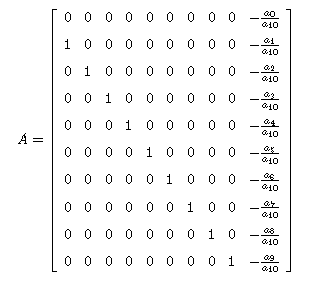
The characteristic polynomial of this is the determinant of the following:
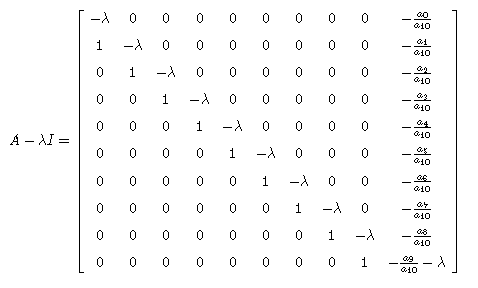
(For another application of the characteristic polynomial and the companion matrix, click here.)
To find the determinant, we expand along the first row. But then we discover that only two minors that matter: the one in the upper left corner and the one in the upper right. Breaking this up into minors and cofactors yields the following:
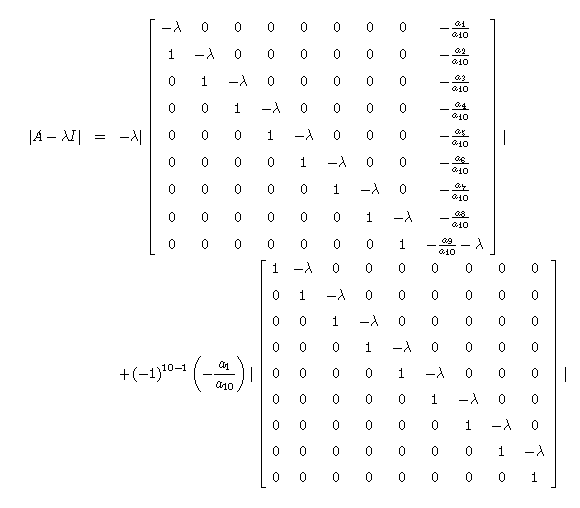 The second matrix, however, is an upper triangular matrix with ones for all of its diagonal entries. Its determinant, therefore, is unity. Also rewriting the coefficient of the second term, we have
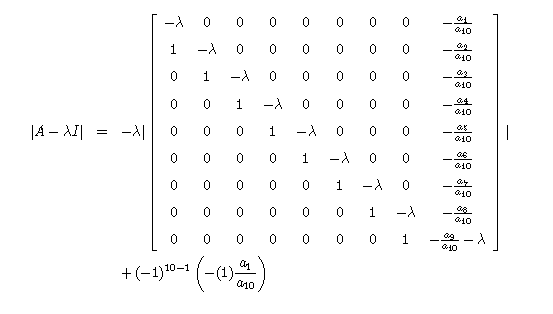 or
or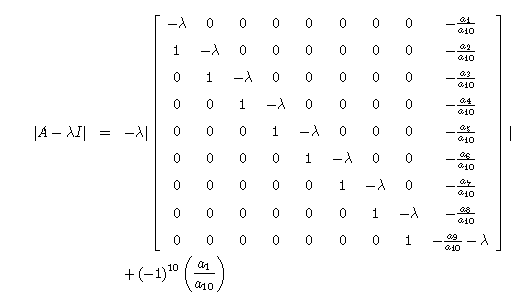 Repeating this process for the next set of minors and cofactors yields
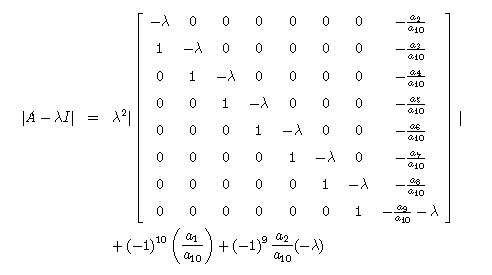 Note carefully the inclusion of
 in the second term. We can also write this as
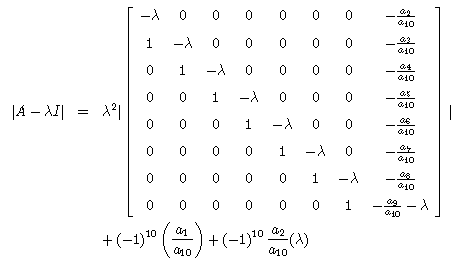
Repeating this process until the end, it is easy to see that

or more generally
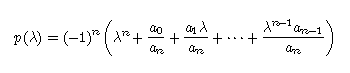
where
is the degree of the polynomial (and the size of the companion matrix.) If we drop the terms we used to make the polynomial monic, we have at last

-
Advice to Graduates: The Importance of an Objective
It’s that time of the year again, when some students turn into wage-earners, others just move on to another curriculum, and still others just tank. Once the mediaeval outfits return to the closet while some who just came out of the closet try to push others they don’t like into the closet, college faculty are generally saddled with the task of documenting their work for accreditation agencies.
Thinking about that turns me back to my last degree pursuit, and the course in Statically Indeterminate Structures. It was my first structural course past the very basics (my first degree was in Mechanical Engineering, where I specialised in machine design). But it was indeterminate in more ways that structurally; the professor’s MO struck me as bizarre. After years of textbook/problems/tests, there was none of that here. His treatment of topics reminded me of a 1960’s art movie; no plot, and no clear connection between one scene and the next. He had no textbook, just notes which appeared on the overhead projector. Homework consisted in substantial projects whose due dates were flexible; you worked and worked until the incomplete disappeared.
I despaired of learning anything (my father dying in the middle of course didn’t help) but I really did. There was method in his madness; I am a better engineer for the effort. As the department head, he made two more decisions which went against the grain. When his only other full-time professor retired, he brought in one full-time professor (now department head) and me as an adjunct. Both of us had our primary experience in the offshore oil industry, and this in a landlocked state!
Getting back to the accreditation progress, one of the requirements of our discipline specific accreditation organisation (in our case ABET) was that we develop an objective for our college. True to form, my professor said that we could develop any objective, down to and including becoming the worst engineering school in the country. Once again that struck me as bizarre, but after reflection I realised he was right, because if we had an objective to be the worst engineering school in the country, we wouldn’t be that worst school! The programs with no goals would do that!
The point of this strange diatribe is that having an objective, a goal, is essential to success in life, no matter how you define success. To start with you can’t succeed at anything if you have no criteria for success, and an objective gives you that criterion. Beyond that, as with ABET, having a goal–any goal–will put you ahead of everyone else that doesn’t have a goal, and that’s a large set of people these days.
There’s a lot of debate these days about why people raised in the upper stratum of society have the best shot of ending up there themselves. We speak of more stable family structure, better educational opportunities, better mental stimulus, etc. But my experience teaches me that underlying all that is that people raised in expensive zip codes are given goals in life and then pushed to make them reality. Sometimes it doesn’t work; the goals given are unrealistic, unsuited for the subject, or just plain worthless. But the combination of being raised at the top and having a purposeless life almost never happens, especially these days.
Down the ladder things are different. It’s easier to get into a pattern of drifting through life, bouncing from job to job, dole to dole and lover to lover without much thought about where one wants to end up. It’s especially easy in this country, and one of the unstated goals of the welfare state is to make that drifting the norm. It’s why immigrants at all levels do so well; they come from places where those without a goal get wiped out.
A few years ago Rick Warren had his tremendously successful The Purpose Driven Life. At the time churches marvelled at the idea, but for me it was a given. Is there any other way to live it? But unfortunately for many it is, even in churches where a purpose is an underlying assumption.
For the Christian, the ultimate goal is eternal life in Jesus Christ. That idea, oddly, has come under attack from some Christians who believe that an emphasis of the heavenly goal is the road to earthly irrelevancy. But I disagree; the eternal goal not only moulds your actions here leading up to it, but also puts you beyond the ultimate hold of the “god of this age” (cf. 2 Cor 4:4) and his agents and assigns, which is why same agents and assigns dislike Christianity so much.
But that dislike shouldn’t dissuade us from the pursuit of those eternal goals:
But all the things which I once held to be gains I have now, for the Christ’s sake, come to count as loss. More than that, I count everything as loss, for the sake of the exceeding value of the knowledge of Christ Jesus my Lord. And for his sake I have lost everything, and count it as refuse, if I may but gain Christ and be found in union with him; Any righteousness that I have being, not the righteousness that results from Law, but the righteousness which comes through faith in Christ–the righteousness which is derived from God and is founded on faith. Then indeed I shall know Christ, and the power of his resurrection, and all that it means to share his sufferings, In the hope that, if I become like him in death, I may possibly attain to the resurrection from the dead. (Philippians 3:7-11)
It’s time to not only have an objective–which is better than none–but the objective.
-
In South Florida, Taming the People Won't Be Easy
But Palm Beach County sheriff Ric Bradshaw’s going to try:
Florida House and Senate budget leaders have awarded Palm Beach County Sheriff Ric Bradshaw $1 million for a new violence prevention unit aimed at preventing tragedies like those in Newtown, Conn., and Aurora, Colo., from occurring on his turf.
Bradshaw plans to use the extra $1 million to launch “prevention intervention” units featuring specially trained deputies, mental health professionals and caseworkers. The teams will respond to citizen phone calls to a 24-hour hotline with a knock on the door and a referral to services, if needed.
The idea that we can and should keep people from committing crimes before they get around to it is part of 9/11’s legacy, and the Boston Marathon bombings are a reminder that we haven’t got the hang of it. And of course there are those sticky civil liberties issues:
“We want people to call us if the guy down the street says he hates the government, hates the mayor and he’s gonna shoot him,” Bradshaw said. “What does it hurt to have somebody knock on a door and ask, ‘Hey, is everything OK?’…
“How are they possibly going to watch everybody who makes a comment like that? It’s subjective,” said Liz Downey, executive director of the Palm Beach County branch of the National Alliance on Mental Illness. “We don’t want to take away people’s civil liberties just because people aren’t behaving the way we think they should be.”
Good question, especially in a place like South Florida, where people are as a rule not notably friendly, polite, or what not. (There are exceptions.) How can you tell whether someone is approaching criminal activity or just being their usual mouthy self? And what about people who don’t give advance notice?
Bradshaw’s basic problem is that he’s in a region with little or no sense of community, and trying to throw money at the problem using the mental health community/industry isn’t going to fix that any time soon.

Sailing the Last Voyage with Newton and Pascal
 Positive Infinity