-
When Public Servants Were Barred from Being Priests
Such was the case in the late Roman Empire, by no less of a personage than Pope Siricius. Writing to the bishops in North Africa, he gave eight reasons why a person should not be consecrated to the priesthood, saying that “if after the remission of sins (baptism) he (the candidate for the priesthood) takes on the belt of public service it is not right for him to be admitted to clerical orders.” (Letter V, 1) The “belt of public service” was part of the uniform of the Roman bureaucracy, which took on military form in its civilian part as well. The Council of Toledo made the same prohibition in 401. Siricius expressed the same disapproval of people passing from civil service to the priesthood in a later letter to several bishops (Letter VI, I, 3.)
Why was this? Siricius and others were well aware of the nature of late Roman politics, which involved patronage and graft, to say nothing of torture and execution. He could not imagine someone successful in the Roman bureaucracy having the moral character necessary to be a Christian priest or bishop. For all the trashing of fourth century Christianity by some of those who came after, this is a higher standard than much of what we see these days. We are better at making our own system look clean, but there is plenty of corruption to go around.
And when the opportunity to unload this bureaucratic weight came around, as Britain did a few years later, the glee was clear, as we can see in the Pelagian Fastidius’ De Vita Christiana:
We see before us plenty of examples of wicked men, the sum of their sins complete, who are at this present moment being judged, and denied this present life no less than the life to come…Those who have freely shed the blood of others are now forced to spill their own…Some lie unburied, food for the beasts and birds of the air…Their judgements killed many husbands, widowed many women, orphaned many children. They made beggars and laid them bare…for they plundered the children of the men they killed. Now it is their wives who are widows, their sons who are orphans, begging their daily bread from others.
Today, of course, Christians are made to think that participation in public life is their Christian duty, but there was a time when just the opposite was commended to Christ’s followers. In both cases good reason is involved; it is not as easy an issue as some think.
-
A Letter from the Rector
I was looking through some papers and found a letter from an Episcopal rector with this:
I did enjoy your letter and it just makes me that much more distressed that you left the Episcopal Church. Somehow, with your mind and keen feelings, we should have been able to hang on to you. We sorely need the prayers of everyone and their understanding during this time of crisis in the Church. It would be so easy to “throw in the sponge” and go along with the crowd, but my disposition is not such. I suppose I will go down fighting for what I feel I have to do.
Personally, I do not think there is much hope for the Episcopal Church at the present time except to grow smaller and smaller as more and more people leave it to go elsewhere, or to join with the Anglican body now being formed.
And the date? Perhaps in the last decade or so, after the crisis detonated by Vickie Gene Robinson’s elevation to bishop? Hardly. The letter was written in January 1978, the rector was the Very Rev. James C. Stoutsenberger, and the parish was St. Joseph’s Episcopal Church in Boynton Beach, FL.
Before I get to commenting on this “contemporary feeling” epistle, some background is in order.
My home church is Bethesda-by-the-Sea in Palm Beach; however, in 1972 we moved to Boynton Beach. I was the only one in my family going to church anywhere at that point, and that was St. Thomas More Catholic Church, the destination for my “Tiber swim.” A few years later church attendance became a “political football” in my parent’s protracted divorce, and that’s where Rev. Stoutsenberger came in.
Now for some observations about this letter, which could have been written a quarter century after it was:
- The “Anglican body” he was referring to was that of the predominantly Anglo-Catholic “continuing” Anglicans, which had met and issued a statement the prior year. As we all know, they formed a few parishes and dioceses, but really didn’t make much of a dent in TEC.
- At the time most of the impetus to form a new body came from the Anglo-Catholics. The Charismatics, like their LGBT counterparts, were too fixated on changing existing institutions and not making new ones. The Reformed, I suppose, were simply out to lunch in those days, or “swimming the Tweed.”
- It’s interesting to think what would have happened if these continuing Anglicans had really taken hold at the time; the Dennis Canon wasn’t passed (or was it?) until the following year. It would have definitely levelled the playing field had those seceding not had to deal with it.
- The Episcopal Church’s lurch left and the membership bleed that followed isn’t a recent phenomenon; it was just Round II, Round I having taken place in the 1960’s and 1970’s. “Smaller and smaller” has been the trajectory of TEC ever since, except they managed to stop the bleeding in the 1980’s and 1990’s long enough to gather people in who weren’t there for the first drop, but many of whom were involved in the second.
- Most of the people who left at the time and stayed in Christianity either swam the Tiber like I did or went to an Evangelical or Charismatic church of some kind.
- I think one major reason the continuing Anglicans didn’t make the impact their later, AMiA/ACNA/CANA counterparts did was the lack of a ready means to make a community and spread the message. The internet handed the Anglican world just that in the 1990’s, and the rest is, as they say, history.
- Another reason was the continuing churches’ lack of communion with Canterbury, an obsession which has lurked in the Anglican/Episcopal psyche from the start. The AMiA, formed by the provinces of Rwanda and South-East Asia, fixed that problem to some extent, and now we have the results of the recent Primates’ meeting.
Stoutsenberger put “his money where his mouth was” and ended up serving at a FiFNA affiliated parish in Lantana. He passed away in 2004, living long enough to see the explosion that has brought us where we are. It’s sad that it took the elevation of an openly gay man to motivate people, because TEC’s problems were clear long before that event. That’s indicative of peoples’ low consciousness and understanding of what Christianity is all about, and that situation (in this country at least) shows little sign of improving.
-
Some Thoughts on Bossuet's History of the Variations of the Protestant Churches
One of the things that some of the major Anglican blogs will throw out from time to time is the question of what their readers/commenters are reading on the side when they’re not keeping up with the latest Anglican debacle (like the recent Primates’ Meeting.) Through the Christmas holidays, while waiting for some long runs to come out of the computer, I finished Bossuet’s History of the Variations of the Protestant Churches, both volumes of same. That may seem quaint to some, although this piece on the recent Primates’ Meeting strikes me as being taken out of the Variations without Bossuet’s ability to entertain and inspire. (Most Catholic priests these days lack Bossuet’s ability both ways, but that’s another post…)
The Variations were Bossuet’s efforts to show the serious problems inherent in the Reformed churches. So how successful was he? Part of how successful he seems depends upon how you accept his view of Roman Catholicism. A Roman Catholicism which is more like Bossuet envisions it–conscious of Scripture, independent of the state, Augustinian in theology–would be a better entity to adhere to than the one that he had then and we have now. A big part of the problem is that the reverends pères jesuites, or at least one in particular (Pope Francis,) are once again propagating their morale accommodante, as they did in Bossuet’s France (much to its long-term detriment.) Unfortunately then and now the situation is more complicated, but Bossuet tends to ignore this.
His invective against Protestantism, however, works, and it does because he picks his battles carefully. Although it’s easy to get lost in his nit-picking of the endless declarations of faith (they contradicted each other and Catholic doctrine,) the largest thing he goes after is the complete hash that Protestant churches made over the nature of the Eucharist. It was the first major split in Protestantism, pitting Lutheran consubstantiation (with its multiple definitions) against Bill Clinton’s Eucharistic Theology as advocated by Zwingli, and the variations which followed…Bossuet succeeds in showing that, once you get away from the literal meaning of Christ’s words instituting the Eucharist, you get a mess compared to which the problems of transubstantiation pale.
That’s not the only thing Bossuet occupies his pages with, though. Except for the Anabaptists and what we would call the “Radical Reformation,” he covers his subject pretty well. Needless to say, his point of view is biased. It becomes ferociously so when he gets to the English Reformation, which he depicts as a combination of duplicity and brutal state coercion (he conveniently ignores Queen Mary, but she simply kept up the pace set by her father, only for the other side.) The one person that comes out of the narrative with her reputation intact is Queen Elizabeth I, whose settlement pulled back from the outlying positions of the Reformers (much to the distaste of the Puritans and other dissenters who spent the next century trying to pull in the other direction.) For people who are enamoured with the myth-making of the English-speaking peoples, Bossuet’s viewpoint is hard to swallow but necessary.
Another interesting digression of Bossuet’s was his narrative of pre-Reformation groups such as the Albigensians, Waldensians (the “Vaudois” as he calls them) and the Bohemian Brethren. The Reformers saw them as their forerunners and, indeed, looked to groups such as this as proof that there was always a “true church.” (This last point was revived in the nineteenth century in the “Baptist Succession” idea of J.R. Graves and those who came after him.) Bossuet shows that the theology of these groups was at serious variance with what the Reformers taught, which led the latter to try to bring the former into line with their own idea. Especially interesting are the Vaudois, who were in reality an unauthorised, non-celibate religious community in Catholicism more than a stand-alone church; their main fault is that they believed that unworthy priests did not administer valid sacraments. (Anyone who has been in church work knows that gauging the worthiness of ministers can be a dicey proposition at best; I think the Vaudois were unreasonable in that regard.)
To my mind, the best part of the work was when Bossuet takes on Calvinism. He hits the nail on the head when he characterises it as follows:
This doctrine of Beza was taken from Calvin, who maintains, in express terms, “that Adam could not avoid falling, yet was nevertheless guilty, because he fell voluntarily;” which he undertakes to prove in his Institution, and reduces the whole of his doctrine to two principles: the first, that the will of God causes in all things, even in our wills, without excepting that of Adam, an inevitable necessity; the second, that this necessity is no excuse for sinners. Hereby it is plain, he preserves free will in name only, even in the state of innocence and after this there is no room for disputing whether he makes God the author of sin, since besides his frequently drawing this consequence, it is but too evident, by the principles he lays down, that the will of God is the sole cause of that necessity imposed on all that sin.
Bossuet goes on to show two characteristics of Reformed types that persist to this day: they spend half the time in their unbending insistence of their idea, and the rest of it back-pedalling from the fatalistic consequences of that idea. The first was certainly in evidence in the smack-down that the Arminians experienced at the Synod of Dort, and the second started afterwards. Much of the later history of Protestantism–especially the Wesleyan movement and its progeny–has been trying to fix this serious doctrinal problem, but given the Reformed strength in both the seminaries and the upper socio-economic strata of Christianity, it will always be an uphill battle.
As I alluded to earlier, Bossuet is an Augustinian; nevertheless, he has no sympathy with those who wanted to take Augustinianism (especially Calvin) in a new direction. He also lays to rest Chesterton’s charge that Luther, an Augustinian monk himself, took Augustine’s doctrine (which certainly has problems of its own) to its logical conclusion. Bossuet’s case for his own church would have been stronger had the Jesuits (with the backing of his own sovereign, Louis XIV) had not been undermining it with their casuistry, which Pascal (someone Bossuet was certainly familiar with) attacked with gusto in the Provincial Letters.
No matter where you’re at on the issues Bossuet discusses, the History of the Variations of the Protestant Churches is an interesting take on the Reformation, a process which did not end with Luther, Calvin and Cranmer but only began.
-
My Thoughts on the Anglican Primates' Meeting
It’s just about over, and the Primates meeting in Canterbury have made their official statement, such as it is. Here are some observations:
- I’ve always felt that it was unrealistic to expect the current Archbishop of Canterbury to allow TEC and ACoC to get the boot. In that context what happened, i.e., TEC being put in the “penalty box” for three years, was more than I expected, especially in view of the manipulative way Welby handled the meeting.
- I was also surprised that the gathering “upholds marriage as between a man and a woman in faithful, lifelong union.” Obviously most of the primates gathered believe that; getting an Anglican group to be that plain about saying it is another matter altogether. Evidently the GAFCON primates, along with a growing group from some of the other provinces, are having some impact.
- Officially, ACNA got nothing out of this. I am sure that Canterbury aficionados in the ACNA felt the thrill up their leg at Archbishop Foley’s presence at this meeting, but it really doesn’t amount to much. Welby has always tipped his hat to ACNA without really giving them what they’re looking for, i.e., designation as the “official” Anglican church in the U.S., the TEC itself getting the boot.
- Evidently TEC Presiding Bishop Curry is reverting to good old Episcopal “mealymouth” in taking the Primates’ decision in stride. He knows that GC will not back down on same-sex marriages, so nothing will change in TEC. Given TEC’s current membership erosion and financial woes, Curry may have been handed a nice excuse to cut back on their contribution to the Anglican Communion Office; he’s got more pressing problems right at the moment.
- The omission of the Canadians in the penalty box can only be described as bizarre.
- I still think that Welby is in a tight place at home with officiating same-sex marriages; sooner or later the CoE will be forced to, if it does not capitulate in advance. That would be a game changer that the ACNA, and to a lesser extent GAFCON, aren’t quite ready to effectively deal with.
All this being the case, I still think that the GAFCON provinces and their allies need to make other arrangements. What happened this week only drags things out. The Anglican Communion, like Brunei, is a good place to watch the grass grow.
-
Evangelicals Having "Buyers Remorse" on Being Pro-Life?
Sure looks that way, at least for the organisers of Urbana15:
In an op-ed published on Monday, Kristan Hawkins, president of Students for Life (SFL), revealed the Urbana15 team denied her group’s exhibitor application.
SFL received an email from Urbana’s Exhibits Manager thanking the pro-life youth organization for applying, but denied their application because, “… Students for Life does not align with Urbana’s exhibitor criteria. One of our key criteria for exhibitors is to have advancing God’s global mission as the vision and purpose of their organization.”
It’s easy to forget, but at the time of Roe v. Wade, evangelicals were decidedly unenthusiastic about the pro-life cause. With Roman Catholics it was another story, although to some extent that was muted in the upheaval following Vatican II. Evangelicals generally took a blasé attitude towards the subject. It was more important, to their mind, to work on evangelising those who made it to the age of accountability rather than to fret over those who didn’t, as they had no worries about their eternal destiny.
It took some promotion, but by the 1980’s Evangelicals and the “Religious Right” were in the forefront of the pro-life movement, to the point where there are people out there who think that the Roman Catholic obsession with the subject came from the Evangelicals!
Today, for conservative Roman Catholics, pro-life is the social issue, even taking precedence over same-sex marriage. And there are Evangelicals for whom it is the same, as is probably the case with most of the Students for Life. However, in the ever-running popularity contest of Evangelicalism, some have decided that the pro-life cause carries too much baggage, and thus it gets banned from an evangelistic gathering like Urbana15. It’s like, after forty years or so of making the pro-life movement central, Evangelicalism is showing signs of “buyers remorse” for a cause they didn’t much care for to start with.
Personally I think both getting people into the world and getting them saved after that are important. But the Body of Christ is supposed to be equipped with diverse gifts and callings, right? So do we all really have to do the same thing? Evidently in this age of enforced groupthink this is too much for some Christian leaders.
If being pro-life is the thing for you, you’re probably better off being Roman Catholic than Evangelical.
-
Consistency, Convergence and Stability of Lax-Wendroff Scheme Applied to Convection Equation
The purpose of this project is to examine the Lax-Wendroff scheme to solve the convection (or one-way wave) equation and to determine its consistency, convergence and stability.
Overview of Taylor Series Expansions
The case examined utilized a Taylor Series expansion, so some explanation common to both is in order. The general expression for a Taylor series is found in A Course in Mathematical Analysis Volume 1: Derivatives and Differentials; Definite Integrals; Expansion in Series; Applications to Geometry (Dover Books on Mathematics)
and is given as

As a general rule,
will represent a time or distance step, i.e.
, although the second case will require a more versatile application of
In any event, the forward spatial Taylor series expansion from a single point is given as
For our analysis
is the function of the finite difference approximation, contrasted with the exact function
. The subscripts
and indices for space and time respectively. The backward spatial expansion is given as
In like fashion the expansion for time is as follows:
Convection Equation
Now let us turn to the convection equation. Although CFD aficionados refer to this equation in this way, in solid mechanics this is the “one-way” wave equation, i.e., without reflections. The derivation and solution of this equation is detailed here.
In either case the governing equation is
When solved using the Lax-Wendroff scheme, it is expressed as
where
The solution for this problem is given in Numerical Methods for Engineers and Scientists, Second Edition.
Application of Taylor Series Expansions for Consistency
If we apply the results of the Taylor series expansions to the Lax-Wendroff scheme and perform a good deal of algebra (including substituting for
,) the result is
Rearranging, making a change in notation and dropping the
terms as well,
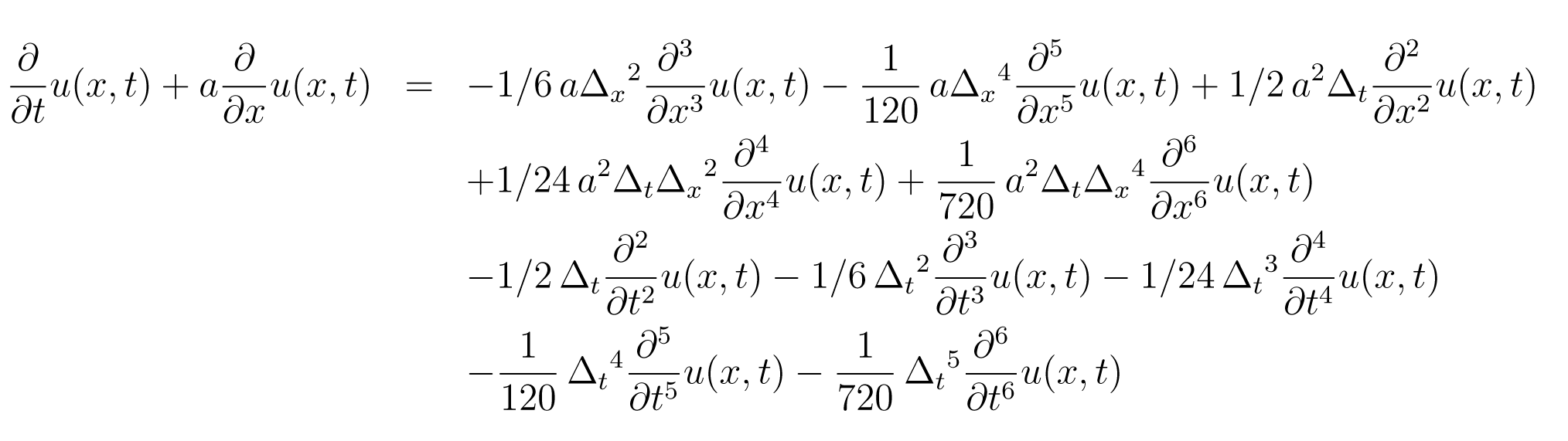
On the left hand side is the exact equation, which is strictly speaking equal to zero. On the right hand side is the residual for consistency of the finite difference scheme. If the scheme is consistent with the original equation, it too should approach zero as
. Based on this we note the following:
- All of the right hand side terms contain
- The lowest order terms for the time and spatial steps on the right hand side are
and
respectively. Thus we can conclude that the truncation error is
.
Or is it? Let us assume that the solution is twice differentiable. By this we mean that the function has second derivatives in both space and time. (Another way of interpreting this is to say that “twice differentiable” means that the solution has no derivatives beyond the second, in which case many of the terms in the Taylor Series expansion would go to zero.) Then we differentiate the original equation once temporally, thus
Now let us do the same thing but spatially, and (with a little additional algebra) we obtain
Adding these two, we have
which is, mirabile visu, the wave equation. Applying this solution for the original equation to the finite difference residual results in
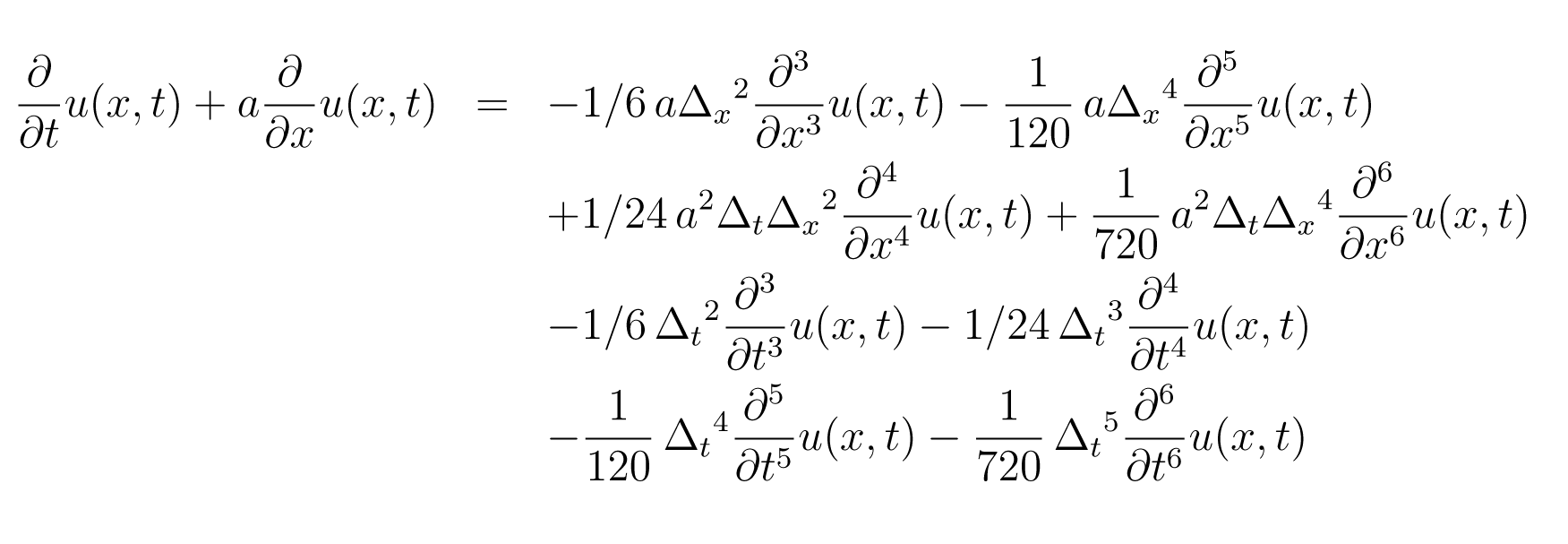
Now we see that the lowest order terms are
and
. We duly note that the fourth order spatial derivative is multiplied by
. However, the squared term will be the predominant one as
Consistency in a Norm
The Taylor Series expansion is only valid at the point at which it is taken. For most differential equations, we are interested in solutions along a broader region. This is in part the purpose for considering consistency in a norm.
Let us consider the result we just obtained, thus
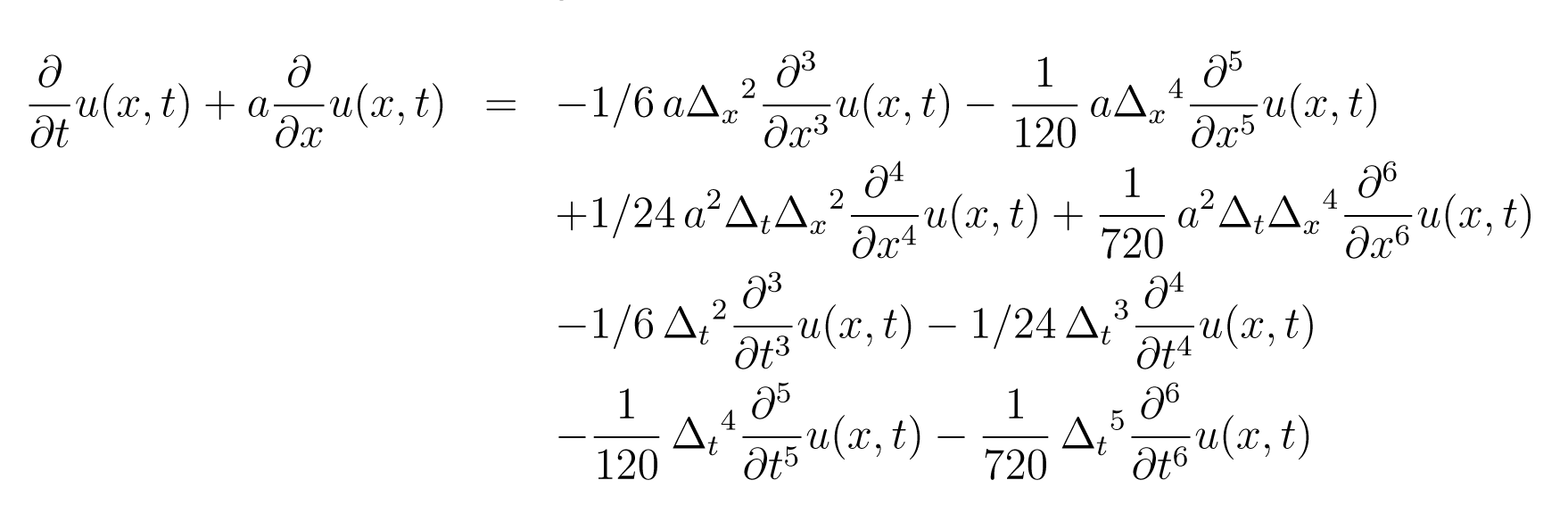
The right hand side represents the residual for consistency of the finite difference scheme. If we were to consider a Taylor Series expansion for all of the points in space and time under consideration, what we would end up with is an infinite set of residuals, i.e., the right hand side of the above equation, which could then be arranged in a vector. If we designate this vector as
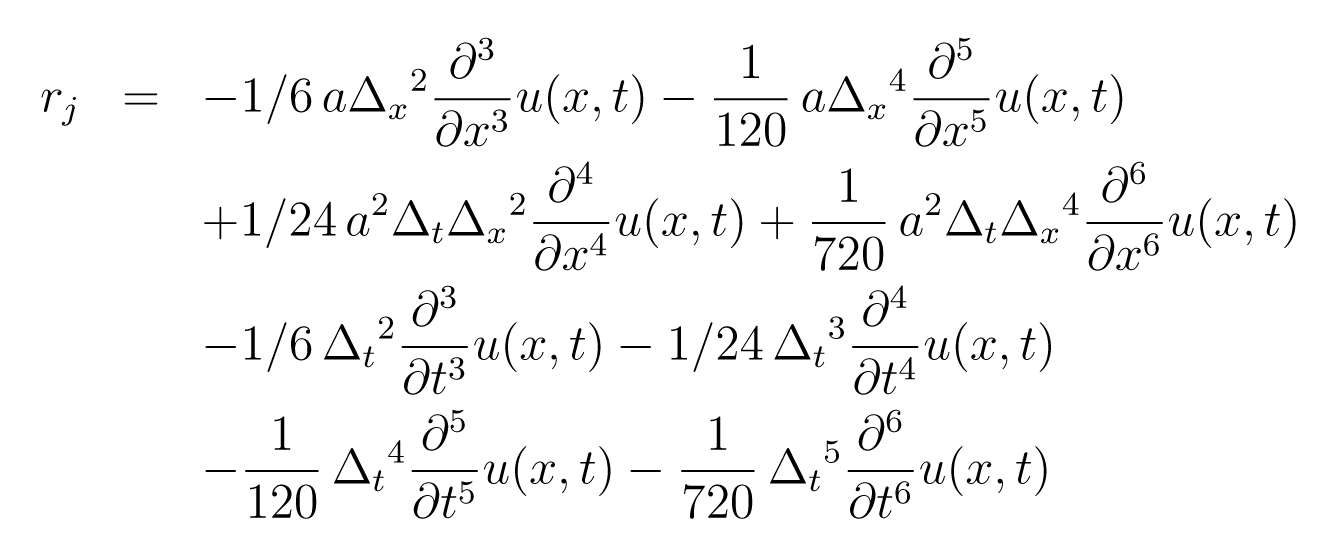
Now let us consider the nature of the differential equation. The following is adapted from Numerical Solution of Differential Equations: Finite Difference and Finite Element Solution of the Initial, Boundary and Eigenvalue Problem in the… (Computer Science and Applied Mathematics)
.
We can consider the differential equation as a linear transformation. Since we have defined the results as an vector, we can express this as follows for the exact solution:
and for the finite difference solution
The result difference between the two is the residual we defined earlier. The finite difference representation is the same as the original if and only if
is the same in both cases. Combining both equations,
and rearranging
Now let us consider the norm. Given the infinite number of entries in this vector, the most convenient norm to take would be the infinity norm, where the norm would be the largest absolute value in the set. For an inner product space,
We have shown that each and every
as
and
. If
are bounded (as they are in a linear transformation,) then
and thus the exact solution and its finite difference counterpart become the same. This is consistency by definition. (The most serious obstacle to actually constructing such a vector–a necessary prerequisite to a norm–is evaluating the derivatives. One “solution” would be to used the exact solution of the original differential equation, but that assumes we can arrive at an exact solution. In many cases, the whole point of a numerical solution is because the exact, “closed form” solution is unavailable. Thus we would end up with numerical evaluations for the derivatives.)
As for other norms such as the Euclidean norm, if the entries in the vector approach zero as
von Neumann Stability Analysis
Turning to the issue of stability, we will perform a von Neumann analysis. In this type of analysis we will analyze a stability factor
defined as follows:
The idea behind this is to determine “whether or not the calculation can be rendered useless by unfavourable error propagation” (from The Numerical Treatment of Differential Equations.) In other methods, such as perturbation methods, an error is introduced into the scheme and its propagation is explicitly analysed. The von Neumann analysis does the same thing but in a more compact form.
The heart of the von Neumann method is to substitute a Fourier series expression into the difference scheme. Thus, for our difference scheme
we substitute
to yield
As an aside, When most people think of “Fourier series” they think of a real series of sines, cosines and coefficients. This was certainly in evidence in the presentation of the method in The Numerical Treatment of Differential Equations. However, it has been the author’s experience that the best way to treat these is to do so in a “real-complex continuum,” i.e., to express these exponentially and to convert them to circular (or in some cases hyperbolic) functions as the complex analysis would admit. An example of that is here.
Solving for the amplification factor defined above,
Simplifying,
or
and then
Solving for
. Since negative values for
for this method to be stable. Thus we can say that the method is conditionally unstable.
Convergence
The Lax Equivalence Theorem posits that, if the problem is properly posed and the finite difference scheme used is consistent and stable, the necessary and consistent conditions for convergence have been met (see Numerical Methods for Engineers and Scientists, Second Edition.) We have shown that, with the assumptions stated above, the scheme is consistent with the original differential equation, with or without the provision of twice differentiability. The method is thus convergent within the conditions stated above for stability; outside of those conditions the method is neither stable nor convergent.
- All of the right hand side terms contain
-
The Ottoman Way of Dealing with the House of Saud
First, the “I told you so”: I have been dealing with the Sunni-Shi’a divide since 2005, now everyone knows how important it is.
Now for something different: this, from Andrew Wheatcroft’s The Ottomans
:
Deep in the heart of Arabia, the desert warriors of the Wahabi sect, fanatical in hatred for the wickedness of the world, had built a great army dedicated to purifying the Faith with fire and the sword. To many, they seemed reminiscent of the armies of the Prophet that had swept out of Arabia in the first century of the Muslim era. For the Wahabis, the luxury and good living in the holy cities of Medina and Mecca was an abomination, a new Sodom and Gomorrah. In 1804 they captured Medina, the second city of Islam, and purged it of evil; then they rode north to take war to the gates of Baghdad. In the following year, the Wahabi leader Abdullah ibn Saud refused to allow the pilgrims on the haj–the pilgrimage to Mecca–to enter the holy city unless they accepted the principles of Wahabi puritanism. In 1806, the pilgrims humbled themselves before the Wahabis and were allowed entry…
In February 1807 Abdullah entered the holy city of Mecca and loosed his warriors in an orgy of destruction and looting. They purged the city of anything which was not within the teachings of the Koran…
Wheatcroft does not mention it, but the house of Saud had intermarried with the founder of Wahabi Islam’s descendants; it was and is a family affair.
It took a few years for the Ottomans to get Mecca back, and they did so with the help of Egyptian Pasha Mehmet Ali:
In 1813 these same troops (the new Egyptian “Ordered Army”) slaughtered the Wahabi army and recovered the holy cities of Arabia. Mehmet Ali sent the keys of the cities to the sultan, and once again the sultan’s name was honoured in the Friday prayers at the heart of Islam…
In 1818 the triumph was completed when an Egyptian army led by Ibrahim Pasha captured the Wahabi leader, Abdullah ibn Saud, and sent him in chains to Constantinople. (Ottoman Sultan) Mahmud handed the Saudi chief to the ulema, who questioned him closely and found him an incorrigible heretic. They returned him to the justice of the sultan. Abdullah was publicly beheaded, as an eyewitness observed, ‘at the door of the gardens of the serail’, and his head was displayed on a marble column.
It took the British, with the help of T.E. “Lawrence of Arabia” to oust the Ottomans at last from Mecca and Medina and hand them to the house of Saud.
I would like to think that the leaders in Cairo and Ankara have called to mind this little known piece of history. The tricky part is getting the place back without either the oil fields or the holy cities or both falling into the hands of Tehran.
-
Why Evangelicals Don't Read Philo Judaeus
It’s the New Year again, time to look at something substantive. This topic may seem a little arcane, but rest assured there’s a grenade with a pin waiting to be pulled.
Evangelicals are generally suspicious of the whole concept of relating the Bible to the ancient world around it, except archaeologically. But there are two Jewish authors more or less contemporaneous with the New Testament that get mentioned frequently: Flavius Joesphus and Philo Judaeus. Getting past mention, Josephus gets quoted frequently, although he sold out God’s Chosen People at Jotapata during the Jewish War.
Philo is another matter. When Hendrickson published The Works of Philo: Complete and Unabridged, New Updated Edition
, the publisher noted “the relative lack of availability of Philo’s works.” The internet has solved that problem (although reading the hard copy is a lot easier than doing so on an iPad, for instance) but Philo is still someone you don’t hear cited very often. Lack of availability isn’t the problem: what Philo has to say is.
One issue that hasn’t quite been tidied up is Philo’s influence on the New Testament. Simply put, did the New Testament’s authors (especially John and the author of Hebrews) read Philo and be influenced by him, or did all of them simply work out of the same Platonic play-book? The jury is still out on this question; I tend to side with the latter. The idea that the New Testament has any Hellenistic philosophical or cultural influence–and the whole subject of Hellenistic vs. Palestinian Judaism–is a complicated one that spills into our understanding, for example, of the early part of the Book of Acts. These days its more fashionable to denigrate any Hellenistic influence, and this denigration runs from the successors of Darby to N.T. Wright. So chalk up one reason why Evangelicals leave Philo to gather dust on the shelf.
Philo’s writings cover the interpretation of some important parts of the Old Testament, especially the early parts. His influence on Patristic Biblical hermeneutic, especially with the likes of Clement of Alexandria and Origen, is enormous, if, like Tertullian, not gratefully acknowledged. So what did he have to say?
Let’s start with the easy part: Philo had a high view of the truth content of the Scriptures. He routinely refers to Moses as the author of the Pentateuch, and in that context states the following:
And this same man (Moses) was likewise a lawgiver; for a king must of necessity both command and forbid, and law is nothing else but a discourse which enjoins what is right and forbids what is not right; but since it is uncertain what is expedient in each separate case (for we often out of ignorance command what is not right to be done, and forbid what is right), it was very natural for him also to receive the gift of prophecy, in order to ensure him against stumbling; for a prophet is an interpreter, God from within prompting him what he ought to say; and with God nothing is blameable. (On Rewards and Punishments, 55)
Philo pushes toward what we would call a “mantic” concept of the inspiration of the Scriptures, which is discussed elsewhere. That may not be what Evangelical scholars think when they consider inspiration, but a mantic concept is implied in most everyday Evangelical teaching and preaching.
So much for the easy part: so how does this play out in Philo’s commentary on the Scriptures? Let’s consider the six days of creation–a hot topic these days–and here is where things get interesting:
And he says that the world was made in six days, not because the Creator stood in need of a length of time (for it is natural that God should do everything at once, not merely by uttering a command, but by even thinking of it); but because the things created required arrangement: and number is akin to arrangement; and, of all numbers, six is, by the laws of nature, the most productive: for of all the numbers, from the unit upwards, it is the first perfect one, being made equal to its parts, and being made complete by them; the number three being half of it, and the number two a third of it, and the unit a sixth of it, and, so to say, it is formed so as to be both male and female, and is made up of the power of both natures; for in existing things the odd number is the male, and the even number is the female; accordingly, of odd numbers the first is the number three, and of even numbers the first is two, and the two numbers multiplied together make six.
It was fitting therefore, that the world, being the most perfect of created things, should be made according to the perfect number, namely, six: and, as it was to have in it the causes of both, which arise from combination, that it should be formed according to a mixed number, the first combination of odd and even numbers, since it was to embrace the character both of the male who sows the seed, and of the female who receives it.
And he allotted each of the six days to one of the portions of the whole, taking out the first day, which he does not even call the first day, that it may not be numbered with the others, but entitling it one, he names it rightly, perceiving in it, and ascribing to it the nature and appellation of the limit. (On the Creation, 13-15)
Philo basically turns the whole narrative into a numerological exercise, extracting the meaning from the numbers that come up. It should be noted that Philo wasn’t just making all of this up on his own; the significance of numbers was intertwined with Greek mathematics, as anyone who has read Nicomachus of Gerasa (who came from the Decapolis and lived in the years after the New Testament) will attest. It was a tradition that went back to Pythagoras himself.
“And on the sixth day God finished his work which he
had made.” It would be a sign of great simplicity to think
that the world was created in six days, or indeed at all in
time; because all time is only the space of days and nights,
and these things the motion of the sun as he passes over the earth and under the earth does necessarily make. But the sun is a part of heaven, so that one must confess that time is a thing posterior to the world. Therefore it would be correctly said that the world was not created in time, but that time had its existence in consequence of the world. For it is the motion of the heaven that has displayed the nature of time.When, therefore, Moses says. “God completed his works on the sixth day,” we must understand that he is speaking not of a number of days, but that he takes six as a perfect number. Since it is the first number which is equal in its parts, in the half, and the third and sixth parts, and since it is produced by the multiplication of two unequal factors, two and three. And the numbers two and three exceed the incorporeality which exists in the unit; because the number two is an image of matter being divided into two parts and dissected like matter. And the number three is an image of a solid body, because a solid can be divided according to a threefold division. (Allegorical Interpretation, I, 2-3)
Here he basically denies the creation in six literal days. After you pass Ken Ham the smelling salts, you might ask: how can he state in one place that Moses put this all down without error and in the other deny the six literal days? The answer is the key to understanding how both Philo himself and those who came after him interpreted the Scriptures.
Virtually any Neoplatonist–and that includes Philo and many others–held as axiomatic the idea that the ultimate reality of the universe was beyond the physical world. That may seem odd to us, but the one place where that concept is entertained in the sciences–mathematics–developed in the same milieu with Neoplatonic philosophy, as a quick perusal of Philo’s quotes above will attest. That in turn was not only infused into Judaism and Christianity but also Islam, especially in Persia, where it appears in many of the Sufi writings. (A Persian was also one of the first to write a book on algebra).
Given that, the primary role of the Scriptures is not as a proof-text but as a window to God’s truth. In this context the words of scripture and the acts recorded there are merely signs of the heavenly, incorporeal truths that are behind them. Philo’s method is allegorical, i.e., the words of Scripture are allegories for a spiritual truth behind them. In fact, in this context a good argument can be made that allegory/typology as the first meaning of Scripture is also a sign that it is inspired.
This method, for all of its well-documented weaknesses, has one main advantage: it simplifies the interpretation of texts when the “literal” meaning is difficult. We see this in the passage on Genesis above; the same passage is often interpreted in a more-than-literal way by “old earthers” of all stripes. In a New Testament context, Origen frankly discusses this subject in favour of an allegorical method. “Difficult” can also include things that no longer are favourable to a new audience, such as the wars in the Old Testament. These problems existed for the ancients as well, albeit they prioritised the problems differently than we do.
Additionally the method enables the interpreter to apply historical passages to the moral, personal and spiritual betterment of its hearers. Most people (especially Americans) don’t have a really good sense of history; this application enables people to relate the truths of Scripture to their own lives when they otherwise would not. This part of the method is alive and well, especially in the Charismatic world.
The viable alternative to this is to use the “progressive revelation” concept, such as we see in Daniel-Rops’ Sacred History. Most evangelicals are even more afraid of this than allegory, in no small measure because a) it too is hard for people to understand and b) many liberals have misused it for their own foul purposes.
Instead what we have these days is a hermeneutic which is literal, in concept at least, which has as high of a view of inspiration as Philo had but insists that the literal interpretation (which doesn’t necessarily equal the author’s intent) is it, difficulties or not. The largest drawback to this is that, in instead of seeing the Old Testament as a type and preparation for the New, they elevate the commands of the two to a nearly equal level, which is one reason why we end up with “synthetic Judaism” more often than not.
The Bible deserves better than what we’re giving it these days. Philo’s method has problems of its own, but it’s time that we look for a better way than the one we’re using, and in that regard Philo–and the whole Patristic tradition that, to varying degrees, drew from him–is as good of a place to start as any.

Sailing the Last Voyage with Newton and Pascal



















 Positive Infinity