-
Why the elites hate Vaughan Williams
When Marie Hall stepped on to the stage at the Queen’s Hall in London to give the first full performance of a new piece from Ralph Vaughan Williams, few could have imagined that exactly a century later, this apparently unremarkable piece would have turned into a political football. The Lark Ascending; Romance for Violin and…
Why the elites hate Vaughan Williams -
John Wesley and the Liturgy
From William Palmer Ladd’s Prayer Book Interleaves:
The Church of England had its Prayer Book, and thus the liturgical way of life was kept alive. But when in the XVIII century, the heyday of the Whig bishops, the easy-going parsons, and the infrequent Eucharists, a prophet arose in the person of John Wesley, the Church knew not the day of its vindication, and literally stoned him. In 1938 many Anglicans, including the Archbishop of Canterbury, joined with Methodists throughout the world in observing the 200th anniversary of Wesley’s ‘Aldersgate Experience.’ That a priest of the Church of England should have had a religious experience was a strange reason for such an elaborate commemoration. And, unfortunately, it identified Wesley with modern Methodist prayer-meetings, whereas he was essentially a Prayer Book churchman, and the embodiment of Anglicanism at its best.
Reared in the churchly atmosphere of his father’s vicarage and of Oxford University, he came to an understanding of sacramental theology by a study of the Fathers, of Jeremy Taylor and other Caroline divines, and of non-juring churchmen like William Law. In his preaching tours throughout England he always attended the services of the parish church. He received communion weekly, and indeed as many as four times each week on the average throughout his entire ministry, so it has been estimated. He urged the duty of constant communion. And his communion services attracted the common people beyond the capacity of the churches to hold them. Few priests in any period of Church history have ever done more to popularize the Holy Communion.
His one lapse from Anglican order-laying his hands on Coke-is to be explained in part by his acceptance of St.Jerome’s teaching of the equality of bishops and presbyters, but chiefly by his intense conviction of the importance of the Holy Communion. It was a desperate step, but he took it only after he had repeatedly failed to persuade the English bishops to provide bishops and sacraments for his American Methodists. Seabury similarly failed. The two were in London at the same time. If they could have met and agreed on a common plan of action. it might have changed the religious destiny of the new world. (pp. 18-19)
-
The Baptists, Their Doctrine and Their Nasty Politics
Next week the Southern Baptist Convention meets in Nashville. They’re facing a number of serious issues: declining membership, Critical Race Theory, and sex abuse scandals, both opposite-sex and same-sex. They’ve had some high-profile departures from the Baptist universe such as Russell Moore, an enlightening analysis of which is here. The denomination everyone thought “had it all” is in trouble.
People who come out of Apostolic churches always find the Baptist–and Evangelical–idea rather strange. They attribute this to “lack of discipleship” and “lack of community.” Neither of these is true; in some ways, the Baptists can make a more effective case against Anglicans and Roman Catholics than can be done the other way. The reason why Baptist and Evangelical churches are the way they are stem from one simple thing: their idea of unconditional perseverance, or “once saved always saved.” When coupled with a generally Arminian view of election, the results look good on the surface but eventually kick back, and that’s what we’re seeing now.
For me this is personal: I had to get the Baptist thing “out of my system” before moving forward. I always tell people that 2.5 years at FBC was the longest 2.5 years I’ve spent anywhere. I hope this will be enlightening for people who don’t understand how this style of mind plays out.
To do this I’ll take a leaf from the Landmark world, in the form of a debate. I feature the The McPherson-Bogard Debate elsewhere, but this is the Garner-Smith Debate. It took place in Gainesville, FL in May 1974 between Albert Garner, a well-known Missionary Baptist preacher, and James Tilden (J.T.) Smith, one from the Church of Christ. The two topics under consideration are as follows:
- Baptismal Regeneration; and
- Unconditional Eternal Security
It may surprise Apostolic types that the Church of Christ, so far away in many ways from their idea, supports baptismal regeneration, but in a way they do. The Baptists of course are very strong supporters of eternal security, irrespective of which form of election they pick.
By the time of the Garner-Smith debate projected visuals were reasonably common, in the form of the infamous “view graphs.” Some (like these) look primitive now, although they’re not much better than some of the ones I saw at Texas Instruments. The first one I want to put up is from Smith, showing his idea of what the Baptists believe about salvation (and their idea that baptism isn’t necessary for that.)

Smith doesn’t miss a chance to take a pot shot at groups neither one of them likes (Roman Catholics, Methodists, etc.) But basically he’s spot on, especially with the “straight shot” part of the diagram. Although it’s part of the baptismal regeneration part of the debate, his characterization of salvation as “cannot be lost–unconditionally secure–idolatry and murder not make soul in danger” is basically either what the Baptists believe or the logical conclusion of that belief.
That concept is a game changer for the life of the church. The people I normally associated with being free from moral constraint were the Communists, who deny the existence of a non-material reality. But here we are. And Garner never responded to this. This basically turns the life of the church into a numbers game; once you’ve got them saved, that’s it.
It’s true that the Baptists have a thorough program for follow-up, especially in their Sunday School system and other types of training. But these are not for salvation: these are for giving believers a credible witness in the world. It’s the key counterweight to their idea of perseverance, and I’ve known many Baptists who are faithful to that. (The only thing I never quite grasped was why Baptists, when they prayed, frequently asked God to forgive their sins: my impulse was to ask them “Why?”)
But as anyone who has done church work knows, the higher up you go in the system the fewer contacts with people outside the church–and by extension the lost–you have. That decreases the need to maintain a witness, especially outside of the realm of publicity. In turn this leads to the viciousness of Baptist politics, as was on display in Paige Patterson’s ouster. It’s little wonder under these circumstances that Russell Moore chose the carefully planned exit he did: he knew that an ecclesiastical piranha tank awaited him if he didn’t, and then he would be ruined for sure.
This leads to the next observation for those institutions that welcome Moore and other refugees from the Baptist world: you need to force them to do “pew time” until they free themselves from their Baptistic idea of eternal security. That’s easier said than done. My Baptistic mother, who put me through the Episcopal system of the 1928 Book of Common Prayer, the Comfortable Words, and being characterised as a miserable offender every Morning Prayer, was shocked years later to discover that I didn’t believe in Baptistic eternal security. She said she “hoped” I would come around to it! Raise up a child in the way he should go…
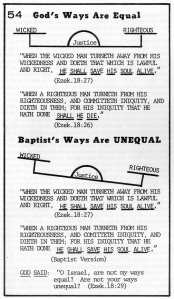
Which leads to another of J.T. Smith’s graphics, at the right.
All of this should show that the Baptist’s ways are certainly unequal, in this regard at least. They’ve produced a successful system which has transformed a region, but they took a slick shortcut to do it. That slick shortcut has affected the American Evangelical world in ways that it does not understand, even in those groups that don’t formally share its eternally secure theology. It’s the real source of a great deal of “easy believism” that gets attacked by people like Robin Jordan.
The Baptists need to wake up to the dilemma they’ve created. If they don’t, their love of evangelism won’t come to much: the eternities they profess to care about won’t be changed, and then they won’t be the only ones in trouble.
-
Giving Paige Patterson the Boot Was Messier Than You Thought
Southwestern’s dispatch in the annual Book of Reports, which presents information for messengers attending the denomination’s upcoming annual meeting, alleges Patterson misappropriated “confidential donor information” and took seminary property after his 2018 termination over allegations of mishandling sexual abuse.
The report comes three months after the seminary settled a lawsuit against a foundation that shifted millions in funding following Patterson’s departure.
I find this amazing; given the way Patterson was booted (he was out of the country when it happened) if he somehow stole or misappropriated seminary property, it was the seminary who wasn’t paying attention. At the time I noted the following:
But the way the Board reversed its previous decision and unceremoniously dumped him is unfortunately typical of the way Southern Baptists handle situations like this. In their system you’re either highly favoured or cast into outer darkness, there’s no middle ground…I think much of that has to do with their defective combination of Arminian election and Calvinistic perseverance. Once you’ve made your decision for Christ and then mess up, the only explanation left is that you weren’t saved to start with. So how can anything subsequent to that be trusted? Out with you.
In addition to this, the way the seminary booted Patterson is consistent with current corporate practice. “Back in the day” you had some time to wrap up your business, clean out your office and leave. Now it’s standard to change the locks on your office (and your computer) and force you to fight the institution for your own stuff. The fact that Patterson was in Germany was all the better in the eyes of the seminary.
Had the seminary simply appointed a representative to go through the whole thing with Patterson, it would have been better. But that’s not the corporate way these days, and it’s not the Baptist way either.
-
Ecclesia Anglicana: For What Does She Stand? by Frank Weston
Clip source: Ecclesia Anglicana: For What Does She Stand? by Frank Weston For What Does She Stand? by Frank WestonProject Canterbury Ecclesia Anglicana: For What Does She Stand? An Open letter to the Right Reverend Father in God Edgar, Lord Bishop of St. Albans by Frank [Weston], Bishop of Zanzibar London: Longmans, Green & Co.,…
Ecclesia Anglicana: For What Does She Stand? by Frank Weston -
You’re an Anglican Now, Scot McKnight, Leave the Baptistic Stuff Behind
I never thought I’d ever see a debate on the subject of the inerrancy of Scriptures in an Anglican context. But one Dr. Scot McKnight, Professor of New Testament at Northern Seminary and (I think) in the C4SO (the usual source of trouble in the ACNA these days) has put himself front and centre with a piece on the inerrancy of the Scriptures. This is an important topic, but the way he sets things forth shows me that Evangelicals are too deep into their own stuff, even when they try to escape into places like the ACNA.
My first exposure to the term was an article in the original Jerome Biblical Commentary, and needless to say they weren’t too hot on the idea. They also got into the hermeneutical issues surrounding this, which I’ll come back to. Later on I read Harold Lindsell’s The Battle for the Bible, which really was the call to arms (not WO) for the Southern Baptist Resurgence in the 1970’s.
I think that the Scriptures are God’s authoritative revelation, period. I used the term “unBiblical” regularly on this site to characterise positions which are either sub-Christian or completely non-Christian; the fact that we have this revelation makes this job possible. The whole push for the inerrancy of the Scriptures a half century ago was the result of conditions which have changed.
The undermining of the basic concept of the truth content of the Scriptures came from the advent of German Higher Criticism. A good case can be made that the whole shipwreck of the Episcopal Church had its genesis in the acceptance of this in the seminaries. Once this is done the Scriptures lose both their claim to truth and their relevance to Christians now. This underpinned the modernist attack on traditional Christianity.
Higher Criticism represented an attempt to beat the Biblical narrative, and how it came into being, into the form of German philosophy. That may have made it possible to think that our seminaries had assumed the mantle of science, but it was pseudo-science, for many reasons. One place where the deconstruction of that narrative has taken place is Biblical archeology. McKnight speaks disparagingly of that, but the process has been going on since at least the days of Roland de Vaux and continues to the present.
All of this created the shipwreck that hit the rocks after World War II. The Episcopal Church bled members during the late 1960’s and 1970’s in the aftermath of this. Evangelical churches picked up some of these pieces, fuelled not only by their affirmation of the truth content of the Scriptures but, in the case of the Pentecostals and Charismatics, the manifested belief that God did the same things to day that he did in the Scriptures. It’s a lot easier to believe the former when you hold to the latter.
Liberals, when surveying the wreckage they wrought, realised (if not admitted) the error of their technique. So they came up with a new approach: postmodernism, where the idea shifts from “the Scriptures say it, but they’re not reliable,” to “the Scriptures say one thing, but really mean another.” They’ve shifted the debate from an textual reliability issue to a hermeneutical one. That, I think, is where the real conflict is, but McKnight and others are still deep into the stuff they started with.
So what is to be done? In one place McKnight gives a clue by saying that “we can talk about “inerrancies”: Origenist, Augustinian, Protestant, Princetonian, and even postmodern!” I give an example of this in my piece Why Evangelicals Don’t Read Philo Judaeus. Philo very much believed in the inerrancy of the Scriptures but had no problem denying, for example, New Earth Creationism. I have discussed Origen himself in my piece The Significance of the Literal Meaning of Scripture: An Example from Origen. Getting rid of the term “inerrancy” really doesn’t accomplish anything except perhaps making him and other refugees from Evangelicalism feel better about themselves.
We need more than that. What we need is some kind of agreement on a hermeneutic. I left out the term “authority” from the discussion because I don’t think that any Protestant church has or can claim authority to interpret the scriptures and make same interpretation stick. Given Anglicanism’s rootedness in the Apostolic tradition, a Patristic-based hermeneutic would make sense, but getting most seminaries and seminary academics to go along with that will be an uphill battle.
So in the meanwhile: McKnight and others like him would do well to leave their qualms about things like inerrancy in their Baptistic past and move forward with what they really believe the Bible says and means.
-
That They May All Be One, Even If Their Educational Level is Different
This past weekend I reposted two articles The Neoliberal Age: The Decomposition of the Self – Covenant (Part 1 of 2) and The Neoliberal Age: The Decomposition of Anglicanism – Covenant (Part 2 of 2). As some of you may suspect, the principal reason why I reposted these excellent articles is because they, at last, highlight what is probably my pet peeve about North American Anglicanism, be it in its Episcopal, ACNA, Continuing or Charismatic form: it’s class stratification, or more specifically the elevated socio-economic position of most of its adherents. (They’re mostly white too.) As the second article points out (it was really difficult to pick a particular passage out, there are so many good ones):
Surely, even the most glancing look at the demographic make-up of our parishes would make clear why the social issues Anglophone Anglicans concern themselves with most passionately are indistinguishable from the popular causes of the urban white elite of the day. So it is that when we hear some official pronouncement from a diocesan office or synod, we hear little that is discernably Anglican by any doctrinal or historical measure, nor even Christian. Instead, what we are greeted with is something that is conspicuously identical to the ideological talking points peddled by the political machines. While this problem might be obviously skewed towards parroting the liberal talking points of the day given the state of our hierarchy, our conservative loyalists often do no better in resisting the thought-terminating influence of propaganda. TEC’s turn from being the Republican Party at Prayer to the Democratic Party at Prayer was, after all, little more than a sleight of hand in the parlor room of the ruling class.So why is our Anglican witness so mealy-mouthed, complacent, and derivative? Why are we, despite all our practiced journalese, so out of touch with both our Christian siblings around the world and the unchurched neighbors? Perhaps on an institutional level it is because Anglophone Anglicans have never experienced a true crisis of wealth and power until recent decades. Unlike our Christian siblings across the world who have and continue to suffer true persecution and are sustained by the blood of the martyrs, our current troubles are almost entirely self-inflicted. We have always been the church of the elite for the elite — and not just in England. For how small Anglicanism has been in America, a disproportionately large number of American presidents have been Episcopalians. Our stately pretentions run so high that the Cathedral Church of St. Peter and St. Paul in Washington D. C. is instead known as the “National Cathedral.” What purchase, after all, do the dusty names of the chiefs of the Apostles have next to the glorious hegemony of the United States? Cuius regio, eius religio is our true ecclesiastical motto — that is, render unto Caesar the things which are God’s.American non-Catholic (a hat tip to Baptists and Pentecostals who don’t think they’re really Protestants) Christianity is class-stratified from top to bottom, with the Anglicans on top, the Pentecostals on the bottom, and everyone else in the middle. That stratification is reflected in the educational level and ethnic makeup of the memberships. There’s really nothing Biblical about Christianity being this way.
Today American Christianity in general and the ACNA in particular are faced with things like Critical Race Theory and wokeness. And it’s true that neither of these is Biblical either. But ignoring the first unBiblical behaviour to deal with the second (and third and…) doesn’t help. As long as North American Anglicanism doesn’t find a way to deal with its demographic trap, it’s going to face these issues with one hand tied behind its back, irrespective of the Biblical eloquence of those who rightly oppose the import of these ideas.
It’s all ironic because the ACNA was ultimately birthed by the intervention of several African provinces of the Anglican Communion, which themselves are the demographic (and vis a vis TEC doctrinal) opposites of their North American counterparts. I really think the ACNA missed a moment when it insisted on autocephaly from these bodies, and it continues to miss it by not even attempting to force the CoE’s hand in turning over the Communion to the Africans.
Things get worse because many of those attracted to the ACNA from the Evangelical world come to it in the same largely white, upwardly mobile (ecclesiastically and socio-economically) group that shrinks from really pushing back from ideologies that come from the top of our secular society, as that would impede the upward mobility. That’s the lesson from the recent stink re C4SO and the “gay Anglicans” row. It’s one I’ve pointed out in my own church, which a few years back had the “Think Younger” idea about new ministers coming in and taking things over. I had the bad taste to point out that their list of luminaries was overwhelmingly white and didn’t reflect the composition (or the future) of our own church. Their response was rather mushy.
This won’t be an easy task. (Just ask the United Methodists!) People from different classes look at life differently, and ethnic differences only complicate things further. To weld these into one church is not simple and is going to involve putting aside stereotypes and conventional wisdom. If done right, to do so will insure the doctrinal integrity of the church much longer than ignoring this problem.
Our Lord prayed “Neither pray I for these alone, but for them also which shall believe on me through their word; That they all may be one; as thou, Father, art in me, and I in thee, that they also may be one in us: that the world may believe that thou hast sent me.” (John 17:20-21 KJV) We usually think of our denominational differences with this passage, but if we can’t get our act together on issues of educational level (which drive our class differences these days) and the other things that set us apart from each other, does the organisational division really matter?
-
The Neoliberal Age: The Decomposition of Anglicanism – Covenant (Part 2 of 2)
Clip source: The Neoliberal Age Part II: The Decomposition of Anglicanism – Covenant (Part 2 of 2) The Decomposition of Anglicanism – Covenant This is an essay in two parts. Part one may be found here. By Paul (H. Matthew Lee) “Anglican ministers and bishops are proud and rich, live in wealthy parishes and dioceses…
The Neoliberal Age: The Decomposition of Anglicanism – Covenant (Part 2 of 2) -
The Neoliberal Age: The Decomposition of the Self – Covenant (Part 1 of 2)
Clip source: The Neoliberal Age: The Decomposition of the Self – Covenant The Decomposition of the Self – Covenant This is an essay in two parts. Part two may be found here. By Paul (H. Matthew Lee) “In combating racism we do not make progress if we combat the people themselves. We have to combat…
The Neoliberal Age: The Decomposition of the Self – Covenant (Part 1 of 2)

Sailing the Last Voyage with Newton and Pascal

 Positive Infinity