-
Some Advice for the ACNA on Sexual Scandal
The ACNA is in quite a pickle, especially it’s Diocese of the Upper Midwest, with its recent sexual assault scandal in Illinois. There have been many reactions to it; the one that has gotten most of the attention is the Diocese’s, where the bishop is now on leave.
Handling stuff like this isn’t for amateurs, and to show that I’d like to take a trip down memory lane on an other Anglican-Episcopal (in this case the latter) institution, the St. Andrew’s School in Boca Raton, Florida. It’s personal not only because I’m an alumnus but because I found myself a part of it. I’ve tried to cover it on this blog, so I’ll refer to stuff on this and another of my sites.
Let’s start in 2016, with this:
Although things really broke in the Spring–and Headmaster Peter Benedict resigned at the time–it’s still an ongoing business, as Interim Head of School Jim Byer discussed in an email to the alumni:
“At the same time, the start of this school year has been a difficult time for all of us at Saint Andrew’s, and I appreciate your interest and concern for what has happened here. Many of you are aware of the results of two independent investigations related to violations of faculty/student boundaries and inadequate policies and procedures to protect students, as well as the stories that have been reported in the local media.
“Please know that our school is committed to student safety, and I fully expect our community will be stronger and safer as the result of improvements in this regard. We have instituted mandatory child abuse annual training for all faculty and staff in accordance with Florida Department of Education training curriculum, we will hold accountable all who interact and engage with students on a daily basis, and we have engaged qualified, trained professionals to thoroughly examine and closely supervise the residential life program. I am also engaging an expert to oversee the restructuring of all aspects of risk in the school, to further safeguard the welfare of each and every student here.”At the time I stated that the school’s decision to “lawyer up” was a tacit admission of guilt. That’s not all the story: law firms which specialise in this kind of thing have extensive resources to investigate this kind of thing and to properly interact with victim and perpetrator alike. My first advice to the ACNA and the diocese is to engage the services of one or more of these kinds of firms. That’s what happened with the Ravi Zacharias situation; it’s ironic that the firm they chose was the same firm the people who acquired my family business in 1996 used.
About a month later I noted the following about another Episcopal boarding school scandal that was tangentially related to St. Andrew’s:
It’s interesting to note that, according to this, “(Headmaster) Zane terminated White in 1974 after he said White admitted ‘sexually abusing a sophomore boy and attempting to sexually abuse at least two and likely three others.’” The wheels of justice turn very slowly in this “enlightened” Episcopal Church, since someone was put on notice 42 years ago. It puts Episcopal Bishop Porter Taylor’s statement that White “…had been identified by former students of St. George’s School in Rhode Island as having engaged in sexual misconduct in the early 1970s while he served on the staff at that school” in a different light. He should have used the plaintiff attorney’s favourite phrase “by his own admission,” but he didn’t.
Back in Boca Raton, things ground on another two years, until this:
In late March we shared with you information regarding Bruce Presley, a former board member (1994 – 2000) and part-time instructor at Saint Andrew’s. As we mentioned in that communication, Mr. Presley allegedly engaged in inappropriate behavior while he was at the Lawrenceville School (New Jersey) in the 1970s, prior to his time at our school and unbeknownst to us until earlier this year…
As part of this process, however, we received an allegation of past sexual misconduct involving a former member of our faculty, Evans “Dutch” Meinecke. Mr. Meinecke taught at Saint Andrew’s from 1971 – 1983. He passed away in 2006.
Upon learning of this information, we reported the past incident in question to the proper authorities and initiated an internal review in accordance with our policies and procedures. We also enlisted the support of William Shepherd, a partner at the law firm of Holland & Knight, to further investigate these allegations and any other claims that might surface during the course of his investigation. The investigation found that Mr. Meinecke sexually abused a student while he was employed by our school. We have shared this same information with the schools at which Mr. Meinecke previously taught.
We are grateful that this former student had the courage to come forward. We, the entire Board of Trustees and the school community, are deeply sorry for the harm Mr. Meinecke has caused. We know that nothing can erase the actions of Mr. Meinecke, but we are committed to doing all that we can to support survivors impacted by sexual abuse while at our school…
Most importantly, we want all of you to know that we are here to help. Please do not hesitate to communicate with us directly if you have any questions or concerns. We also encourage you to be in touch with Susan Schorr, an investigator with the law firm of McLane Middleton, if you have any information, past or present, that you think may be of interest.With this the memory clicked, and I contacted Ms. Schorr, who in turn referred to me to Mr. Shepherd. The latter interviewed me re my incident with Mr. Meinecke. Both of them were professional and thorough in their interview and made the process as painless as could be possible. But at this point, as I noted in 2019:
I did manage to become SA’s first documented victim of sexual harassment at the hands (literally) of Evans “Dutch” Meinecke.
My only complaint is that, after Mr. Shepherd’s interview, the school didn’t do a simple follow-up contact until after some pestering. That’s very important with people who have come forward. Other than that the school’s handing of the situation was good.
The ACNA is a relatively new organisation and has a lot to learn about many things, and this is one of them. It took some time for St. Andrew’s to figure it out. My advise to the ACNA is to follow St. Andrew’s lead and engage legal counsel (albeit expensive) to assess its risks, interact with victim, perpetrator and witness alike, and to present as clear a picture as possible to all parties and stakeholders. And don’t forget the follow-up, even if you need to deputise someone to do the job.
-
Is Meaningful Lay Involvement in the Church That Bad?
Every now and then I run across an article that has me saying to myself, “What is going on here?” One such piece is Ben Jeffries’ Abiding with Error in the ACNA. There’s a great deal to unpack here, but I’m going to try to focus on one thing: his idea that easing the laity out of the meaningful life of the church is a plus.
Let’s start with a liturgical issue, he notes the following:
1907 — General Convention loosed the ancient discipline that made ordination a required qualification for preaching a sermon in the midst of a liturgy.
Back in the Old Country, the 1662 BCP had provision for lay people to celebrate Morning Prayer. With that is the implication that the lay person doing this might say something outside of the liturgy. That never quite made it into the American prayer books, but since the 1662 book has a special place in the life of Anglicanism, that should not be discounted or classified as a “wound.”
Of course I’ll bet that Jeffries may be thinking that such a provision was the “camel’s nose in the tent” for something like lay presidency, which the ACNA’s allies in Sydney have advocated. In turn that assumes that the Holy Communion is the normative/only service on Sunday. He should be informed that it’s not just Anglo-Catholics who advocated for that: liturgical movement types such as William Palmer Ladd did the same thing. And I’m also sure that there are many in the more traditional parts of the ACNA who feel that the results of the liturgical movement are a wound in a league of their own.
There are some (wounds) that were inflicted while we were still a part of The Episcopal Church, which would have been fatal to us had they not been treated and healed at our founding, e.g. the consecration of women as bishops, the consecration of openly gay persons as bishops, or the laity having authoritative voice in council on matters of faith, etc.
Let’s look at the last one: easing the laity out of their “authoritative voice.” The first thing that statement assumes is that the laity were responsible for the rot that engulfed the Episcopal Church. I rather doubt that; the vast majority of lay people had neither the inclination nor the education to take on such a task. The rot in the Episcopal Church started in the seminaries with the introduction of Higher Criticism of the Bible, going back to the latter part of the nineteenth century. While that isn’t as significant as it is for, say, the Baptists, it’s a start. The Episcopal Church was led down the path of its own destruction by its own ministers, and Jeffries would do well to acknowledge that.
I’ve spent most of my life in churches where the ministers pretty much ruled the roost, and the lack of accountability that results from that can have some unpleasant results, such as we’ve seen in the Roman Catholic Church with Bishop Stika in Knoxville, to say nothing about my own church. Concerning the last, I’d like to repeat an observation I made:
The second is that (with exceptions) our ministers and academics alike have a “trade union” mentality, that thinking and speaking/preaching of the deeper things of God is “bargaining unit” work and that the laity (“scabs” in union terminology) don’t have any business delving into this kind of thing on any level. Sometimes it’s framed as a replication of Roman Catholicism’s view of the priesthood, but that’s too high of a view of what’s going on.
I definitely get a strong whiff of the trade union mentality in Jeffries’ piece.
As far as the other issues he deals with, I’d like to go back to a piece I did in 2008 when the ACNA was in the process of its formation:
There are several items that tell me that Anglicans better be in for the long haul on this one:
The difficult process of recognition, as Conger outlines. That speaks for itself.
I don’t see any Archbishop of Canterbury, either the present occupant or any successor that a British Government might suffer, recognising this province. They can talk about the ACC or the Primates all they want, but unless the Archbishop of Canterbury gives the high sign, real entry into the Anglican Communion is impossible.
The issue of women’s ordination (WO.) There’s simply no consensus on this issue, irrespective of which side you take. That goes to the heart of the apostolic succession issue, which is key for a proper Anglican church.
The resolution of the seceding dioceses, which will involve the U.S. court system.
The real possibility that our government, in its desire to be politically correct and its need for revenue, will begin revoking tax-exempt status for churches that do not embrace homosexuality. That will doubtless be coupled with a legal assault based on anti-discrimination legislation and all of the other legal tools I outlined in my 2007 piece Waiting for the Cops to Show Up.
The many “wounds” that Jeffries describes were and are not bugs in the ACNA: they’re features, there from the start. That’s especially true with WO. Either he was and is naive about the reality of, say, WO in the ACNA or he and people like him went into it with the idea that they would be able to beat it into submission.
Either way, I think it’s safe to say that Jeffries would be better off in a Continuing church from a doctrinal and practical standpoint.
-
An Anniversary, An Announcement and Looking Ahead
Today is an anniversary I’ve commemorated before: it’s the anniversary this web site/blog (take your pick) got its start as the Wave Equation Page for Piling. It’s been twenty-four years since I put the first pages on GeoCities, and it’s been going (with spin-offs) ever since. It’s time for a little looking back, and some […]
An Anniversary, An Announcement and Looking Ahead -
Sifting Through That Which Remains
A memorable quote from Anne Carlson Kennedy on the death of her own grandfather: It’s only when you grow up and start trying to assemble bits of information together about the people who have put you in the car, and taken you out again, and lifted you up onto a stack of books on a […]
Sifting Through That Which Remains -
Anglican Tidbit: Benedictus es, Domine
This tidbit was an old favourite of mine back home. First, the canticle itself, from the 1928 Book of Common Prayer:
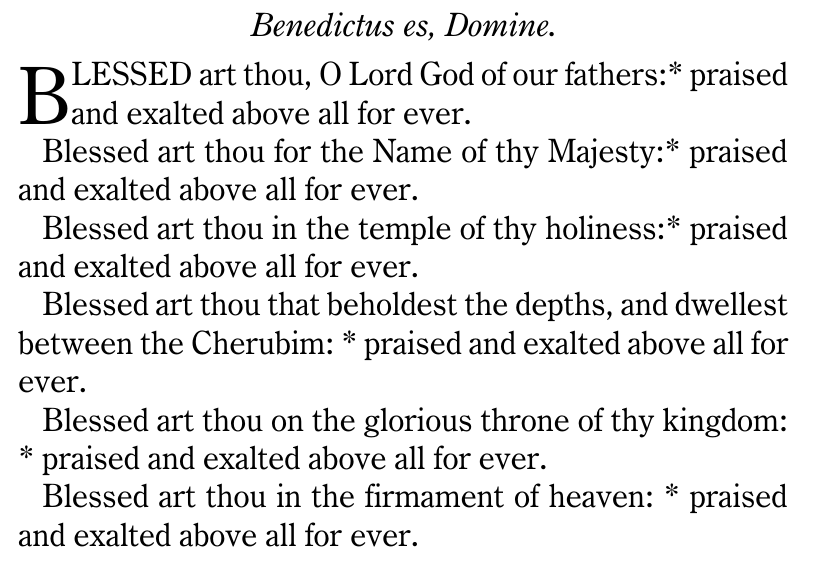
It was introduced with the 1928 BCP. Before that (and in the 1662 BCP) you only had two choices between the First and Second Lessons of Morning Prayer:
- Te Deum Laudamus, that magnificent hymn that many French martyrs sang to their beheading during the French Revolution. However, like the Gloria in Excelsis, it’s notoriously difficult.
- Benedicte, Omnia Opera, the deuterocanonical/apocryphal (take your pick) song of Shadrach, Mishach and Abed-Nego in Nebuchadnezzar’s fiery furnace. If that’s what they sang in the furnace, there’s no doubt that they had divine asbestos in their clothing: it’s very, very long.

With the Benedictus es, Domine, a shorter piece between the lessons was possible, and our youth choir took advantage of that.
Below is an actual proper Anglican performance of same, at St. John’s Church in Detroit.
It shares a common defect with many proper Anglican performances: the organ, the sole instrument allowed, gets progressively louder, drowning out the choir and making it impossible for the congregation to sing along. This was a fault with much of the worship I grew up with. Unfortunately, loud organs wouldn’t end with my years as an Episcopalian, and now loud organs are replaced with loud praise and worship teams, with the same result: inhibiting the congregation’s desire and ability to join in the worship.
-
Elevations on the effects which the Incarnate Word produces on men immediately after his Incarnation

These elevations concern Mary’s visitation to her cousin Elizabeth, who was pregnant with John the Baptist. It includes an exposition of Mary’s canticle the Magnificat, shown below. The elevations are as follows: Elevations on the effects which the Incarnate Word produces on men immediately after his Incarnation: 1, Mary goes to visit Saint Elizabeth. Elevations on […]
Elevations on the effects which the Incarnate Word produces on men immediately after his Incarnation -
The Reformed vs. Athanasian/Nicene Approach to God
An interesting comparison by Bobby Grow:
Scholastic Reformed theologians claim to be in line with Nicene theology proper. But when you read scholastic Reformed theology, particularly their confessions, what becomes immediately apparent is that scholastic Reformed theology operates out of the apophatic ‘negative’ and/or speculative tradition for thinking a doctrine of God (and Christ); whereas Nicene theology thinks from cataphatic ‘positive’ and/or revealed theology for thinking God. By way of prolegomena or theological methodology this places Niceno-Constantinopolitano theology at loggerheads with something like we see in the scholastically Reformed Westminster Confession of Faith (WCF).
First, the Reformed theologians aren’t the only ones working in an apophatic tradition. Moses Maimonides did likewise, and his contribution is certainly valued by Aquinas and myself.
Second, I am inclined to think that Grow is right on this point. As frequent visitors to this site will attest, I’m not much on Reformed theology in any form, and as the years pass I get progressively sourer on the subject. Pieces like this only justify my antipathy.
Third, I think it’s fair to say that Scholastic theology, of which I am an enthusiastic student, started to go downhill after Aquinas, which is the opposite of the narrative that, say, Francis Schaffer was so enamoured with. The idea of a “Reformed Scholasticism” is somewhere between an oxymoron and a sign of the decline that began years before Calvin and Luther.
Fourth, I wonder if this apophatic aspect of Reformed scholasticism made it easy for the Sydney Anglicans to come up with their lame idea of functional subordination in the Trinity without essential subordination. That’s just speculation on my part.
The one part I’m not so sure about is this:
But this is to our point: to think God from speculative philosophical notions, as the Arians and Homoiousions did, only leads to unbiblical conclusions, and thus grammar about who God is; indeed, it thinks of God in terms of whatness rather than whoness as a first-step. Athanasius, and the Nicene theology he helped develop, repudiated thinking God from Hellenic frames of reference, and instead allowed God’s Self-revelation in the Son, Jesus Christ, to shape the way he, and the other Nicenes, thought God.
As I’ve noted elsewhere, the whole Arian controversy ran in the context of Greek philosophy. Athanasius and his homoousion colleagues simply did a better job aligning it with the Scriptures. It was ultimately beyond the ken of Greek philosophy to explain essential subordination in the triune Godhead, but I think that problem can be solved.
-
Book Review: William Palmer Ladd’s Prayer Book Interleaves
Significant movements and trends in both history in general and the church in particular tend to be long term. That’s one reason why Evangelicals have been skunked by their opponents: the Evangelicals are in a hurry for the Lord’s return and their opponents are playing, more or less, the long game.
Such it is with liturgy. The fights we have today over Novus Ordo vs. TLM and that dreadful 1979 BCP vs. the rest (and that’s an oversimplification given Anglicanism’s complex structure) have been brewing for a century or more. You can even see that in the much-vaunted 1928 BCP, and the ink wasn’t even dry on the first printing when the “hankering for more” started.
A great deal of that hankering is expressed in this book, Prayer Book Interleaves by Dean William Palmer Ladd, Dean of the Berkeley Divinity School. The book is a posthumous compilation of the Dean’s articles, mostly written in the late 1930’s.
Ladd died 1 July 1941, just after Nazi Germany invaded the Soviet Union and five months before the U.S. would enter the war. The gathering storm, the rise of Adolf Hitler and the Nazis, and of course the spectre of Communism are a background for the work and give it a relevance for our time, since both of these movements–and many others–continue to challenge Christianity here and elsewhere.
So what is Ladd’s solution? Ladd himself was a part of what he and we call the Liturgical Movement, that movement that had its genesis in Roman Catholicism and which rumbled through the system until it burst into full view with Vatican II and the promulgation of the Novus Ordo Missae in 1970. It’s tempting to see the Episcopal Church as a remora on this shark, but Ladd certainly didn’t think so. Although he is aware of the differences in the challenges of each, he is also aware of the commonalities of them as well, although even he admits that the Cranmerian liturgy was, in reality, a first step in addressing the problems of the Roman liturgy.
His central thesis is that the Holy Communion should return as the normal service on Sunday. He expressed this belief as follows:
Each worshipper shared in the worship of the whole Catholic Church, earthly and heavenly. Brotherhood and loyalty, democracy and equality, were spiritual realities having a super-natural basis. The eucharistic fellowship excluded any distinction between aristocrats and slaves. It was not undermined by snobs and money-grubbers, our fifth column today. (p. 8)
I suggest that the essential on which we should concentrate today is the Holy Eucharist. (p.63)
The practice for the Eucharist to be the service on Sunday is of course normative in Roman Catholicism. He repeats this sentiment elsewhere, but his idea ignores the following:
- The church in his day and ours lacks the vetting process the early church had for admitting people into the Communion. They even dismissed the catechumens before that part of the service! I doubt this would go over very well now.
- Christianity today lacks the unity of opinion about what the Eucharist basically is, something I pointed out in Bill Clinton’s Eucharistic Theology: It Depends on What “Is” Is. Ladd tries his best to ignore or minimize this inconvenient truth, and that’s a typically Episcopal approach to a problem: paper over differences with either liturgical niceties or Anglican fudge. My high school chaplain attempted to do that on this issue and I was totally unconvinced. Subsequent history (to say nothing of this) has borne out the importance of this problem.
- His characterisation of the “snobs and money grubbers” as a “fifth column” denies the reality of the Episcopal Church’s elevated demographics: They’re not a fifth column, they’re front and centre! This problem would only get worse with the aftermath of World War II, and is something the ACNA needs to watch with C4SO.
- He objects to the fact that the Holy Communion’s lectionary readings have none of the Old Testament. Of course, that’s what Morning and Evening Prayer are all about, right? It’s also interesting that, while he was decrying the lack of OT readings for the Holy Communion, the editors of the 1928 BCP’s lectionary were toning down those they thought were in bad taste! The subsequent changes in the lectionary for the RCC, TEC and ACNA speak for themselves.
Some other interesting quotes are as follows:
From thinking of the failure of the Roman Church to cultivate a living liturgical tradition, my mind wandered off to the many ways in which that great communion is a reactionary and obscurantist influence in our modern life. I recalled its hostility to the child-labor amendment, its sinister censorship of the American press and movies, its bloody hand in Spain, its self-seeking political intrigue all over the world. And then in a more Christian mood I recalled the fact that such a repudiation of the gospel is by no means a monopoly of the Roman branch of the Church and that as a matter of fact again and again the Romans have fought for the underdog. How about our own shortcomings-our alliance with a favored social and economic class, our self-indulgent living, our cut-and-dried worship, our snobbishness, our racial intolerance, our neglect of Christian unity, our ineffective missionary effort, our bankrupt Christian education, our indifference to theological learning? Such thoughts were depressing. But suddenly the Easter Alleluia rang out-‘Praise ye the Lord!’ and the Tract -‘The truth of the Lord remaineth forever!’ Then a deacon came down from the altar, knelt before the archiepiscopal throne, and held out a book for the archbishop to kiss. It was the gospel book. That was a reassuring ceremony. Miserable sinners are we all-but still Christians-and in some degree we do pay allegiance to the risen Lord and his gospel. (pp. 59-60)
But what is unsatisfactory in this search for fundamentals is that when we find them they are not necessarily Christian. They underlie religion in general. And the very ideas mentioned above stand out, in fact, in that great revolution which is fundamentally religion and which is so much in all our minds today-Hitlerism. Fellowship? Yes, the fellowship of all Germans as against the world is both more evident and more effective than our Christian fellowship. Sacrifice? What sacrifices have not the German people made in the last ten years, and still are making for the sake of their Reich! Faith? Not the eucharistic faith in the risen Lord and in the power of the Holy Spirit, yet a faith that removes mountains. Sanctification of the material world? That is the meaning of ‘blood and soil.’ What is lacking is the Christian way of life. Hate, revenge, lying, ruthless cruelty, have taken the place of justice, truth, long-suffering, mercy, pity, peace, and love. Belief in God, but rejection of Christ. An altar, but no Christian gospel upon it. (p. 74)
Comparing the enthusiasm of the Nazis to the lack he sees in Christianity is similar to the comparison I made with the Communists, and frankly I didn’t get much of a response. But that leads me to my next quote…
These thoughts have come to me recently as I have been watching the antics of one of those crucifers of the familiar type who parade up the church alley with gauntleted hands, cross pressed against chin and nose, eyes peering into space, body stiffly leaping forward in a sort of goosestep at each beat of the music. I am hopeless of trying to open the eyes of the clergy to the absurdity and vulgarity of this performance, and to the discredit which it must bring on the Church in the eyes of people of good taste and reverent feeling. What can be done? (p. 106)
Had the Third Reich–to say nothing of the Soviets–not given goosestepping such a bad name, that’s exactly what we (youth choir and acolytes alike) would have done, especially when our organist struck up the 1940’s Hymnal’s #385. It definitely had a “Dr. Strangelove” feel to it. OTOH, while he continually decries stepping in time with the music, I have no idea what a reasonable alternative would be.
Such an ideal of worship characterizes many parts of our eucharistic service, notably the dialogue beginning ‘Lift up your hearts,’ which, since the earliest times, has inaugurated the solemn oblation and communion. But other parts of the service have a definitely individualistic character. In the Middle Ages, that ‘period of unexampled liturgical decay,’ as Father Gregory Dix calls it, people began to go to mass to get something out of it for themselves, or for their relatives and friends in purgatory. Our Prayer Book inherited this individualism. Cranmer prided himself that with the new service it would be ‘every man for himself.’ The confession is of that character; it is of individual, not corporate, sins. And when at the climax of the service the worshipper kneels at the altar to receive communion, he is turned back upon himself with the words ‘given for thee,’ ‘preserve thy soul,’ ‘Christ died for thee.’
Today this ‘save your soul’ approach to religion is completely discredited. It should be eliminated from the Eucharist. There should be intercessions, as the rubric allows, on subjects about which the whole congregation is, or ought to be, concerned, such as the parish and the community, missions and social justice. And in the political sphere we should supplement the antiquated petition that God may ‘direct and dispose the hearts of all Christian rulers’; the ‘rulers’ today are mostly infidels, and, even if our Christian President made himself a ‘ruler’ with Almighty God to direct his heart, it would not solve the greatest of our political problems. To omit the confession, as has already been suggested, would be a gain. (p. 110)
The “communal” nature of the Eucharist of the Liturgical Movement aficionado is the greatest weakness of the whole enterprise. He, like so many others, ignores the real lesson of the Wesleyan revival and works under the assumption that, if we renew the liturgy, the people will be renewed. What he cannot understand is that it isn’t an “either/or” proposition but a “both/and” proposition: the renewal of the liturgy and the renewal of the people must go together even if they are not the same, otherwise we do two things: we force people to choose between their eternal destiny and liturgical correctness, or we end up with a people who simply go through a new set of motions. That style of mind has made the last half century or more a difficult road for many of us.
I’d also make another comment about his disparaging comments re our rulers: he says elsewhere that “Only a few Christian rulers like Chiang Kai-Shek and some South American despots are left.” (p. 65) Those are interesting choices for a social justice person like Ladd, to say the least.
He spends a lot of time in reviewing changes for the 1928 BCP that I’m sure those who put together the 1979 BCP took those into consideration. Had he and his contemporaries taken into consideration the realities of the Christian life and not been so obsessed with their own idea the whole Liturgical Movement would have borne better fruit for Anglican and Catholic alike. It’s good, however, to let a proponent of the movement like him speak for himself in Prayer Book Interleaves by Dean William Palmer Ladd; it’s easier to see the strong and weak points of something that has impacted many of us.

Sailing the Last Voyage with Newton and Pascal
 Positive Infinity