-
Anglican Tidbit: Bookplate of Frederic S. Fleming, Rector of Trinity Wall Street
Below is an interesting artefact: the bookplate of the Rev. Frederic S. Fleming (1886-1956,) Rector of Trinity Wall Street from 1932 to 1951.
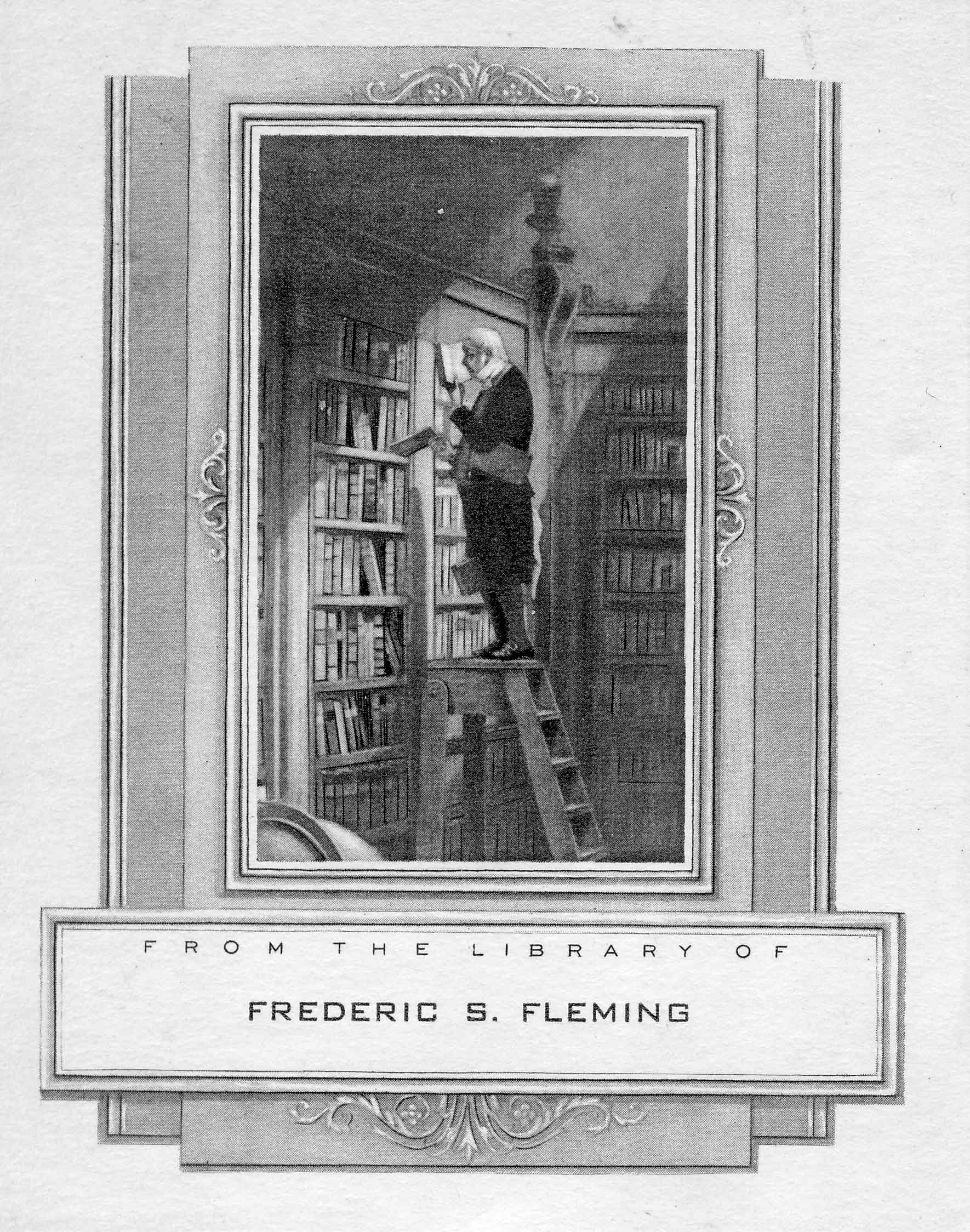
The book it came from was The Divine Liturgy by Herbert Luckock, which I reviewed here. Given his High Church inclination, I’m sure it was a favourite.
His signature in the book is here.
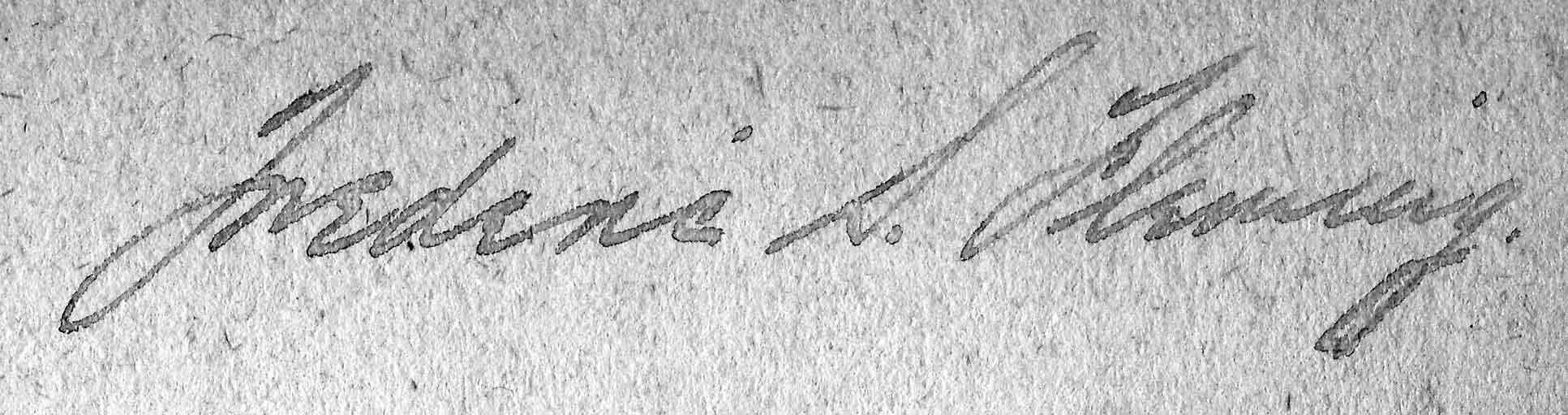
Like other Episcopal ministers, he started out in the corporate world, in his case Nabisco. He was elected to the episcopate but turned it down, preferring to be a rector. He was a member of many boards, some of them charitable institutions.
-
The Sad Case of Knoxville’s Catholic Bishop, Rick Stika
I went to Knoxville at Bishop Stika’s invitation. The Pillar reported last month that the Congregation for Bishops in Rome had received complaints about Stika’s leadership in the Knoxville diocese, and was considering initiating an apostolic visitation, or investigation, in the diocese.
The complaints, which came from both priests and laity in the diocese, focused on an investigation into sexual misconduct on the part of a diocesan seminarian. Priests alleged the bishop had an unusually close relationship to the seminarian, and had interfered with the investigation.
For me, this is more than passing interest: it was in this diocese (actually it was in the Nashville diocese at the time, the Knoxville diocese is fairly new) that I met my Waterloo with Roman Catholicism, and still have close friends there. I’ll make a few quotes from the excellent Pillar article and a few comments:
Several priests said they are concerned that a Vatican investigation won’t look seriously at the constellation of issues the diocese is facing, or the crisis of leadership they perceive. Several expressed concern that Cardinal Rigali, who has sometimes referred to Stika as a “son,” would use influence in Rome to protect the bishop. Many expressed skepticism that, without public accountability, the Church’s process for justice would actually work for them.
Some lay people told me the same thing. But others said something much simpler: With a diocese they believed to be in crisis, they just had no idea where to go. Or with whom to speak. Or how to get help — help they said was sorely needed — for their local Church.
This is a key issue for Ultramontane Roman Catholicism in general. When bad things happen, there are few places to turn because the famous Catholic penchant for subsidarity isn’t reflected in their own structure. The result is that bishops and parish priests can become “little Caesars” with limited accountability to those whom they’re supposedly serving–the people of God.
“What was sold was a $25 million cathedral and a $25 million campaign, and it was going to be paid for. Well, we all knew those were fantasy numbers to begin with. But nobody asked the right question,” one priest in a senior leadership position in the diocese told me.
“If you asked how much the cathedral cost — well, the cathedral cost between $35 and $36 million. I don’t doubt that. What did the project cost? Well, because they had to buy property, they had to do site work, none of that was in the initial proposal. So the bottom line is the project is a $42 million project.”
“The diocese only approved $25 million, but you ended up with a $42 million cathedral, which basically leaves you with $17 million to fund in a diocese. I mean we are not a rich diocese.”
East Tennessee in general isn’t a wealthy part of the country, although traditionally Roman Catholicism has had an above average income demographic in this area. But the gross overrun and inadequate planning reminds me of my own church’s disaster with its denominational office expansion. The big difference from a numbers standpoint is that Stika’s project was larger by a factor of five than ours. My guess is that he was trying to make a statement, but all he’s shown that, like my own church, he has champagne taste and beer pocketbook, and is no better a manager of funds than his non-Catholic counterparts. But anyone who has followed the Vatican’s own financial scandals over the years, complete with dead bodies, knows that.
Marcy Meldahl was the director of human resources, employment services, and benefits in the Knoxville diocese from 2004 until 2014…
Meldahl claimed: “The bishop said to trustees of that scholarship fund: ‘I’m going to take that money, put in an IOU, and that IOU will pay you greater interest than what you’re getting now.’ Well, the IOU is only good if there’s going to be money to pay it back.”
“And that’s the money that’s given to help pay tuition,” she said, “for people who can’t pay for Catholic education. And it’s given for that reason.”
Back in the early 1980’s, I was involved in a Catholic Charismatic prayer group. We were under a great deal of pressure, some of which was of our own making and some of which came from a Church which didn’t really care much for what we were doing. It was also the days of “if you want peace, work for justice,” the nuclear freeze, and other left-wing emphases which tended to deflect hierarchy and faithful alike from their relationship with God.
A major turning point for me took place on day when, while discussing things with one of our prayer group leaders, she mentioned that, because of the high tuition, she could not afford to send her eight children to Catholic school. So they went to public school.
That revelation was the beginning of the end of me as a Roman Catholic. I concluded that any church that was too bourgeois and self-satisfied not to subsidise its own needful children to attend the schools it wanted them to attend was too bourgeois to be an advocate for social justice. So I took my leave on a course that’s best encapsulated in The Preferential Option of the Poor.
Instead of being a refuge from Blaine Amendment type anti-Catholicism in public schools, Catholic schools around here have turned themselves into private schools for those wealthy enough to send their children there. Some dioceses actually step up to the plate and fix this problem, but Knoxville, because of the cathedral, is in no position to do so now, even if it wanted to on a large scale.
I hope that Stika’s difficulties can find a happy resolution, both for himself and especially for his diocese. But with Catholicism’s murky Ultramontane politics, I’m not holding my breath.
-
A Young Episcopalian Writes About Pentecost
My last year in Church School was in sixth grade, after which I “graduated,” first into youth choir and then as an acolyte. For that final year our teacher got the idea for us to put out a “newspaper” (the Jerusalem Daily News, obviously a take-off the Shiny Sheet) which might have been put out after the day of Pentecost, or Whitsunday. I got to write two of the articles and they looked like this:
New Sect Founded on Pentecost Day
At 3:00 this morning a sudden rush of “wind and fire” came upon the apostles of the late Jesus Christ and their guests. The early rumor was that the apostles and their guests were drunk, but Peter, one of the apostles, said that “they had been filled with the Holy Spirit.” The new sect was called the Christian Church, and its doctrine is the one set down by Jesus Christ.
Later in the day 3,000 people were baptized.
3,000 People Were Baptized
This afternoon 3,000 people were baptized, becoming members of the Christian Church.
These people vowed to follow the doctrine of the church, like to take communion and to give prayers.
After that the newly received people sold all their possessions and left the city.
Two years ago John the Baptist was doing a similar ceremony in the River Jordan before he was murdered.Some comments;
- I think they had me write this in two stages.
- The business of the “late Jesus Christ” was a journalistic adaptation (I’d hate to see what our media would put down these days.)
- The business of “3:00 this morning” showed how much I understood the watch system of the New Testament. If my parents taken a more proactive stance in my Christian education, I would have been informed that the Holy Spirit fell at 0900.
- The idea that the people “sold all their possessions and left the city” is entirely sensible in a wealthy place like Palm Beach.
- One of our Rector’s (Hunsdon Cary’s) favourite books to quote was Virginia Cary Hudson’s (relative?) O Ye Jigs and Juleps. In it she expresses the desire to visit the Holy Rollers, but her parents wouldn’t let her go. Little did I realize that I would end up in a Pentecostal church (and work for same for 13 1/2 years,) but God has a sense of humor.
-
Book Review: Ella Katharine Sanders’ Jacques Bénigne Bossuet: A Study
In an effort such as this blog to present Bossuet’s works in English, one thing that becomes clear is that resources about his life and works in English are rather sparse. As Sanders herself notes at the start of Jacques Bénigne Bossuet: A Study, “Yet in England, notwithstanding the widespread and increasing appreciation of French […]
Book Review: Ella Katharine Sanders’ Jacques Bénigne Bossuet: A Study -
Anglican Tidbit: A Bulletin from 1938
From time to time I’ll present what I call “Anglican Tidbits,” which are little things from the. Since North American Anglicanism has had an influx of people with little or no heritage in the Anglican world, I think it would be useful.
The first one is a bulletin from Trinity Episcopal Church in New Orleans, dated 30 October 1938. It is shown below.


Some interesting things about this are as follows:
- The Prayer Book is, of course, the 1928, put into use a decade earlier. The pagination reflects the 1936 reformatting of the Psalms, which is what we normally see in copies of the book.
- The Lectionary is the original one, not the 1945 version which most copies of the 1928 book contain. I discuss the difference between the two here.
- The hymnal was not the 1940, but the 1916, which can be found here.
- It’s worth noting that there is no Holy Communion service; it’s Morning Prayer and Evening Prayer.
- Evidently Trinity was high enough in the pecking order to have a Canon of the Ordinary to come deliver the sermon at the church.
This bulletin was preserved because my grandmother, Myrtle Warrington, was memorialising her mother, who had passed away recently. I think at least some of her brothers had been involved in the building of the church. The Rector, Robert Coupland, had married her and my grandfather in 1916.
-
The Baptists and WO: It Isn’t About Authority, Albert Mohler
Mohler opines in a lengthy piece on the subject:
In truth, the issue of women serving as pastors fuelled the Conservative Resurgence in the SBC. The question was instantly clarifying. The divide over women serving in the pastorate served as a signal of the deeper divide over the authority and interpretation of the Bible. Simply put, the only way to affirm women serving in the pastoral role is to reject the authority and sufficiency of biblical texts such as 1 Corinthians 14 and 1 Timothy 2. There is more to the picture, but not less. Furthermore, the Christian church in virtually every tradition through nearly two millennia in almost every place on earth has understood these texts clearly. In most churches around the world, there is no question about these texts even now. Furthermore, there is the testimony of God-given differences in the roles of men and women in the church and in the home throughout the Bible. The pattern of revealed truth is not hard to follow.
I was in the SBC when the Resurgence got rolling. Maybe it’s because I was an Episcopalian at one time, but I gave little thought to this issue. I always thought this was about the inerrancy of Scriptures regarding such things as eternal life, the Resurrection, and things like that. One very powerful memory from the era came in a facing pair of articles in the Baptist and Reflector. The conservative article came from Adrian Rodgers, who appealed to the authority of Scripture. The opposing one simply exhorted us to get with the program that existed at the time.
So, as Lenin would ask, what is to be done? The answer to that question is different in a Baptist context because their ecclesiology is different from just about everyone else.
To start with, the SBC cannot claim any magisterium because the whole concept is denied by their idea. Mohler’s recitation of the Baptist Faith and Message Statement is a little misleading because it does not reflect an authoritative interpretation of the Scriptures; it’s simply the statement of a consensus of a group of churches in a voluntary association. Baptist churches have traditionally denied that there is or should be an overchurch of any kind. That, however, precludes truly authoritative statements by the SBC, something I discuss in my 2007 piece Authority and Evangelical Churches, which also discusses the dicey concept of preachers in Baptist churches having real “authority” as well. (The creeping in of human authority in Baptist debate hasn’t done anything to move things forward.)
Because the local church is the supreme body in a Baptist association, it’s their job to set people forth in the ministry, and for other local churches to accept or reject their judgment. If one church sets a woman forth in the ministry, others are not bound to accept her or that ordination. In principle that’s the way that Baptist churches are supposed to work.
The problem is that, having eschewed real ecclesiastical authority, SBC churches at least have substituted rigid uniformity and conformity to keep everything and everyone in line. When that breaks things get really ugly, because, when combined with their defective view of justification and perseverance, Baptist church politics are the nastiest out there. But that insistence on uniformity has hampered their outreach outside the Scots-Irish realm, which is the main driver behind the Baptist decline in numbers.
Mohler mentions Saddleback Church’s ordination of women, and tries to issue a “call to arms” as follows:
Southern Baptists are now, yet again, at a moment of decision. This is no longer a point of tension and debate. These moves represent an attempt to redefine and reformulate the convictional foundation of Southern Baptist faith and cooperative ministry. The theological issues have not changed since the year 2000 when Southern Baptists spoke clearly and precisely in the Baptist Faith & Message. More importantly, the Holy Scriptures have not changed and cannot change.
What Mohler and others will not come out and say is that, if they’re really serious about this, there is only one recourse: to kick Saddleback Church and others who practice WO out of the SBC, the state convention and the local association. That’s what Texas Baptists started to do with Beverly Hills Baptist Church in the 1970’s over its acceptance of modern Pentecost; it never got beyond the local association, but the idea was there.
But that brings us to another point: past the local churches, the SBC is a complex of organisations including Lifeway (once called the Sunday School Board,) the International Mission Board (once called the Foreign Mission Board,) the North American Mission Board (once called the Home Mission Board) and of course the seminaries. Kicking out Saddleback Church would potentially create the publicity problems that the Episcopal Church tried to avoid by not disciplining James Pike in the 1960’s. But it would also deprive these institutions of the money and people flow that they currently enjoy, and given the times we live in that’s a scary proposition.
I am sure, however, that J.R. Graves, Ben Bogard, and my mother’s parents are laughing from eternity at the mess that the SBC has gotten itself into. The Landmark Baptists’ most significant issue–the one that inspired them to bolt from the SBC at the turn of the last century–wasn’t doctrinally or lifestyle based but on the SBC’s aforementioned overchurch institutions, which they considered to be contrary to Scripture. Without these institutions Baptists would have much more room to manoevre, but with them they are forced to “thread the needle” by continuing to support these institutions and maintain their desired doctrinal position.
And we all know what happens when we try that:
At this, Jesus said to his disciples: “I tell you that a rich man will find it hard to enter the Kingdom of Heaven! I say again, it is easier for a camel to get through a needle’s eye than for a rich man to enter the Kingdom of Heaven!” On hearing this, the disciples exclaimed in great astonishment: “Who then can possibly be saved?” But Jesus looked at them, and said: “With men this is impossible, but with God everything is possible.” Then Peter turned and said to Jesus: “But we–we left everything, and followed you; what, then, shall we have?” “I tell you,” answered Jesus, “that at the New Creation, ‘when the Son of Man takes his seat on his throne of glory,’ you who followed me shall be seated upon twelve thrones, as judges of the twelve tribes of Israel. Every one who has left houses, or brothers, or sisters, or father, or mother, or children, or land, on account of my Name, will receive many times as much, and will ‘gain Immortal Life.’ But many who are first now will then be last, and those who are last will be first. (Matthew 19:23-30 TCNT)
-
Renewing Your Faith: The Aftermath
In the last post, I gave a book review of Donald Connolly’s In a Holy Year, Renewing Your Faith: An Anthology of Spiritual Readings. I promised I’d give some life reflections on this, and this is the fulfilment of that promise. This book is more than just a book: the anthology compiler was my first parish priest as a Roman Catholic, and had an immense influence on my life going forward from my last year in prep school when I swam the Tiber.
Let’s start with the question I left hanging the last time: why did it take nearly forty years for me to read the book? By the time I first sat down with Fr. Connolly and discussed the possibility of me becoming Roman Catholic, I had already read Augustine’s City of God, which is ahead of where most prospective converts are. I had heard of The Imitation of Christ, so I read his other anthology A Voice for the Heart: The Imitation of Christ and An introduction to the Devout Life for all Christians. But a great deal of devotional literature in general and Catholic literature in particular struck me as what I mother would call “pap.” I guess I was afraid that I would encounter this here, and I was delving into the source material already. (I started with Aquinas’ Disputed Questions on Truth my freshman year in college, went on to the Summa the following.) Had I overcome my prejudices, Connolly’s book would have been nice prep for what I was delving into.
That, in turn, leads to the next question: why did I become Roman Catholic in the first place? Put in a Thomistic context, the answer is simple. What I really wanted was a comprehensive worldview which made the objective existence of God credible, and only Thomistic Catholicism provided that. My years as an Episcopalian demonstrated that “man does not live by Anglican Fudge alone.” Evangelicals were and are focused on the individual and his or her salvation, but if there’s one thing that was drilled into me from the start, it’s that it’s not all about you. Moreover both of the latter emphasise the subjective at the expense of the objective, which wasn’t what I was looking for.
I became Catholic in what were, for me, ideal circumstances: a parish backed (literally) by a major seminary, with a seminary academic as a pastor. Once I got through college–where the more subjective issues were dealt with–parish life was a dead end, Aquinas (or just about any other substantive Catholic thinker) were hard to find, and some kind of exit was inevitable.
Today I’m in the “mother church” of my Pentecostal denomination, and right across the street once again is the major seminary. But it’s different now. To start with, Pentecostals look at the reality of God differently. Their idea is simple: the God who did the great things in the Bible is the same God and does the same great things now. This is an improvement over the liberal (God never did any of this stuff) or the cessationist (God did it in the past, but he’s not doing it today.) But it still is more of an individually focused approach as opposed to a universally focused one.
Even with that, for all of the great things there are two factors that have blocked any kind of replication of my first experience as a Roman Catholic.
The first is that Pentecostal academics spend too much time trying to recreate on an academic level the experience they had on a decidedly non-academic one. Like the liberals, three sheets to the wind, who regaled Elaine Pagels with old Gospel songs, they try to recreate the experience in an alien environment. They also frequently conflate the spiritual experience with the cultural one. In the context of the Church of God this means Scots-Irish cultural hegemony, and right at the moment that’s the last thing we need.
The second is that (with exceptions) our ministers and academics alike have a “trade union” mentality, that thinking and speaking/preaching of the deeper things of God is “bargaining unit” work and that the laity (“scabs” in union terminology) don’t have any business delving into this kind of thing on any level. Sometimes it’s framed as a replication of Roman Catholicism’s view of the priesthood, but that’s too high of a view of what’s going on.
The lesson from all this is simple: when you start out in life, pack well for the journey, you never know when you’re going to end up in the wilderness. God provisioned me better than I knew, and for that I am thankful.
-
Renewing Your Faith: The Book Review
Ever wanted to spend time with someone who impacted your life but is now gone? As we see the annual odometer spin ever faster, that desire becomes more common. For Christians, we have the assurance that we will see those people who were likewise committed to Christ once again on the other side. But the time we really need their counsel is on this one.
Some leave a legacy of books, videos or other tangible expressions of self. I’ve commented before that one influential person who died too young was my first parish priest as a Roman Catholic, Donald Connolly. In addition to being a seminary academic (he taught homiletics) he left a few books. One of them was In a Holy Year, Renewing Your Faith: An Anthology of Spiritual Readings. I managed to read his abridgement of The Imitation of Christ in his A Voice for the Heart: The Imitation of Christ and An introduction to the Devout Life for all Christians, but never got to the first one (for reasons I’ll try to explain later.) It’s obviously not a substitute for one-on-one dialogue but the subjects he covers answer some questions and address some contemporary issues that Catholics face.
As explained in the introduction, the book was prepared for the Holy Year of 1974-5 proclaimed by Pope Paul VI. For the uninitiated, that technically means the liturgical year, which started on Advent I (1 December 1974) and ended on the Feast of Christ the King (23 November 1975,) although the Pope himself used the calendar year for the event. It is an anthology of twenty-four Catholic authors and works covering six topics:
- God
- The Bible
- Jesus
- Mary
- Sin, Angels and the After-Life
- Spiritual Helps
- The Catholic Apostolate
There was also an appendix on indulgences. Some Trads like to think that the indulgences were officially abolished with Vatican II, but such was not the case: on 29 June 1968 the Vatican issued a Handbook on Indulgences, and the Appendix is an “executive version” of same, complete with one simliar to this.
It is difficult to summarise the wide variety of authors that Connolly used, including Romano Guardini, Bruce Vawter, St. Louis de Montfort, Walter Farrell, and Columba Marmion. It’s worth noting that Connolly included both pre- and post-Vatican II authors. As he expressly states in the introduction:
No one has ever been able to explain the Faith so flawlessly and perfectly that an updating was not occasionally felicitous. Indeed, scholarship today advances so rapidly that one can find his work out of date almost before the manuscript ink is dry. True, many of the selections chosen for this Anthology were published before the world was given the insights of the Second Vatican Council. Yet, there are millions of souls who reached heaven long before the Second Vatican Council was convened…some of them by reading the books selected here.
The selections in this Anthology were deliberately chosen for their orthodoxy, their simplicity, and their ability to communicate. Some of the words used by the authors are now regarded as archaic; as, “Holy Ghost” instead of “Holy Spirit.” It was decided to leave things as they were originally printed, in the hope that moderns would come to realize that efforts were made in generations past, to propagate the Faith, and that not every work of spiritual value has to be mottled with quotations from one’s one immediate literary environment. It seems ironic that while people still revere Shakespeare, they often regard written classics on the spiritual life as irrelevant if the publication date is more than a year old. Love of God, dedication to Christ, and devoted loyalty to the teaching authority of the Church are not new concepts…
That leads to the first observation: unlike the gap between Lazarus and the rich man, the gap between pre- and post-Vatican II Catholicism is crossable and in fact products of both co-exist quite nicely in this book. That suggests that, even at this early date, a smooth transition between the two was envisioned and thought possible. The fact that the American church botched the transition is more of a reflection on the Americans (and others) than the Council.
The second is the strong underpinning of Thomas Aquinas’ thought in most of the works in the anthology. As long-term readers of this blog know, Thomism has been a major influence in my life, and this book confirms that my interest in the subject was encouraged by Connolly himself. (A good sample of that is here.) I think that Connolly felt that Thomism was the theological glue that would hold things together in the transition. Unfortunately his support base for that was thin. On the left, I had at least one priest who attacked the Aquinan view of things, and I doubt he was alone. On the other, I don’t see the Trads promoting it, preferring to content themselves with sacramentals, ceremonials and (like Mormons and many Evangelicals) a “waist-down” view of life. But there’s no doubt in my mind that, without Aquinas, Catholic theology and thought are doomed. To use a distinction that my Calculus I professor (who was a Catholic ex-seminarian) taught me, it may not be sufficient, but it’s necessary.
Much of the book is helpful to Catholic and non-Catholic like, more than one might think. Obviously the two parts of the book that are least to the taste of the non-Catholic are Mary and purgatory. His treatment of the Blessed Mother–chiefly drawn from St. Louis de Montfort–shows that it’s easy to go overboard on this, especially when she is referred to as co-Redemptrix. (This is impossible because Mary is entirely a created being, even the current Occupant of the Vatican understands that.) As far as purgatory is concerned, the problem with this was suggested from reading Aquinas himself: if disembodied creatures (such as angels and demons) move towards or away from God instantaneously, why should disembodied human souls after death do any differently? It’s worth noting that Connolly didn’t really put these front and centre in his own parish ministry; John Paul II made them (especially Mary) wedge issues to push unauthorised ecumenism out of the Church.
However, for me the least satisfying part of the book is the last one, on the Catholic Apostolate. Like Catholic theology in general, it’s long on how the lay Catholic should internalise the Christian life and short on how he or she should externalise it. Although the length and the scope of the book make a thorough treatment of the “how-to” aspect impossible, for someone who worked in the field of lay ministries this omission is very problematic. (And I might add that Roman Catholicism isn’t unique in its defective vision of the role of the laity.) This part also bares some of the problems with Catholic social teaching, which I discuss here.
As someone who has put out several books as a solo effort, I can sympathize with his struggles with getting things right, especially with the technology of the time and his probable lack of proofreaders. The book suffers from numerous spelling errors and other printing mistakes. Overall, however, it’s a good read, and frankly it’s aged well, even (or especially since) it does not reflect the “either-or” mentality in which our social media-driven world delights. With some cleaning up it would make a decent reprint. The book, unfortunately, doesn’t give any indications of the permissions he got from the various authors and publishers, and in some cases his references are so defective it’s hard to track down the original book from whence some of them came.
-
Elevations on the Conception of the Word
These elevations are primarily about the conception of Jesus Christ in Mary, and as such is an exposition of Bossuet’s idea of Mary’s role. But it’s also a theological tour de force: Bossuet turns his elevations on Our Lord’s human beginning into an emotional panegyric of his divine, eternal origin. One of the best examples […]
Elevations on the Conception of the Word
Sailing the Last Voyage with Newton and Pascal
 Positive Infinity