-
Dollar Hegemony is Truly Toast
A couple of weeks ago, I commented on the end of dollar hegemony. Many of you doubtless thought I was smoking crack.
On a recent visit to the New York area, I got to spend time with my cousin, who works in a Manhattan based hedge fund. Ignorant of the wide variety of cuisine the area has to offer, I asked her to pick the place so her family and ended up at a restaurant that calls itself ‘The Rupee Room.’ (This is excellent, by the way.)
When New York hedge fund managers take you to The Rupee Room, you can make book on it that dollar hegemony is toast.
-
Yet Another Baptismal Certificate, and Why I Blog About the Anglican/Episcopal World
I’ve been presenting a series of baptismal certificate forms (the back of them) on this site; this is another, from the mid-1960’s.
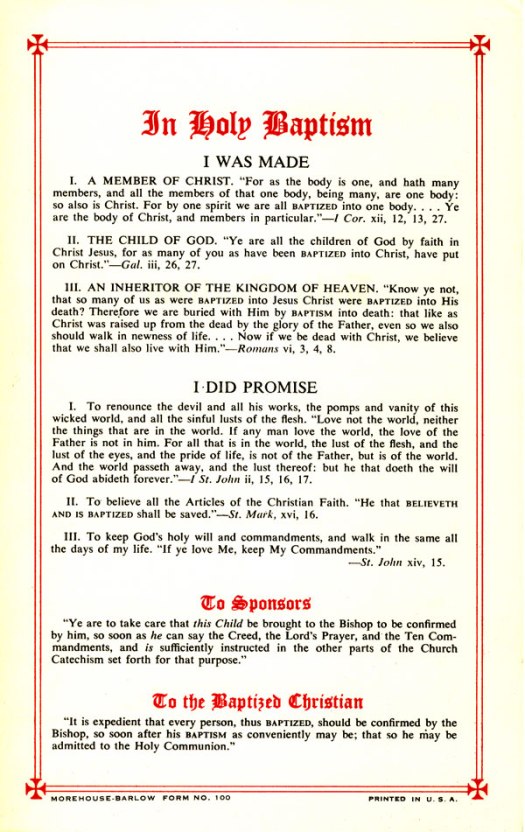
It is very similar to the one from the 1920’s except for the formatting.
All three baptismal certificates can be downloaded in one pdf file by clicking here.
Now that orthodox Anglicans can produce proper baptismal paperwork, they can turn their attention to other weighty matters, such as the proper training of acolytes and paying your youth choir (I hope you don’t imitate the latter!)
Why I Blog About the Anglican/Episcopal World
Many (including one of Titusonenine‘s elves) who visit this blog/website (it some of both) assume that, because I spend so much time commenting about the Anglican/Episcopal world, that I must be a part of it. The story about how I ended up doing this is has many twists and turns.
I was raised in the Episcopal Church, baptised and confirmed at Bethesda-by-the-Sea Episcopal Church in Palm Beach. (George Conger, the well known Anglican journalist, is also an alumnus of Bethesda.) In logical progression, I went to the Diocese of South Florida’s (now Southeast Florida) Episcopal prep school, St. Andrew’s. That experience made such an impact that I swam the Tiber as a Sixth Former, irritating the school’s liberal chaplain.
That decision in turn led me into the Charismatic Renewal, which in turn led to a long period of fluidity in my church commitment. That fluidity ended when I married my wife, who introduced me to the Church of God, a Pentecostal church. I joined that church and have been a member ever since.
In 1996, our family having divested itself of the business we were in, I was offered the position of Coordinator of Field Services for the Church of God Department of Lay Ministries, which I accepted. The Department, which is a denominational ministry, primarily oversees two ministries: men’s ministry and personal evangelism. A little over nine years later I was promoted to Ministries Coordinator, which is the #2 position in the Department.
The Church of God has more in common with its Anglican/Episcopal counterparts than one might think. To start with, COG has a centralised, episcopal form of government, more centralised in many ways than TEC. A corollary of that is that the local church property is held in trust for the general church, much as it is under the Dennis Canon in the TEC. The main difference between the two is that, while COG’s practice is more or less consistent from the the start of the denomination, TEC’s history is more complex and the practice of property holding amongst the parishes has more variations, which the Dennis Canon attempted to solve ex post facto. Finally, the Pentecostal view of Christianity, with its Wesleyan-Holiness antecedents, is directly descended from the Anglican one via its rejection of rigid Calvinistic perseverance by Article XVI.
But that certainly didn’t end my interest in the Anglican world. In 2003, I began to write/rewrite my fictional series The Island Chronicles. Much of the background research for that drew me into Anglican/Episcopal worship and polity, which in turn made me take a look at what was currenly going on there. At that time this meant the ordination of Vickie Gene Robinson, and websites such as Virtue Online (and later Titusonenine) showed me that there were orthodox Anglicans who were prepared to fight for what they believed in. I was impressed by this. I knew I wanted to do something to help. But what?
The first “what” was the publication of the online versions of the 1662 and 1928 Books of Common Prayer (I actually developed one for the fiction, too.) When this was first linked to in the spring of 2004, the site traffic suddenly jumped. I knew I had something of interest, so I started Anglican Corner and continued to keep up with events and add pieces on the subject. When I launched a blog in 2005, I was able to continue writing and commenting on the subject.
It’s easy for Evangelicals to be critical of those who chose to stay in TEC, although I made my choice a long time ago. But the longer I follow this ecclesiastical drama the more sympathetic I am with those who did, although I think their position is presently untenable. And following Anglican blogs and news services has been an education in other ways:
- Anglicans tend to deal with the more serious issues facing the church, not only concerning human sexuality but many others, and frequently with more depth than other non-Catholic sources do. Too many Evangelicals are focused on the immediate needs of their flock or are trying to reactivate revival as the primary method of growing the Gospel in society (it’s working in the Global South but not in North America) to step back and look at some of the long-term issues they’re facing.
- All of the new Anglican entities in North America (and soon coming to the UK?) need to be more entrepreneurial than they have been accustomed to be in the past. In this respect they have a lot to learn from their Evangelical (and particularly their Pentecostal) counterparts. This is because parishes joining these entities generally lose the property and certainly lose the “brand name” that still carries a lot of weight in the US in spite of the best efforts of reappraisers to screw it up.
- The invasion of the Global South provinces into the US is of great comfort to reasserting Anglicans, but it is of historical import to the rest of us. The centre of gravity of Christianity is shifting to the Third World, and the whole idea of third-world people overseeing upscale Anglicans in the US is definitely “ahead of the curve” for many people on both sides of the divide.
In 1968, the demonstrators in the streets of Chicago shouted, “The whole world’s watching!” That’s true of the Anglican/Episcopal world today. On the front lines of both a struggle for the soul of Christianity and the shifting realities of the religion’s demographic and ethnic make-up, Anglicans are in an exciting place. Maybe too exciting, but know and be sure that you are not alone.
Seeing, therefore, that there is on every side of us such a throng of witnesses, let us also lay aside everything that hinders us, and the sin that clings about us, and run with patient endurance the race that lies before us, our eyes fixed upon Jesus, the Leader and perfect Example of our faith, who, for the joy that lay before him, endured the cross, heedless of its shame, and now ‘has taken his seat at the right hand’ of the throne of God. Weigh well the example of him who had to endure such opposition from ‘men who were sinning against themselves,’ so that you should not grow weary or faint-hearted. (Hebrews 12:1-3)
That’s true both of the saints in heaven and many of the rest of us on earth.
I have spoken to you in this way, so that in me you may find peace. In the world you will find trouble; yet, take courage! I have conquered the world.” (John 16:33)
-
More on The Golden Compass
My piece late last week on The Golden Compass has generated some interesting comment, especially from Mark.
First, an interesting follow up. I spent some time talking about the reality of some people’s atheism. Atheist Theodore Dalrymple, writing on Sam Harris’ site, has also come to the conclusion that being a "pure" atheist is a trickier proposition than many of the unbelief’s proponents would have us…believe? So theists such as me aren’t the only ones to perceive the reality of this problem.
And that brings us to Mark. He makes the following statement:
You said it yourself, the god killed is called “Yahweh” Is that the name of the christian god? I think not.
Well, unless you are a Marcionite, Yahweh is certainly the name of the Christian God. It is based on Exodus 3:14-15, where God reveals his name to Moses. The fact that later Jewish and Christian tradition substitutes "Lord" or "Jehovah" for this out of respect for the divine name does not change this. Just take a look a the Jerusalem Bible (English and French) and see for yourself how the Old Testament reads when "Yahweh" is restored.
While we’re at it, let’s explore the issue of Marcion. He was a wealthy man from Pontus (on the Black Sea in what is now Turkey) in the second century A.D. He came up with a religion where the God of the Old and New Testaments were in fact different. According to Marcion, the Old Testament’s deity was incompetent and vindictive; the New Testament’s loving and kind. It would be interesting if Marcion had inspired some of Pullman’s thinking.
Then Mark asks the following question:
Besides, he ("Yahweh") gets killed, does that sound like something a divine being does?
No, it doesn’t, but that’s my point: you can’t be a real atheist and believe in the death of God at the same time. That’s the dilemma that both Dalrymple and I are looking at: people proclaim themselves atheists one minute and then turn around and say things that require the existence of God, at least at some point in time.
-
What Will American Christianity Do After the Baby Boomers?
What should churches start doing, given Wuthnow’s findings? My answer would be that they should redistribute energy. When we think of all the time and energy that churches invest in children, youth and their parents, and when we think of the high level of clout exercised by senior church members, it’s clear that young adults are being left out or left behind. This is tragic for the church because it means that the substantial investment in children and youth is too often allowed to be lost when they graduate high school. And it’s tragic for the young adults because during the years when they make their biggest life-shaping decisions, they’re outside the church’s circle of influence and support.
Read the entire Christian Century article.
I hope my pastor is listening. Is yours? I am confident that my fellow South Floridian Travis Johnson is, and you can visit his site and see how he’s doing it.
-
On the Value of American Missions, Dollar and Otherwise
Abu Daoud is absolutely correct in his response concerning the impact of the falling US Dollar on American missions:
The weakening dollar will have a bad effect on world missions, by the way. It will become more difficult for the US to send out as many missionaries as it does today.
Working as I do in close proximity with my church’s World Missions department, I am very aware of the problem here. The cost in US Dollars of supporting American missionaries has become much higher of late, especially in those regions (Europe and the UK, and to a lesser extent East Asia) where the dollar is further and further upside down relative to the local currency. It is a real problem for Americans called of God to go to these parts of the world.
However, this is as good of an opportunity as any to take issue with a message that many American mission agencies either state or imply, i.e., that, if the U.S. doesn’t send out missionaries, the Gospel will not be spread and the world will not be saved. While this may have had some validity in the past, this is not the case today. The Anglican Communion is an excellent example of this: with the widespread apostasy we see in North America and Europe, the “Global South” provinces are having a field day directing missions (if not necessarily financing them) toward the U.S.
Beyond that, many Christians from all parts of the world are answering the call to take the Gospel outside of the borders of their home countries. The Koreans which the Taliban kidnapped in Afghanistan are a recent, well-publicised example of this, but there are many others.
One example of such a missions effort took place several years ago when Gordon Robertson, Pat’s son, was in Manila, Philippines, managing CBN Asia. He got together with Miguel Alvarez, a Church of God missionary originally from Honduras, and together they began a school to train Asians to go to the neighbouring countries (Thailand, Malaysia, Cambodia, India, etc.) and do missions work. The Filipinos and other Asians are culturally closer to those they are ministering than Westerners, and bluntly they are far less expensive to send out then their Western counterparts. It was also a good example of cooperation between a parachurch ministry and a denomination, which we need to see more of. It took a little nerve, though; as Miguel explained to me, they started the school first and informed their respective organisations about it later.

Miguel Alvarez lining up his putt carefully at the LifeBuilders Golf Tournament. He shows equal care in his ministry, currently to the rapidly growing Hispanic population in the U.S. The U.S.’ role in world missions is important. One reason God has blessed this country in spite of the way it does is because Americans have generously supported missions work both with funds and personnel. But the Great Commission was for the entire church; as men and women from other countries go out to spread the Gospel and, yes, lay people give of what resources they have to support this, the blessings to everyone will increase.
-
The Bologna Club is On the Move Again
CNN’s piece that Some Christian Pastors Embrace Scientology is one of the sorriest developments I’ve witnessed in a long time.
Scientology and Christianity are diametrically opposed in their entire approach to life and eternity. The fact that Christian pastors are seeking help from Scientology is a sign of the desperation that too many Evangelicals (?) feel in their quest to move up in the world, a topic I dealt with in Taming the Rowdies.
 My opinion of Scientology is coloured by some family history. Lafayette Ron Hubbard, Scientology’s founder, was a cub reporter in the Washington, DC aviation scene of the 1930’s. My grandfather Chet (at the right) was a major figure in that scene; Hubbard did a story about him in the October 1933 issue of the Sportsman Pilot. I summarised my thoughts on the subject at the website dedicated to Chet’s aviation career, which bear repeating:
Our idea about Scientology boils down to what we feel are its two objectives:
- To be a religion that addresses the issue of modernity head-on.
- To do so in such a way as to generate maximum cash flow for its leadership.
Modernity is very much at the centre of this story, and its unleashing was a dangerous business for most of the twentieth century. Attempting to build a religion in that context is no safer of an enterprise than building a political system or an ideology. Hubbard added to it the element of fantasy, which is also a product of modernity. The ability of an individual, a political party or the state to build its power based on the projection of illusions was a well trodden path in the twentieth century. As for the cash flow aspect, the evidence suggests that this part can be called an unqualified success.
There are many sites that deal with Scientology on an adversarial basis, and the Scientologists are not afraid to use any means at their disposal to try to rid themselves of these. As a Christian, however, my view is different from many of Scientology’s opponents. True freedom is to be found in the saving, resurrection power of Jesus Christ, God’s son, not in Scientology and not in the Lodge which my grandfather was active in all of his adult life. That conclusion is in some measure the result of the legacy my grandfather left, but that’s another story altogether, and my purpose has been and is to be as complete and broad in my scope as I know how.
And I added the following:
Perhaps there is one place where L. Ron Hubbard assumed some of my grandfather’s legacy. Somewhere along the line he became the chairman of the "Bologna Club."
The "Flying Bologna Club" was the name given by correspondent Ernie Pyle to the lunchtime gathering of aviators at the old Washington-Hoover Airport. My grandfather was "Chairman" of that club. That airport, my grandfather and Hubbard himself are gone, but it’s obvious that the Bologna Club lives on to mislead Christian pastors–with sad eternal consequences.
-
The God-Hating Liberals and The Golden Compass
It looks like we’re "off to the races" again with the impending release of the anti-religious children’s film The Golden Compass. Based on the open atheist Philip Pullman’s books, the release is beginning to generate the predictable firestorm.
Unfortunately, as is the case with much anti-religious (usually anti-Christian, most of these people don’t have the guts to take on Islam) material these days, it’s a sad song we’ve been hearing for a long time.
In Pullman’s trilogy on which the movie is based, a pair named "Adam and Eve" end up killing a god named "Yahweh." But such a scenario begs many questions. Is he saying that God was once alive but now dead, as liberal "Christians" used to do in the 1960’s before they got run over in the stampede out of the church? Why does he give publicity to the creation story, one that evolutionistic atheists hate just about worse than anything else? Why can’t athetists write about the glorious world they’re supposed to be leading us to, rather than incessantly coming back to the theistic one they’re trying to destroy?
Looking for the answer takes me back to an episode on the 700 Club in the late 1970’s, when Pat Robertson was interviewing Richard Wurmbrand. He was the Romanian Anglican/Lutheran minister who spent many years in jail under Nicolae Ceauşescu’s communist regime. Later he founded the organisation that is now known at the Voice of the Martyrs. Well versed in Marxism, Wurmbrand made the statement that Karl Marx wasn’t a true atheist–he knew God existed, he just hated him. (That, BTW, is where the phrase "God-hating liberals" comes from.)
For anyone who knows anything about communism, that’s a pretty bold statement. Universal atheism was one of the fundamental objectives of the "dictatorship of the proletariat," where the "opiate of the people" would dissappear along with the state. In the end neither did. At the core of the problem is the simple fact that eternity is more hard-wired into human beings than atheists want to admit.
And that includes the atheists as well. They never seem to tire of pillorying Christianity. But, in doing so, are they admitting that they’re not real atheists? Surely they should have figured out by now that real Christians face an uphill battle in getting to positions of power and influence in Western societies, certainly in Europe and to a lesser extent in the U.S. But they keep on acting like they’re facing a firing squad from the nearest megachurch. Like Madeleine des Cieux’s miracles in the novel The Ten Weeks, the more attention the left-wing government paid to the miracles, the stupider it looked. In spending so much time attacking religion, the atheists only admit that a) they really hate a God they’re afraid exists more than deny his existence, and b) give backhanded credibility to Christians.
The danger for Christians–and it’s a real one–is that, in a country where Evangelicals work far too hard to be a part of society, Christian parents will take their children to see such a movie without realising the nature of its message. The campaign against the film may be lampooned by its critics, but it’s part and parcel with the system. After all, secularists, you weren’t hauling the few children you had to the Chronicles of Narnia, were you?

Sailing the Last Voyage with Newton and Pascal
 Positive Infinity