-
Fifty Years Ago, Swimming the Tiber Was Good. Now…
It’s that time of the decade again. As I noted ten years ago, fifty years ago today (on the Feast of Christ the King no less):
On a very nice South Florida November afternoon, I took my baby blue Pinto on the very short drive to St. Thomas More Parish and, with just me and Fr. Connolly there, I took the profession of faith as a Roman Catholic. These days, both churches like to do stuff like this in big public ceremonies but, as was the case with my baptism seven years before, it was in private.
It was the beginning of the spiritual adventure of a lifetime, starting with the intellectual part and going to the Newman Association, the Charismatic Renewal, and ultimately hitting the wall because of that renewal. It’s a move I have no regrets about making, even a half century.
But to do it now…things don’t look so hot, thanks in no small measure to the current Occupant of St. Peter’s see and the many who are like minded with him. My years as a Roman Catholic made me aware of the possibility of him and he hasn’t disappointed. It’s sad that the Church has missed the opportunity of real renewal, but it has, in the West at least and evidently in Latin America too. Most of the problem comes from the perceived need to preserve the institution at the expense of the spiritual well-being of the flock. That manifests itself in a number of ways. One of them is the uninspiring parish system, which is better designed to dispense sacraments than to create community. Another is the fear of being crushed by the culture, which is no different than the reverends pères Jesuites of old (and they are in the driver’s seat right at the moment.)
It’s sad that, in an age where many are looking for reliable, consistent authority, the Roman Catholic Church is so out to lunch, but here we are, and we need to make the best of it.
-
John Milton’s free speech crusade
For John Milton, death was not the end of his troubles. He spent his final years blind and disgraced, in continual fear of execution by the state. As…
John Milton’s free speech crusade -
J. Robert Ashcroft: Assemblies of God Pastor, Evangelist, Educator, College President — Flower Pentecostal Heritage Center

This Week in AG History — November 2, 1958 By Ruthie Edgerly ObergOriginally published on AG News, 03 November 2022 James Robert Ashcroft (1911-1995) served God, family, church, and community with unwavering integrity in every opportunity he was given. Known as a man of prayer, the Scriptures, and the Spirit, he served the Assemblies of […]
J. Robert Ashcroft: Assemblies of God Pastor, Evangelist, Educator, College President — Flower Pentecostal Heritage Center -
The tyranny of a Covid amnesty — UnHerd

I spent the last days of innocence before Trump and Brexit heavily pregnant. Like many first-time mums, I read a lot of pregnancy books, but the one I liked most was… 1,620 more words
The tyranny of a Covid amnesty — UnHerdOne thing that would come from this amnesty would be “forgiveness.” I’m not sure forgiveness means much in a post-Christian culture such as ours, but the real problem is that people don’t differentiate between the unforgivable and the inexcusable, something I discuss in my post The Important Difference Between Inexcusable and Unforgivable.
-
Book Review: “Who is My Neighbor? An Anthology in Natural Relations” — The North American Anglican
Who is My Neighbor? An Anthology in Natural Relations . By Thomas Achord & Darrell Dow. Self-published. 584 pages. $24.99. We live in an age where traditional and Christian morality are being eroded. Basic Christian teaching that permeates much of the history of Western Civilization is under attack. It is important when we see this…
Book Review: “Who is My Neighbor? An Anthology in Natural Relations” — The North American AnglicanI discussed this issue re the 1928 Book of Common Prayer in my recent post And Who Are Our Betters? A Sticking Point From the 1928 Book of Common Prayer. I showed then that the priorities of the 1928 BCP and Our Lord regarding who is our neighbor are not the same (and guess which one takes priority?) And I detect a drift towards the 1928 in this book review, that our first neighbors are those above us and those infamous “betters.”
The thing that American conservatives of all types have missed in the whole business of “betters” is that the events of the 1960’s and beyond were only a rejection of authority in appearance but not reality. The ultimate goal was to replace one set of authorities with another or, as Mao Tse-Tung would say, “one class overthrows another.” Unfortunately our revolution is not from the bottom but from the top; it involves the replacement of one elite with another, and not an improvement either.
Anglicanism, which is authoritarian by nature having a “chain of command” from the King or Queen downward, is at sea when the authorities are not univocal, which is a large part of the mess the Anglican/Episcopal world finds itself in.
One alternative from the Scots-Irish world is a clan family structure, as opposed to the authoritarian WASP model. It’s not an improvement for the advancement of society but, in times of uncertainty, it’s more durable. That was shown in the 1970’s. To move forward will take a different approach both from what we did in those days and what some of us are doing now in attempting to replicate the past.
-
And Who Are Our Betters? A Sticking Point From the 1928 Book of Common Prayer
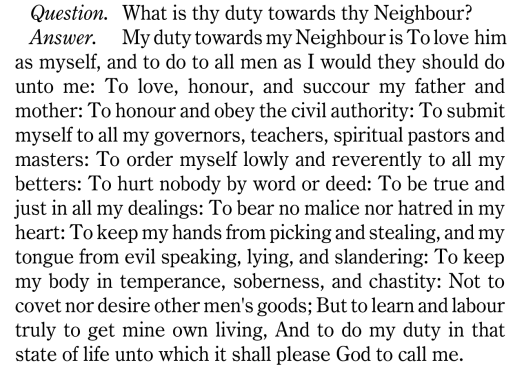
Most frequent visitors to this site know that I was raised on the 1928 Book of Common Prayer and in general am a fan of same. But it has issues, and a Twitter post pointed out one of them, which comes from the Catechism, in theory given to all those which seek to be confirmed. For those of you who know my opinion on playing up to our “betters,” this definitely got my attention.
As is the case with most things in the 1928 BCP, this relates to scripture. Let’s start with this:
Just then a Student of the Law came forward to test Jesus further. “Teacher,” he said, “what must I do if I am to ‘gain Immortal Life’?” “What is said in the Law?” answered Jesus. “What do you read there?” His reply was–“‘Thou shalt love the Lord thy God with all thy heart, and with all thy soul, and with all thy strength, and with all thy mind; and thy neighbor as thou dost thyself.’” “You have answered right,” said Jesus; “do that, and you shall live.” (Luke 10:25-28 TCNT)
But then the Student came up with this:
But the man, wanting to justify himself, said to Jesus: “And who is my neighbor?” (Luke 10:29 TCNT)
Both Our Lord and the catechism deal with this issue on two levels: who is my neighbour and what am I supposed to do? Concerning the former, those whom the catechism lists–parents, civil authorities, teachers, “spiritual pastors and masters,” and those infamous “betters”–are people we look up to in society. For the latter, the catechism deals with many things which are covered in the Ten Commandments, along with some which Our Lord included in his summation of the Law.
I’d like to concentrate on the former, because it is here that we see the greatest disconnect between what the catechism commanded us and what Our Lord himself had in mind to answer the student’s question:
To which Jesus replied: “A man was once going down from Jerusalem to Jericho when he fell into the hands of robbers, who stripped him of everything, and beat him, and went away leaving him half dead. As it chanced, a priest was going down by that road. He saw the man, but passed by on the opposite side. A Levite, too, did the same; he came up to the spot, but, when he saw the man, passed by on the opposite side. But a Samaritan, traveling that way, came upon the man, and, when he saw him, he was moved with compassion. He went to him and bound up his wounds, dressing them with oil and wine, and then put him on his own mule, and brought him to an inn, and took care of him. The next day he took out four shillings and gave them to the inn-keeper. ‘Take care of him,’ he said, ‘and whatever more you may spend I will myself repay you on my way back.’ Now which, do you think, of these three men,” asked Jesus, “proved himself a neighbor to the man who fell into the robbers’ hands?” “The one that took pity on him,” was the answer; on which Jesus said: “Go and do the same yourself.” (Luke 10:30-37 TCNT)
While the catechism had in mind for us to look upward to view our neighbors, Our Lord has us to look outward and downward.
The problem with that is that the Episcopal Church, then and now, is the church of the economically privileged, filled with people who have little contact with those who are not (and who are as unprepared to deal with them as the priests and the Levites of the parable.) This simple fact has eluded the church’s social justice warriors for the last half century, and things have only gotten worse now that class is banished from the conversation. The catechism, in addition to Anglicanism’s obsession with authority civil and ecclesiastical, reflects the common experience of many Episcopalians: look upward for contact and inspiration.
The student of the law asked Jesus the question: who is my neighbour? The catechism begs the question: who are our betters? Today we’re supposed to be living in a flattened, egalitarian world. And yet people purport themselves as our “betters” to be given a deference which would make the catechists of yore blush. They have their PhD’s (and EdD’s, such as Jill Biden,) they have their positions, they virtue signal the right things, etc. We should order ourselves lowly and reverently to them, just like it says above. That’s the message we’re constantly fed, and anything contrary is scorned and, just to make sure, blocked.
Unfortunately that kind of deference isn’t restricted to either a certain part of the political spectrum or even the Anglican/Episcopal world. In the Evangelical world, after a half century of separation from the Fundamentalist/Modernist controversy and (in the South at least) a deep distrust for those “above” them, we have the volte face of the “big bucks” lording over our churches, their grip only ending with death (and in churches with endowments, not even then.) We have opportunists who bear the name of Christ using their high position in the government to influence the church’s response to COVID, and getting a fawning following. We see an entire movement turning itself into a “success method” when its institutions and basic theology are singularly unsuited for the task.
The 1979 BCP completely rewrote the instruction of the Christian faith, but its left-leaning leadership expected the same deference and obedience from its parishioners as the catechism of old demanded. When they didn’t get it, they decried the renegades as schismatics with litigation following, and do the former up until this day.
The day we put God’s authority first and that of our “betters” down the line is the day we will truly be able to reach out to our neighbours–all of them.
-
Scottish nationalism is fuelled by resentment — UnHerd

Forget the Hogwarts Express. Three times a year, I get on a train at London Kings Cross and make a physics-defying journey towards Montrose in Angus, the Scottish town where I lived for the first 17 years of my life. 1,418 more words
Scottish nationalism is fuelled by resentment — UnHerdResentment is just about the only thing that really resonates in Celtic societies, something I pointed out in my piece Elizabeth Warren and the Resentful Scots-Irish. It led the Irish to independence in the 1920’s only to fall to dominance to the EU one hundred years later. It is stuff like this why I have given up on Celtic independence on either side of the Atlantic.
Sailing the Last Voyage with Newton and Pascal
 Positive Infinity