-
Challenges Infinity, and is Soon Gone: The Death of Tony Clarke
Back in November, I posted a brief narrative piece from the Moody Blues’ album Days of Future Passed, along with some thoughts on the album’s New Age underpinnings and its influence on me and on my novel The Ten Weeks.
A snatch of that narrative piece is a good way to note the sad passing of the album’s producer, Tony Clarke:
The record producer Tony Clarke was one of the architects of symphonic “prog rock” through his work with the Moody Blues. His production on the group’s album, Days of Future Passed (1967), and its hit single, Nights in White Satin, blended the sounds of an electric rock band with a symphony orchestra and came to be seen as a hugely influential landmark. He went on to work with the group on six more albums, helping them to become one of the most commercially successful bands of the era.

-
Checking for Nitrogen Dioxide in Traffic
The Obama administration set stricter limits on the amount of nitrogen dioxide in the air for short periods of time along busy roads and is requiring states to install monitoring equipment in big urban areas in an effort to crack down on pollution during periods of high traffic.
Vehicles are a major source of nitrogen dioxide, which can cause respiratory problems.
The Environmental Protection Agency issued the new standard Monday, seven months after first proposing new short-term limits. Businesses said the new standard is too strict while environmentalists said it didn’t go far enough. The EPA set the acceptable amount of nitrogen dioxide in the atmosphere at 100 parts per billion over any hour-long period. The EPA last year proposed a limit of as little as 80 parts per billion.
It has been the long-term objective of the left to severely curtail the use of automobiles for commuting. Unable to do the obvious (raise the petrol prices, as they do in Europe) they have resorted to other rather ham-handed and restrictive methods to achieve this: CAFE standards, emissions testing in “non-compliant” urban areas, and other things to make auto travel as much of an expensive pain as possible.
This simply adds to the roster. Nitrogen dioxide emissions, as the article points out, have been regulated since the early 1970’s, and every auto sold in the U.S. has provisions to reduce these emissions. To add this is simply a way to force cities to reduce commuting traffic during “rush hour.” There are only two practical ways to make this stick: force people into hybrids (which cut the engine off when sitting) or make them stay at home. (They could stagger people’s hours, but that’s an idea that hasn’t quite caught fire.)
It’s interesting to note that, when the EPA first started to regulate NOx emissions in the U.S., the first response of the auto makers was to cut down the compression ratio of car engines. As anyone with a background in thermodynamics knows, doing that reduces the efficiency of the engine, which increases fuel consumption, which increases the emission of–you guessed it–carbon dioxide, the greenhouse gas!
There’s no winning this game under the present rules of engagement.
-
We Already Have a Feminised Church
I see that The Times’ Ruth Gledhill is on the trail of this issue:
The charity is in the process of doing research into why men don’t come to church, and their questionnaire makes, for this woman anway, pretty reading. Read on for some of the reasons they suggest why real men might not like going to church.
Being involved with a denominational men’s ministry, I think I know a few things about this. Most of what she brings up in the article were dealt with in (and the questionnaire may be inspired by) David Murrow’s book Why Men Hate Going to Church, which I reviewed here. But I do have some additional thoughts on this subject.
- The difficulty of the “vicar wearing a dress” is hilarious if you understand the historical background behind it. In spite of the “Bible teaches that men wear pants” mentality, in both Old and New Testament times everybody wore robes, or a “dress” if you please. (The Chinese even reversed dresses and trousers until we came along and messed them up.) Trousers were introduced into the Roman world by the barbarian tribes which invaded it; the vestments of Anglican and Catholic alike are descendants of the robes worn by Late Roman imperial officials. But that leads to the next problem…
- Too much of the “re-masculinisation” of the church in the U.S. is made to depend upon the imposition of the rough, rural Scots-Irish culture as the “real man” culture. That will not fly in this century. There are other ways to express masculinity, but in the U.S. at least the structure of Evangelical churches mitigates against real alternatives, for the moment.
- It’s not really addressed in the articles linked to, but since I’m on the subject I’d like to address another issue: the idea that women ministers will feminise the church. I hate to say the obvious, but in Evangelical churches we have an overwhelmingly male ministry and still have a feminised church. As counterintuitive as Evangelical churches can be, perhaps the ascendancy of female ministers is a great opportunity for really meaningful men’s ministry!
-
Wind Can Power 20% of Eastern U.S.. But Would They Let It?
Reuters assures us this is so:
Wind energy could generate 20 percent of the electricity needed by households and businesses in the eastern half of the United States by 2024, but it would require up to $90 billion in investment, according to a government report released on Wednesday.
For the 20 percent wind scenario to work, billions must be spent on installing wind towers on land and sea and about 22,000 miles of new high-tech power lines to carry the electricity to cities, according to the study from the Energy Department’s National Renewable Energy Laboratory.
“Twenty percent wind is an ambitious goal,” said David Corbus, the project manager for the study. “We can bring more wind power online, but if we don’t have the proper infrastructure to move that power around, it’s like buying a hybrid car and leaving it in the garage,”
But the article itself alludes to the tricky part: would people allow the infrastructure, both the wind generators and power transmission lines, to be built?
And, more significantly from a political standpoint, would the “scientific left” get behind it? If their behaviour from the 1960’s onward is any indication (remember nuclear power? or the opposition to the Martha’s Vineyard wind generators?) they’ll fight it tooth and nail. They’ll do it in spite of their commitment to global warming as an indisputable scientific fact. And that’s a big reason why I don’t think that the left, for all of their “belief in evolution” can claim to be either scientific or rational.
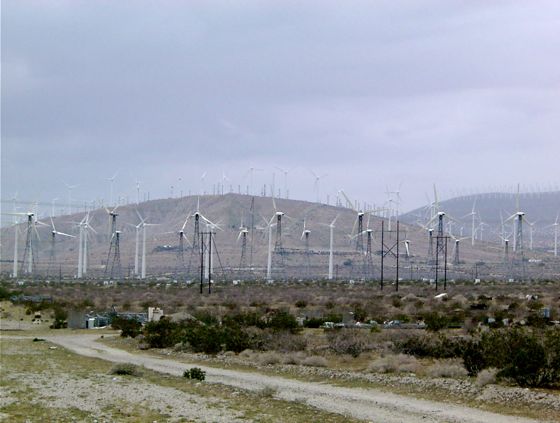
To end things on a more upbeat note, let me present a few pictures from the wind generator farm near Palm Springs, CA, taken in 2004.


-
Choose Life
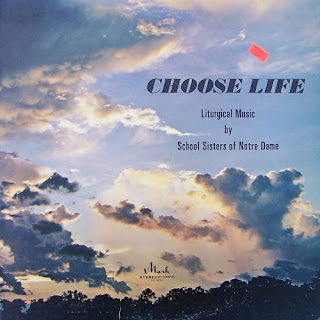 Since this is the day we’re supposed to think about these things, I’m going to feature an album from The Ancient Star-Song that’s a favourite of mine: Choose Life, from the School Sisters of Notre Dame (in Mankato, MN.)
Since the album dates from 1976, I would think that, when they recorded the title track (which you can download here,) they were thinking about Roe v. Wade.
The thing that separates this album from a lot of the Catholic music of the era is the quality and complexity of the vocal arrangements.
-
Strange Bedfellows: Liberals and Muslims
On the first day of this decade, one Muslim extremist broke into the apartment of Danish political cartoonist Kurt Westergaard, whose “Muhammad-in-a-bomb” cartoon’s publication in Jyllands-Posten ignited another round of rage in the Islamic world. Westergaard joins Salman Rushdie, Geert Wilders and others who are forced to live underground because they have drawn the ire of at least part of the Muslim world.
As Bruce Bawer in City Journal notes, across the Skagerrak in Norway, long-time women’s rights activist Hege Storhaug has suffered a home invasion of her own. Three years to the day before Westergaard retreated to his panic room, one or more people burst into her apartment, beat her unconscious and left her in a pool of her own blood.
Muslims on the prowl again? Probably not. In this case, Hege’s main opponents were a combination of leftists in both the Norwegian media and the political activist community who were incensed by her 2006 book But the Greatest of All Is Freedom: On the Consequences of Immigration. In response to this they launched a campaign to demonise her as a racist and Islamophobe and, following the play-book they ascribe to their opponents, hate speech led to violence.
Islamophobe? Why should the left care if anyone hates Islam or not? They certainly don’t care if people hate Christians. But Islam, if it succeeds, will be the end of much of what leftists hold to be “beautiful and good.” That includes but is not limited to their sexual agenda. Homosexuals and those who engage in sexual activity outside of marriage—especially women—will find themselves subject to capital punishment if sharia is implemented, a frequent goal of Muslim groups.
And yet we in the West have been treated to this strange pas-de-deux between leftists and Muslims which has complicated our efforts to deal with those followers of the Prophet who use terrorism to achieve their aims. Leftists have pursued this agenda consistently, especially in the last decade. London Mayor Ken Livingstone thought nothing of displacing the Kingsway International Christian Centre while making way for the largest mosque in Europe near the 2012 Olympic venue. The Anglican/Episcopal world has been regaled with the strange relationship between Episcopal Bishop of Washington (DC) John Chane and Iranian President Mahmoud Ahmadinejad. While promoting the complete acceptance of homosexuality in the life of the Episcopal Church, Chane has cultivated his friendship with a man whose regime hangs homosexuals from truck cranes. Sometimes things leave the realm of reality completely. New York’s Metropolitan Museum of Art recently moved to eliminate images of Muhammad from its Islamic Art Gallery (these were done many years ago, before the absolute ban on these images went in to effect.) They are even changing the name of the Gallery to that of art from “Arab Lands, Turkey, Iran, Central Asia and Later South Asia.” Their solicitousness for Muslim sensibilities is so divorced from reality that Islamic arts’ export Kishwar Rizvi characterised the name change as “a shame” and misleading.
Examples such as these abound. But how to explain them? Politics makes for strange bedfellows, but this one stretches credulity. From the Islamic viewpoint, the relationship is fantastic; it has given Islam credibility in the West it would not otherwise have. But how can the “multicultural” left justify it? Let us look at four aspects: a) the shared assumption between the left and Islam, b) “millet” or “identity” politics, c) the left’s myopic view of Islam and d) hedging their bets in the event of an adverse result.
The Shared Assumption of the Left and Islam
With all of the significant differences between Western liberalism and Islam, one important similarity stands out: the goal of both is implementation and enforcement of their respective agendas by the state. In that respect the two sides are alike and can, if not agree, understand each other.
With Islam, the situation is fairly simple. Islam is an idea where religion and politics not only go together, they are a unity. The ultimate goal is the establishment worldwide of the dar-al-Islam, under sharia, lead by the Caliph, who is at once a religious and secular leader. The major change in recent times is that Muslims are becoming more proactive in the achievement of this goal, as opposed to the fatalism of the past. Both the nation states that are especially active in forwarding the agenda (Iran and Saudi Arabia) and the non-governmental organisations formed along the way (al-Qaeda, Hezbollah, Hamas, etc.) are transitional in the achievement of the objective. The major complication is that there is more than one Muslim idea out there as to who amongst these “transitionals” ends up actually leading the caliphate (the Sunni-Shi’a divide is the most prominent of these divisions.)
The left, by and large, is a statist movement. Their goals are ultimately achieved through supra-national organisations, the EU currently being the most successful. (The UN is somewhat more complicated because of the presence of Third World countries in the General Assembly, which have the bad taste sometimes to express their own views rather than those of their liberal patrons.) Nation states and NGO’s are their transitional organisations, especially the former, who have the power to tax. They furnish employment for their advocates and dispense patronage for their client groups. Their ability to promulgate laws is, for them, the preferred method of defining morality. If it’s legal, for the left, it’s moral, and illegal is immoral. The complicating factor, as with Islam, is how to deal with the “lower level” divisions when things finally coalesce.
Thus we have two sides whose style of mind, with distortions, are mirror images of each other. Neither of them have any use for Christianity, who proclaims a kingdom beyond this world, a purpose for life beyond politics and power, and whose logic and MO frequently baffle both.
“Millet” or “Identity” Politics
Students of Ottoman history are familiar with the millet system. Certain religious groups, especially Christian ones, were allowed to practice their religion if they lived in an isolated society, a “millet.” Their community leaders were accountable for their actions and held authority in the group. Christianity went on for centuries in the Middle East in this way, only to be chased away in recent times by Islamic extremists practising religious cleansing.
So why did the Ottomans, the successful leaders of Islam for more than four centuries, allow these people in their midst? Because they were useful to them! They were a reliable counterweight to Islamic groups, many of which were always conspiring against Ottoman rule. As long as they served the purpose of the Ottoman state, they were allowed to remain.
To a large extent leftists, although they preach equality, are in reality practising millet (or in a more contemporary expression identity) politics. One only needs to look at the Democratic Party in the US to see this in action. They are in reality a coalition: blacks, Hispanics, “women,” LGBT people, etc.. If one’s opponents make strategic mistakes (such as the Republicans’ stand on illegal immigration) then keeping such a coalition together is all the simpler. Each community has its leadership which demands and receives patronage for themselves and their group. Those who would breach this convention and look elsewhere for inspiration (like Clarence Thomas) are punished. The left sees Muslims as another identity group to be added to their arsenal, ready to receive the same kind of patronage as the others. Additionally the left sees Islam as a counterweight to Christianity, its usual opponent for the last three centuries.
The Myopia of the Left
It should be obvious from the above that the left’s primary challenge is to keep all of the groups that support them in their camp, as opposed to either leaving the fold or overpowering the rest. So far they have been reasonably successful in this endeavour. Based on past performance, the left proceeds with the idea that they can both use the Muslim community as a part of their power base while at the same time containing their higher ambitions, as they have done with other groups.
That expectation is buttressed by the idea that Islam, in their view, cannot win against an “enlightened,” secular West. Such as view has more than a tinge of racism attached to it, since most Muslims do not have European ethnic backgrounds. It’s a supremely ethnocentric view, but also overlooks a simple fact: if a weapon of mass destruction is properly built and operational, it doesn’t matter whether the man or woman who pushes the button or sets the timer believes in Western civilisation or not. Recent history, especially in Europe, also suggests that, when Muslims act in concert, they are capable of blunting the rule of law and imposing their idea on at least the proportion of the population adjacent to them.
Hedging Their Bets
It’s probable that at least some on the left have considered the possibility of the failure of their political scheme. And that leads to another aspect of the leftist-Muslim entente: the idea that the left, realising their own weakness, is going along with Islam’s demands in the hope that, if Islam predominates, they can become a protected millet within the scheme of things. This turn of events is most likely to first come to pass in Europe.
Unfortunately such attempts to curry favour (or use others for one’s own advantage) can backfire, and do so tragically. One of the best examples of this comes from post-Roman Britain. Having cast off imperial rule, the native rulers found themselves saddled with the task of defending their part of the island on their own. They, convinced by Vortingern, brought in the Saxons to help defend against barbarian attacks from the Continent. This was good Roman practice; however, this time, the results went an entirely different direction, as the Saxons turned on their Briton masters and began their own conquest of England.
Experience teaches that Islam, once the controlling factor in a country, will move to impose sharia on the population and do so without exception. Although the Ottomans were probably the most able rulers the Islamic world has ever known, their system of encapsulating and using non-Islamic groups to their own advantage is going out of fashion, replaced by the religious cleansing we see all too often in the Middle East today.
So What’s a Christian To Do?
This strange, symbiotic relationship between the left and Islam leaves Christianity in a quandary. How best to deal with it? What is our future in the face of two such powerful and antipathetic groups? There are three possibilities.
The first is to go on fighting what is, in effect, a two-front war against these groups on a legal and political basis. In my opinion, such a conflict, waged in a purely political and legal environment, is not winnable. Christianity in the West will continue to find itself caught in the middle, and ultimately share the fate of old Poland, partitioned and eliminated.
The second is to attempt an alliance with one or more elements on one side or the other. Islam, with its shared aversion for Western mores, is a logical partner. But there is too much bad history between Islam and Christianity for this to be viable on a consistent basis, and in any event such a pairing suffers from the same problems that the Islamic-leftist relationship does, especially when it comes to answering the question, “Who wins?”
Looking in the other direction has possibilities as well. Although the multiculturalist leadership will brook no opposition to their idea, some of the followers are having second thoughts. For example, Dutch homosexuals, swept from the streets of Amsterdam by Muslim thugs, are largely voting towards the right. The Creteil Bebel soccer league business underscores the antipathy between Islam and the LGBT community. Ken Livingstone lost his last re-election bid as Mayor of London. For this to work, however, will require a more libertarian view of the role of the state on both sides, and particularly in the US that doesn’t look forthcoming.
The third possibility is this: Christians should be…Christians. Americans are notorious for projecting their “God and country” ideal back into the New Testament and its teachings on our relationship with government. But the truth is that the church came into a world driven by patronage from top to bottom, cruel in dealing with opponents (the Jews and Britons took the worst of Roman power during the first century) and without a really good way for most people to redress their grievances or impact state policy. Nevertheless, the church grew until it achieved what Michael Walsh referred to as “the triumph of the meek” largely by caring for those around it and pointing them to a kingdom that really was the way their Saviour described it:
“My kingly power,” replied Jesus, “is not due to this world. If it had been so, my servants would be doing their utmost to prevent my being given up to the Jews; but my kingly power is not from the world.” (John 18:36)
Is ours any different?
Sailing the Last Voyage with Newton and Pascal
 Positive Infinity