-
Prayer Walking — Northern Plains Anglican
-
Break the Church? What Choice Did We Have?
A priest I know wrote many years ago (and I paraphrase here), “There are two cardinal rules: You don’t change the faith, and you don’t break the church.” The Episcopal Church, in redefining marriage, has changed the faith. Those who departed to form the ACNA have broken the church. Both have grieved the Holy Spirit, and undermined the witness of the gospel. Two decades on, this is the sad legacy of 2003.
His account of the events that led up to the formation of the ACNA, the expensive and torturous (and unnecessary) litigation over the property is an interesting one, but I think it leaves out a few things.
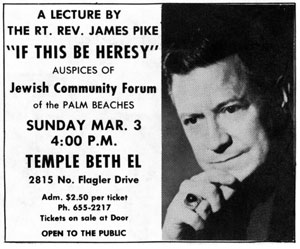
The first one is that what happened to the Episcopal Church long antedates the crisis detonated by V. Gene Robinson in 2003. It goes back to at least the 1960’s and the church’s failure to deal with serious problems such as James Pike. As I noted in this piece, the Episcopal Church blinked because it was more concerned about its image than in defending the faith that was entrusted to it. And that was in the 1960’s.
After all that–the erosion of belief in the objective reality of God and the Scriptures, WO, and last but not least that dreadful 1979 BCP–things settled down in an Episcopal Church that had already shrunk from its 1960’s high water mark. Martins, by his own admission, says that “While there were many openly gay and lesbian priests in the Episcopal Church by 2003 (though not without significant controversy from the 1970s to the 1990s), no bishop had been so open when elected.” Why he wouldn’t expect the next stop to be taken–and succeed–is hard to understand. But succeed it did.
I thought at the time–and still do–that it’s a sad commentary on a the Episcopal Church that had been on the track as long as it has–and longer than people like Martins cared to admit–had so little substantive pushback, either by those who left or those who stayed, until 2003. To some extent how far to port that things were in the Episcopal Church depended upon where you were and at what level you operated. Parishes went on as they were for years (a few still are) unbothered about what was going on “upstairs.”
But to say that the people who ultimately formed the ACNA–to say nothing of other groups or even the Continuing Churches which barely made a dent in the 1970’s–were guilty of “breaking the church” is a stretch. There were those who were moving in for vainglory or a purple shirt. As Greg Griffith noted nine years ago when he and his family swam the Tiber:
…the promise of the orthodox Anglican movement outside of The Episcopal Church never materialized either. Populated as that movement is by many good people, it has the institutional feeling of something held together by duct tape and baling wire. It is beset by infighting and consecration fever, and in several of its highest leadership positions are people of atrocious judgement and character.
But that’s the nature of church politics. The Episcopal Church ultimately broke itself. To blame those who departed for “breaking the church” in this circumstance is unfair.
Since were on the subject of “breaking the church,” how about those of us lay people who, when faced with the choices given us–and without the option of starting a new denomination–we had two choices: stay and experience the rot of our faith or leave and try to grow in grace somewhere else. It would take someone deep into what we call in the Church of God “preacher religion” to completely discount the schismatic nature of leaving a church, but it is in reality a chip in the glass. When it happens often enough–and the Episcopal Church has seen that over the least half century plus–we have a large breakage. But again we come back to who really caused it.
At the time I began my own exit from the Episcopal Church, I wasn’t told I was breaking the church, but I got some interesting responses. One of the rectors at Bethesda, sagely noting that the church was about people (the truth of this didn’t come through to me until I worked here) then informed me that I needed to forgive, effectively casting it as a personality conflict. While there were certainly elements of that, I was on a quest for answers in life and a church which would furnish them, and honestly the Episcopal ministers on either end (church or prep school) were not furnishing them.
After I began the Tiber swim, things shifted. To some extent going to the Roman Catholic Church from the Episcopal one is playing a trump card, as I pen in this dialogue from my fiction:
“Is there any question about the validity of the sacraments of the Roman church?” Julian asked.
“There’s never a question there—it’s ours that seem to always be in doubt,” Desmond answered. The Bishop glared sourly at Desmond.
“No, dear Julian, there isn’t,” the Bishop admitted.
But then I started getting the usual Episcopal canard: “You’re not allowed to think as a Roman Catholic.” (I’ve heard my fellow Palm Beacher George Conger repeat that on occasion.) Growing up in a very authoritarian home, that wasn’t much of a change of scenery, but I found Catholicism has a very deep intellectual tradition and furnished answers to many of my questions. It also never seems to occur to Episcopalians that Anglican Fudge and fence-riding aren’t very good alternatives to serious answers.
But I digress…many things have occurred to all of us since that time. I joined the Anglican blogosphere because I sensed that, finally, someone in the Episcopal church wanted to really stand up for the faith and do something about it. That fact that it ended in the formation of the ACNA–and the jury is still out even after all this time as to whether that body will fulfil its mission–was in my mind unavoidable if dreadfully unpleasant. Again, to accuse people in this circumstance of “breaking the church” is unfair, although the process is certainly painful, as the Episcopalians and Anglicans know and the Methodists are finding out.
In the years I’ve been active in this world I’ve had the chance to meet online many people, some of whom a) have stuck it out in the Episcopal Church and b) retained their orthodoxy. It’s too bad these people (or people like them) weren’t in my life when I was making the decisions I did; I would have liked to have them as Rector and still would under different circumstances. When messy situations arise like this, people are forced to make all kinds of hard decisions. Ultimately the bar of eternity is where we account for those. But had the Episcopal Church focused more on that destination, we wouldn’t be in the mess we’re in now, would we?
-
Free to Do Otherwise [Commentary on Browne: Article X] — The North American Anglican
Long-time followers of this site know that this is a very serious issue with me. As I explained in my post/video Liturgy, Pentecost, Wesley and the Book of Common Prayer, Part I: What is a Liturgy?, I do not believe that Anglicanism–and by extension those churches founded on Wesleyan theology, such as Holiness and Pentecostal churches–can be considered truly Reformed. By that I mean that both election and perseverance must be absolute. If nothing else the existence of penitential rites (a common feature of Morning Prayer, Evening Prayer and the Holy Communion) mitigates against absolute perseverance. I look at this issue from a slightly different perspective in my post What I Learned About Approaching God From the 1928 Book of Common Prayer.
-
This Ends Here — Northern Plains Anglican
-
Eat, Pray, Get Cancelled — Unherd
This week has brought mixed news for beleaguered Ukrainians. Their army’s counteroffensive is taking a heavy toll on its own troops; there have been …
Eat, Pray, Get Cancelled -
Giving Rick Warren the Final Boot
And they did:
Nobody expected Rick Warren’s appeal to be successful—not even Rick Warren. But he still stood up in front of 13,000 Southern Baptists gathered in New Orleans to make his case.
“No one is asking any Southern Baptist to change their theology! I’m not asking you to agree with my church,” he insisted, reading from a printout at a microphone on the floor of the convention hall during a three-minute speech. “I am asking you to act like a Southern Baptist, who have historically agreed to disagree on dozens of doctrines, in order to act on a common mission.”
For messengers at the SBC annual meeting, employing women pastors was not an agree-to-disagree issue. A vast majority—88 percent—voted to uphold the decision made back in February to disfellowship Saddleback.
Southern Baptists Reject Rick Warren’s Saddleback AppealThe blunt truth of the matter is that large churches like Saddleback really don’t need a denomination to thrive. These days denominations generally exist to support their medium and small size churches. The fact that the SBC has several large churches in its stable is a testament to a century and a half of evangelisation and organisation. Whether it’s going to be able to use either or both to break out of its ethnocentric and respectability trap and reach out again in a meaningful way is a whole different issue.
It’s worth noting that many of the churches which have defected to the Global Methodist Church are the UMC’s larger churches. Although denominations primary serve their medium and small size churches, they need their larger churches for financial reasons. Given their structure and strength, the SBC, IMHO, is in a better position to survive the loss of one large church like Saddleback than the Methodists several.
Rick Warren and his church should have taken their defenestration like Markov and moved on. But he instead chose to waste his time–and ours–on making himself and his church the issue.
Sailing the Last Voyage with Newton and Pascal
 Positive Infinity