-
The “Leaky” Church of God Marches On
With all the recent excitement over Calvin Robinson and WO, something has come to my attention: the existence of another Church of God related site that has been using my material. Back in the day (2000-2010) we could speak of an “Anglican Blogosphere” which was instrumental in forming the ACNA. The Church of God was a little late to the party but in the last years of the decade we had the “Missional Movement” which resulted in the “tithe on tithe” cuts that ended my career in the International Offices. We also had sites like Actscelerate, which contributed greatly to that event as well.
Since then most of our “voices” have migrated to social media, something which I’ve always been wary of since once you put something on social media it’s really theirs to copy and/or dispose of. But there are a few holdouts (like this one) in the open internet. In the past I’ve noted ourCOG, which not only has used my material but also had posted things that I’ve commented on. This post, with its strange title, is indicative of this place: cogleaks. So just what are these people leaking?
Let me state at the outset that the Church of God isn’t the most transparent organisation I’ve ever been associated with. It is centralised in a way that rivals Roman Catholicism, and has a long heritage of pastors being the “boss man” of their churches. (Their members, many of which worked in the mills, mines and factories that were a part of our once-great industrial base, were to a point congenial to that kind of hierarchy.) That ethic works up the “food chain” through the state offices to the International Office and the Executive Committee. The result of this is twofold. The first is that it engenders distrust between the “layers” of the system, something that was documented twenty years ago in the “Bowers Report,” and that distrust certainly hindered the efforts of my department–Lay Ministries–to disseminate and promote men’s ministries and personal evangelism. The second is that it encourages, intentionally or not, holding back information about the business of the church. Hence, anything that comes out is assumed to have been “leaked,” whether that be a fair characterisation or not.
It is in that context that we need to understand sites such as ourCOG and now cogleaks. The latter first posted in 2007, so it’s been out there for a long time. Most of the time it takes material from other places and reposts it. This site has been a source for a long time; the first “repost” from this site was in 2016. Many of the posts are without attribution of any kind, which (as I also pointed out to ourCOG) is a violation of the Terms and Conditions of this Website, Privacy Policy and Information About Endorsements. Nevertheless it tells me that this site has some admirers out there; considering the Church of God has never been the central focus of this site, that’s gratifying.
So what kind of site is cogleaks? Like this one and our COG, it’s a WordPress blog. It’s theme is like nothing else I’ve seen; it has a black background with green, fixed-pitch font Letter Gothic typeset. I think that’s supposed to mean that it comes from a very “dark web” type of source, but for someone who actually got work done with that kind of screen in front of him, in its own way it’s very cool and retro. The downside is that it’s hard to find anything on the site; there is no search box, no category list, no timeline list, nothing. I suppose that the author figures people will find this site via the search engines, but my experience here is that search engines are an on again, off again proposition. The articles come from a wide variety of sources and cover a wide variety of topics, most of which centre on our church’s hierarchy.
So who is behind this long-term effort? The posts themselves drop a few bread crumbs, and even though the site is technically anonymous there are two things which point to a possible author, or at least to where he or she comes from. The first is that many of the posts concern things in South Florida, so I’m thinking the person behind cogleaks is a South Floridian. That’s congenial for me because I’m one too and so is Travis Johnson, a major mover behind the “Missional Revolt” and currently embroiled in a dispute with a Lee University faculty member (who has brought charges of conduct unbecoming of a minister against him.) South Floridians are a unique bunch; whether it’s Glenn Greenwald or Travis or the webmaster of cogleaks or myself, we’re not much on “playing up” to the leadership.
The second thing can be seen in many of the posts on cogleaks but for me one thing stands out: the reposting of my 2015 piece What Working for the Church of God Taught Me About Race. I’ve reposted this on social media (and elsewhere) many times and the universal response from our church people is…crickets. The Scots-Irish “core” of this church–left, right and centre–doesn’t really want to deal with the issues I bring up in this post. This and other things lead me to believe that the person behind cogleaks is outside of this “core,” which would be a refreshing addition to our church’s conversation.
If there’s one thing that bothers me about cogleaks, it’s the “axe-grinding” I read on the site. That’s not unique to cogleaks, but I’ve tried to avoid that in my years online. Some would say that cogleaks’ anonymity makes that possible, but I’ve seen plenty of that with people who are quite open about who they are and were they’ve been. Generally speaking it’s indicative of a lack of due process (perceived or actual) in whatever system they’ve found themselves in, be that the Church of God, Catholic Charismatic covenant communities, or what not. A more open, transparent system would mute a great deal of that.
This year is going to be a crucial one for our church. We have three Executive Committee positions open and of course our ministers can certainly not nominate the other two. The last General Assembly saw a great deal of online organisation which drove our discussions. We have the shadowy “Atlanta Group” with their idea of who should run the church and how it should be done. (Declaration to same group: if you’re a successor to the “Think Younger” movement of the last decade, you need to take heed to what I told them back then in my post My Response to “Think Younger” and the Church of God General Assembly.) We are in a culture whose lurch to the left is not leaving us unaffected. Traditionally the doctrinal and practical homogeneity of our church has made many of our clashes personal disputes played out on a grand stage, but the possibility of the substantive issues being thrown in with personality clashes isn’t an encouraging one.
Our church needs “voices” who love our church (I do, but sometimes it drives me crazy) and who want to advance the mission that God put it on the earth to fulfil. Let us move forward to speak the truth in love, not just as an expression but as a reality. I welcome cogleaks as another one of those and hope to interact on a fruitful basis.
-
The Inconvenient Truth About the Nature of the Priesthood
Chris Findley goes at it again in his opposition to women in the “priesthood”:
There are few topics in the church today that are bound to stir up more impassioned arguments than that of women and the priesthood. Undoubtedly there are good people on both sides of this debate. Surely, there is a love for Jesus and his church among those who both call for acceptance of this practice and those who call for rejection of the same. Sometimes these debates become heated and insulting and that is to our shame.
What should be at the center of any debate on the matter, particularly based on the Anglican’s own formularies, must be Scripture. Second to this, careful consideration must be given to the saints who have gone before us, that “great cloud of witnesses” who have cared for the church in past generations. Everything else, including our feelings or social convention must give way to the Bible itself and its historical exegetical practice.
I’ve dealt with this topic before. Before we even get to WO, the first thing we need to deal with is the nature of the priesthood itself, which Findley assumes more than he explains. I dealt with both almost five years ago in my post The Problem Overlooked in the McGowin-Nelson-Johnson Debate Over Women’s Ordination, from which the following is taken:
…at the risk of oversimplification, Nelson and Johnson state that, since Christ was male, it is necessary for a male to represent him at the altar, thus women cannot do this task. This is familiar to any one who has moved in the Roman Catholic world. The problem with this is that it presupposes an unbiblical ecclesiology. It requires that the celebrant, as a priest, represent Christ at the altar, and thus be empowered to effect the transformation of the elements as Our Lord did at the Last Supper and Paul enjoined us to continue in the Eucharist. That in turn leads to the whole concept of the Mass as a present sacrifice, which I deal with elsewhere.
At the risk of being repetitious and otiose, let me remind my readers of the following:
Again, new Levitical priests are continually being appointed, because death prevents their remaining in office; but Jesus remains for all time, and therefore the priesthood that he holds is never liable to pass to another. And that is why he is able to save perfectly those who come to God through him, living for ever, as he does, to intercede of their behalf. This was the High Priest that we needed–holy, innocent, spotless, withdrawn from sinners, exalted above the highest Heaven, one who has no need to offer sacrifices daily as those High Priests have, first for their own sins, and then for those of the People. For this he did once and for all, when he offered himself as the sacrifice. The Law appoints as High Priests men who are liable to infirmity, but the words of God’s oath, which was later than the Law, name the Son as, for all time, the perfect Priest. (Hebrews 7:23-28 TCNT)
We don’t need a priest representing God any more. We have one perfect priest, Jesus Christ. We may appoint someone to represent us before him when we gather together, but Our Lord needs neither representative nor substitute. I’ve debated this subject in the past and you can read that here and here.
Once that is posited, Nelson’s and Johnson’s case collapses. That doesn’t entirely solve the issue, and it brings another one to light: the whole nature of the church. When the ACNA was started I noted that there were two major issues of division that remained unresolved: WO (this one) and the Reformed-Anglo-Catholic divide. The two are related; McGowin actually touches on this issue in her response but doesn’t really pursue it. In American feminism the custom is to superimpose postmodern ideas of equality on existing structures without considering the merits of those structures to start with, and the result is cognitive dissonance. The same problem applies to same-sex civil marriage: it never occurred to anyone to debate whether civil marriage was working for heterosexuals before extending the franchise to same-sex couples.
It is ironic that Findley quotes Hebrews, where the true nature of the priesthood under Christ is discussed. But, since we live down the road from each other, we can discuss this issue more thoroughly if he likes.
Another note: my title is taken from another Tennessean, Al Gore. The thing that Al Gore and others have never done is to really solve the problems he set forth, and the thing that should have been done a quarter century ago is to re-initiate the broad-based implementation of carbon-free nuclear power. But these days we are better at lamenting at our sad state or ginning up movements than we are at solving our problems.
-
Losing Seasons — Northern Plains Anglican
My sermon for the Last Sunday of Epiphany, 2024. Delivered at Church of the Resurrection, Sioux Falls, South Dakota. Lectionary Year B I …
Losing Seasons -
Calvin Robinson Hasn’t Quite Closed the Loop on Authority and WO
By now I am sure that most people reading this are aware of the controversy surrounding Fr. Calvin Robinson’s dismissal from the Mere Anglicanism conference after criticizing women’s ordination in his talk. Of course, I agree entirely with what Fr. Robinson said about that practice, and was pleased to find him make many of the same arguments I made in my own article against it.
But he also attacks the Reformation as well:
However, while I agree with Robinson’s opposition to women’s ordination and critical theory, they were not the only things he criticized in his talk. Robinson also spent some time arguing that liberalism and aspects of Marxism stem from the Protestant Reformation, a movement he has previously claimed was “a mistake.”
What many fail to realise is that, if we reject WO, rejecting the Reformation isn’t as easy as it looks. While Robinson understand this, he needs to take further measures to be consistent.
Let’s start with the whole business of authority. I did a piece entitled Authority and Evangelical Churches and I will pull some quotes therefrom:
So where do Evangelical churches fit into this? The honest truth is that every Evangelical church–without exception–is the result of an act of rebellion from constituted ecclesiastical authority. That trend started with Protestant churches in general, although most of these complicated the issue by their alliance with the state. But look where it went from there. The Methodists seceded from the Anglicans, the holiness and Pentecostal churches in their turn seceded from the Methodists, and the Baptists simply seceded from everybody including themselves. The multitude of denominations is a testament of one secession from another, of one rebellion against existing authority after another. As noted in Taming the Rowdies, in the US the rebel churches not only succeeded in rebelling against constituted secular authority (the British) but then turned around and, with the connivance of the Freemasons, managed to get the established churches booted out of their places in all of the colonies!…
The day I come to the conclusion that submission to a human authority structure is the ne plus ultra of the Christian life is the day I return to Roman Catholicism, because the Roman Catholic Church is the only Christian church with a consistent theory (if not always practice) of authority.
So, if continuity of authority is what you’re looking for (and it’s obviously a big deal with Fr. Robinson,) then the Reformation was a mistake. We need to look elsewhere for reasons to justify it.
Now let’s turn to my piece Women in Ministry and Authority in Churches: A Response to the Ugley Vicar, which was my response to John Richardson (of blessed memory) on this topic. Richardson, who opposed WO, nevertheless brought up John Goldingay’s “Authority A and Authority B” paradigm. I’ll reproduce Richardson’s summary of Goldingay:
In it, he identified two kinds of authority. Authority A is the institutional kind possessed by the centurion, who said to one man “‘Go’ and he goes, to another ‘Come’ and he comes.” Authority B, he said, is the kind possessed by Jesus who, “spoke with authority because he was in touch with God and with truth” (8).
Goldingay then went on to consider the implications for the church’s ministry, with the following observation:
… in the church it is the position of elder-presbyter-priest/bishop that has become, as it developed clearly into two offices, the most important locus of Authority A in the church. (22)
Goldingay’s distinction may be criticized in the details of presentation (did Jesus not possess an ‘Authority A’, precisely as recognize by the centurion?), but it is helpful in considering the nature of authority itself, particularly as it applies to the ordained ministry. For what many members of the Church of England do not realize is just how much the authority of their ‘hierarchy’ is an Authority A, not B.
I would invite my readers who are interested in this topic to peruse the whole post, but a summary of what I got out of the dialogue and subsequent reflection is as follows:
- Authority “A” is a part of any organisation, and doesn’t necessarily imply spiritual supremacy of those who hold it, which is a key point to what follows.
- Authority “B” can come in one of two forms. One is Roman Catholicism’s magisterium, where the church can both pronounce on matters of life and eternity and make them stick to the faithful (even when they have dicey Scriptural backing.) This authority extends to its priests, who are both dispensers of the sacraments (grace) and take the place of Christ at a sacrificing altar. The other is what you see in modern Pentecost where the church is under the straight direction of the Holy Spirit, who raises up charismatic leaders (I’m thinking about the pattern shown in Judges, not the self-validating stuff we see now) to guide the Body of Christ.
- Authority “B” was necessary when the canon of the New Testament was non-existent, being written or being finalised. The need for it subsequent to that is doubtful. This is the springboard for the whole Reformation, although Protestant churches routinely claim things that smack of Authority “B”.
- Anglicanism’s place in all of this is complicated, and depends upon how you view the English Reformation. I tend to the more “Protestant” view, which accentuates the separation between Rome and Canterbury.
- In any case dispensing with Authority “B” in churches pulls the rug out of the key argument against WO: that it puts women in authority, and specifically spiritual authority, over men. Once you deny that the church still has Authority “B” your main case against WO goes with it. (The flip side to that is that women cannot claim it either, something that feminists don’t want to admit. One of the things, however, that modern Pentecost has demonstrated is that you can have WO without feminism.)
- I think that the RCC’s claim of Authority “B”, while having promoted some very nice theological constructs, has overall had a deleterious effect by promoting things that are contrary to the character of our Founder.
Calvin Robinson needs to swim the Tiber if he wants to be consistent. Unfortunately this is the worst moment (in my lifetime at least) to do Tiber swimming, something I tried to set forth in Gavin Ashenden Swims the Tiber. But if he wants to be consistent about both of these issues, he (and others) don’t have very many nice choices these days.
-
About Those “Loosey-Goosey” Communion Theologies, Episcopal and Otherwise
Here in the Church of God we’re in a explosive situation over one of our ministers criticising another minister/church institution employee over his receiving communion at his wife’s Episcopal church. There are many issues surrounding this, but as someone who has been in both churches in my lifetime, there’s one thing that I’d like to focus on: the whole business of who gets to receive communion in both of these “traditions” (I’m not fond of that terminology, but I haven’t come up with a better one.)
Let’s start with the Episcopalians. The Protestant Episcopal Church I grew up in had what is normally termed a “closed” communion. It was restricted to those who had been confirmed in the Episcopal Church, which is one reason why I was confirmed at the appointed time. Since then things have gotten “loosier and goosier” (to borrow a term from the pile driving industry) and now confirmation is no longer a prerequisite to receive communion. We’ve heard about those who would admit the unbaptised to Holy Communion, and I’m sure this happens.
The Episcopalians, however, are not alone in loosiness or goosiness. I’ve been in the Church of God for two score now and have never heard anything about baptism (water or the Holy Spirit) being a prerequisite for taking communion. There is nothing in the teachings of the church; the only requirement is that the person doing so be a believer. (And baptism isn’t even a necessity for joining the church!)
Going back to the days of wine (along with harder stuff) and the 1928 Book of Common Prayer, before every communion we were told to admit our sins to God as their burden had become intolerable. After that, of course, we recited the Comfortable Words, which were very much that for me. Since that dreadful 1979 BCP was instituted, that confession has become softer (they should consider just reciting Jimmy Buffett.) One again the Church of God rises to the occasion. Since we have no regular rite for the Holy Communion, there is no necessity for any kind of proclamation for self-examination, that part is sometimes left out, which is a pity (see also 1 Cor. 11:28-30.)
So what are the takeaways from this? I have a few:
- The Church of God needs to define a few things about the Holy Communion, as it was instituted in the Last Supper along with foot washing. A regular rite wouldn’t hurt either; since we are in the Wesleyan-Holiness tradition and John Wesley didn’t have any problem with having a prayer book, we shouldn’t find it offensive. Leaving behind Bill Clinton’s Eucharistic Theology: It Depends on What ‘Is’ Is would also be helpful, although that’s not explicitly written into our teachings either.
- Personally I won’t receive communion in either an Episcopal church, an ACNA or a Continuing church (to say nothing of an RCC church, which has its own additional problems these days.) That’s because I have not been formally received (back) into any of these.
- The minister who complained about receiving Communion in the Episcopal Church did so because this church is a “gay-friendly church.” While I’m sure some Episcopalians would try to dodge this characterisation, during the last quarter century and more the actions of its prelates and the General Convention say otherwise.
-
Promoting People Too Quickly is Never a Good Idea
In a happier timeline, Driscoll, Patrick, and Chandler would still have another 15-20 years of effective ministry ahead of them as a team: Driscoll is still only 53, Patrick would be 53, and Chandler is 49. For context, Tim Keller was 58 when he published The Reason for God and John Piper was 42 when Desiring God was published and 54 when he spoke at Passion in 2000 and gave his “Don’t Waste Your Life” sermon. So if you think Piper’s Passion sermon and Keller’s Reason for God are their most consequential or influential personal works, that would mean that each of the Acts 29 triumvirate would still be several years away from the ages Piper and Keller were for their most far-reaching, influential works—and that is all to say nothing of all the things both men did after those two signature works. Keller published 29 books after he wrote The Reason for God, many of which I actually like better than Reason. Piper wrote or contributed to nearly 60 volumes after his Passion sermon many of which, likewise, surpassed the Passion sermon or, in my opinion, Desiring God.
One of the effects of technological advance is that it gives younger people a way of moving up very fast without either acquiring experience or proper vetting/due diligence. Generally they are already adjusted (being a college professor, I know the limitations of that adjustment) to the newer technology, which has increased the edge that youth has in our culture. The downside is that a)people peak earlier, especially when the technology changes (Meador notes the advent of social media changed the dynamics, which it did) and b)they don’t acquire the experience one gets moving up at a “normal” pace to endure blowback when things get tough.
Meador’s piece mostly contents itself with the Reformed world, although I’ve seen the effects of too-rapid promotion outside of it. I still believe that an unmentioned problem with all of these people–and I’ve discussed this specifically in the context of Tim Keller–is that they’re trying to minister to a demographic which is basically hostile to real Christianity and will bend the faith to their own idea when given the chance. The reason for that is simple: they have discovered that God is a competitor to their domination of the world around them, and they resent it bitterly. Better to shake the dust off our feet and move to happier mission fields as the Pentecostals have done. Those who do believe that God has call them to this mission field better be prepared to operate as if Christianity is illegal, which is soon coming if these people get their way.
-
My Thoughts on “The Place of Scripture in the ACNA” from the North American Anglican
I found this piece intriguing, and have several observations.
- In my interaction with Anglicans and Episcopalians on social media, I find myself the “last man standing” in terms of having a living memory of how it was done in the Episcopal Church (let along having been baptised an Episcopalian) before the church’s version of al nakba (the Spanish feel the same way about the loss of their remaining empire in the Spanish-American War) in the 1970’s. Am I the only one left? Obviously not, but with few exceptions the rest of us who are still on this side of eternity have either ridden the ship downward since then or completely divorced themselves from the Anglican world. The ACNA started as a refuge from TEC’s second disaster in the 2000’s, but many of the refugees they picked up were likewise those who joined in the 1980’s and 1990’s not understanding what they were getting themselves into. Since then more newbies have joined up. So the ACNA is from a communal memory standpoint a new project in many ways.
- In my Advent Series 2023: What is Done During Advent?, I pointed out that the whole liturgical year is a hermeneutical lens through which we look at the Scriptures and God himself. That’s a departure from what most Evangelical and Evangelical-adjacent churches do. The liturgical cycle, with or without mandatory Communion each service, is a teaching tool of the Scriptures. Topping the list of changes that newbies must deal with is the way the Old Testament is considered relative to the New, which is vastly different from what we see in typical non-denominational (and many denominational) churches.
- We need to be honest and admit that the earlier or “classical” Anglican liturgies are better at being teaching tools of the scriptures than those influenced by the Liturgical Movement. The 1662 BCP was designed to be a “read the Bible in one year” program set in a liturgical context, and the rest are such to varying degrees. Whether William Palmer Ladd liked it or not, the Liturgical Movement was primarily a Roman Catholic project, where the central emphasis is on the Church. Keeping the Word front and centre has been difficult since Trent (Bossuet is an exception,) and recent Biblical scholarship has only made matters worse.
- The ideal of “Word and sacrament” set forth in the article is a trickier balance than first apparent. The ACNA runs the risk of drifting to the emphasis of the latter over the former. Making Communion the normative service helps that drift along, if for no other reason than time constraints. It is easier to make the liturgy of the word front and centre in Morning and Evening Prayer than in the Holy Communion. Sacraments are great but their reception is no substitute for a laity first pointed to God through the Scriptures. Roman Catholic experience should inform us that overemphasis of the sacraments leads to a church which is good at checking the boxes but not so hot on developing an informed laity, and it also leads to a church where the clergy gets the idea that, as long as the sacraments are being administered, everything is good, and we can neglect developing a strong pastoral system.
-
Healey Willan’s Second Communion Service, Now in the Public Domain?
There’s a great deal of publicity surrounding Steamboat Willie entering the public domain this year. But for Anglican/Episcopal veterans of the “Old High Church” another public domain entry may be significant: Healey Willan’s Second Communion Service, featured in the 1940 Hymnal. You can see it below, from this site:
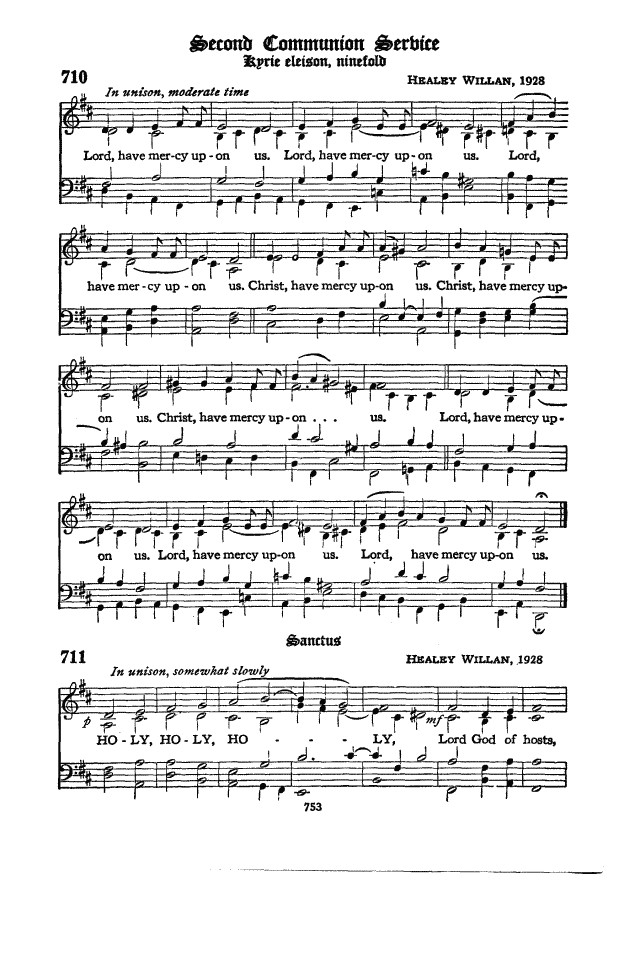
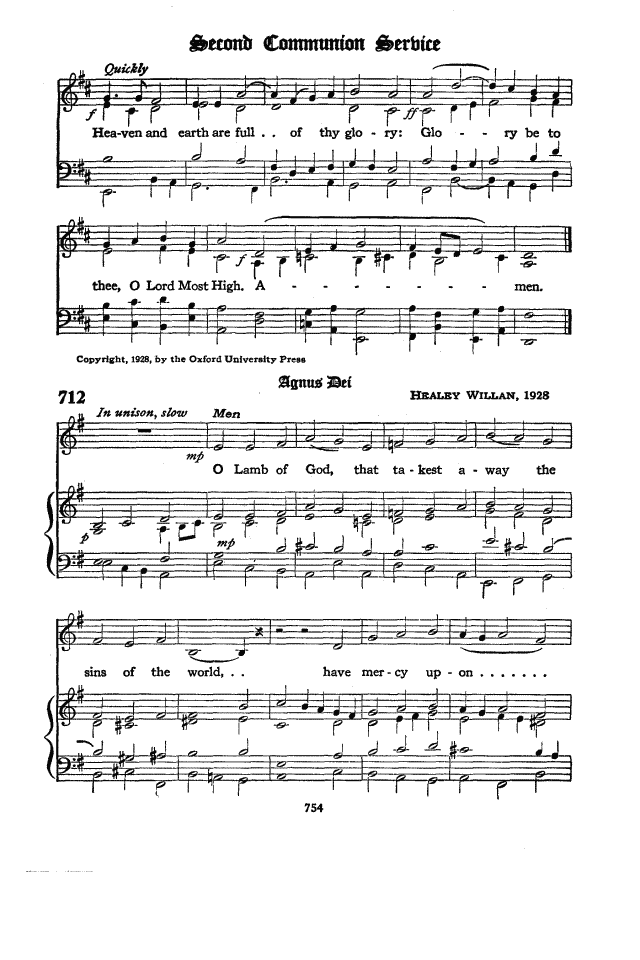


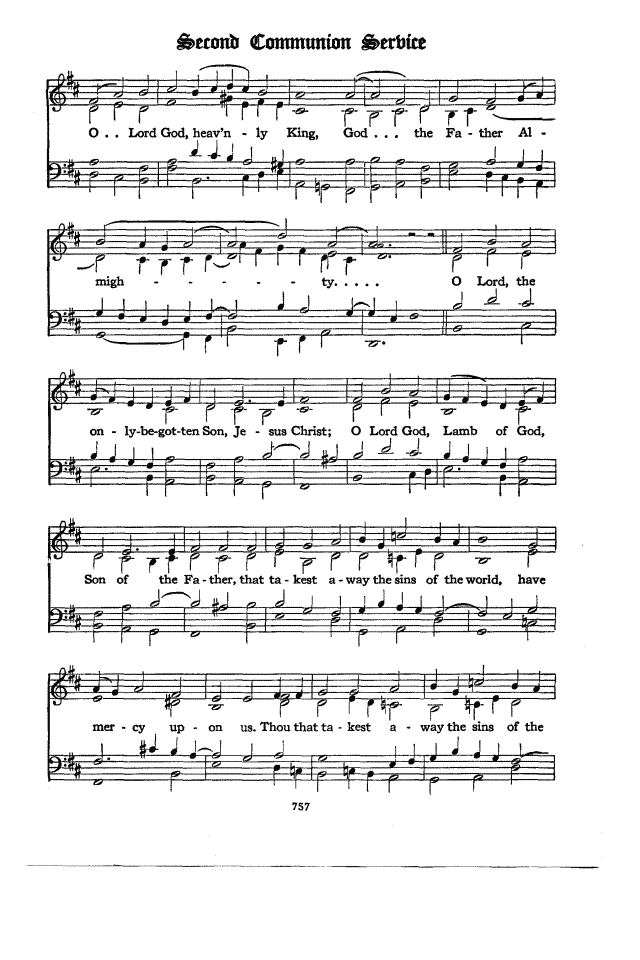

This was beloved back in the day, and part of it was used at the dedication of this ACNA church (presided over by Archbishop Foley Beach.) It’s haunting and a favourite of mine from my years at Bethesda, and in the Bethesda bulletins I’ve posted it appears in every Holy Communion service.
At the bottom of the page it proclaims “Copyright, 1928, by the Oxford University Press.” So it should share the fate of Steamboat Willie. But I’d double check this first; please refer to the Terms and Conditions of this Website, Privacy Policy and Information About Endorsements. If it’s true I hope someone will do a suitable “open source” performance and share this delight of the Old High Church with the rest of us.
-
How the Main Line Churches Lost the Plot

It’s a New Year, and the beginning of another year when the “smart set” (to use an old expression) goes after Evangelical Christianity. They even have a movie waiting in the wings as we gear up for yet another grueling Presidential election year. The spectre of Evangelical Churches “taking America back for God” with all that goes with that haunts these people, even though after forty years of political activity the Evangelicals don’t have a lot to show for it.
Some of us, though, who in past times limited our ingestion of brain-cell killing substances, have a problem. We remember the time when the Main Line churches—those bastions of proper religion—ruled the roost in our culture, and the Evangelicals were those impecunious souls across the tracks. As Richard Niebuhr put it a little more professionally:
The primary distinction to be made here is that between the church and the sect, of which the former is a natural social group akin to the family or the nation while the latter is a voluntary association. The difference has been well described as lying primarily in the fact that members are born into the church while they must join the sect…
In Protestant history, the sect has ever been the child of an outcast minority, taking its rise in the religious revolts of the poor, of those who were without effective representation in church or state and who formed their conventicles of dissent in the only way open to them, on the democratic, associational pattern.
Let’s start by doing the most dangerous thing one can do with an American audience: state the obvious. The Main Line churches had some issues which need to be frankly admitted. The first of those was the lack of overt state support. Unlike their European counterparts/ancestors, American Main Line churches shed their official status, mostly as a result of the First Amendment (although that didn’t formally apply to the states until after the Civil War.) That in turn deprived them of state sanction and support. In Europe that made the task of any non-state churches an uphill battle, although in the long run it has proven suicidal for Christianity in general. But a quick survey of the impressive edifices Main Line churches have built (like this one) and the broad impact they have had on the culture should inform us that the Main Line churches have overcome this impediment very nicely, thank you.
The second is that there were and are Trojan horses in the Main Line scheme of things. The most prominent of them for a long time were the Methodists. The children of both revivalist Christianity and Anglicanism, until recently they housed a truly diverse collection of social classes and people, more so than any Christian group outside of Roman Catholicism. In the long run, however, the most successful Trojan horse was the Southern Baptist one. Its rise to prominence was, in good Scots-Irish fashion, a product of winning the battle by losing it. It (and the Baptist groups that split off from it) became a substitute government for the one lost with the Confederacy, as evidenced by the enormous amount of literature out there on “Baptist polity.” The South went into a century of poverty and isolation after the Civil War, an ideal climate for developing a culturally dominant religion unhindered by the modernist storm taking place elsewhere (more about that in a moment.)
The third was that, while Niebuhr was right in noting the difference in being born into a church vs. joining a sect, the requirement of conscious joining has the effect of raising the commitment level of the membership. The best precedent for that in American culture is the Masonic Lodge, the model of the civic organisations that have dominated American life for so many years. You can in fact have an organisation that is both respectable and requires people to join it as conscious adults. “To be one ask one” has been their slogan for many years, and even though the Lodge’s impact isn’t what it used to be it has left its mark.
That leads us to one of the Main Line’s biggest advantages: respectability. Americans are obsessed with respectability, which is linked with their obsession with “moving up.” This was especially true after World War II, and the history of churches like the Episcopal one, which experienced serious growth in this time, is a testament to the importance of respectability. The fact that Main Line churches have seriously squandered this in the last half century should put the lie to the idea that Evangelical churches have “muscled in” on their turf; the Main Line churches created a vacuum into which Evangelicals have simply rushed in to fill.
Main Line churches also had the advantage of being the church of the “Old Country,” and in a nation of immigrants that wasn’t something to be gainsaid. How quickly that was shed depended upon the ethnic group, but that’s an advantage that shouldn’t be minimised.
So how did the Main Line churches go into the decline the way they did? Had the Main Line churches more aggressively used their advantages, they could have easily slowed or stopped their own fall, either absolutely or relative to the Evangelicals. But they didn’t. Some of that was due to general trends in the twentieth century, but two trends in particular made it clear that Main Line churches somewhere “lost the plot.”
The first was the intrusion of Modernism into the seminaries, especially as that related to Biblical scholarship. Having jettisoned long ago the Patristic hermeneutic which addressed many of the same issues posed by science and theodicy, they were unprepared for the pseudoscientific higher criticism of the Germans which turned the Scriptures from proof texts to disproof texts. That in turn corroded the confidence of the ministers in their own faith, a corrosion in the warmer waters of the seminary that was more rapid than the colder seas of the parish and the laity. Ultimately the Main Line churches experienced a form of global warming where everyone’s corrosion was accelerated and church became pointless for many.
The second was the whole “social justice” movement in the church. There are so many things obviously wrong with this—after years of touting their respectability and success, a social justice movement didn’t make a lot of sense, for starters—but more than one generation of laity has been accused of being the perpetrators of social injustices. I’ve always thought that the social justice movement was, in part, the product of a underpaid clergy doing a “shadow revolt” against a well-heeled laity. Ultimately, as was the case with their Catholic counterparts, the social justice warriors never realised that the “preferential option for the poor” and the “preferential option of the poor” weren’t the same, or they would have migrated to the Pentecostal churches, only to discover that they had a different view altogether of how to right the wrongs of society.
So what are the takeaways from all this? I think there are two.
The first is that the Main Line churches could have put up a better fight than they did against the intrusion of Evangelical ones. They had the resources and they had the numbers but used neither of these. They never took their Evangelical competitors seriously until it was too late. Now we have a whole cadre of people who have made careers out of lamenting the problems of Evangelical churches, but much of this was avoidable. It is more profitable to place the blame on—and learn the lessons from—the failures rather than always curse the successes.
The second—and the reason why the first happened—is because the Main Line churches didn’t put up the fight as they had lost the plot—they quit believing in their own mission. Having done that, it was only a matter of time before someone would come in to fill the vacuum, and someone did.
While the Main Line’s current woes are an interesting and important topic by themselves, there’s a greater lesson to be learned. One thing I’ve discovered in following the Episcopal Church’s woes for the last quarter century is that institutions like TEC are microcosms of the culture at large. The sad truth is that the West in general has lost the plot and no longer believes in what made it the success it has been. There is no reason to believe that the West will fare any better than the Main Line churches, especially since it’s up against opponents that have a lot more going for them than American Evangelicals. If that conflict ends the way I think it will, all the whining and fulminations of Evangelicals’ opponents be irrelevant, and not having learned the lessons will be fatal to Main Line and West alike.
-
With Pope Francis, The Provincial Letters Ride Again
He’s crossed the Rubicon with Fiducia Supplicans:
True, today’s declaration from the Vatican does not change Church teaching. Fiducia Supplicans earnestly insists on a distinction between giving a blessing to a homosexual couple and blessing their relationship. Good luck conveying that distinction to the world.
Anyone can ask a priest for a blessing; that has never been in question. But when two people ask a priest to confer a blessing on them as a couple, how can the Church avoid the impression that the priest, as representative of the Catholic faith, is blessing their union?
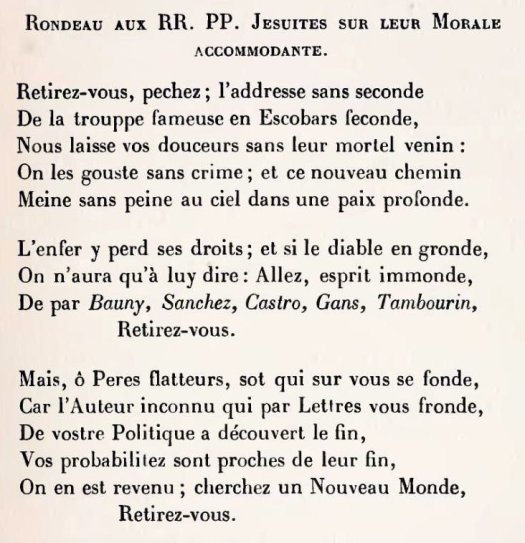
Back in the seventeenth century, Blaise Pascal wrote his Provincial Letters, where he set up a Jesuit who explained to his patient (for a while) listener the order’s morale accomodante, how great it was and (by implication) that it was in concord with the teachings of the Church. The Church eventually had a few things to say about that but not before Pascal and his fellow Jansenists were beaten into submission.
Well, that great Jesuit Pope Francis has done it this time. He has legalised same-sex blessings without de jure changing the teaching of the Church. And instead of that most Catholic monarch Louis XIV, the Jesuits of the present time can rely on the gods of this world to deal with the Jansenists who dare to resist.
I have dealt with the topic of Pope Francis and his agenda repeatedly on this blog (perhaps some of those posts will appear at the bottom of this one) and don’t need to repeat them. The impulse to turn the Roman Catholic Church into another Global North Main Line church has been there for a long time, certainly was when I was in the Church and has only gotten stronger. Francis and his ilk have learned nothing from the decline of these churches, that these churches are really pointless and that there is no need to go there, even if you agree with their idea. The assumption that “people will always go to church” has been belied, especially in Europe but now on these shores as well.
Those who have sought refuge from the apostatising silliness of Main Line religion (to say nothing of the exvangelicals) in the RCC are really in a tight spot. Didn’t we join ourselves with the Rock? Isn’t this the same Church who holds the keys? Those were certainly factors in my own Tiber swim. But we come to the point where we realise that, whether by doctrine or (in my case) by ecclesiastical practice, we have to chose between “going along to get along” and eternal life with Jesus Christ. There are many people out there who are going to have to make that choice, and Francis’ ill-advised encyclical will only hasten that.
As I’ve said before, it’s too bad that the issue of same-sex relationships has pushed things to this point; other things should have done so sooner. But it’s the world we live in, and we have to deal with it the best we can. It’s just too bad that our public discourse is so debased that we don’t have a Pascal to make us ROFL at these people.

Sailing the Last Voyage with Newton and Pascal
 Positive Infinity