-
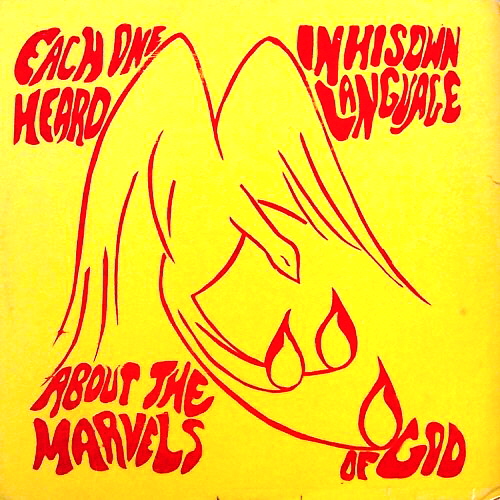
St. Pius X Seminary Choir: Each One Heard In His Own Language About The Marvels Of God
Century 30441
1968One of those early, pre-NOM works, it was led by Rev. Nicholas Freund. The best way to describe this album is “eclectic.” It has some of the “space age” effects of Leo Nestor’s Sons of the Morning, but doesn’t venture into the refined realms of that work. It explores the combination of folk and choir as does God Unlimited and Peter Scholtes’ parish, but lacks the original compositional resources. From a 1960’s folk and rock standpoint, it’s definitely a step forward from the likes of The Winds of God and has some nice covers of some of the best of early post-Vatican II folk music, and many Catholic parishes and student groups would follow in its footsteps for the next decade and beyond.

The songs:
- Acts 4.1-2
- Pentecost Sunday
- I Am The Resurrection
- Come Children Hear Me
- Who Is This Man
- Get Together
- Introit-Sing To The Lord
- Kyrie-Lament For The City
- Gloria-Joy In The City
- Credo-Death In The City, Sanctus-Lord Of The City, Agnus Dei-New Life In The City
-
Broken Windows and Spiritual Warfare: An Ash Wednesday Reflection
We’re starting yet again another Lenten season. The streets of New Orléans (and doubtless other cities which go out for Mardi Gras and Carnival in a big way) are full of trash but quiet. If you’re not Roman Catholic and on fast and abstinence, it’s a great time to eat in the French Quarter.
But it’s a great time for everyone–the January “Daniel Fast” types notwithstanding–to stop and think penitentially about their spiritual state. It’s the time when we consider Our Lord’s own forty-day visit to the desert and how Satan came to call with his own agenda, which was frustrated then and certainly on Calvary and the empty tomb.
There is a lot of stuff out there on spiritual warfare, how to wage it and how to win it. I don’t spend a lot of time on the subject, but when I do I turn to another realm I deal with a lot here: politics.
The 1960’s saw, among other things, a skyrocketing in the crime rate, especially in the urban areas of the United States. Boomers who grew up in the sticks wistfully speak of a time when they could live in their houses with the doors unlocked. Having grown up in South Florida, I wonder what country these people came from. The high crime rate came in part with migration from Northern cities where it was also high, as New York proved when the lights went out in 1977.
In the early 1990’s even New Yorkers had their canful of the high crime rate. Into this situation stepped Rudy Giuliani, who along with his police Commissioner Bill Bratton aggressively pursued the “broken windows” policy. The idea behind this was simple: if you cracked down on petty crime such as the squeegee masters, graffiti, etc., you would make it clear to everyone that crime wasn’t tolerated and the rate would drop. It worked: crime fell throughout the 1990’s and into the new millennium, and New York became a safer city to work in and a better place to visit, as my wife and I found out in 2006. (My guess is that the current mayor will undo a lot of this, with a resulting rise in the crime rate to be expected).
The same principle works with spiritual crime: take care with the small things the Enemy puts in front of you, and chances are the big stuff won’t be a problem. As St. Thomas Aquinas pointed out in Summa Theologiae, 3 q.41 a. 4 (emphases and bullets mine):
The temptation which comes from the enemy takes the form of a suggestion, as Gregory says (Hom. xvi in Evang.). Now a suggestion cannot be made to everybody in the same way; it must arise from those things towards which each one has an inclination. Consequently the devil does not straight away tempt the spiritual man to grave sins, but he begins with lighter sins, so as gradually to lead him to those of greater magnitude. Wherefore Gregory (Moral. xxxi), expounding Job 39:25, “He smelleth the battle afar off, the encouraging of the captains and the shouting of the army,” says: “The captains are fittingly described as encouraging, and the army as shouting. Because vices begin by insinuating themselves into the mind under some specious pretext: then they come on the mind in such numbers as to drag it into all sorts of folly, deafening it with their bestial clamor.”
Thus, too, did the devil set about the temptation of the first man.
- For at first he enticed his mind to consent to the eating of the forbidden fruit, saying (Genesis 3:1): “Why hath God commanded you that you should not eat of every tree of paradise?”
- Secondly [he tempted him] to vainglory by saying: “Your eyes shall be opened.”
- Thirdly, he led the temptation to the extreme height of pride, saying: “You shall be as gods, knowing good and evil.”
This same order did he observe in tempting Christ.
- For at first he tempted Him to that which men desire, however spiritual they may be–namely, the support of the corporeal nature by food.
- Secondly, he advanced to that matter in which spiritual men are sometimes found wanting, inasmuch as they do certain things for show, which pertains to vainglory.
- Thirdly, he led the temptation on to that in which no spiritual men, but only carnal men, have a part–namely, to desire worldly riches and fame, to the extent of holding God in contempt. And so in the first two temptations he said: “If Thou be the Son of God“; but not in the third, which is inapplicable to spiritual men, who are sons of God by adoption, whereas it does apply to the two preceding temptations.
And Christ resisted these temptations by quoting the authority of the Law, not by enforcing His power, “so as to give more honor to His human nature and a greater punishment to His adversary, since the foe of the human race was vanquished, not as by God, but as by man“; as Pope Leo says (Serm. 1, De Quadrag. 3).
In the case of Our Lord, Satan was beaten from the start, so no matter what level he went to he hit the wall. But in the beginning it was not so: man gave into the first temptation and things went downhill from there.
If we want victory in life and spiritual warfare, we must resist the small things lest we then graduate to the larger ones. Remember, “the devil is in the details.”
-
Maybe I'm in the Catholic Blogosphere Too
I spend a great deal of time on the Anglican/Episcopal world, to the extent that I’m listed in Anglican blogs such as StandFirm, Anglican Curmudgeon, and Locusts and Wild Honey (and for these listings I am grateful, their links are in the blogroll).
Evidently the Roman Catholics are starting to find a kindred spirit, as is shown by this email I got recently:
I am Joseph Atkins, webmaster and editor of the Catholic Dating Blog. Our blog focuses on providing dating tips and advice to single Catholics seeking life-long relationships. We just recently updated our list of the top 100 blogs by Catholic sisters and nuns. I thought you and your site’s audience might be interested in checking it out: http://www.catholicdatingsites.net/top-100-blogs-by-catholic-sisters-and-nuns/ .
If you do find this list to be a good resource, might you be able to link to it from your blog? Let me know if you have any questions or comments.
If you are Roman Catholic, have covered the really important things in Christianity, are looking for a life mate and–ahem–are not called to the celibate life which the blogging nuns represent, perhaps this is the site for you.
A few years back, when the “Prayer of Jabez” movement was all the rage, my wife and I went to a fundraising event with a ministerial couple. The minister was rather large. After the then stock pitch to “enlarge our borders” the minister noted that he wouldn’t because “my borders are large enough”.
Perhaps Positive Infinity is enlarging its borders, hopefully in a healthier way than many of our ministers do.
-
Rev. Ian Mitchell: What a Difference Thirty Years Make
One of the more interesting albums I posted (or more accurately reposted) is Ian Mitchell’s American Folk Song Mass. At the time he was living in Chicago. Listening to the album, it doesn’t take a genius to figure out which side of the political spectrum Mitchell was coming from. But I’ve always taken an open view of that subject when considering albums of the Jesus Music era, which should be obvious to anyone who’s looked through them.
Evidently he headed for the coast, for this appeared (appropriately) in the 31 October 1985 issue of the Los Angeles Times:
A preliminary injunction forbidding the Rev. Ian Mitchell to perform any functions as rector of St. Athanasius Episcopal Church in Echo Park after Nov. 20 was issued by Superior Court Judge John L. Cole, who said he will appoint a retired jurist to try to mediate. But lawyers for both sides said an out-of-court settlement is very unlikely. Episcopal Bishop Robert Rusak had asked for the order, on the ground that Mitchell’s election as rector of the city’s oldest Protestant congregation was illegal, since the priest’s license to preach and celebrate Mass had been revoked. Mitchell’s supporters responded that he was being forced out because he attracted Latinos and homosexuals as new members of the congregation. In recent months, the issue has so divided the parish that rival Sunday services have been held in the main sanctuary and parish hall.
Today of course Mitchell would be a hero in his diocese (especially considering the bishop) and everyone else would be getting the boot. But that’s emblematic of the changes in the Anglican/Episcopal world, and (as the album attests to) those changes started long before the current flap detonated in 2003.
But both situations have litigation in common.
-
The Big Differences Between Pope Francis and the Prosperity Charismatics
The greeting video that Pope Francis sent to Kenneth Copeland’s conference has created a stir. There are the usual Protestant vs. Catholic kinds of issues being brought up, and of course the obvious one: why a Pope who has pushed Catholic social teaching back to the forefront–to the discomfort of American conservatives–would even give a group whose Christian life is tied to their income the time of day, let alone a greeting video.
The Pope, however, has a better handle on what’s really going on outside of Roman Catholicism than many Protestant leaders do. He realises that prosperity teaching, love it or hate it, has a lot of appeal to people who don’t have a lot and either haven’t figured out how to do it the old “American Protestant work ethic” way or don’t live in societies where the way upwards is very transparent. So such a greeting makes more sense than it would seem.
Prosperity teaching has turned Christianity on its head; any dialogue it might have with Roman Catholicism cannot be cast in the usual stereotypes. Getting beyond the ecclesiological and doctrinal problems, the biggest differences between Roman Catholicism and Prosperity Charismatic Christianity can be summed up very simply: they’re polar opposites in their attitude towards human suffering and “the money”.
It’s really a matter of origins. Roman Catholicism came into a world where the attitude was, as cripsly expressed by Tacitus, that “the gods care little for our well-being, but greatly for our chastisement.” Combined with the miserable world that came out of Rome’s fall, Stoicism and the example of Our Lord on the Cross, we had a religion that regarded suffering not only as an part of life but laudable as a spiritual discipline.
Prosperity teaching, however, came out of a world where wealth creation seemed like magic. Taking the example of Our Lord’s resurrection and naïvely uninformed about how the civilisation they lived in actually accomplished all it did, prosperity teachers and their followers live in a world where suffering, far being from a virtue, is generally regarded as the judgement of God on an individual, and prosperity as the sign of blessing.
The situation with “the money” is equally divergent. Roman Catholicism has traditionally regarded money and business with suspicion, its own accrual of wealth notwithstanding. That is reflected in Francis’ “revival” of Catholic social teaching. Its priests and religious take vows of poverty along with chastity and obedience. The “contemplative life” is traditionally considered the highest Christian state on this side of eternity, and that life is one of poverty.
For prosperity charismatics, “the money” is like winning to Vince Lombardi: it’s not everything, it’s the only thing. People used to be shocked at Robert Tilton’s “corrupt” practices, but face it: all he talked about was the money, what did you expect? “The money”, present of future, is what validates the prosperity charismatic, and to say that they’re obsessed with the money is only an understatement because we cannot find an English word to express the reality. That’s spilled over into just about every corner of Full Gospel Christianity. After years of following the Anglican/Episcopal split over homosexuality and belief, to turn to my denomination and find it tearing itself apart over how much went to its centre spoke powerfully to priorities.
And this demonstrates another truth: where the money goes is an important issue. When I became a Roman Catholic, I was warned that I would have to pay to receive forgiveness of sins or just about everything else. In practice I found little of that. My years in a Pentecostal church, however, have been a different story. It’s hard to imagine a spirituality which has wrapped itself around giving more than this one. The sentiment that people who don’t pay tithes are going to hell isn’t as uncommon as one would like. In the face of what gets broadcast about the need and blessings of giving, Tetzel looks like a rank amateur.
So how to bridge these gaps? What Francis is probably banking on is that, sooner or later, prosperity teaching is going to hit the wall. This is for two reasons,
The first is that prosperity teaching doesn’t really account for situations–and everyone has them–when God doesn’t do either according to our expectations or those that are drilled into us from the pulpits or television. When I was growing up, liberals would bawl over how they didn’t believe in God any more because he didn’t do what they expected him to do (remember Gilbert O’Sullivan)? The New Atheists have taken this up with a vengeance: how can there be a God when so many bad things happen? (I deal with this in more depth here). Prosperity teaching plays right into this and, in many ways, atheists and prosperity charismatics are working from the same assumptions, only coming to different conclusions.
The second is that the ability for prosperity charismatics to accumulate wealth has always depended upon an economic system that permits it to the extent that ours has. That’s in jeopardy for two reasons. The first is the growing inequality and class stratification of our society. Prosperity Charismatic Christianity is the preferential option of the poor par excellence; when they find that they have a bulletproof glass ceiling above them, they may change their attitude towards the aspirational spirituality they have adopted. Moreover in the West the heavy hand of the state is tilting against any form of Christianity. That is at the heart over the current fracas over bakers and florists refusing same-sex civil marriages; making economic activity of any kind a matter of conscience, and forcing people to make decisions that will cost them economically, goes straight against prosperity teaching in a way that few other things do.
On the other hand, prosperity charismatics, triumphalistic by nature, may figure that God is on their side and the Pope and the Church under him will come their way. But given current realities and the durability of Roman Catholicism, I wouldn’t put money on the prosperity teachers. They’d probably take it anyway.
-
Robert Munday's Doing It Over Again, and a Note on Systematic Theology
Former Nashotah House Dean Robert Munday’s “If I had to do it over again…” is an excellent response to a sorry episode. I know it’s hard for someone who has put his life into a work which others delight in unravelling to watch that take place.
Some comments on what he had to say:
To be more precise, Episcopal seminary education has concentrated on preparing men and women for a career in the Episcopal Church (note my choice of words) but has been utterly incapable of equipping them for biblically-faithful, Gospel-centered, Spirit-empowered ministry.
That may end up being the epitaph of American Protestant and Evangelical Christianity. If there’s one thing that bothered me more than anything else in church work, it is the obsessive careerism of so many in the ministry. That in part is because it’s full of Boomers, but that’s not the only reason. Jesus Christ came, in part, to offer a radical alternative to the careerism of the Middle East, past and present, and for us to replicate that in church is unfaithful to Our Lord.
Most observers generally agree that the Charismatic movement in the Episcopal Church began with the Rev. Dennis Bennett’s experience of the Holy Spirit while he was rector of St. Mark’s Church in Van Nuys, California, in 1960. The next thirty years saw a remarkable spiritual renewal that included leaders such as the Rev. Terry Fullam, from St. Paul’s Church, Darien, Connecticut, and a list of other leaders and parishes that is much too long to list here.
Alongside that Charismatic renewal, Evangelicals in the Episcopal Church, which had long been a small and beleaguered minority, began to find new life and strength, and a sense of their own identity. They were aided in their self-discovery by Evangelicals from the UK, Australia, and elsewhere. There were organizations dedicated to promoting renewal in the Episcopal Church, but there were numerous, seemingly spontaneous examples of spiritual renewal popping up all over the Church as well. Several entire dioceses began to take on the character of the renewal movement. Those who had been touched by the Charismatic renewal and the Evangelical resurgence came to grips with the realization that no existing Episcopal seminary was capable of training biblically faithful, Spirit-filled clergy to serve and lead parishes. This realization led to the founding of Trinity Episcopal School for Ministry.
Reformed people hate to admit it, but the Anglican Revolt would have never taken place without the Charismatic Renewal (with all of its faults) providing the fuel and the people motivated by that fuel.
The opposition to my remaining as Dean was driven ostensibly by Bishop Ed Salmon’s contention that I was getting Nashotah House in trouble by being too closely allied with those who were outside of TEC. The reason I use the word “ostensible” is that it should have been apparent to all concerned (and should be doubly apparent in retrospect) that Bishop Salmon was using his position as Chairman of the Nashotah House Board of Trustees to undermine my position as Dean and President and to take the job for himself.
Is Bishop Salmon insane? Or is he one of these Episcopalians who, irrespective of how loony or heterodox the church becomes, stick with it until their last breath? I’ve always been amazed at the institutional loyalty that TEC is capable of instilling in people, particularly since it traditionally discourages any time of enthusiasm as in bad taste. But we see here two things going: the obsessive “company man” being a thoroughgoing careerist to boot.
You can have orthodoxy or you can have the Episcopal Church, but you can’t have both.
It’s just too bad it took so long for so many to realise this, but not everyone gets to grow up Episcopalian “where the animals are tame and the people run wild”. Maybe that’s why it clicked for the senior Henry Louttit so early.
And for something completely different:
During my years at Trinity, I happened to meet the professor who was then teaching Systematic Theology at Nashotah House (around 1994). We were discussing which textbooks we used for teaching theology, and he remarked that he used John Macquarrie’s Principles of Systematic Theology. I gulped, and explained that, at Trinity, we treated Macquarrie in a separate course on Contemporary Theology where we did apologetics against him. (I should add that this theology professor left Nashotah House before I began as Dean, and I had the opportunity to select his successor, who is thoroughly orthodox.)
Let’s face facts: after St. Thomas Aquinas, there is no systematic theology. Period.
-
Bishop Salmon Plays Colonel Nicholson. Again.
He’s really stepped in it this time:
An invitation by Dean Edward Salmon to Katharine Jefferts Schori to be the guest preacher at Nashotah House’s historic seminary chapel has resulted in at least two resignations from that seminary’s board. A memo from Bishop Jack Iker of the Diocese of Ft. Worth (confirmed by his staff) says he has resigned in protest as a trustee from the Nashotah House Board where he has served for the past 21 years. Bishop William Wantland (Diocese of Eau Claire, ret.) who presently serves as Assisting Bishop of the Episcopal Diocese of Fort Worth has also distanced himself from the Nashotah action.
This action was taken in protest of the Dean’s invitation to the Presiding Bishop of TEC to be a guest preacher in the seminary’s chapel. Citing the lawsuits initiated by her against this Diocese, Bishop Iker notified the Board that he “could not be associated with an institution that honours her.” Similarly, Bishop Wantland sent notification that he “will not take part in any functions at Nashotah” nor will he continue “to give financial support to the House as long as the present administration remains.” He is an honorary member of the Board (without vote) and a life member of the Alumni Association.”
I took flak for my adverse opinion of Salmon’s performance in the All Saints Pawley’s Island fiasco. In my defence I noted the following:
Salmon reminds me of Colonel Nicholson in The Bridge on the River Kwai. Nicholson insists on building a top-flight bridge, irrespective of the fact that it is for the enemy, and resists its destruction. Nicholson does this because it is the “proper” thing to do, and shows that he and his men are superior to their captors. But the end result is that the enemy has a bridge.
The enemy has another bridge, thanks to Bishop Salmon once again doing the “proper” thing. Fortunately this time some of his colleagues have shown that experience is a hard teacher and that they plan to learn from it.
-
Head and Heart Knowedge: Doing What They Said Couldn't Be Done
Dale Coulter’s moving piece on adoption, image and God’s love (including extensive reference to St. Thomas Aquinas) brought back a more prosaic incident that happened to me while working in the family business.
About thirty years ago, between trips to China, I had to make a trip to Holland for an offshore hammer repair. With me were my two field service people. One of them was a country boy from Alabama. As we took the motorway from Amsterdam to Rotterdam and looked out on the Dutch countryside, he made the comment “The old cowboys said that couldn’t be done.”
“What’s that?” I asked.
“Grazing sheep and cows together,” he replied. Sure enough, out in the pastures the two species were contentedly eating grass. Those familiar with the American West know that shepherds and cattle people came to blows because the sheep graze closer to the ground than cattle do, eating supper past the cows’ capabilities. The Dutch, without the luxury of vast expanses of land (and much of theirs reclaimed the hard way) figured out how to get both to coexist.
In many ways Coulter’s piece is like that: it’s a moving piece about his own experiences with his adoptive parents and biological children. Such is generally a call for pure sentimentality, but Coulter interweaves St. Thomas Aquinas’ theology of the love and will of God and his leitmotif of beginnings, causes, and ends to make a very nice tour de force, if one that’s at first surprising.
The surprise comes for those of us who have hung around Evangelical and Pentecostal Christianity for a long time. Ever since I’ve been involved in this type of Christianity, I’ve always heard another leitmotif in one form or another: the vast gulf between “head knowledge” and “heart knowledge,” that gulf as unbridgeable as the one between the rich man and Lazarus and for the same basic reason. The message was simple: you get one, you chuck the other; you go with the heart, you go to heaven; you go with the head, you go to the other place. That wasn’t restricted to Evangelical circles either: once I got past my first Catholic parish, it was even difficult to get anyone fired up about Aquinas at the parish level, although some of that came from the left.
That idea was primarily developed for two reasons: to cater to a population whose formal education was frequently lacking, and to steer them clear of the kinds of open-ended speculations that are popular in the general culture. Up to a point it’s succeeded, but much of the current crisis that Evangelicalism is going through can be traced back to this dichotomy. (For the Mars Hill types: I take this on from a Biblical standpoint here.)
I come from a profession that requires a great deal of deep reasoned thought to solve its problems, but the goal is to figure out what’s going on and come up with a solution. The basic problem with American Evangelicalism’s aversion to an intellectual approach to theology or anything else is that, as long as things are going the way they have, life is good. When the ground shifts, however, forethought is lacking and we’re forced into a reactive mode where we’re always playing defence. The Pentecostal response is to restore the prophetic to the church, but our response to prophecy depends on our earlier conditioning. If we’re not conditioned to really look ahead, the “prophetic” we receive will only be the pathetic. (For a completely different view of prophecy from the one we’re used to, this from Moses Maimonides will be of interest.)
That lack of skill with the “art of thinking,” as those venerable Jansenists Arnauld and Nicole would say, touches many practical issues, some of which have graced this blog over the years:
- How can a group of serial ecclesiastical rebels claim legitimate authority? And how can they claim authority and still deny that they have magisterium, i.e. the ability to interpret the Scriptures authoritatively?
- Why should churches whose ecclesiology speak of strictly a gathering of saints–up to baptising only adults–expect themselves to be at the head of the culture? (How they did that in the American South is another one of those “cows and sheep” situations, but then again the American South is one of those places where everything is different.)
- How can people protest “redefining marriage” and then keep on insisting that the state continue to be involved in it? If the state is involved in it, then it can and will redefine it as it did with “no-fault” divorce and now with same-sex civil marriage.
- Why do we insist that we interpret the Bible literally and then turn around and insist that the Eucharist is totally symbolic?
- Did we really expect that we could get secular power without the moral hazard that goes with it? And did we really expect that we could “bring America back to God” through the electoral process when neither Old nor New Testament support such an idea?
- Do we really expect to continue on without persecution and a cost for discipleship when Our Lord promised otherwise?
These are just a few of the “fun” issues that we must face. Some ability to think would be helpful here. To some extent we’re in the same situation Islam is in: we’ve woken up to a world not of our making where the only response we know is to come out swinging. And I think, as a sometime Thomist, that this is unworthy of our calling as Christians.
What we need to do is what Arnauld and Nicole did: to teach the art of thinking, especially to those in our leadership. The start for that would be to upend our current idea of “systematic theology:” we need, like Aquinas, to start with God and carry on from there. Beyond that we need to reaffirm that what we know translates into what we do and how we live, and to be ready to make the dissemination of that knowledge a centrepiece of our program. From there we need to take a more realistic view of the world, which is still fallen the last I checked.
To go on the way we have isn’t going to work, and that alone should be incentive enough to get head and heart knowledge to graze together as they are supposed to.

Sailing the Last Voyage with Newton and Pascal
 Positive Infinity