-
My Thoughts on “Lee University Doctrinal Integrity and Teaching Fidelity.”
Last month the Executive Council of the Church of God, in partnership with Lee University, completed the document referenced above. You can get the full details of this here. My purpose here is not to rehash the entire process (which started last September) but to comment on its results. The challenges from the culture that both the Church of God and Lee University face are serious ones; it’s best to tackle them now than to wait until it is too late.
My personal interest in this topic is heightened because, as I announced on another site, starting this Fall I am teaching engineering at Lee University. Lee has traditionally been a liberal arts college but it is venturing more towards professional education, first with its nursing school and now with its engineering program. I have contended for a long time that our educational system needs to move more in a hard science direction (and one that will not, in my opinion, deflect it from a faith mission.) This is my chance to make a contribution to that in a Christian school. My entry–and this joint effort–comes with the background of the dispute between one of our prominent ministers and a Lee faculty member about the latter receiving the Holy Communion at his wife’s Episcopal parish. So the urgency of this topic is compounded.
All that said, let us start with this:
Within the context of rapidly shifting societal norms and religious beliefs, and in response to concerns expressed within the Church of God, the International Executive Council determined to review the instructional practices at Lee University. The review process included a series of meetings involving members of the Executive Council and leaders from Lee University.
It’s difficult to overstate the role that Lee has in the Church of God. My years of working in the International Offices (and being married to a Lee graduate) have resulted in my hearing “I went to Lee with him/her” many times. A leftward lurch would be a disaster for not only Lee but the church in general, especially in a church which struggles more than most with resolving differences of opinion and thinking difficult issues through.
From here I’d like to go through the actions which the Lee board approved and sent to the Executive Council:
Lee University will develop a certification course for its faculty including an orientation to the history, culture, doctrines, and practical commitments of the Church of God; and that this certification be required of all faculty engaged in teaching theology, church doctrine, ecclesiology, and/or practical theology at Lee University.
It’s worth noting that our ministers have opposed one or more of their number losing his or her credentials because of lack of fidelity to the Declaration of Faith. How this will play out with the Lee faculty will be interesting. The tricky part of such a certification is whether it identifies people who really have problems with the Declaration of Faith without doing so to those who agree with it but don’t believe and teach “the way we’ve always done it.” I will also remind people that just because you’re a product of the culture doesn’t mean you are faithful to the doctrine.
The Lee University Board of Directors reaffirm its existing policy requiring all faculty members to abide by the existing contractual and policy commitments to the lifestyle and doctrinal commitments of the Church of God as they relate to personal conduct, scholarship, and teaching.
The current application for employment states verbatim that “Faculty members at Lee University agree in their contracts not to propagate religious, teach or publish anything contrary to the Declaration of Faith.” The Faculty Handbook is explicit in the type of conduct which Lee expects its faculty to exhibit, and that includes unacceptable opposite-sex conduct in addition to same-sex conduct.
Lee University will explore the establishment of a required Christian Discipleship class, offered at the 100 level, as an addition to the religion core of Lee University.
Personally I’d look at the whole religion core to make sure that discipleship is integral to it. I’ve discussed this issue before, but face it, Jesus told us to go make disciples.
In collaboration with the Church of God Division of Education, Lee University will explore a means to integrate ministry credentialing in the Church of God within the ministry degree programs of the Lee University School of Theology and Ministry.
It makes sense that the Division of Education, which oversees the education of our ministers, would have input at this stage.
Lee University Board of Directors adopts the following policy changes related to the faculty of the School of Theology and Ministry (STM):
a. Given their central role in training future ministers consistent with the doctrines and teachings of the Church of God, faculty members in the School of Theology and Ministry may not be a member of, regularly attend, or regularly perform ministerial functions at churches or other religious organizations with doctrines, beliefs, positions, or other ministry practices in conflict with the Statement of Beliefs on Human Sexuality.
b. Codify the existing STM practice of hiring only Pentecostal scholars on its faculty and operating policy of the Board of Directors, including hiring preference for Church of God scholars. Exceptions to this policy would require board approval.
c. Require a written response from all faculty candidates reflecting their views on the doctrinal commitments of the Church of God and the Lee University Statement of Beliefs on Human Sexuality and Gender.
d. Require at least one scholarly writing per year from all ranked faculty members on an article of the Church of God Declaration of Faith, Doctrinal Commitments or Practical Commitments.
e. Provide incentives to faculty members who are credentialed ministers with the Church of God.
f. Establish a faculty hiring advisory committee, comprised of three Ordained Bishops of the Church of God (a local pastor, an administrator from the Church of God Division of Education, and a sitting member of the Executive Council), to review the applications and/or interview new faculty members and supply an assessment of the candidates to the University President for consideration by the Board of Directors.
Lee already requires two things from faculty applicants: a) a Personal Faith Narrative, and b) a Personal Faith Statement on the Integration of Faith and Learning. (I’ll be glad to post mine if you’re interested.) My guess is that (c) will be implemented with an additional statement to those. It will be interesting to see how the science and engineering faculty do on (d). I think that (e) needs to be expanded to include lay people, especially in those fields where our ministers are scarce. Concerning (f), Lee may want to have a tiered review process for part-time and full-time faculty.
The Lee University Board of Directors shall establish a subcommittee to review all new faculty hires prior to the University President presenting candidates for consideration for approval by the board.
I think that this needs to be integrated with (f) on the previous point to reduce duplicate effort.
Lee University amends its moonlighting policy to prohibit employees and faculty members from engaging in outside employment or serving in a ministerial staff position, whether or not for compensation, at churches or other religious organizations that have doctrines, beliefs, positions, or other ministry practices in conflict with the Statement of Beliefs on Human Sexuality.
Lee’s moonlighting policy, even for part-time faculty, is more restrictive than what I have been used to at the University of Tennessee at Chattanooga. OTOH UTC requires an annual Conflict of Interest report out of its faculty, something that Lee might want to consider.
It’s a sign of the times that the issue of human sexuality is the “wedge” issue that our opponents–both inside and outside of the church–have picked. That’s a change from the doctrinal and theological ones that dominated the 1960’s and 1970’s. That’s why this issue is central to this narrative and to the future course of Lee and the Church of God. The unaddressed issue is the role of the federal government in all of this, but perhaps I presaged this in my 2007 piece Waiting for the Cops to Show Up.
Overall I think this is a step in the right direction. The method of implementation is crucial; what we need is a transparent process with a minimum of bureaucratic inefficiency. The stakes are too high for this process and those like it to fail.
-
The ACNA is Really at a Crossroads
This excellent piece by the Ven. Canon Justin Murff lays it out:
This June, the College of Bishops of the Anglican Church in North America will meet at St. Vincents College in Latrobe, PA from June 20 – June 23 to hold a Conclave to elect the next Archbishop of the ACNA. Many in the ACNA feel that the election of the next Archbishop will determine the future of the entire church.
Make no mistake, there are several elephants in the room that whoever the bishops elect, the next archbishop will require a unique set of skills and enduring fortitude to meet the challenges head on if the ACNA is to survive and meaningfully join the emerging re-formed global Anglican community.
I said towards the beginning of the adventure that is the ACNA had two major issues that it needed to resolve: the Anglo-Catholic divide and WO. Murff doesn’t mention the former, probably because the really serious amongst them have an alternative in the Continuing Churches, which themselves are making progress towards unity. About WO, however, Murff is right that it is still a key issue:
The current policy is seen by many as simply kicking the can down the road. But the next Archbishop will need to lead the church towards a globally acceptable position that honors the gifting and ministry calling of Women (especially in the diaconate) yet respects and reserves the historic and biblically faithful position of the episcopacy and presbytery.
There are two keys to resolving this issue. The opponents of WO need to give up the RCC-based concept of authority. The supporters need to give up grievance and rights driven feminism (which has been seriously complicated of late by the transgender movement.) I can’t see either of these wanted to part with their respective security blankets; tbh I’m not optimistic that this is going to be resolved any time soon without schism.
But now to some other issues:
Ultimately, the ACNA needs a dedicated house of training for our Deacons and Priests. Part of the current dilemma is that the current slate of schools that provide Anglican tracks for our clergy still wrestle with their own identity (Episcopal, Lutheran, Baptist, High church, Low Church, Deconstructed Evangelical, etc). It is amazing that a denomination with more than 1,200 parishes has no institution of higher learning of its own. The time has come to chart a way forward to remedy that.
Starting any kind of educational institution (and keeping it on course) is problematic these days, both financially and doctrinally. I discussed this from a prep school standpoint in my post Maybe an Anglican Boarding School Isn’t Such a Good Idea After All. Obviously a seminary and a prep school are different “kettles of fish” (as my old Mainer prep school physics teacher would say) but we only need to look around at the number of colleges and universities closing to see what a daunting task this really would be. Perhaps the ACNA should consider either a) picking up a closing school to start the effort or b) going outside of the U.S., where it could avoid the accreditation system’s tendency to grind down conservative institutions.
Having a more homogeneous clergy would go a long way to address the decidedly heterogeneous laity that is coming into the ACNA. Although laity with incoming “baggage” is nothing new to the Anglican-Episcopal world (as I noted in My Mother the Exvangelical) a clergy that’s for the most part on the same page would help dealing with issues like I Wonder…How Many of these ACNA Exvangelicals Still Believe in Eternal Security?
If a weak Archbishop is elected, the ACNA runs the very real risk of being overran by Nigeria because the lifeboat that saved many clergy, has now become a U-Boat intent on firing with full effect.
I don’t think the effort by the Nigerians is as big of a deal re the ACNA in general as some do. It’s true that many clergy “owe” the Nigerians but as time rolls on many of them (like Beach himself) will “age out” of the system. They may be able to pick up a few congregations but I don’t see a massive shift towards a church with direct African oversight.
When looking at the field of candidates there are very few Bishops, (made fewer by retirements) who have board international experience, are actively serving on the board(s) of Seminaries educating Anglican clergy, have current experience regularly testifying and meeting with our elected officials in Washington, D.C. advocating for religious freedom and liberty, who have more than a decade of Episcopal experience leading large and diverse groups of clergy, and who have significant experience standing up for their Diocese and the ACNA on a global stage.
This is a sad admission, that a denomination whose Anglican spirituality has attracted generations of American leaders is left with that shallow of a bench.
We must pray against ego’s and agendas and pray that the Lord’s will be done and let us all pray that the next Archbishop of the ACNA will not be her last.
I’ve railed against Egos Inflatable to Any Size: The ACNA-AMiA Fiasco and other similar kerfuffles. It’s a thing in the Anglican world, and it’s sad to see. May God bless and guide the ACNA in this critical moment, our prayers are needed.
Note on Justin Murff: I had the honour to meet him at a Regent University event, where he is an adjunct faculty member. But he’s not in the Divinity school; he’s in the Robertson School of Government. Justin is also related to Don Murff, whose contributions to geotechnical engineering in the offshore oil industry–my specialty–are considerable, and whose comment on my MS thesis was very nice.
Also on the faculty of the Robertson School of Government is another Anglican divine, the Rev. Dr. Andrew J. Nolte. He has the distinction of being the only member of the Regent faculty who is fulfilling the original commission of the school as a Christian University.
-
Fenestrae de Allegoriae: Allegory As A Window to Reality–The North American Anglican
This very elegant piece (written by a guy from Arkansas, something I understand well) underscores an unpopular but ultimately unavoidable reality we need to face: without recovering at least the Patristic idea of Biblical interpretation, we’re going to be in serious trouble. I’m not sure this is adding to what he says but it’s a little more direct:
- The ultimate reality in the universe is one we cannot see, i.e. the spiritual. This fact has been lost to contemporary Christianity, which is one reason why a blindly literal view of Scripture has become so popular.
- I don’t think the Patristic method can be always characterised as allegorical. I think a better term to use for most of it is typological.
- The fact that we can legitimately interpret the Scriptures in this way is a sign that we have a Divine book. (You’re welcome, Orthodox.)
- I don’t see this impinging upon taking the moral commands of the Scriptures at their face value, it’s impossible to do them any other way. That eliminates much of the mischief we see the postmodernists inflict on us. On the other hand…
- …finding typological value in the Old Law is certainly fair game, considering Our Lord came to fulfil the Law. Re-establishing the real relationships between the Testaments would go a long way to getting rid of the synthetic Judaism that dominates large parts of Christianity these days.
- And, of course…there’s always the question of the seven days!
-
Feeling the Pain and Answering the Question About Roman Catholicism
There are times in life when some of the buried past comes up, and last week was one of them. Last Thursday, we said goodbye to the matriarch of the family that lead the Catholic Charismatic prayer group I was a part of in the late 1970’s and early 1980’s. We’ve stayed connected with the family so it wasn’t like, “we haven’t seen you in years” and the reciprocal.
As I’ve said many times, my years as a Roman Catholic were crucial in my formation as a Christian, both intellectual and spiritual. The prayer group was in the centre of the last act or two of that play. I outlined that history in my tribute to her husband, who passed away in a house fire in 2008. The suppression of the Catholic Charismatic Renewal in Chattanooga forced a course correction for me which wasn’t really voluntary but has been a fruitful endeavour of its own. I still believe that the main driver in that suppression was the desire of local Catholicism for respectability, something the Renewal didn’t seem to confer. It was also driven by the change in pontificate. John Paul II wanted to run a tighter ship, and ecumenical movements such as the Charismatic one didn’t fit in his agenda. Knowingly or not, his desire for institutional integrity outweighed his ostensible pastoral desire for a laity alive in its faith. (In some ways that desire outweighed any impulse on his part to get to the bottom of the priestly sex scandals, a thing that the current Occupant of the See of St. Peter shares.)
The Charismatic Renewal had its own problems. Many of those centred around the authority issue in the covenant communities. I had beaten those off in Dallas before coming to Chattanooga, and I was blessed to be a part of a group whose leadership did the same in the group, even with the head of the Tennessee-Georgia Christian Camps in our midst. Ultimately though it wasn’t enough.
Those controversies and the fallout were long in the past when we gathered to say farewell to Jo Ann Roueché. Her funeral was lovely, but you could tell the priests who celebrated it were more traditional than those who did her husband’s sixteen years ago. The program “read the riot act” about who was allowed to receive the Body of Christ, and I still have a hard time with the “new” translation of the Mass. The music was a mix. They started with this classic from the “old folk Mass” and had some traditionally Protestant songs but many were more “traditionally” Catholic. It worked well because, in the aftermath of the suppression, her children started the Roueché Chorale, which has become a community institution, and perform everything with their characteristic professionalism.
That music produced one of those “aha” moments. The Chorale’s style is more formal and beyond the folk style which predominated during the Charismatic Renewal. But then I realised: I’ve been asking the questions like How Did We Get From Scanlan to #straightouttairondale? I then realised the answer was right in front of me: the Catholic Church had beaten us (well, some of us) into submission, those who were left had to adjust and adapt. That beatdown got a professional explanation in David Peterman and the Hard Choices of the Catholic Charismatic Renewal, but from a worship style standpoint the guitar strummers had to put them back into the case for good, and the hand raisers had to lower them for the last time.
The chief victims of the current papal beatdown are the trads. I’m not really in sync with their idea but I am sympathetic with their suffering from the way the Church is treating them. It’s the same story we went through. After I left I read Pascal’s Provincial Letters, and considering what he and the Jansenists went though, I saw the same story. No matter what motivation you ascribe to these beatdowns, the result is always the same: the enforcement of mediocrity amongst those who have to “know when to kneel, when to stand, and when to reach for their wallet.“
For those of us who were challenged by the Church and then betrayed in this way, it still hurts, even after all of these years.
Memory eternal, and my prayers are with the family.
-
Appeal to Novelty–The Logical Place
Probably the most egregious use of this fallacy in recent times was in selling the public on the mRNA vaccines against COVID-19. These had not been tried on such a wide scale, and doing so was, IMHO, scientifically irresponsible. At the time I was suspicious of this and stuck with a more traditional adenovirus vaccine (J&J) which itself had been trashed by its competitors.
That suspicion, in turn, was based on experience both in my usual profession and with computers. Just because something is the “latest and the greatest” doesn’t mean it’s the best. But that was the way these vaccines were sold to the public.
In the end, I think this will have long-term effects on people that are only now being realised.
-
My Mother the Exvangelical
These days the exvangelicals get a great deal of attention, both from those who are glad they’re “ex-“, those who aren’t, and those who aren’t sure there is an “ex-” from Evangelicalism. I fall into the last group, and a big reason for that was my own mother. Since next Sunday is Mother’s Day, it’s a good time to tell this strange tale, and even though it was a long, long time ago, there are some lessons for us today.
My mother was born and raised in Central Arkansas, home of Bill Clinton’s Eucharistic Theology: It Depends on What ‘Is’ Is, in the years between the two World Wars. She was raised Southern Baptist. Her parents were serious Christians. That’s where the complications began: when she was in high school, her parents left the SBC and helped to start the Bethel Missionary Baptist Church in Morrilton. It was around that time when Ben Bogard, basically the leader of the Landmark Baptist movement and a family friend, debated Aimee Semple McPherson in the The McPherson-Bogard Debate. We’ll come back to that conflict later.
In any case World War II came, and everyone’s life was upended. She lived through the tragic death of her brother and working in the ordnance plant. All of that done she moved to Chicago where she lived with relatives and started a new life in the “city of big shoulders.” A new life was an understatement: she met and married my father and became a part of his family, one that was very different from the one she was raised in except for the Lodge. She settled down in the northern suburbs of Chicago, but as a Southerner the question of church always lurked in the back of her mind.
The Baptist split over slavery produced two wings with two different ideas of how to do church. There’e evidence that she tried a northern Baptist church but evidently this did not work out for her, my father or both. The Southern Baptists, who had up to this point stuck with the “gentleman’s agreement” of not starting churches in the North, broke that when their members starting migrating north to escape Southern poverty. In Chicago those churches would have been on the South Side but, as anyone familiar with the Windy City knows, those are two different worlds, and that wasn’t a world she wanted to go to.
Ultimately that problem would be solved when we left Chicago for Chattanooga, and four years later for Palm Beach. But the issue of church was unresolved. At this point a key character in the plot becomes important: my father’s mother. A New Orleans raised Episcopalian, she had already been the Episcopal Church’s missionary to a family of rude (and victorious) Northerners. My mother thought highly of her, and as time passed her participation in Episcopal life–and her children’s also–became more consistent, especially when we arrived at one the church’s premier parishes: Bethesda-by-the-Sea. Two years after we moved to Palm Beach she was confirmed along with my brother.
And as for me…the year after we moved, I received my divine encounter. One of the first questions I asked in the wake of that was “Have I been baptised?” The answer was no. My brother was adopted, a process facilitated by my father’s brother-in-law, an OB-GYN in northern Virginia. He was duly baptised at the time. A little less than two years later my mother brought me into the world and it was rough on both of us; my health wasn’t the best for a long time afterwards. Her excuse was that I was too sickly to be baptised, although it certainly was no rougher than getting a bath, and I had plenty of those. It’s become evident that she, Baptistic at the core, disliked infant baptism and really didn’t want me to experience it. She got her way; my baptism at Bethesda was a) believers’ baptism in act if not in form and b) private, something that was going out of fashion even in the Episcopal Church of the day. With that out of the way, I was confirmed the year after they were.
Life at Bethesda should have been routine after all that. But it wasn’t. The first fracas was the dispute between the Vestry and St. Mary’s Guild, in which she was active, over the rummage sale in the parish hall. I recount that in my piece A State of Being. The end result was fabulous: the Church Mouse resale shop, which has become a Palm Beach institution. But I think that my mother, wanting to leave church disputes in her Baptist past, was uncomfortable at the whole adventure. It left an even sourer taste in my father’s mouth, which derailed any interest he might have had in church.
Under the surface there was something else that would come back to influence events in later years: the whole business of “eternal security,” or “once saved always saved.” My mother was an adherent of that, but, in classic lex orandi lex credendi fashion, I was not, which I explain in What I Learned About Approaching God From the 1928 Book of Common Prayer. I was blissfully unaware of her idea; I think that our rector may have had more insight into that, as I discuss in The Episcopal Snobs and the John Wayne Evangelicals. She felt that I would come around on my own, but raise up a child in the way he should go…
But the biggest grenade in her foxhole was the upheval the Episcopal Church was undergoing in the 1960’s and 1970’s. Unlike the exvangelicals today, whose consumeristic mentality conditions them to expect everyone else to suit their purpose, my mother and her generation were more geared to a “get with the program” mindset, which may explain why the Episcopal Church of yore absorbed people like my mother with less angst than, say, the ACNA is experiencing these days. To ruffle those feathers took some effort, but the Episcopal Church certainly rose to the occasion. At the centre of the controversy was the Book of Common Prayer: Bethesda was experimenting with the aptly named “trial liturgies,” and my mother was unenthusiastic about all of them. She didn’t have any use for WO either, which led to her souring on her favourite Rector at Bethesda, Robert Appleyard, who advocated for same as Bishop of Pittsburgh.
For her the controversies were cut short by back surgery and leaving Palm Beach, which shifted her focus elsewhere in life. Some of that focus fell on me: they sent me to an Episcopal school only to encounter The Man Who Facilitated My Exit from the Episcopal Church and convert to Roman Catholicism. Neither of my parents liked this, but neither of them understood that the pre-Vatican II RCC they had encountered in places like Chicago and Guatemala wasn’t the same as the one I was received into. But then their marriage blew up and, in the process, my mother’s last chance to become an active Episcopalian (or Anglican) came up. A person who became very supportive of my mother through all of this was Father James Stoutsenberger, rector in Delray Beach. He was in the process of transitioning to the “Continuing Churches.” But although his prayer book was right his style was too Anglo-Catholic for her Baptistic taste. Had she swallowed her aversion to “formalism” the family’s subsequent course may have been very different.
The rest of the story played out in a different fashion. When I married a Pentecostal and joined her church, my mother went postal, a highly Baptistic thing to do. Although it cast a pall over our relationship for many years, the year before she went to meet God she joined our church, the end of a long and strange life journey.
So what can we learn from this saga?
- Evangelicalism is like the Hotel California: you can check in, but you can’t check out. It leaves such a deep impression on those who are products of “the system” that they never get past it and really grasp the “new” system they might embrace. They go through life with baggage they can’t get rid of; a humorous example of that can be seen in the seminary academics which revert to their old type hymnody when three sheets to the wind.
- One thing my mother wanted to do was to get away from the rigid dogmatism of her past. But she was basically a conservative person, even in an Episcopal context (as her position on the Prayer Book showed.) Today some who attempt the transition she did are not of like mind; their journey to places like the ACNA is in some ways an implicit exit strategy from real Christianity, which can have dangerous consequences for everyone.
- It’s possible for the Evangelical impulse to be transmitted to children even after the formal conversion. That was certainly the case for me, although I’ve come to realise that sorting all that out is a complicated business. I suspect that Anglican rectors are paying better attention to that kind of thing these days, but one never knows…
- I Wonder…How Many of these ACNA Exvangelicals Still Believe in Eternal Security? The Reformed may find this heartening, but even they should consider the consequences of combining an Arminian view of election with a Calvinistic view of perseverance.
Happy Mother’s Day.
-
Dr. Howard Thomas: The Remarkable Deliverance of a Tennessee Physician from Drug Addiction–Flowers Pentecostal Heritage Center
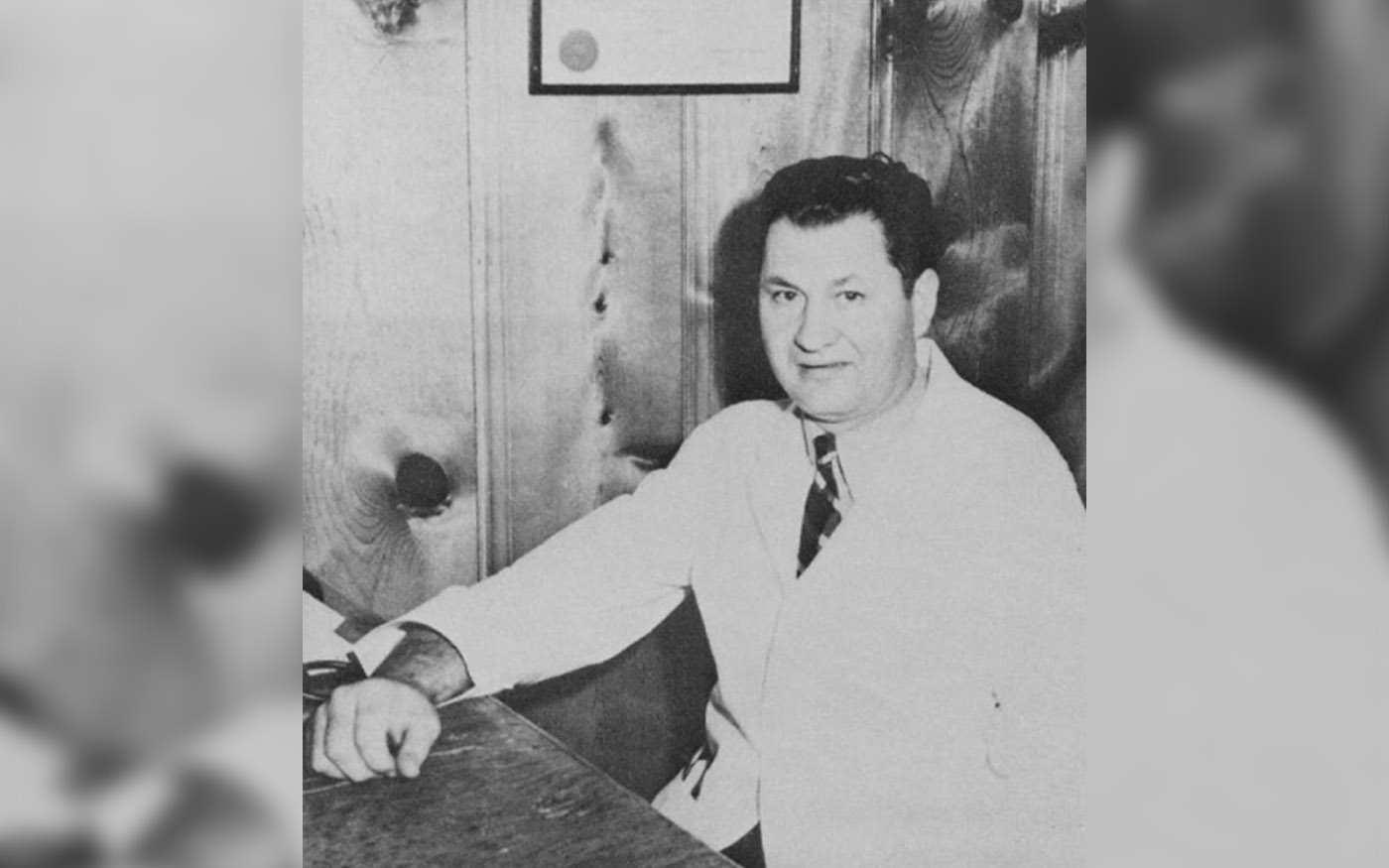
This Week in AG History — May 3, 1970 By Darrin J. RodgersOriginally published on AG-News, 02 May 2024 Dr. Howard Thomas (1927-2016) had a promising career as a physician, but a drug addiction almost destroyed his marriage and professional life in the early 1960s. After hitting rock bottom and ending up in a private […]
Dr. Howard Thomas: The Remarkable Deliverance of a Tennessee Physician from Drug Addiction -
My Response to “Embracing the Evangelism Opportunity as a General Department…..Again! Let’s Talk About It – Part One”
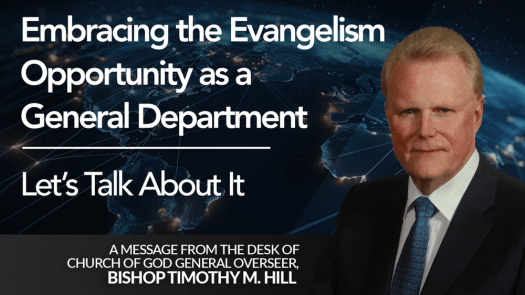
I was heartened to see Tim Hill’s piece (reproduced by ourCOG) on this topic. As many of you know, I worked in the Department of Lay Ministries from 1996 to 2010, which came out of the Department of Evangelism and Home Missions in the early 1990’s (something that Tim Hill mentions.) What many of you don’t know is that I was also the webmaster for Evangelism and Home Missions (EHM) during much of the 2000’s. By that time its agenda had shrunk (as Hill notes) and its funding was lean. I got to work with some great people but the prime of this part of the church was past.
Without rehashing many of the issues Hill brings up on the topic, based on my experience if the Church of God is serious about bringing this department back (and on its face I think it’s a good idea) we need to address two issues:
- We need to bring back the role of the laity in evangelism. Too much of the mentality in the Church of God (and every other church in the revivalistic tradition) is that evangelism is the work of a special cadre of preachers who come into town and “blow in/blow up/blow out.” I think part of the reason why Charles Beach and Leonard Albert had the Lay Ministries Department separated from EHM was because of its focus on preacher evangelism. There’s no evidence in the New Testament that Our Lord intended to entrust the entire work of evangelism to such a ministerial cadre. In all churches but especially in church plants the laity plays an important part in spreading the gospel, and to do that effectively they need training.
- We need to link evangelism and discipleship. The Great Commission is about making disciples; evangelism is a necessary means to that objective but not a sufficient one. A Christian culture does some “pre-evangelism” discipleship, but irrespective of the merits of the culture we don’t live in that kind of world any more. In a culture like ours–and especially with some of the groups we are missional to–evangelism comes in the middle of two stages of discipleship, both of which are on us to do. Unfortunately the way our church is structured–and the proposal of bringing an evangelism department back into being doesn’t help–the two are handled separately. That needs to be addressed.
It is my fervent hope and prayer that the Church of God will be rightly guided in this part of its mission.
-
The scandals haunting Pope Francis–unHerd
The cardinals are already meeting to discuss who should be the next pope. Some of the liberal ones, who feel safe because they’re in favour with the ailing Pope Francis, can be seen comparing notes in a bar near the gates of the Vatican. The conservative cardinals are more nervous: they gather at suppers in each other’s apartments or — if they can trust the fawning waiters not to betray them — in a favourite restaurant.
The scandals haunting Pope Francis–unHerdAbout as good of a summary of the situation as Pope Francis prepares to meet God.
Sailing the Last Voyage with Newton and Pascal
 Positive Infinity