-
St. Augustine on the Literal Meaning of Genesis–Science Meets Faith
It’s interesting to note that, in this passage at least, Augustine bases his reticence on insisting on a literal six-day creation based on the fact that it would be an embarrassment! In our day, where too many Christians (especially Evangelicals) are in “play up to the world” mode, one would think that this argument would be in vogue, but we don’t see it explicitly put that way very much.
As noted in my post Why Evangelicals Don’t Read Philo Judaeus, at least some of classical antiquity had been teed up to the idea that the creation was completed in more than six twenty-four hour days (and back then the hours weren’t even fixed!) Moreover Augustine’s idea of “literal” was typically Patristic in that it included the allegorical, analogical or typological meaning, something I’ve discussed elsewhere on this blog.
-
The Creator of “Egos Inflatable to Any Size” Has Passed On
Dr. Ron Gilbert of Cleveland, longtime educator and award-winning videographer, passed away peacefully on July 1, 2024, in a Chattanooga hospital with his loving wife, Cheryl, and his children by his side. He was 74.
Long time readers of this site will remember my post Egos Inflatable to Any Size: The ACNA-AMiA Fiasco (and other posts like it.) There I noted the following, where I didn’t mention him by name:

“Professor Shagnasty” (Ron Gilbert) going after “egos inflatable to any size” at one of our meetings. For me, a humorous way of looking at this is to recall a comedy routine in our own church by a Lee University faculty member (who is, BTW, now a part of a Charismatic Anglican church). He describes an “Inflatable Camp Meeting” which is like these inflatable playgrounds. It includes, of course, campground, chairs, and stage. On that stage are “general officials” who, in the routine, have “egos inflatable to any size”! (Little wonder he had to make an exit from the church! Long time readers will note that I have used this illustration before, in this situation and others).
Perhaps he’ll put together an “Inflatable Cathedral”. Sad to say, the egos will be there as well. They certainly have been up to now in the real thing.
Ron was a gifted communicator, but I’m not sure ACNA’s prelates would have been better prepared for this than our Church of God ones were.
Both the Pentecostal and Anglican worlds were blessed by his presence; his Celebration of Life Service is below.
-
The Promise and Perils of the ACNA-RCC Dialogue
In a historic step, the Vatican is working toward “full communion” with conservative Anglicans by recognizing Anglican holy orders and churches without requiring “amalgamation or conversion.”
The union will be based on a Malta II proposal presented by the Anglican Church of North America (ACNA), that revives the Malta I report agreed upon by Pope Paul VI and archbishop of Canterbury Dr. Michael Ramsey in 1966.
In my post Book Review: Trevor Gervase Jalland’s The Church and the Papacy, I note the following:
Unless you figure that Protestant and Orthodox churches will simply roll the Roman Catholics–and in some places like Latin America that’s a possibility–sooner or later some accommodation with the See of Peter needs to be considered, or at least the obstacles to that accommodation need to be dispassionately discussed.
Evidently people in both the ACNA and the RCC have been thinking along these lines. As someone who has experienced both the Anglican and Roman Catholic worlds, I find myself with mixed feelings about this whole adventure.
The biggest plus is that it would put some Anglicans on par with the Orthodox, i.e., a church with the apostolic succession and valid sacraments and orders but not in formal union with Rome. I say “some” because, although the model for this is a sixty-year old protocol between Rome and Canterbury, the latter is conspicuously absent from the process. The biggest obstacle is women in the episcopate, which affects the apostolic succession. Since this is extending to GAFCON, how the RCC plans to deal with provinces like Kenya and South Sudan is hard to know at this point. Doing this, however, would undo one of the RCC’s least thought out self-inflicted wounds–denying the validity of Anglican orders.
Doing just this is a major step forward and would go a long way for the unity of Christianity. But there are perils for both sides.
Let’s start with the Anglicans. Ever since the days of Richard Hurrell Froude (I personally find his brother William of greater interest) there has always been the desire within parts of Anglicanism–translated into practice–of being “more catholic than the Pope.” This strikes me as an attempt to “keep up with the Joneses” without realising that we just might be the Joneses! The most tragic occurrence of this in the history of the church is the Old Believers controversy. Although I doubt the Anglo-Catholics have the fires at the ready, they may move (and some are moving) in the direction of things such as the Marian devotions, the merit system of grace, the Immaculate Conception, purgatory and of course the Catholic concept of the priesthood, which appeals to the authoritarian streak. I honestly don’t think that the cause of Christ or the progress of the Church are served by these things, and some of us have lived through a Roman Catholicism where they were virtually absent.
The Roman Catholics have their problems, too. If there’s one thing the current Occupant of the See of Peter hates more than anything, it’s people who are more Catholic than he is, and by that I’m referring to the Trads. It’s possible that he sees the ACNA as yet another dumping ground (along with the SSPX) for these people, whom he has set to drive out of the Church. Driving out dedicated people isn’t new to the RCC, but it is always harmful. (For a church like the ACNA which is having trouble digesting the exvangelicals, this has both promise and peril.) But we should realise that this Occupant, like his counterpart at 1600 Pennsylvania Avenue, won’t last forever. The ACNA has had its taste of a white-knuckle conclave, but it will pale besides the next one in Rome. The RCC has trashed the reputation it has amongst more traditionally minded Protestants as a “safe haven,” this will certainly affect any ACNA-RCC relationship going forward.
As I said in my book review, the core problem is this:
What Christianity needs is leadership which is committed to transmitting the paradosis of the Apostles without expanding it.
I’d like to think that this union would be a step towards that, but I’m not counting on it.
-
The Ghosts of Gothard and the Headship Charismatics Still Haunt the ACNA
The new Most Rev. Steve Wood’s home diocese’s position on WO bears that out:
Bishop Wood’s position is more nuanced. The Anglican Diocese of the Carolinas Policy for Women in Order has supported the ordination of women as deacons and priests in the church, with the provision that women may not serve in the office of rector...
Alice Linsley a cultural anthropologist, former Episcopal priest who renounced her orders as a priest after extensive biblical scholarship, told VOL that the weird constraints placed on ordained women in Bishop Steve Wood’s diocese are the result of an unbiblical doctrine called “male headship.”
“Both women and men can be in authority, but not serve in the same roles. In the biblical texts, women of authority are not named as frequently as men of authority simply because the Hebrew were a caste of ruler-priests and women never served as priests. To be right believing means to uphold the received tradition in full. That tradition never involved females at the altar or men in the birthing chamber. Women and men have different roles in God’s plan and design.”
If you hear anyone talking about headship in a Christian church, you can be sure that the ultimate source of that is the one and only Bill Gothard, who made it a cornerstone of his teaching in the 1970’s. It’s been taken up in unlikely places like the Southern Baptist Convention. It was also the wellspring for the “Shepherding Movement” amongst Charismatics (Catholic and Protestant) in the same era, and that got a smackdown from none other than Pat Robertson. But the itch to be “in authority” has if anything gotten worse since that time, as evidenced by the NAR and even the ACNA’s decidedly undemocratic structure.
The most serious problem is that, in a chruch with an episcopal structure like the ACNA, the whole concept of the priesthood that goes with this is unBiblical. The desire to be a “fourth Rome” surfaces in things such as the conclave they recently had. I think some of the motivation for that stems from the idea that “the Episcopal church apostacised, the RCC didn’t,” but some of us saw the likes of the current Occupant coming.
The quoted article also notes the following:
There were Hebrew women of authority. Line of descent was traced through high-status wives, especially the cousin brides. Residential arrangements included neolocal, avunculocal, matrilocal, and patrilocal, and the biblical data reveals that the responsibilities and rights of males and females were balanced, yet distinct.
As a Palm Beacher, the whole concept of “high-status wives” ordering around men of lower status is a natural one. Pity the thought that the ACNA is that bourgeois!
-
ACNA: Habemus Papam
Latrobe, Pennsylvania – The College of Bishops of the Anglican Church in North America has elected its next archbishop, the Rt. Rev. Steve Wood, bishop of the Diocese of the Carolinas. The College met in conclave in the crypt of St. Vincent’s Basilica at St. Vincent’s College in Latrobe, Pennsylvania from Thursday, June 20 through Saturday, June 22, 2024.
Bishop Wood will serve as the third archbishop of the Anglican Church in North America which was founded in 2009 and now has over 128,000 members in over 1,000 congregations across Canada, Mexico, and the United States.
He’s got his work cut out for him. But first he needs to throw a party at Page’s Okra Grill.
-
Jürgen Moltmann RIP
Announced in the Church Times:
THE German theologian Professor Jürgen Moltmann, who was widely read in English translation, died on Monday, aged 98.
A member of the Evangelical Church in Germany, he was Professor Emeritus of Systematic Theology in the University of Tübingen. But his serious theological reading first began in the UK, to which he was brought as a prisoner-of-war at the end of the Second World War.
As is my custom, I don’t say things about the dead I wouldn’t say while they were living. This is my assessment of the man from my post My “Journey” with Jürgen Moltmann:
One place where Moltmann should read his own stuff is the issue of theodicy. On the one hand, he sighs that the terrible wars of the last century have put the issue of theodicy out of reach. That’s been a common sentiment of Europeans who went through these wars; it has been a big push in the decline of Christianity in Europe. In the 1980’s my mother had an English S.O. who became an atheist because of his experience in World War II; the effect was different over here. On the other hand, Moltmann points out that modern man is now the master of his own destiny. Then why did he allow these wars to happen? Why were humans out to lunch on this? This may not answer the theodicy issue to Moltmann’s satisfaction, but it should (usually doesn’t) give humanists pause as to the superiority of their idea…
Overall, I found going through his talks an education. It made me look at liberal theology in a different way, if not in a more favourable one. As far as Göttingen people are concerned, I’ll stick with the list I gave at the start and leave Moltmann to the liberal seminary academics.
I’m glad that Giles Fraser “closed the loop” on the theodicy issue the way he did; we’d all be better off if that were more frequent.
-
Formulating Orthodoxy: The Centrality of Canon Law for Common Prayer and Doctrine–The North American Anglican
There are a couple of things that the Rev. Andrew Brashier’s verbiose treatment of the subject left out.
The first concerns the whole “Patristic revival” that brought things such as the Apostolic Canons back into view. He’s right that it was a background for both the Novus Ordo Missae and that dreadful 1979 Book of Common Prayer. Traditionalists of all stripes will be unenthusiastic about such a reminiscence, and those traditionalists are key to the second point. It’s worth noting that another canon that came back into view was that of the Mass, as I noted in my series on the subject.
The second point is simple: the canons aren’t worth much unless the bishops are prepared to enforce them, especially on points of “faith and morals” to use the Catholic expression. I’ll repeat my piece on James Pike; when the Episcopal Church lost its nerve on disciplining him, the end of real Christianity in that venerable institution had its beginning:
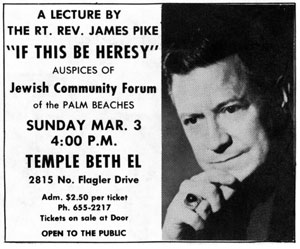
In holding his lecture in West Palm Beach, Pike was invading what was for him “enemy territory.” In an article in the July 2006 issue of Chronicles magazine, author Tom Landess reminded us of the following:
In 1966, a group led by Henry I. Louttit, bishop of the Central Archdeanery of South Florida, demanded that Pike be tried for heresy.
John Hines, Presiding Bishop of the Episcopal Church, met with Louttit and a small delegation in New York and told them he had polled key figures in the mass media, who had declared unanimously that a heresy trial would severely, disastrously damage the Church’s image.
Most of the bishops agreed. The Bishop of New York expressed the feelings of the majority: “Of all the methods of dealing with Bishop Pike’s views, the very worst is surely a heresy trial! Whatever the result, the good name of the church will be greatly injured.”
Hines asked Louttit and his cohorts to allow an ad hoc committee to address the problem more informally, less visibly. Louttit reluctantly agreed. Members of the committee met, engaged in a great deal of hand-wringing, and came back with a report that said in part:
It is the opinion that this proposed trial would not solve the problem presented to the church by this minister, but in fact would be detrimental to the church’s mission and witness…This heresy trial would be widely viewed as a “throw back” to centuries when the law in church and state sought to repress and penalize unacceptable opinions…it would spread abroad a “repressive image” of the church and suggest to many that we were more concerned with traditional propositions about God than with the faith as the response of the whole man to God.
At Wheeling, West Virginia, the House of Bishops adopted this statement by an overwhelming vote, though they also agreed to “censure” Bishop Pike – a small, dry bone tossed to Christian orthodoxy. In the above passage, two phrases — “acceptable opinions” and “repressive image” – revealed what was really going on.
Henry Louttit was a frightful bore from the pulpit, but he was right: it was heresy, and frankly it still is. People such as Pike detonated the jerk to the left that caused the Episcopal Church to lose a third of its membership in the 1970’s. Once again the Pharaohs on the left are making their move and once again God’s children are forced into exodus. But now there is a Promised Land.
But it will only be a promised land if it is lead by the likes of Moses and Joshua, and we’ll find out next week if the ACNA will put such people at the helm.
-
Facing Reality on Christian Colleges and the Liberal Arts Education
The news that Cornerstone University in Michigan is ending all humanities and arts programs (with booting of professors following) has shaken many in the Christian collegiate community. It’s also something that comes close to home: this fall, Lord willing, I’ll start teaching engineering at Lee University, which has been a liberal arts college for a long time but is itself starting an engineering program, having done the same with a nursing program earlier. Having been taken to task more than once regarding my opinions on engineering programs (that’s an ablative absolute for those of you who missed it,) I feel that it’s time for a reality check on this whole subject, because Cornerstone (and Lee for that matter) are not the only Christian colleges adding what their detractors refer to as “vocational training.”
As part of this I need to make a disclosure: I know Cornerstone’s president, Gerson Moreno-Riaño, from my association with Regent University, where he was Vice-President before coming to Cornerstone. About ten years ago my PhD program experienced a funding crisis which led some of us (especially the foreign students) to wonder if we would end up “on the street.” Lacking guidance from either our own institution or from searching on the internet, I turned to my contacts at Regent (as I mentioned in my dissertation) of which Moreno-Riaño was one. Their response was simple: if our PhD program was ended without getting the students to graduation, transfer out or abandonment of their degree pursuit, our institution would experience the “Wrath of SACS” (its and Regent’s chief accreditation agency.) It wasn’t easy but we got through, and Moreno-Riaño’s (and others’) advice was very helpful.
With that out of the way, I’d like to lay out in as simple terms as possible why I think liberal arts education–Christian and otherwise–is in trouble:
- Higher education is expensive. There is a serious aversion in the liberal arts community about evaluating one’s education in terms of the revenue the subsequent career will generate, but barring a general amnesty from Joe Biden those loans have to be paid back somehow. (And, thanks to some stupid changes in our law, you can’t discharge them in bankruptcy.) Most of that is due to administrative bloat, some of which comes from compliance with the maze of Federal and state regulations, but some is just the way things are done these days, and it’s not good.
- The idea that one needs to go to college to obtain any benefit from such an education is simply not right. Exposure to the arts and history (to say nothing of foreign languages, living or dead) is something that must be started much sooner; college is too late. But colleges have been expected to compensate for the manifest deficiencies of our primary and (especially) secondary educational system, which has diluted the content of the undergraduate degree. Our schools (and not just the public ones) have contented themselves with developing conformity to the “system” in the students and not the critical thinking skills they really need.
- Liberal arts education has been politicised to the point that it’s hard to characterise it as “liberal” in any sense of the word. That in many ways is the consequence of our obsession with instilling conformity with a system; it’s encouraged the development of a power dynamic in our academics. It’s also the consequence of Americans’ investing too much in the ability of our institutions of higher learning to mould character, when that too needs to start earlier.
- Liberal arts advocates downplay the ability for scientific and technical pursuits to develop thinking skills. Nowhere does that prejudice find refutation in reality than with mathematics. One of the last courses I took for my PhD was Advanced Linear Algebra. (It was from that course that this post was inspired.) Our professor taught it from a strict “theorem and proof” standpoint, not one congenial to his engineering students. It was his idea that mathematics should be used to teach logical thinking, and he certainly carried through with it. Another math professor noted that computer programming was a form of mathematical proof; you need to know how to thing logically to be a good programmer, although the road to that, for me, had a few “bumps.”
And there are practical realities to consider. American universities are bracing for a demographic cliff which started with the economic crash of 2008 and from which we have never recovered. Moreover students at more than Christian institutions are shifting towards career choices (and the education to go with them) that generate enough revenue to provide for oneself and a family. But it’s more than hard necessity: why must Christian students and institutions shut themselves off from scientific and technological pursuits in a world where both are an integral part of life? Many of the stupid decisions we see in our society stem from an elite with little scientific or technical training.
As far as Moreno-Riaño’s program for Cornerstone is concerned, the execution strikes me as too drastic. The article notes that other institutions will doubtless take a more gradual approach, but as just noted there are real forces behind such transitions. As also noted Moreno-Riaño’s plan requires being able to find adjuncts to “stand in the gap,” which isn’t as straightforward in a place like Grand Rapids as one might think. And building a faculty in engineering is certainly going to induce “sticker shock” in Christian institutions; it may be a necessary transition, but it won’t be an easy one.
When Jack K. Williams became President of Texas A&M University in 1970, he made the following statement:
I believe that during the years ahead we will be witness to a geometric rise in the development and adoption of innovative techniques and programs. In matters large and small, the atmosphere of education is heavy with the smell of change. For some of us this is a heady perfume; for others it is the pungent odour of brimstone. Either we sail the strange sea, benefited by whatever navigational experience we have and can command, or we will become passengers on educational vessels whose rudders are managed by others…*
More than a half century later quite a few in Christian education are smelling brimstone. It’s time to stop and embrace the expansion of Christian institutions into new territory unless, of course, you don’t mind if they end up with no territory at all.
-
It’s That Time Again: Reflections on the 2024 Church of God General Council Agenda
It really is that time again: the Church of God is looking at another General Council and General Assembly in Indianapolis, IN. The agenda itself is here and I’ll be doing a “blow by blow” commentary on same.
Before all of that let’s start with a cautionary note: the most significant part of the Council’s work is to elect our “general officials.” This year there are three open positions (out of five) on the Executive Committee due to term limits. The “post-Constitutional” era we’re in now highlights the fact that we can pass all of the resolutions we want, but unless we have leaders with integrity and insight, we won’t get the result that we need and miss God’s plan for his church.
So let’s get to it:
Global Harvest
This is good; however, it’s worth noting that the model of missionaries coming only from the U.S. is long in the past. Today missions is a) finding people called from wherever they come from and b) sending them to where God has called them to go. I find that Americans don’t quite get that, but we’ve been here at least since the days of Miguel Alvarez, Gordon Robertson and the Asian Centre for Missions, and this will accelerate as we move forward.
Ministry of Evangelism
The Presiding Bishop teed up this discussion earlier this year and I commented on it in my post My Response to “Embracing the Evangelism Opportunity as a General Department…..Again! Let’s Talk About It – Part One.” This item would basically bring back the old department of Evangelism and Home Missions as a restructured Ministry of USA Missions, with elected leadership and a more active board. My comments re the need to include discipleship in this department’s agenda stand.
As an example of this, consider the children’s Bible video series Superbook. It’s certainly evangelistic (it includes the salvation prayer with every video) but it’s also a discipleship tool in that it shows children how to live as Christians. That kind of thing is what we’re going to have to do in cultures—including our own—where the “prediscipleship” of the culture is lacking or absent altogether. Without this our evangelistic efforts will be trapped in a cycle of “blow in/blow up/blow out” without results that stick in this life and the life to come.
One observation: The director and assistant director are limited to one four-year term. Bro. Hill said that he didn’t want this position to become of those going off of the Executive Committee. With the single term, there’s a good chance that the position will become just that.
State Evangelism and Missions Director
I have a couple of questions:
- Why are lay people excluded from this Board? They can serve at the International level (I’m on the Division of Care Board,) why not the state level? Although before the reorganisation the Evangelism Boards (and I’m glad to see them coming back) had oversight over lay ministries at the state level, some states had a state lay board. That was a hit or miss proposition depending upon the state Administrative Bishop. It would be easier to have lay people at the state level on the main board rather than to have two.
- How much have we considered the role of the laity in evangelism and discipleship? Do our ministers really believe that they can do the job by themselves? The New Testament doesn’t support such a concept and neither does experience. Evangelism training for the laity needs to be a part of this effort. This kind of training is both good for outreach and good for those trained, as you cannot share the Gospel unless you know the Gospel.
Biblical Sexuality
This is of a piece with my discussion on “Lee University Doctrinal Integrity and Teaching Fidelity,” where I discuss the issue in detail. I think it’s unfortunate that we have to have a resolution like this but we have to play the cards we’re dealt.
Female Ministers on Trial Boards
This is an attempt to involve women on ministerial trial boards (especially those which involve moral failure) without dealing with the issue of women not being able to be ordained bishops. It’s a good step but we need to come to a happier resolution on this subject.
Generational Harvest
This issue has been something of an obsession with our church leadership, both in terms of the people brought into the church and our ministers. As someone who has taught college students for over twenty years, the most important thing for our people to do (along with the evangelism training mentioned above) is to be real in their Christian walk.
Doctrinal Fidelity
In 2008 we tried to pass a resolution to require our ministers to explicitly agree with the Church of God Declaration of Faith. The effort failed; unless there’s been a major shift of opinion amongst our ministers on this topic, unless we address two issues it will (and should) fail again:
- Forcing such agreement would basically shut off debate on the Declaration of Faith and the other statements of faith and practice, which is great until you consider these were all passed at a General Assembly in the past and should be amendable by another one in the future. Some provision needs to be made on disagreement with these statements in the context of changing these in a formal way at the General Assembly.
- Keeping a resolution of this kind from being used as a weapon by one minister against another in order to settle personal scores. Whether that’s successful depends upon the integrity of our ministerial trial system more than the resolution itself, although some mention of that problem would be helpful.
Some of the resolution involves our educational institutions, and I dealt with that in my discussion on “Lee University Doctrinal Integrity and Teaching Fidelity,”
Resolutions re State Overseers and Ordained Bishops
These clear up some technical matters and there is no problem with them.
Responsible Use of Social Media/Digital Platforms
In 2012 a resolution of this kind was put before the Council and failed. It was in the wake of the “Missional Revolt” that led to the cut in the “tithe on tithe” and the reorganisation of the church. I said at the time I felt that the purpose of the resolution was to prevent a rerun of the Missional Revolt. My experience in the Anglican/Episcopal world told me that what has happened in that world—which resulted in the formation of the ACNA—would have never succeeded on the scale it did without the internet and social media, which is basically what happened to the Continuing Churches in the 1970’s. In a church which has the deficient transparency and redress of grievances that ours does, social media is frequently the only way those concerns can come out, although I have reservations about how most of our dissenting social media gets that job done.
Although the present resolution is more carefully crafted, I still don’t like it. The way we conduct ourselves on social media is an extension of how we conduct ourselves face to face and on “legacy” media. We badly need to learn how to discuss issues in a constructive manner, but social media isn’t the cause of that problem. The Scriptures and other governing rules should be enough on social media and elsewhere.
Biblical Worldview
This is something we need to have, although a lot of what passes as a “Biblical worldview” in Protestant churches isn’t up to the status of a worldview. Some of that relates to the relationship between the Old and New Testaments, and there’s a resolution dealing with that, too (see below.)
Priesthood of All Believers
This is one of those things which people like to say more than they like to implement, which speaks to the role of the laity I discussed earlier.
Ordinances of the Church (Communion)
This particular topic came up in the last General Council. It was sent back for reconsideration because, as written then, it implied that the proposed change was the actual position of the original General Assembly in 1906, which was not necessarily the case. This addresses that problem, but in the meanwhile two other problems have arisen that need consideration:
- We need a serious “tightening up” of our whole approach to the Holy Communion, something I discussed in my post About Those “Loosey-Goosey” Communion Theologies, Episcopal and Otherwise. At this point our Communion practice is little better than that of some left-wing ministers of that “gay-friendly church.”
- Although the Holy Communion (along with Baptism and Foot Washing) were classified as ordinances at the start, that isn’t carried through in our subsequent statements. We need to figure out whether we consider them as mere ordinances or ascribe a more sacramental nature to them.
Sexual Abuse of a Child/Sexual Exploitation of a Minor
I have no problem with the revocation of ministerial credentials in this case. This extends the penalty to being cast out of the Church of God altogether. My guess is that, for one or more situations, it was too easy for a minister with revoked credentials to go join a church and continue the nasty activities. The practice of permanent exclusion for serious sin has precedent going back to subapostolic times and has sanction in the New Testament; it’s drastic but in some situations it’s necessary.
While on the subject, as a practical matter the Church of God’s first response to problems like this is simple: call the cops. All things considered, that’s the best approach. If the state changes its opinion on paedophilia (and that’s a real possibility) we may be in an entirely new situation, as we are with other matters we thought were “settled” in our society.
Ministerial Reporting
This is a technical measure that should be passed.
Statement on Racism
Every time I link to my 2015 post What Working for the Church of God Taught me About Race, the response is almost always the same: crickets. The problem in the Church of God isn’t racism but ethnocentrism, and until we get past that we’ll never be the church God wants us to be. We only need to look at the example of the Assemblies of God to see what happens when we transcend the limits of ethnocentrism. That also applies to some of our more progressive voices, as I pointed out during the “Think Younger” movement.
Institute of Leadership Development
Personally I’m getting tired of the American obsession with leadership and leadership development. The more we seem to harp on this subject the poorer the quality of leadership we seem to get, and I’m speaking of our secular world. Leonard Sweet told me that what we need more than this is to teach followership; I’m inclined that this is right and that, if we started with this, those who come up in the system would be better leaders when their time came.
Statement of the Old Testament
There isn’t much in Evangelical Christianity that indicates the retrograde state of thinking than the need for a statement like this. From its start the Church of God, in concord with virtually every other Christian church, has regarded the New Testament as the rule of faith and practice. A century or more of levelling hermeneutic has opened the door for turning Christianity into a form of synthetic Judaism, and that’s not what Our Lord had in mind. The whole meaning of a Biblical worldview (discussed earlier) hangs on how we understand the relationship between the testaments, so this is an important issue.
These then are my thoughts on the 2024 Church of God General Council Agenda; I hope they have proven helpful.

Sailing the Last Voyage with Newton and Pascal
 Positive Infinity