

Well, it’s that time again: at the end of the month the Church of God (at least some of it) meets in Orlando for our General Assembly. From a formal procedural standpoint it’s a two stage process: first the General Council of ordained bishops meet to debate and pass on appointments and resolutions/changes to the minutes and then the General Assembly (consisting of everyone) makes final approval or disapproval of what the Council has voted on. It’s not a delegate system but a “whosoever shows up” system.
It took me a little longer than usual to get the General Council agenda for this year but it’s here. Thanks to an odd (and fairly recent) quirk in our elected officials’ terms, the General Council/Assembly doesn’t vote this year on the Executive Committee (Presiding Bishop, the three Assistants and the Secretary-General) but other elective positions are up for a vote. I don’t get into handicapping these elections; I stick with the agenda, and it’s an interesting one this year.
One thing that isn’t on the agenda this year is WO. Given the way the ACNA and the SBC have heated up their politics on this issue, it’s probably for the best, although there are some other items that should have likewise stayed off of the agenda. So with that in mind here goes: I won’t reproduce the agenda itself, you can see the whole thing by downloading it here.
Global Harvest
This is one of those “mother, apple pie and the flag” resolutions that nevertheless should be restated from time to time. It is the core mission of the Church of God. One good addition is the commitment “To engage in advocating for religious freedom around the world,” something the Church of God has not been very proactive doing (unlike the ACNA, for example.) One thing that really needs discussion is putting the Church of God internationally on a “even footing,” instead of the implied home/mission field dichotomy, in its governance.
Ordinances of the Church
I hate to be the fly in the ointment, but I don’t think that giving people a blanket indult that those who are at the Lord’s Supper to be “allowed to participate.” We need to consider the following:
23 For I myself received from the Lord the account which I have in turn given to you-how the Lord Jesus, on the very night of his betrayal, took some bread, 24 And, after saying the thanksgiving, broke it and said “This is my own body given on your behalf. Do this in memory of me.” 25 And in the same way with the cup, after supper, saying “This cup is the new Covenant made by my blood. Do this, whenever you drink it, in memory of me.” 26 For whenever you eat this bread and drink the cup, you proclaim the Lord’s death-till he comes. 27 Therefore, whoever eats the bread, or drinks the Lord’s cup, in an irreverent spirit, will have to answer for an offence against the Lord’s body 28 and blood. Let each man look into his own heart, and only then eat of the bread and drink from the cup. 29 For the man who eats and drinks brings a judgement upon himself by his eating and drinking, when he does not discern the body. 30 That is why so many among you are weak and ill, and why some are sleeping. 31 But, if we judged ourselves rightly, we should not be judged. (1 Cor 11:23-31)
The lack of a penitential rite of any kind preceding the Holy Communion is a major fault of the way it’s done in Evangelical and Evangelical-Adjacent churches in general and ours in particular. In the past our people were exhorted to examine themselves, but in some cases that’s gone by the wayside. Any call to “come to the table” should be done with either of these approaches as a part of that, this resolution doesn’t address that important Biblical issue. Personally I think we need to work on losing Bill Clinton’s Eucharistic Theology: It Depends on What ‘Is’ Is, but that’s another uphill battle…
Elected Officials
My wife was speaking with a friend who was comparing the salaries of some leaders of parachurch ministries with our Executive Committee, and was surprised that our EC people were paid much less than the parachurch people. Being the International Offices veteran that I am, I was handed the phone and assured her that our people were doing just fine because of the honoraria and other outside income they were allowed to have.
That loose attitude towards outside income goes back to the beginning of the church, when our church people and their ministers were very poor and preachers were “pounded” (with pounds of food.) I’ll be honest: I collected a few of those honoraria myself while working for the church, most unexpected and grateful for all of them. I never thought until I spoke with my wife’s friend that there was a real upside for the church in our “loose” policy!
But let’s get real: you can only have one full time job. This kind of “double dipping” goes too far. The one thing I would change is the time to make the transition. I would do ninety (90) days at the most. The one hundred eighty (180) days is too long, it spans a quarter of a two-year term.
Filling the Vacancy of the Secretary-General
This is a technical correction, and I think it’s fine.
Youth and Discipleship Board, Boards and Committees
We did some “house cleaning” in 2010 that we shouldn’t have, and getting rid of this board–of a large and important part of our International Offices–was one of them, and bringing it back is a good idea.
Full disclosure: I am a member of one of those divisional boards (Care Division) and it’s one of the best things I have done in the Church of God, being involved with great ministries and interacting with the people on the board and in the division. For those who think that these boards are an expense, they are not: members are leaned upon to financially support the ministry the board oversees. And it’s worth noting that may of the ministries my board oversees (Chaplains’ Commission, Real Life Village, Smoky Mountain Children’s Home, etc.) have their own boards. So this move has precedent.
Related to this is another amendment to the minutes, that all board members in these kinds of boards be members of the Church of God in good standing. This is also a good idea.
Modifying Exhorter Licensure
This ministerial credential is a sort of diaconate for those outside of the church. “Doing something” about this has been kicked around for some time and this would do a number of things, from requiring specialisation in the credential to having to renew it every two years. I think the last has the idea that the exhorter’s licence–which is to be renamed “licensed minister”–is a transitional phase to becoming an ordained minister (who don’t and won’t have that requirement,) and would force these people to “fish or cut bait” on their ministerial calling and course. This is opposite of what many churches are doing, but it wouldn’t be the first time we lived in an alternative universe.
Ministerial Reporting
Our ministers at all ranks are required to report their statistics and activities. Now our minutes will reflect that this is done online. One interesting sideline is that, if you retire from the ministry, you need to separately petition not to have to report. This is because some of our ministers never really retire. I remember recording a men’s ministry for a church back in South Florida, and the pastor’s status was recorded as “retired.” Turns out he had pastored in New York state, “retired” and then took on another church in Florida!
Anti-Human Trafficking
This is necessary, especially considering that many of our members both here and elsewhere are more subject to this than we might think, as many live in poverty.
Ethical Use of Artificial Intelligence
This is also timely. In a recent post on another website, I said the following from a pedagogical standpoint:
AI, for all of its potential and actual benefits, encourages mental laziness. There, I said it.
We can add spiritual laziness to that, and this resolution addresses that.
Immigration
Given the heated debate over this, I wish we didn’t have to deal with this topic. The way the framers of this resolution tried to get around it was to reaffirm a 2012 resolution (you approved this once…) This may or may not work in the present climate.
Putting aside the political objectives of either unrestricted or severely restricted immigration, as a church if we do not grow our church with nonwhite people groups (and most immigrants are) we will neither grow at all nor fulfil our mission as a Pentecostal church which seeks to see the Spirit poured out on all flesh. Most of the people from elsewhere who populate our churches are hard working God fearing people, the kind of people a nation which has its head on straight really wants to have.
Limited Ministry/Restoration Process
Our church has a good ministerial restoration system. I guess I’m biased because of my role on the Care Board (which directly oversees this) has informed me of what we actually have. There are two extremes to be avoided: one where any infraction means getting your license pulled with no recourse and the other just letting things and people get away with anything. Unfortunately there are supporters of both. I think both of these resolutions are fine.
Offending Ministers (Ministerial Discipline)/Rights of the Plaintiff in Ecclesiastical Trials
The ACNA has made these processes something of a legend these days. Our system is not as convoluted as theirs but we do have ministerial trials, I discussed one last year. These resolutions tighten up some of our procedures, which is not a bad idea.
State Women’s Ministries Board
Women’s Ministries have been in the Minutes since the 1920’s, so it came as a shock in 2010 that the department for those was abolished along with our Lay Ministries department, which handled Men’s Ministries. So, like the Youth board, this is a restoration of something we had before. Men’s and Women’s Discipleship is now one department and has made progress from its beginnings.
Financial Transparency in Pastoral Appointments
The idea that a prospective pastor should have access to a prospective church’s financial condition is only fair for a pastor coming into a church. I think, however, that we should also include the opposite: any church considering a prospective pastor should have information on the financial status of the church he or she is leaving. It is not right to bounce ministers which do not have some basic financial discipline from one pastorate to another.
The Church
This is an item that, on the surface, is another “mother, apple pie and the flag” business, but if we dig a little we will see that there are some issues it doesn’t address (or readdress) but needs to do so.
Let’s look at a quote from the proposed resolution:
That the Church of God is a New Testament church, which recognizes the local church, delineated by its geographical setting, as the foundation of all ministry activities where the pastor nurtures and leads all members to exercise spiritual gifts.
What this means in practice is that the pastor is expected to receive the vision from God, communicate that to the congregation, and the latter is expected to follow that vision. I’ve heard this enunciated from the pulpit on numerous occasions, including our Presiding Bishop. It in turn brings up another question: where does the Church of God and its ministers get their authority? It’s a question I’ve been asking since my 2007 piece Authority and Evangelical Churches and dialogue with the “Ugley Vicar” John Richardson (of blessed memory) three years later entitled Women in Ministry and Authority in Churches: A Response to the Ugley Vicar (and the issue of WO is most assuredly tied up in determining the concept of authority in churches.) And I haven’t gotten much in the way of answers.
The Church of God actually addressed this issue head on in our first General Assembly in 1906:
Our Articles of Faith are inspired and given us by the Holy Apostles and written in the New Testament which is our only rule of faith and practice…After due consideration the Assembly accepted the following motto or ruling: We do not consider ourselves a legislative or executive body, but judicial only. (from Like a Mighty Army.)
As a judicial body the General Assembly (and by extension the entire church) can only interpret the laws, which was the accepted way American civics was taught back in the day and which has been brought back into fashion (much to the consternation of half of the electorate, alternating between which half.) This means the the church’s mission is to carry out and live by what was left by same Holy Apostles in the Scriptures. It is not to legislate. The authority of God is the only authority that matters.
The ideal for a Pentecostal church is a church led directly by the Spirit in accordance with same New Testament. Unfortunately the unique pastoral demands of Pentecostal congregations–specifically the exercise of the manifestations and gifts–coupled with the nature of our congregations have led to a more authoritarian system, which has deflected us from that ideal. The resolution’s emphasis on the church being the people of God is a salutary step in that direction but our structures need to reflect our convictions in that matter. In saying this I don’t want to give the impression that I believe the Church of God has this problem all to itself. Anyone who lived through the Charismatic Renewal in the 1970’s knows that, when compared to the excesses of the Shepherding Movement that Pat Robertson called out, the Church of God had an superior pastoral system informed by years of experience. It’s one reason why, on an operative level, our church feels more like a family than an institution.
I think the best solution to the problem is to add language to it which explicitly reproduces the quoted sentiments from our first General Assembly as to where the ultimate leadership of the church–credentialled ministers and laity alike–must come from.
Priesthood of All Believers
This is set forth because, as the rationale states, “…prevalent belief systems involve intermediaries as a theological necessity.” These usual suspects are the Roman Catholics. Coming from a department which definitely promoted this concept, I’ve come to realise that this whole subject needs a deeper dive.
When I co-authored Ministering at the Altar about twenty years ago, it became apparent that our use of the term “altar” didn’t line up with the term’s use elsewhere, including the Scriptures. With that reality I did my best to close that gap. In both Temple/Tabernacle Judaism and Roman Catholicism, the altar is a place of literal sacrifice, and putting the two in the same breath is intentional.
Non-Catholics generally associate the intermediary business with the confessional, but the principal point of mediation is the Sacrifice of the Mass. Roman Catholicism considers itself the replacement for Temple Judaism, which is why its enthusiasm for the State of Israel is and always will be lukewarm at best. The sacrifices performed there when Our Lord was on the earth are continued, in their idea, on the altars of Catholic churches–be they against or pulled out from the wall–every day.
I have pushed back against this concept in my piece Why I Don’t Agree With the Concept of the “Sacrifice of the Mass” and elsewhere. Contrary to their teaching, it is unnecessary to agree with this idea to then believe and be convinced of the real presence of Christ in the Eucharist. I’ll reproduce the classic Anglican formula for the consecration of the elements, from the 1928 Book of Common Prayer:
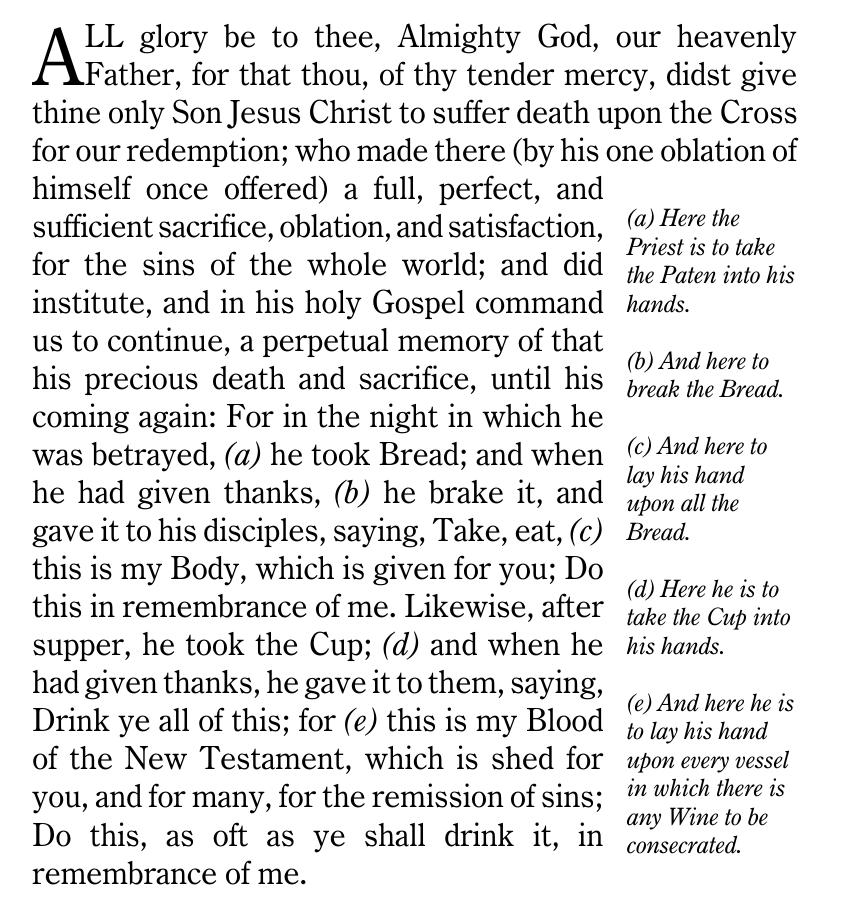
The New Testament teaches a different concept. Christ’s sacrifice is once for all, sufficient and complete. He is our great High Priest and the priesthood of Temple Judaism is abolished as insufficient. As the resolution states, we are all priests, albeit not sacrificing ones as his sacrifice is all that’s needed. In a sense one result of Jesus Christ’s finished work on the Cross is that we all got a promotion.
That being the case, this resolution needs to be backed up by giving our laity a larger voice in the course of the church. We could start with restoring the pastoral preference vote, which hasn’t done anyone any favours. This also speaks to the pastoral concept I discussed in the previous resolution.
Biblical Worldview
This is always a good thing to have. The problem in implementation is that churches like ours don’t integrate the Scriptures very well with the world around us. That’s something that Roman Catholicism has done a better job of, although it has laid eggs of its own, as the previous resolution commentary demonstrates. Taking some judicious lessons from them would be useful, and might avoid losing people who are ideal in background for our church like Vice President J.D. Vance.
But I’ve gone to meddling…I better shut up. To paraphrase Origen, this blog post having reached a sufficient length, we will bring it to a close.


Thank you for explaining these items. For us outsiders (I’m ACNA), it’s hard to figure out what the resolutions are about.
LikeLike
For a church with a centralised, Episcopal government, the Church of God is sui generis.
LikeLike