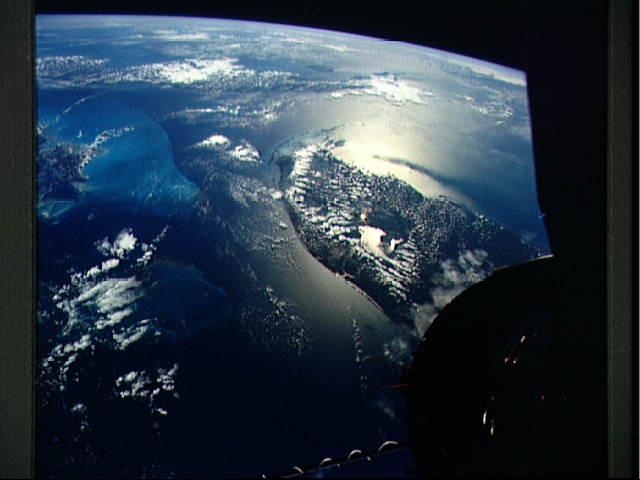
The recent “there and back again” of Artemis II is an achievement, even if it only beat the previous record by a small proportion. It’s tempting to say that “we’ve done this before” but that should be tempered by two facts: the fact that we did it after a half century gap when the learned experience had largely faded into the past, and the fact that we did it at all. That wasn’t a given in the wake of the way we walked away from the program the last time, content with earth orbit–albeit with some substantial spacecraft and long stays.
Back in the day there were people out there who were ready to push forward–and those who were pushing back–as I documented in my 2019 piece The Day Science Died:
I recently read a book I picked up entitled Space Frontier by Wernher von Braun. It’s basically a series of articles he wrote for Popular Science from the early 1960’s until just before Apollo 11 in 1969, covering various aspects of the space program and accurately describing the moon mission that shortly took place. von Braun was more than a rocket scientist: he was a visionary who saw us going to Mars in 1986, and had a good idea what it would take to accomplish this.
When I read this book, the first thing that came back to mind was the tight relationship between NASA’s civilian efforts and that of the military. That was inevitable, not only because most of the early astronauts were military pilots, but also because rocketry was very much a province of the military. I wish I had read this book before or during my time in the aerospace industry; it would have given me context for my work.
But the other thing that came in reading this book was an ache–an ache for a time when we were literally reaching for the stars (or at least the moon.) The passing of that time–something that basically lost its momentum after the moon shots and never quite got it back–is a point in history when something seriously died in this country, and that was a general commitment to the advancement of our state with science…
But by the time Armstrong and Aldrin set foot on the moon, the mood had changed. The 1960’s were a decidedly Luddite time; technology was blamed for despoiling the environment and creating the “few minutes to midnight” atmosphere of the Cold War. Those who plied their trade in technology were “nerds.” The space program collapsed and the aerospace industry went with it. A new generation turned away from technology to more “relevant” (and easier way up) professions such as law and finance. Instead of landing on Mars in 1986, we were in angst (something we’ve gotten good at) over the explosion of the Challenger.
Fortunately there were two revolutions going on. It took some time (one wonders if pushing the space program would have speeded it up) but the revolution in computing power was changing the landscape. Would the nerds get their revenge? Well, sort of…but people whose training is in the sciences were still very much in the back seat of our society, in contrast to other parts of the world.
It took the initiative of people who are otherwise unmentionable in fashionable circles to get it going again. It’s true that Elon Musk is trying to fulfil von Braun’s vision of going to Mars, but it’s good that NASA is coming back to the mission that made it great.
The one thing we still need to do–and there’s no sign of meaningful movement on this–is shifting the centre of gravity (in itself a scientific concept) of our educational system from the “arts” (such as they are these days) to a scientific one. I am guaranteed to get a hostile response to this when people figure out that’s what I’m saying, but I’m sticking with it: in a world driven by science and technology, ignorance of same is deadly.
No where was this more in evidence than our response to COVID. I commented on the aftermath of that fiasco here:
In addition to the factors you mentioned, there were several others that made COVID-19 such as fiasco in the U.S.
The first was the fact that it invaded a population with many co-morbidities, such as age, cardiovascular disease, diabetes, etc.. It almost seems from that respect that COVID-19 was made to attack our population.
Second, the powers that be decided from the beginning that any cure/prevention for the disease disseminated have an unexpired U.S. Patent. That’s why things such as hydroxycholoroquine or ivermectin were shunted aside, irrespective of their merits or lack of same.
Third, the introduction of mRNA vaccines on a population of 300+ million with as relatively little dissemination of these vaccines (and with as little testing as was done due to time constraints) was irresponsible. But our powers that be used Americans’ obsession with “the latest and the greatest” to attempt to popularise this, up to and including a disinformation campaign against J&J.
Fourth, our authorities spoke with scientifically unjustified certainty about the way to combat the spread of the virus. We went into this “behind the eight ball” of knowledge and should have been more up front about that. When things didn’t go the way they said they would, trust was eroded. I discuss the whole business of certainty (or lack thereof) in scientific and engineering processes in my post Teaching Secular Blasphemy.
Fifth, the way reputable people were treated who dissented from the solutions determined was shameful. I’m thinking primarily of those who signed and supported the Great Barrington Declaration.
Sixth, HIPAA made effective contact tracing impossible, thus the lockdown was the only alternative, collateral damage following.
I happen to teach a specialty (geotechnical engineering) which is basically an applied earth science. As such uncertainty due to the complexity of the environment is part and parcel with the field. Engineering students find that hard to take sometimes but they need the perspective. You can view my engineering courses (with the videos I produced for COVID) here.
I could go on with the effects of our deindustrialisation, which has hampered our efforts both in Ukraine and more recently in Iran.
The jury is still out on whether real science and its validator technology will assume the place they deserve in our society or whether they’ll just be drug out from time to time for the convenience of our power holders.

