
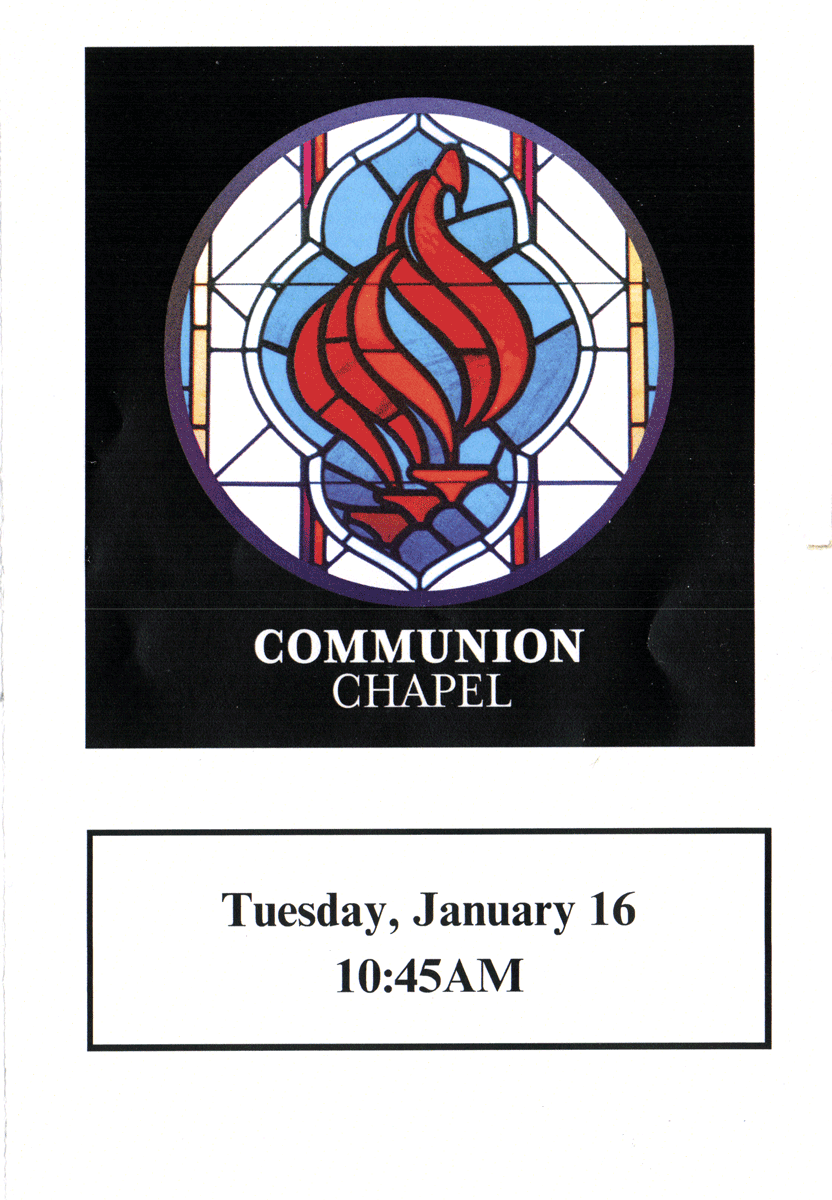
Most of you who have followed this blog know that I was able to do two series at my local church (the North Cleveland Church of God) on liturgical worship and the liturgical calendar. That’s not something that is typical in a Pentecostal church, but it isn’t unique either; I’ve been aware of things going on outside of the church, and some of those things have been taking place at Lee University, where I started teaching last fall. My schedule allowed me to attend the monthly event called “Communion Chapel” (it used to be called Liturgical Chapel but that made people nervous.) It is an official part of the chapel system that students are expected to take part in at Lee; there are a variety of services.
The whole business of exvangelicals has been one that I have dealt with because it looms large in the life of the ACNA and other liturgical churches. This is different in one important respect: it lives in a Pentecostal institution. Although liturgical worship is certainly in the Wesleyan-Holiness tradition (and John Wesley himself was a lifelong Anglican) most Pentecostal churches have eschewed liturgy as “formalism” (following Baptist characterisation) and thus unspiritual. That runs against my own experience during the 1970’s in the Catholic Charismatic Renewal; although much of that worship was not liturgical, there were definitely Charismatic Masses, especially at the Steubenville conferences for young people. So the possibility of seeing the two combined again was intriguing to me.
The director of this chapel is the Rev. Dr. Heidi Johnson. When I emailed her to confirm they were having it on the appointed date, she advised me that “Communion Chapel is tomorrow in The Chapel beginning at 10:45 – however, seats fill up fast, so I recommend coming a bit early.” Now Lee’s chapel isn’t the biggest I’ve seen (yes, Anglicans, I always mentally compare structures like this to Bethesda) but she was right: it was full.
Since I said these were “impressions” I’ll present them in that way.


- The order of service is above, although it doesn’t cover the liturgy completely like a missal or BCP would. It’s definitely a “Gregory Dix” type of liturgy. It is concise; this is doubtless to fit the time constraints, but liturgies from outside (and sometimes inside) churches that do this for a living can be sprawling, unwieldy businesses. Vatican II’s advice that liturgies must be “distinguished by a noble simplicity; they should be short, clear, and unencumbered by useless repetitions; they should be within the people’s powers of comprehension; and normally should not require much explanation” is a good one.
- The music—which, as you can see, is well supported by the music department—is very traditional by Evangelical or Pentecostal standards. The organist takes me back to childhood church music in the “Old High Church” tradition on a pipe organ. In this case, however, it’s on an Allen. (Note to Anglican churches: real pipe organs are high maintenance, especially in hot and humid climates, most of you would be better off with an Allen.)
- The liturgy includes a penitential rite. This may not seem revolutionary to some but in an Evangelical or Pentecostal churches it is; these are generally absent from such services, even though doing it before communion is scripturally mandated! The one used here admittedly did not require Lee students to characterise themselves as “miserable offenders” (which was totally justified for us back in Palm Beach) or recite a “mea culpa” but it was there all the same. The lack of penitential rites is a product of a theology of unconditional perseverance, which is sad to say creeping into our church.
- In an Evangelical way, the liturgy uses scripture through direct quotations, even outside of the liturgy of the Word. One of the geniuses of the traditional Anglican liturgy is that Cranmer was skilled in kneading the scriptures into the liturgy in a seamless way, which made for a smooth liturgical flow.
- The communion itself is a study in contrasts. On the one hand, we can all thank God that it does not endorse Bill Clinton’s Eucharistic Theology. On the other hand it is done by intiction, which is good in and of itself but brings back memories of Intiction: “I Don’t Think You Can Do That.”
- The “Lee Benediction” at the end is “Let the words of my mouth, and the meditation of my heart, be acceptable in thy sight, O LORD, my strength, and my redeemer.” (Psalms 19:14 KJV) It is the banner scripture of the University. Fans of traditional Anglican Morning and Evening Prayer will recognise it as one of the sentences at the start of those liturgies, which means I’ve been preparing for Lee for a lifetime.
This takes place once a month. One suggestion would be to fill the rest of the slots with Morning Prayer, something that Wesley himself included in the prayer book he prepared for the new United States.
So what to make of all this?
- It’s not the “Old High Church,” although it reaches for that at times, especially with the music.
- It’s not the “Old Folk Mass,” although with its deep talent bench Lee could certainly do that (it showed that during the revival the year before last.)
- It’s not the “Old Time Religion” either. In a sense it’s a rejection of the Scots-Irish roots of the church, roots that haven’t quite found wings, especially in the face of the praise and worship movement, which can be shown to have some roots of its own in the Catholic Charismatic worship of the 1970’s.
I’m inclined to think that, for all the interest in liturgical worship by exvangelicals and those who are just looking for something different, this kind of worship will remain an acquired taste in American Christianity. For those of us who acquired it at the start, Communion Chapel may not be exactly what we had in mind, but after all of the years of liturgical upheaval “we” aren’t exactly univocal about what to do better. For me, the best solution is where the burden of our sins becomes intolerable before the comforting words. But now, as Origen would say, this piece having reached a sufficient length, we will bring it to a close.
 Positive Infinity