
A priest I know wrote many years ago (and I paraphrase here), “There are two cardinal rules: You don’t change the faith, and you don’t break the church.” The Episcopal Church, in redefining marriage, has changed the faith. Those who departed to form the ACNA have broken the church. Both have grieved the Holy Spirit, and undermined the witness of the gospel. Two decades on, this is the sad legacy of 2003.
His account of the events that led up to the formation of the ACNA, the expensive and torturous (and unnecessary) litigation over the property is an interesting one, but I think it leaves out a few things.
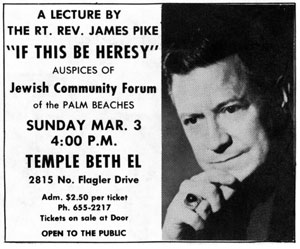
The first one is that what happened to the Episcopal Church long antedates the crisis detonated by V. Gene Robinson in 2003. It goes back to at least the 1960’s and the church’s failure to deal with serious problems such as James Pike. As I noted in this piece, the Episcopal Church blinked because it was more concerned about its image than in defending the faith that was entrusted to it. And that was in the 1960’s.
After all that–the erosion of belief in the objective reality of God and the Scriptures, WO, and last but not least that dreadful 1979 BCP–things settled down in an Episcopal Church that had already shrunk from its 1960’s high water mark. Martins, by his own admission, says that “While there were many openly gay and lesbian priests in the Episcopal Church by 2003 (though not without significant controversy from the 1970s to the 1990s), no bishop had been so open when elected.” Why he wouldn’t expect the next stop to be taken–and succeed–is hard to understand. But succeed it did.
I thought at the time–and still do–that it’s a sad commentary on a the Episcopal Church that had been on the track as long as it has–and longer than people like Martins cared to admit–had so little substantive pushback, either by those who left or those who stayed, until 2003. To some extent how far to port that things were in the Episcopal Church depended upon where you were and at what level you operated. Parishes went on as they were for years (a few still are) unbothered about what was going on “upstairs.”
But to say that the people who ultimately formed the ACNA–to say nothing of other groups or even the Continuing Churches which barely made a dent in the 1970’s–were guilty of “breaking the church” is a stretch. There were those who were moving in for vainglory or a purple shirt. As Greg Griffith noted nine years ago when he and his family swam the Tiber:
…the promise of the orthodox Anglican movement outside of The Episcopal Church never materialized either. Populated as that movement is by many good people, it has the institutional feeling of something held together by duct tape and baling wire. It is beset by infighting and consecration fever, and in several of its highest leadership positions are people of atrocious judgement and character.
But that’s the nature of church politics. The Episcopal Church ultimately broke itself. To blame those who departed for “breaking the church” in this circumstance is unfair.
Since were on the subject of “breaking the church,” how about those of us lay people who, when faced with the choices given us–and without the option of starting a new denomination–we had two choices: stay and experience the rot of our faith or leave and try to grow in grace somewhere else. It would take someone deep into what we call in the Church of God “preacher religion” to completely discount the schismatic nature of leaving a church, but it is in reality a chip in the glass. When it happens often enough–and the Episcopal Church has seen that over the least half century plus–we have a large breakage. But again we come back to who really caused it.
At the time I began my own exit from the Episcopal Church, I wasn’t told I was breaking the church, but I got some interesting responses. One of the rectors at Bethesda, sagely noting that the church was about people (the truth of this didn’t come through to me until I worked here) then informed me that I needed to forgive, effectively casting it as a personality conflict. While there were certainly elements of that, I was on a quest for answers in life and a church which would furnish them, and honestly the Episcopal ministers on either end (church or prep school) were not furnishing them.
After I began the Tiber swim, things shifted. To some extent going to the Roman Catholic Church from the Episcopal one is playing a trump card, as I pen in this dialogue from my fiction:
“Is there any question about the validity of the sacraments of the Roman church?” Julian asked.
“There’s never a question there—it’s ours that seem to always be in doubt,” Desmond answered. The Bishop glared sourly at Desmond.
“No, dear Julian, there isn’t,” the Bishop admitted.
But then I started getting the usual Episcopal canard: “You’re not allowed to think as a Roman Catholic.” (I’ve heard my fellow Palm Beacher George Conger repeat that on occasion.) Growing up in a very authoritarian home, that wasn’t much of a change of scenery, but I found Catholicism has a very deep intellectual tradition and furnished answers to many of my questions. It also never seems to occur to Episcopalians that Anglican Fudge and fence-riding aren’t very good alternatives to serious answers.
But I digress…many things have occurred to all of us since that time. I joined the Anglican blogosphere because I sensed that, finally, someone in the Episcopal church wanted to really stand up for the faith and do something about it. That fact that it ended in the formation of the ACNA–and the jury is still out even after all this time as to whether that body will fulfil its mission–was in my mind unavoidable if dreadfully unpleasant. Again, to accuse people in this circumstance of “breaking the church” is unfair, although the process is certainly painful, as the Episcopalians and Anglicans know and the Methodists are finding out.
In the years I’ve been active in this world I’ve had the chance to meet online many people, some of whom a) have stuck it out in the Episcopal Church and b) retained their orthodoxy. It’s too bad these people (or people like them) weren’t in my life when I was making the decisions I did; I would have liked to have them as Rector and still would under different circumstances. When messy situations arise like this, people are forced to make all kinds of hard decisions. Ultimately the bar of eternity is where we account for those. But had the Episcopal Church focused more on that destination, we wouldn’t be in the mess we’re in now, would we?
 Positive Infinity
Now we’re cooking. TEC definitely became hired hands at some point pre-2003.
I feel zero guilt about leaving however. Partly, because TEC at the priest and bishop level were so uncomprehendingly unrepentant about mistreating me. And partly because I prayed about leaving and felt very clearly that I needed to go to avoid losing personal decency. That the clergy I knew were heretics whose ideas seemed pretty linked to their abusive personal conduct was further impetus.
But that was me and I wasn’t a leader. I guess I feel about ACNA that if it was ok for the Reformation to bail on the Roman Catholics, then it’s ok to bail on TEC for similar issues around corruption.
What do you think about ACNA and why was their litigation unnecessary? I agree with Paul not to sue brothers but don’t know the gist of the legal fights.
LikeLike
It always amazes me that (especially) Anglo-Catholics like Martins lament schism but never stop and consider just this simple fact. You really want to fix schism, you swim the Tiber. But having done that, I can say that there are problems there too, which I have discussed at length.
The institutional loyalty that TEC inculcates in its people always amazes me, esp. since it also cultivates lack of external enthusiasm. The fact that, faced with what was going on in TEC (your emphasis on corruption is something of a novel take,) Episcopalians finally mobilised themselves to do something substantive is amazing. I think at heart the ACNA is one of those things that had to be done to preserve the integrity of the faithful. But leaving–be it at a personal or institutional level–is always painful.
The problems that ACNA had from the start were daunting, however, and a fairer take is that, instead of lamenting the problems they’ve had, we should celebrate that it works as well as it does.
The first problem is the equivocal (I’m using that in a Thomistic sense) baggage it carried over as an Anglican church, some of which goes back to the very start of the Church of England. We have Low Church, High Church, Reformed Anglicans, Anglo-Catholics, and the Charismatics (who formed a larger part of the ACNA’s formation than the rest care to admit.) Last but not least we had WO; the ACNA has basically kicked the can down the road by leaving it at a diocesan level. (This is an issue which will also bedevil GAFCON and the Global South moving forward, the same variations can be seen at a provincial level as well.)
The second is its institutional formation. What I call the “Anglican Revolt” was sponsored by more than one province. The idea was that the churches would have indirect communion with Canterbury in spite of its refusal to formally recognise them. (I think the ACNA has too many people fixated on this issue, but as time passes the appeal of this fades.) When it came time to pull things together, things could get tricky.
The third is related to the second, it’s what I call the “Egos Inflatable to Any Size” issue. The Continuing Churches have had their share of this and are now working to sort this out.
As far as the litigation is concerned, the decision to turn it into the expensive slugfest rests with KJS and the TEC. Faced with declining membership and the need for cash that this induces, the most sensible solution would be to use the Dennis Canon to force the churches and dioceses that were leaving to “pony up” on departure. Some bishops were trying to do just that; unfortunately, KJS is one of those people who believe that real justice doesn’t happen until you win in court. I also think that she was trying to use TEC’s legacy financial strength to destroy the ACNA before it got started. As Martins points out, the results were mixed; had they chosen the settlement route, TEC could have resolved things with less acrimony and more money in the bank at the end.
LikeLike
There are a lot of great Catholics, and the Catholic Church has some real humility in its social breadth and wisdom in its rich intellectual depth. But the mass child rapes and mass coverup at the senior level are utterly horrible. I can’t join that. I suspect clericalism going back to importing Roman Empire style hierarchy played a big role in the child abuse catastrophe. Anglicans of all stripes maybe have less to worry about from clerical celibacy but again I suspect that clericalism and hierarchy are the real problem. And Anglicans are only somewhat more democratic on those fronts. So I worry about that for Anglicans, that they have a core form of organization that is off, too Roman Empire. Maybe, I should become a Quaker but they seem too open to anything. No idea what the answer here is, but my guess is that Anglicans will have centuries old, deep problems until they really involve the laity more.
LikeLike
Because I didn’t “swim the Tiber” until I was 17, I avoided that horrible mess. The RCC compounds the problem with their Ultramontane structure, something that Anglicanism has mercifully avoided. But, yes, lay involvement in both cases would go a long way to fixing many of the problems. Today I’m in a Pentecostal church for these reasons.
LikeLike
Agree on KJS. Just wonder if the ACNA could have walked away from the property?
LikeLike
After it became apparent that “you can’t take it with you,” many parishes did just that. That’s what happened in this case.
LikeLike