-
“Old High Church” Planting–North American Anglican, with Some Comments
Ah, the Old High Church…
The popularity of the Old High Church–both in the Colonial period and in the years immediately after World War II–is something that flies in the face of a lot of Evangelical church growth orthodoxy. How is it possible to grow a church with such as specific form of worship? How can a church expand if its appeal isn’t broadly popular?
The simple answer, from a Palm Beach standpoint, is this: the Episcopal Church didn’t appeal to many people but the right people, and same–demographically elevated and aesthetically minded–responded. That explains the growth of the Episcopal Church in both periods.
One thing the Episcopal pioneers and their Evangelical opponents would agree on, however, is that in order to grow a church you need two things: commitment to the basic message and way of the church you’re promoting and organisation to back it up. That realisation comes from years in church work and it’s something that eludes many who would like to make it happen.
As a product of the Old High Church, I find there are relatively few people who really want to bring it back, much less make it a vehicle of church growth. So what happened? There are several factors.
The first is the demographic elevation that results. Today the Episcopal Church is filled with people who are relatively well to do, white and old. There is no game plan to find “trads” who will fill an Old High Church, and frankly in the Episcopal Church there is no viable game plan to fill the pews with anyone else either.
The second is the aesthetic appeal, which has been a reliable draw for the Episcopal Church. That kind of appeal, however, draws people who are long on the way the church worships and short on what the church actually teaches and believes, which means that when the liberal seminaries and the ministers they turned out lurched the church leftward from the 1960’s onward, the aesthetically minded let things pass.
The third is Anglo-Catholicism. Say what you will about “formalism” and “vain repetition,” the Old High Church was essentially Protestant in doctrine and belief. Today, however, virtually any church which uses the 1928 BCP–or any other traditional Anglican prayer book–is Anglo-Catholic to a greater or lesser degree. Obviously this started with the Oxford Movement but in times closer to the present the ecumenical movement has made union with Rome an obsession. As someone who went from the Old High Church to the Old Folk Mass in two years, my question is simple: What is Catholic? Is it all the frilly vestments you wear, including those birettas? Is it the Latin interjected into the Mass, like EWTN does? Does this and everything else make the sacraments more valid? Were ours invalid because we strummed guitars during the NOM? (Confession: we actually cheated and offered the Eucharist in both species before it was legal in the U.S., although it was Texas…) And where is the Roman Catholic Church really going after the present Occupant of the See of St. Peter goes to meet God, a serious question for all of us?
I really think that the Anglican/Episcopal world–all of it–would do well to stop and consider these questions before allowing Evangelical and Catholic alike to lead those who don’t understand the tradition astray.
-
My Impressions of “Communion Chapel”
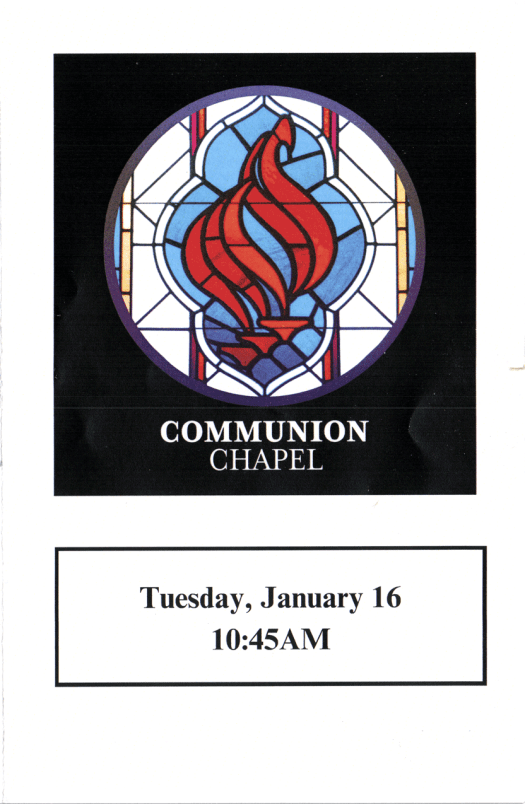
Most of you who have followed this blog know that I was able to do two series at my local church (the North Cleveland Church of God) on liturgical worship and the liturgical calendar. That’s not something that is typical in a Pentecostal church, but it isn’t unique either; I’ve been aware of things going on outside of the church, and some of those things have been taking place at Lee University, where I started teaching last fall. My schedule allowed me to attend the monthly event called “Communion Chapel” (it used to be called Liturgical Chapel but that made people nervous.) It is an official part of the chapel system that students are expected to take part in at Lee; there are a variety of services.
The whole business of exvangelicals has been one that I have dealt with because it looms large in the life of the ACNA and other liturgical churches. This is different in one important respect: it lives in a Pentecostal institution. Although liturgical worship is certainly in the Wesleyan-Holiness tradition (and John Wesley himself was a lifelong Anglican) most Pentecostal churches have eschewed liturgy as “formalism” (following Baptist characterisation) and thus unspiritual. That runs against my own experience during the 1970’s in the Catholic Charismatic Renewal; although much of that worship was not liturgical, there were definitely Charismatic Masses, especially at the Steubenville conferences for young people. So the possibility of seeing the two combined again was intriguing to me.
The director of this chapel is the Rev. Dr. Heidi Johnson. When I emailed her to confirm they were having it on the appointed date, she advised me that “Communion Chapel is tomorrow in The Chapel beginning at 10:45 – however, seats fill up fast, so I recommend coming a bit early.” Now Lee’s chapel isn’t the biggest I’ve seen (yes, Anglicans, I always mentally compare structures like this to Bethesda) but she was right: it was full.
Since I said these were “impressions” I’ll present them in that way.


- The order of service is above, although it doesn’t cover the liturgy completely like a missal or BCP would. It’s definitely a “Gregory Dix” type of liturgy. It is concise; this is doubtless to fit the time constraints, but liturgies from outside (and sometimes inside) churches that do this for a living can be sprawling, unwieldy businesses. Vatican II’s advice that liturgies must be “distinguished by a noble simplicity; they should be short, clear, and unencumbered by useless repetitions; they should be within the people’s powers of comprehension; and normally should not require much explanation” is a good one.
- The music—which, as you can see, is well supported by the music department—is very traditional by Evangelical or Pentecostal standards. The organist takes me back to childhood church music in the “Old High Church” tradition on a pipe organ. In this case, however, it’s on an Allen. (Note to Anglican churches: real pipe organs are high maintenance, especially in hot and humid climates, most of you would be better off with an Allen.)
- The liturgy includes a penitential rite. This may not seem revolutionary to some but in an Evangelical or Pentecostal churches it is; these are generally absent from such services, even though doing it before communion is scripturally mandated! The one used here admittedly did not require Lee students to characterise themselves as “miserable offenders” (which was totally justified for us back in Palm Beach) or recite a “mea culpa” but it was there all the same. The lack of penitential rites is a product of a theology of unconditional perseverance, which is sad to say creeping into our church.
- In an Evangelical way, the liturgy uses scripture through direct quotations, even outside of the liturgy of the Word. One of the geniuses of the traditional Anglican liturgy is that Cranmer was skilled in kneading the scriptures into the liturgy in a seamless way, which made for a smooth liturgical flow.
- The communion itself is a study in contrasts. On the one hand, we can all thank God that it does not endorse Bill Clinton’s Eucharistic Theology. On the other hand it is done by intiction, which is good in and of itself but brings back memories of Intiction: “I Don’t Think You Can Do That.”
- The “Lee Benediction” at the end is “Let the words of my mouth, and the meditation of my heart, be acceptable in thy sight, O LORD, my strength, and my redeemer.” (Psalms 19:14 KJV) It is the banner scripture of the University. Fans of traditional Anglican Morning and Evening Prayer will recognise it as one of the sentences at the start of those liturgies, which means I’ve been preparing for Lee for a lifetime.
This takes place once a month. One suggestion would be to fill the rest of the slots with Morning Prayer, something that Wesley himself included in the prayer book he prepared for the new United States.
So what to make of all this?
- It’s not the “Old High Church,” although it reaches for that at times, especially with the music.
- It’s not the “Old Folk Mass,” although with its deep talent bench Lee could certainly do that (it showed that during the revival the year before last.)
- It’s not the “Old Time Religion” either. In a sense it’s a rejection of the Scots-Irish roots of the church, roots that haven’t quite found wings, especially in the face of the praise and worship movement, which can be shown to have some roots of its own in the Catholic Charismatic worship of the 1970’s.
I’m inclined to think that, for all the interest in liturgical worship by exvangelicals and those who are just looking for something different, this kind of worship will remain an acquired taste in American Christianity. For those of us who acquired it at the start, Communion Chapel may not be exactly what we had in mind, but after all of the years of liturgical upheaval “we” aren’t exactly univocal about what to do better. For me, the best solution is where the burden of our sins becomes intolerable before the comforting words. But now, as Origen would say, this piece having reached a sufficient length, we will bring it to a close.
-
The Pre-Vatican II Catholic Church’s Stand on Abortion
As sort of an aside to The Elephant in the Room on Baptismal Regeneration, this, from Farrell’s Parish Catechism:
Is abortion always a mortal sin? Abortion–willfully causing the death of an unborn baby–is always murder, even when suggested or demanded by a surgeon for any reason whatsoever.
Abortion is the murder of the innocent unborn infant. Abortion also renders the Baptism of the infant impossible; therefore the baby can never get to heaven. Permission from the bishop to forgive this sin must be obtained by the confessor
before he can forgive the sin of a Catholic who knowingly and willingly causes or helps cause an abortion.When Paul VI–yes, that Paul VI–set forth Humanae Vitae in 1968, people acted like it was a surprise and a change in the Church’s position. That wasn’t the case; Paul VI oversaw many changes in the Catholic Church (most notably the Novus Ordo Missae) but this wasn’t one of them. That also includes contraception; you can read it in his Parish Cathechism.
-
The Elephant in the Room on Baptismal Regeneration
I’ve been thinking about posting on this topic, but, in their inimitable way, North American Anglican has posted this. Like many things in Christianity (vernacular liturgy being an important example,) Anglicanism has wrestled with many things it inherited from Roman Catholicism long before the Catholics did, and this is one of them. The core of the article linked to above is that the idea of baptismal regeneration is, in the Anglican tradition, equivocal, to use a good Thomistic term. And unfortunately that’s not unusual.
Let’s start with the starting point, i.e., what they inherited from Roman Catholicism. I’ll pick a couple of catechisms that I just happen to have on hand. Let’s start with the catechism of Joseph Deharbe, S.J. This is from the Sixth Edition (1908,) although earlier editions date back to at least 1876. His definition of baptism is as follows:
What is Baptism? Baptism is a Sacrament in which, by water and the word of God, we are cleansed from all sin, and re-born and sanctified in Christ to life everlasting.
He is quick to sharpen his definitions as follows:
Why do you say that ‘in Baptism we are cleansed from all sin?’ Because in Baptism original sin. and all the sins committed before Baptism, are forgiven.
Is also the punishment due to sin remitted? Yes; the temporal as well as the eternal punishment is remitted in Baptism.
Let’s jump ahead a century to Walter Farrell’s, with which I was received into the RCC. This is from the 1955 edition:
What is Baptism? Baptism is the Sacrament which cleanses you from Original Sin and personal sin, too, if you are sorry for these latter, and gives you the life of grace, making you a child of God, a brother of Christ, a member of His Church.
He doubles down on those who neglect to baptise their infants:
Is it a serious sin to neglect to baptize a baby? If you neglect the Baptism of your infant you commit mortal sin. A baby who dies without Baptism cannot enter heaven and will never see God.
Unbaptized babies will be free from suffering and will probably enjoy a certain peace and happiness in the next world, but will not have the vision of God.
Farrell’s cathechism was revised in 1970, after Vatican II, and the second quotation was modified as follows:
Is it a serious sin to neglect to baptize a baby? If you neglect the Baptism of your infant you commit mortal sin. It is extremely doubtful that unbaptized infants will go to heaven.
Here we see a shift in Baptismal theology, one which evidently Farrell’s catechism is drug “kicking and screaming.” The “elephant in the room” of this whole debate is that, as anyone who has read Dante’s Inferno knows, the Catholic Church taught through the Middle Ages and down to Vatican II that unbaptised infants would end up in Limbo because the principal purpose of baptism was to wash away the effects of Original Sin, a concept set forth by Augustine and which has become standard theology in the West. This explains the urgency regarding the baptism of infants in traditional Catholic practice.
Ending the teaching that Limbo exists only shifted Limbo from the afterlife to this one. If there is no eternal penalty for being unbaptised, what’s the point? It was here that Roman Catholicism has shifted the emphasis from the eternal benefit to the temporal one, by elevating baptism as the initiation into the church and the graces that come from being baptised. This has led to a great deal of the swelling rhetoric that we hear now on the subject, not only from the RCC but from Anglo-Catholics and Affirming Catholics alike.
Anglicanism wrestled with this problem from the start, since it wisely realised that Limbo had no Biblical warrant. The result, as the North American Anglican article notes, is that there was at least a bifurcation in thought on the extent of baptismal benefit and the real meaning of the term “baptismal regeneration.”
I think that the major loss in this whole debate–which has been going on for half a millennium now–is putting the eternal consequences of baptism front and centre rather than diverting the discussion to the temporal ones. Roman Catholicism’s answer was wrong but it was an answer, and that’s more than we see from those both in the RCC and Anglican/Episcopal worlds who have tried to pick up the pieces since.
-
Frank Gough: Another Sad Story with Palm Beach Roots
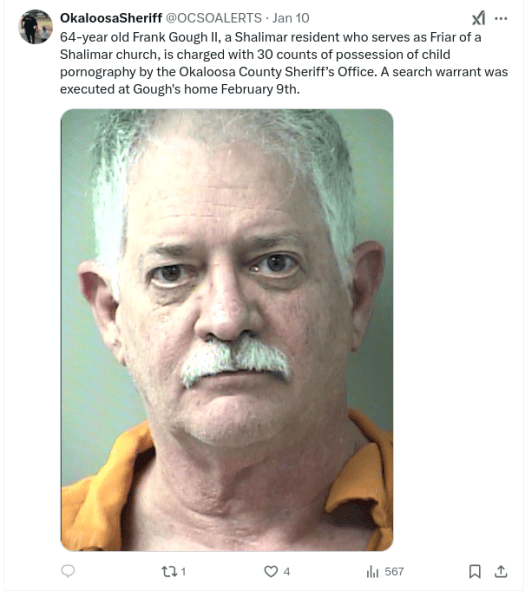
The ACNA has yet another alleged sex abuser on their hands. as you can see above,
His start in life is interesting, to say the least:
Gough grew up in Palm Beach County. His mother died when he was young and his father worked 18-hour days. Gough, the grandson of wealthy Palm Beach socialites, began to rebel. At the age of 10 he started doing drugs. By 17 he led a motorcycle club and sold drugs.
It’s possible that I knew (or knew of) his grandparents, or that he had spent time at Bethesda. But his story is illustrative of two things I have learned in life.
The first is that starting out or ending up in high places doesn’t guarantee that you have character or moral superiority. One thing I have found out the hard way in getting “off the island” is that people really believe that the wealthy have both, which has been a bane of evangelicals getting this country “back to God.” I think the recent populist tilt in American politics represents the dawning of the realisation that this isn’t always the case, but old ways die hard…
The second is that the ACNA should realise that people with activity such as this person is accused of can be found in lots of places, as conservative churches could have told the ACNA from the start. (Full disclosure: I am on the board that deals with moral failure in ministers in my own church.) The blogger of a living text isn’t optimistic of the ACNA’s track record in dealing with problems like this. Instead of throwing shade, anyone in the ACNA who would like some overview of how we deal with people like this should visit this website and I’ll be glad to discuss this.
-
Reformed vs. Re-formed: A Synopsis–North American Anglican
I did my best to follow this back and forth, but it wasn’t easy. For me, however, the key point finally came here:
The crux of this dispute is the nature and substance of the English Reformation. The basic facts of what occurred during the English Reformation are generally agreed upon, but its larger significance and bearing on Anglican identity remain contested. To mention a few concrete examples of such disagreements, on Sutton’s understanding, Reformed Continental influence was minimal; the “specific Protestant Evangelical and Reformed” character of the English Reformation was confined to the short reign of Edward VI;[1] and “the Homilies such as the one ‘On Peril of Idolatry,’ were never fully enforced nor considered to be doctrinally binding in the Church of England.” Historical judgments inform both normative and factual judgments about contemporary Anglican theological identity, and if agreement on the import of the relevant history cannot be reached, then the resulting divide over the character of Anglicanism will be difficult to overcome indeed.
With that in hand:
- A big part of the problem is that “Reformed” these days is equated with TULIP Calvinism or one of its variations. I think that was a serious weakness in Iain Murray’s Evangelicalism Divided: A Record of Crucial Change in the Years 1950-2000; he is evidently of the conviction that, outside of Calvinism, there is no Reformed religion. But, as I’ve pointed out before, the BCP doesn’t support that for the English Reformation, neither does Article XVI. The earliest Continental influences on the English Reformation were Lutheran, not Calvinist. Cranmer definitely wanted a “Reformed” type of Christianity but not in the sense we say that today. Behind much of the struggle for the “soul of England” in the subsequent century and a half was that very issue.
- Tied to the whole topic of whether a church is Protestant or not is whether we accept the Roman Catholic Church’s basic view of itself as an active mediator between God and people. I think that many in the Anglo-Catholic community implicitly accept this without thinking through the implications. Again the BCP accepts the power of “binding and loosing” but severely restricts the church’s choices in implementing that power. Roman Catholicism goes much further than that, at least these days.
- I think fights over how many councils a church accepts is an exercise in futility. We’ve had churches reject ecumenical councils since Chalcedon, and although I don’t agree with them they’ve certainly written their history vis a vis the Muslims (who themselves can be seen as the logical conclusion of Nestorianism) in blood, especially of late. The Roman Catholics keep going on ecumenical councils since Nicea II, and of course since Vatican I the “infallible” Pope has really taken centre stage. As I said in my Book Review: Iain Murray’s Evangelicalism Divided: A Record of Crucial Change in the Years 1950-2000, “…the Catholic position on unity was the same as U.S. Grant’s to Simon Bolivar Buckner—no terms but unconditional surrender.”
As long as Anglicans continually try to harmonise their Christianity to anyone else other than the Scriptures and the Fathers, they will remain a waystation to other expressionions of the faith rather than the sui generis expression that it is.
Sailing the Last Voyage with Newton and Pascal
 Positive Infinity