-
South Korea and their Neighbour: Calling Their Bluff
Although the press covers it as if it’s a total shock, North Korea’s nuclear test is anticlimactic. Everybody–well, almost–knew they were working on nuclear weaponry. Now it’s official.
The main loser in this blast is South Korea, and not just for the obvious reason. They have been obsessed with reconciling themselves with their northern bretheren for a long time, not only for reasons of kinship but because they wanted to eliminate and dependency upon the U.S.–whose troops in the present they resent–and Japan, whose troops in the past they resent. Now their idea that this would be attainable in the forseeable future has gone up in radioactive smoke.
Cold wars with really intrasigent communists (the Chinese are too practical to fall into that category) are endurance matches, one the U.S. won in in the 1980’s. South Korea needs to understand that. They need to get away from doing what we almost did in the Cold War and realise that they need to stay the course until the North’s economy implodes.
Turning to another debacle, we know that Henry Kissinger has been telling President Bush that he needs to do the same in Iraq. But Bush is dealing with an entirely different dynamic in the Islamicists he faces in the Middle East. As we have pointed out time after time, the Arab world tends to be centrifugal, and Bush needs to exploit this and quit fighting the last war. But for those who still are, the rules are still the same.
-
What We Really Need This Election Year

-
When the Herald Sits on a Story, Something is Wrong
The Mark Foley thing–which, of course, does touch South Florida, as one would expect–seems to get deeper. Now we know that the Miami Herald of all papers sat on emails from Foley to the pages. Why? They weren’t explicit enough, and since he was a known homosexual…
Traditionally, the Herald isn’t known to duck a liberal cause when it sees one. Getting rid of Republican representatives is a liberal cause par excellence. It seems to me that their sitting on this is either poor journalism, esprit de corps with a man who is a member of a traditional liberal constituency, or just plain timing (wait until the election when your party is in striking distance, then hit them hard.) Or a combination of one or more of these.
As far as Foley being a homosexual is concerned, the Herald’s editor stated the following:Given the potentially devastating impact that a false suggestion of pedophilia could have on anyone, not to mention a congressman known to be gay, and lacking any corroborating information, we chose not to do a story.
Homosexuals generally resent their way of life being linked to paedophilia, but that’s implicit in the editor’s statement.
Where the animals are tame and the people run wild…
-
The Unexpected Lesson of Mark Foley
The Republicans got another–and unneeded–setback in their quest to retain control of the House of Representatives with the resignation of Representative Mark Foley over his sexually charged emails to some of his pages.
The fact that these are disgusting and that he needs to go is not in question, at least not for us. The whole Foley fiasco, however, illustrates the central problem of the current status of sexual activity under law in most Western countries.
At the start for predominantly Christian cultures, sexual activity was restricted to conjugal relations between a man and wife. This automatically excluded homosexuality (since marriage was and generally is between a man and a woman) and sex with and amongst minors (since marriage was restricted to adults.)
Unfortunately a central tenet of all kinds of left-wing movements is that sexual activity is a necessary centrepiece of a fulfilled, actualised life. So they started by allowing straight up, heterosexual fornication. To facilitate this, they forced the legalisation of birth control and abortion, which is the real meaning of Griswold vs. Conneticut and Roe vs. Wade.
The problem of that is simple: where do you stop? Once this move is made, the goalposts of legal sexual activity acquire wheels, moved around by whoever has the most push. The most obvious result of this was the SCOTUS’ nullification of anti-sodomy laws in Lawrence vs. Texas.
But why here? Most Americans find the whole idea of sexual exploitation of children revolting, but then again they didn’t like the idea of abortion on demand either. And there are forces that would like to change that, too, ones which are well entrenched in our elites. This explains the diffident attitude of many on a lot of the anti-sexual predator laws which come before our state legislatures.
While we’re on the subject, we should not forget that, in the past, a few cultures–and one in particular–used the kinds of sexual contact between Rep. Foley and their young charges as a way for the latter to move up in the world. We explored this issue last year and it bears repeating again.
The central problem with our current situation is that it sends seriously mixed signals to everyone, especially the young. We cannot on the one hand allow (and in our culture encourage) people to have unrestricted sexual activity in some areas outside of marriage and, once these people are aroused, put draconian restrictions on others and result in anything but confusion. And that’s where we are today. If we allow this situation to continue, in a generation the behaviour that cost Rep. Foley his seat in the House will become the real reason that young people go to Washington to be pages: to move up…
-
The Tree that Grows in Heaven
At the very end of the Bible, the following appears in the description of paradise:
On each side of the river was a Tree of Life which bore twelve kinds of fruit, yielding its fruit each month; and the leaves of the tree were for the healing of the nations. (Revelation 22:2, Positive Infinity New Testament)
 Those who are familiar with the Latin Vulgate translation–which dominated western Christianity for a thousand years–know that the "Tree of Life" is rendered there as the "lignum vitae." In turn many of you who live in South Florida or the Caribbean will recognise this as something that grows in places around you.
The phrase "lignum vitae" appears six times in the Vulgate. The first time takes place in the Garden of Eden: "And the Lord God brought forth of the ground all manner of trees, fair to behold, and pleasant to eat of: the tree of life also in the midst of paradise: and the tree of knowledge of good and evil." (Genesis 2:9) In addition to the quotation in Revelation cited above, it appears four times in Proverbs, in each case as something to be desired: "The fruit of the just man is a tree of life: and he that gaineth souls is wise." (Proverbs 11:30)
We see immediately that the lignum vitae brackets history. It appears at the beginning of history, in the place which God had made for Adam and Eve and, by extension, all of us. It reappears at the end, in the place which God intends for those of us who are his possession to live. Life is God’s intended state for us, and the lignum vitae is a reminder of that. The tree is a suitable reminder of this in its current state. It produces a hard, long-lasting wood which has been used in a wide variety of applications, sometimes as an alternative to metals. It takes a long time to grow. That’s one reason why it can be hard to find in our transient urbanisations. For those with the patience to grow it, it can be rewarding: it produces an attractive blue flower, is not a "messy" tree to have around, and it is regarded as a "showy" tree for landscaping purposes.
Unfortunately the lignum vitae has had a hard history in South Florida with the coming of large populations. It is an endangered tree. Its most famous habitat, the Lignumvitae Key, is protected. Such a state is a reminder that God created a paradise in South Florida, but man has largely ruined it, and not only from an environmental standpoint as well. In addition to the damage to the surroundings, living in South Florida is a sure cure for universalism, reminding one that, if there’s a default option in eternity, it’s not heaven.
Below: location of the Lignumvitae Key, near Islamorada.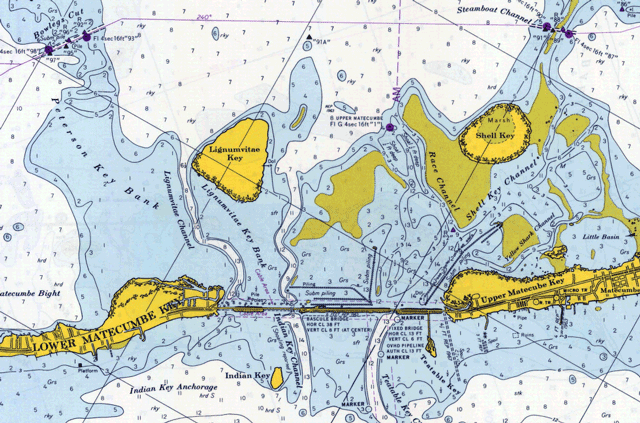
So is the lignum vitae the tree of life that Adam and Eve saw at the start and John saw at the end? We’d like to think so. Some of us who are rooted in South Florida–and, of course, our counterparts to the south, where it is the national tree of the Bahamas, for example–would like to think that the place we call home is a reflection of the final place that God has prepared for us, one where the stain of human sin is washed away and we can hear the following: "’See! the Tabernacle of God is set up among men. God will dwell among them, and they will be his Peoples, and God himself will be among them, and he will wipe away all tears from their eyes. There will be no more death, nor will there be any more grief or crying or pain. The old order has passed away.’" (Revelation 21:3-4)
The only part that the lignum vitae doesn’t match up with its heavenly rendition is the matter of the fruit. Surely being planted next to the River of Life will generate that. So when you see the lignum vitae, think in terms of this being the tree you will see once again if you make it to heaven.
-
Bill Clinton: Too Much Like a Union Meeting
Bill Clinton’s performance in his interview with Chris Wallace reminded me too much of some of the things I used to see during union meetings in my old family business. All too often, when the grievance filed didn’t have the merit they thought it had, at least one on the committee would blow up in front of us.
Clinton is a product of a "working man’s" background in Arkansas. I am too close to this for my own good; not too far north of where he grew up, my grandfather worked for the railroad for 44 years. I know a hothead when I see one, and watching him berate Chris Wallace I saw one who knew he was in trouble and whose only hope was to turn the tables by shoving emotion into Wallace’s face.
Back in the 1970’s my father attempted to fire one of his "hotheads" but lost in arbitration, in part because the aribtrator marked the grievant as a "sturdy yeoman." But when you’ve got a little of that Celtic "sturdy yeoman" in you, it’s hard to romanticise it. Moreover our "yeoman’s" basic problem was that he was running from God; if he had (and eventually did) put God first, many of the problems we had with him–and his own, really–would have been solved.
If we’ve advanced as far as we claim we have in this time of ours, we need to see Clinton for what he is and deal with him accordingly.
-
Anglicans after Kigali: Facing the Inevitable
The call from the “Global South” Anglican primates for a separate chuch for conservatives in the Episcopal Church is not to everyone’s taste, but it is inevitable.
It’s taken a lot of “Anglican Fudge”–to say nothing about institutional loyalty–for conservatives to remain in the Episcopal Church as long as they have. But the time has come to face reality, as we noted last summer in our piece The Communion of One. The Global South primates have done just that. It is not as easy as it looks to an outsider–and will be even more complicated if it’s applied to a state church like the Church of England–but there’s no other way out.
And the liberals? Since they have made church pointless, perhaps they should go out and celebrate the Fall Equinox with their pagan friends.
-
The Colonies are Actually Good for Something
Any American who has dealt with a British “cousin” (for some of us, at least) has sooner or later detected a note of condesension about those poor rude Americans in the “colonies.” Sometimes this condesension is justified, sometimes not.
It is with some amusement, then, that we discovered that the Church of St. Mary the Virgin in Stevington, Bedforshire (photo below), has a link to our popular 1662 Book of Common Prayer page. This is the first time, to our knowledge, that any entity in the Church of England has done this, although we have had links from American Anglican churches of various kinds for some time.

The reason for this is rather unique. We’re used the the idea that copyrights expire, although pressure from Disney keeps forcing Congress to move the goalposts. The 1662 Book of Common Prayer, however, is published by privilege of the Crown, which is the way books were legally published in European countries before the advent of copyright (and free speech, in many cases.) So the “copyright” of the book is in perpetuity within the United Kingdom. The Church of England is working on posting the 1662 book, but it’s in HTML, which isn’t very convenient for printing out.
 So this Church of England parish is forced to rely on a site outside of the UK–in this case, in the “colonies” (literally in this case, it’s one of the original 13)–to enable their parishoners and others to obtain a free download of this magnificent work. (They probably liked the York Minster photo on the front, too.)
We want to extend our thanks to St. Mary the Virgin parish for linking to our site. In addition to helping make the 1662 prayer book more accessible, it constitutes an admission that we in the “colonies” are really useful to the “old country” after all.
-
So What are You Going to do About It?
Earlier this year, my wife and I got a call from an old friend who was passing through town. He wanted to meet with us, so we met him at a restaurant. He came with his wife and daughter.
Things were pleasant enough until he decided to do what he liked to do best: spring “the controversial topic” on us. In this case, his topic was that he didn’t like the fact that a minister we supported entered into a “protocol” of common agreement with a group of Roman Catholics. It didn’t matter that he had never read this protocol, nor did he understand that it was not with the Catholic Church directly. It was evil, we were wrong in supporting anyone who did like this, and we should cease and desist at once.
Needless to say, we were not happy with this assault, especially in view of the fact that we were paying for his dinner. He went on in a classically Protestant anti-Catholic vein for some time. I tired of this and finally confronted him with the question: “What are you going to do about it?” i.e., winning Catholics to Christ.
His answer? He was transporting his family to a small island, renting a plot of land (at a below market rate) out on a point where his daughter could pursue her equestrian interests, and minister to the largely Catholic population from there. Needless to say, we were underwhelmed by this idea.
Visitors to this site know that the raw anti-Catholicism exhibited by our friend isn’t what I do. Having actually been there–and I resent being told about Roman Catholicism by those who haven’t–I certainly disagree with many things the Roman Catholic Church teaches and does, especially as it relates to the nature of the church. And I actually have read this “protocol” and have made a response to it. But the whole idea that people cannot be Christians and Catholics at the same time flies in the face of experience, if nothing else. For me, my years as a Roman Catholic were the spiritual experience of a lifetime, and the main reason why I left was because the Church was unwilling to cultivate the seed she had planted in me.
But there is another issue here: the issue of action. My friend had strong beliefs on the subject, and was more than willing to try to make my wife and I feel guilty about what what we were doing. But the key issue is this: since he thinks that Roman Catholics are going to hell, what was he planning to do to prevent it? The obvious answer was to put in motion a plan to win them. And this guy is an effective soul winner when he puts his mind to it. But to make the results of such an effort really count, you need to target a mission field on the one end and to have a place to disciple people you win on the other. And, looking at his proposed plan, he had neither. That’s why we were underwhelmed.
There are a lot of people out there that are full of talk. (Maybe you’re thinking this site is one of them!) This is true in all fields of endeavour. In this case it’s a ministry, but we have seen this in business and certainly in politics. But when the time comes for an effective plan of action, a lot of the big talkers are nowhere to be found. And many of those who do have a plan of action and are getting results are too busy working their plan to make assaults on the rest of us like our friend did.
So when you see someone come along with a lot of great sounding “good bull” (to use an old Aggie expression) just ask them the question: So what are you going to do about it? The answer will separate those who really “have the goods” from those who simply like to hear the sound of their own voice.
Sailing the Last Voyage with Newton and Pascal
 Positive Infinity