-
Election 2006: Going from Bad to Werts
 When people think of "traditional" Palm Beach restaurants, they usually refer to places such as Testa’s (my grandparents’ favourite hangout) or the Petite Marmite. But for those of us who lived there in the late 1960’s, a place not to be left off of the list was Wert’s, on South Ocean Boulevard not far from Worth Avenue. Our family went there from time to time, and occasionally we would have a Palm Beach Day School function there. Started in 1924, the decor was "traditionally Florida" (the Bonefish Grill attempts to emulate this.) But the one thing that set Wert’s apart from any other place in Palm Beach was the fact that the walls were lined with baby pictures: babies in virtually every pose one could want (and a few one didn’t) with funny captions below. It was great entertainment for me, which doubtless gratified my parents who didn’t have to put up with hearing me at the dinner table.
Wert’s is long gone, displaced by tonier establishments such as Charley’s Crab. But now we have an election year with a voting public that is rightfully discouraged, if not always knowing why. But instead of things always going from from bad to worse, the reality is that, after all these years, everybody is still going "from bad to Wert’s." A lot of the malaise that infects American politics stems from the fact that we are at the end of a thirty year run of increasing social inequity. This has proceeded apace under both Republican and Democrat President and Congress alike. It has been masked to a large extent by economic growth and extensive borrowing, but as both home values and currency fall in value it becomes evident that the basic net worthless poverty of the average American cannot be hidden indefinitely.
Fuelling this is the dominance of one or more "me generations." When a me generation is mixed with power and money, the result is a concentration of both in the hands of a few who can manage to acquire and hold them, leaving behind the rest. The American dream has been maintained by a balance of a sense of public mindedness with the desire for personal betterment. The loss of the former is having the same corrosive effect that Ferdinand Lot observed it had in Rome. As we have noted repeatedly, the Democrat party, with the likes of Hillary Clinton, ought to be having a field day. However, its elites today, unlike Franklin Roosevelt and Jack Kennedy, have forgotten in their contempt how to connect with most people, and most people sense that. The "party of the people" that relies on the like of billionaire George Soros to advance its agenda is not the party of the people at all.
The Democrats want to take themselves the fastest "from bad to Wert’s," i.e., to the elite places like Palm Beach, where those who can live there and those who can’t cross the bridge daily to serve. (It’s also like Wert’s because most of us end up being treated like the babies whose pictures decorated the walls.) This is why the Republican philosophy, for all of the stumbling its bearers have done lately, is the only real check against boomer careerism. Putting the Democrats in power is like giving a pyromaniac petrol; expanding government will only expand their control, which is their only objective, and this in turn will concentrate the control of the country’s resources in their hands. The U.S. was founded under the leadership of an enlightened (in every sense of the word) elite. That enlightenment has long decamped from those who are in power in our country. Our only hope is in people who at least have some concept of the importance of the truly independent person, otherwise we will only accelerate our slide "from bad to Wert’s."
-
Learning It the Hard Way
 I recently had the privilege of addressing the Minister’s Meeting of the Church of God in Ontario, under the leadership of its Administrative Bishop, the Rt. Rev. George Peart (that’s right, Anglicans, Rt. Rev.) It was a really wonderful gathering, and I was able to address the ministers about lay and men’s ministries.
We have always said that one of the great things about Pentecostal churches is that they are inherently multicultural, and the Churches of God in Ontario reflect that. The majority of them are West Indian, with additional contributions from East Indian and a few Caucasian churches.
Most North Americans consider the West Indies a great tourist destination but not much else. However, working in the Church of God, I have found our West Indian bretheren some of the best, and their culture a treasure, and so this meeting was a special treat. Those of you who spend time on this site know that the "islands" are something of an obsession to me, from my stories of cruising in the Bahamas to The Island Chronicles. But being with these people brought back memories of an interesting incident that took place on a visit to England thirty years ago.
When things were slow, I watched the BBC. Now they were covering a "test match" of cricket between the English team and the West Indian team. (The photo I use as a cover for the Positive Infinity New Testament, shown above, shows the Nassau harbour lighthouse with the cricket ground in the foreground.) The West Indians were consistently the victors, so the Beeb dispatched a reporter to find out why they were being beaten at their own game. They interviewed the West Indian captain and his answer was simple: "We learned it the hard way." Without the fancy cricket grounds of England, the West Indians were forced to do with what they had, and the result was that they were better at the sport than the people who invented it.
Americans’ attitude towards people who learn "the hard way" is decidedly mixed these days. On the one hand we love an underdog story of someone who comes with many disadvantages and achieves something great. On the other hand we are afraid for our children to have to experience any hardship. For the last quarter century the Boomers and their successors and assigns have been obsessed with getting the children they have into the "best" schools and driving them (literally in many cases) from one high-commitment activity to another. Some of our schools have banned certain sports (like dodgeball and tag) to make sure that neither their self-images nor their bodies suffer any injuries. The environments that children are raised in are so clean that their immune systems are impaired, leading to growing rates of asthma, food allergies and other auto-immune conditions.
Such trends are reflected in our churches. In conservative churches, we see the growth of "prosperity teaching" and other like trends which tell us that we don’t have to "suffer for Jesus" or anything else, that prosperity is our right. Liberal churches continue their drift into sappy universalism (click here to find out how I was cured of that) and "anything is okay" morality.
But the truth is that the world we live in is as imperfect and sinful as the one that Our Lord came into many years ago. And, although we affirm that Jesus Christ’s sacrifice was one and sufficient for the remission of sins, we also recognise that while in the world bad things will happen and that we must respond to them rather than go into denial and pretend they do not exist. In this respect the Islamic challenge is a healthy reminder of this, but it’s sometimes hard to see what lessons we are learning from it.
But while the West wallows in its own effeteness, the rest of the world struggles with economic deprivaton and a daily challenge to survive. More of this world is Christian–evangelical and Pentecostal–than many realise. Those who come to North America bring energy and desire that is decidedly lacking in the natives. In spite of the fact that those natives are given the best opportunities on the planet, there’s no guarantee that they will prevail in the world marketplace, which is one reason for the lacklustre opposition to illegal immigration.
It works this way in the church, too. Christianity is becoming a Third World religion faster than those in the "West" care to admit. It is no longer the "white man’s religion" because, as I was reminded in Ontario, white people are abandoning at as the rest of the world embrces it. In the Anglican world, the Africans and others–including, not accidentally, the Province of the West Indies–are giving the Episcopal, ACC and CoE a fit, and justifiably so. If missionaries followed weapons and traders in the West’s colonial exploits, what’s to keep the reverse from happening from the Third World? The Islamicists are hoping it will be them, but they’d first better deal with the erosion of their position in places such as Indonesia. There is a serious possibility that the West will lose its nerve in defending its own civilisation against the Islamic onslaught. But same Islamicists need to watch their backside, too, as they face the real "crusaders" in the world, the people that learned it the hard way.
-
Roman Catholicism and Mark Foley: Maybe It Is Better to Wait to Convert
One of our more viewed pieces is Think Before You Convert, an overview of the pros and cons of Anglicans who are thinking about “swimming the Tiber” and becoming Roman Catholics.
It looks like we have yet another reason to think about it, because now we see that Rep. Mark Foley’s Maltese priest at Sacred Heart Catholic Church in Lake Worth did some things with the future Member of Congress that he can’t remember because of the drug-induced stupor he was in. He also did some things that he does remember, like teaching Foley some things “wrong about sex” and undoing the fly of another boy in the parish.
 From a personal standpoint, such problems are too close to home because the two Catholic parishes I regularly attended in South Florida–St. Edward’s in Palm Beach and St. Thomas More in Boynton Beach–flank Sacred Heart in Lake Worth. (Click here for my reminiscence about my time at St. Thomas More.) I will say that I never had any bad experiences of this kind in either parish. But I was seventeen when I converted, and since my parish priests all looked up to me, that puts things in a different perspective. Perhaps that delay was the best thing of all.
It is the sacred duty of any man or woman who is called priest or minister to behave in a way that is reflective of the call from God that he or she has on her life. I have become hard to shock in my old age, but I find this kind of thing impossible to stomach, especially when it happened so close to home and during the time I lived “where the animals are tame and the people run wild.” -
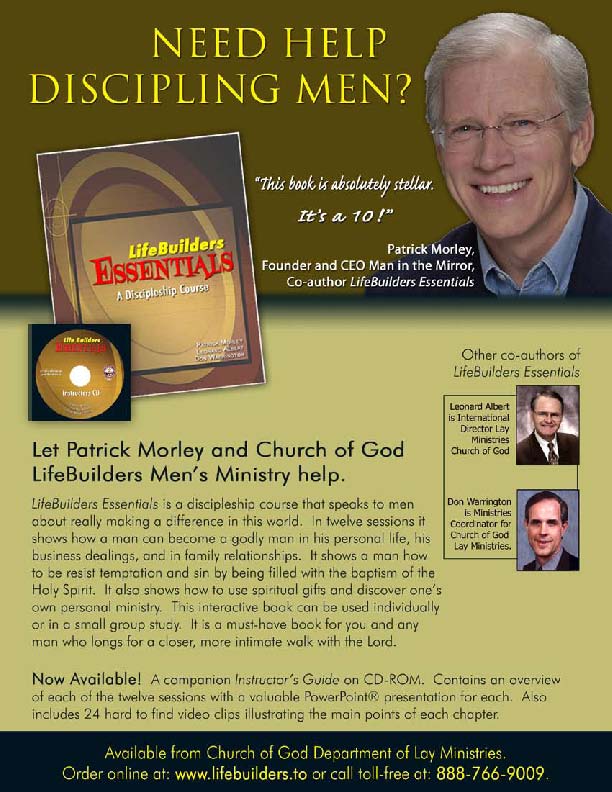
LifeBuilders Essentials: A Discipleship Course for Men
-
Adam Gadahn: The Thin Line of Personal Choice
The charge of treason against Adam Gadahn is a reminder that the line–and consequences–of pesonal choice is very thin, as we commented earlier.
-
Marriage in Massachusetts: We Knew It Would Be Like This
Somehow we’re getting a bad case of “deja vu all over again” in the proposal to restrict Episcopal churches to simply bless people rather than actually marry them.
This, of coure, is the usual practice in Europe. We still think that the long-term objective of many gay rights activists–inside and outside of the Episcopal Church–is to end the church’s privilege of performing civilly valid marriages in the U.S. This is one way to get around having to have a religious exemption for those clergy who cannot, in good conscience, perform gay marriages. That is, of course, if they can get gay civil marriage to stick in the U.S…
Sailing the Last Voyage with Newton and Pascal
 Positive Infinity