-
At the Inlet: October, Part 3 (Ordination and first Communion service)
Table of Contents and Overview for At the Inlet | Information and ordering instructions for all of our fiction
It was Terry’s idea to pray in the Cathedral the night before her ordination, but the whole experience with Barton Caldwell was so exhilarating and draining at the same time that she abandoned the idea upon return to the palace. She did request, though, that she be left alone in her apartment to fast and spend time with God before coming up to be ordained. This lasted until about 1200, when she heard a knock on the door.
She was expecting Darlene’s lady-in-waiting to help her get ready, but instead it was her eleven-year-old daughter they sent. Terry had already been fitted in her cassock; the girl simply helped her finish the job and provide a little companionship before her big event. The girl, whom Darlene had helped through the rattlesnake bite five years earlier, had been well trained in her task by her mother, and was another of those well-mannered Serelian children.
The ordination was to take place in the Royal Study; about 1300 Terry and the girl went up together. When they reached the hallway they were met by both Algernon and Julian. Algernon was to present her to the Bishop, and Julian was with her for moral support.
“Are you all right?” Julian asked. He could feel her hand tremble.
“Not really,” Terry replied. “Anoint me, Julian, lest I collapse in the middle of this thing.” Algernon had stepped away, sensing the stress. Julian anointed her and prayed out of his heart rather than the Prayer Book. She was consoled by this, but Julian felt as he was almost carrying her up the hall to rejoin Algernon.
They stood in front of the closed door. Terry was expecting more traditional Anglican music, but instead she heard an acoustic guitar-vocal combination with a song from long in Terry’s past.
“That’s Paul and Peggy Bucek, from the Retreat,” Terry said to Julian. “ I can’t believe they’re here. Is Father Avalon?”
“He is,” Julian replied. “I’ve coordinated the music with them. They’re a fine couple.”
“They’re the best Catholic liturgists on the Island,” Terry noted. Hearing her old friends from the Retreat was a great comfort to her; it built her confidence. With the end of their song Julian and Algernon knew it was their cue; they opened the door and Terry walked into the room, with Algernon on her left and Julian on her right.
As she walked in, she could see many familiar faces packed into the room. There were Prince William and Princess Catherine from Drahla; Dennis and Andrea were coming for the wedding. Father Avalon was sitting directly behind the royal family. All of the Dillmans, including Devin and his family and parents, were there, as were several ministers from both the Church of Serelia and Alemara. Finally all of Terry’s Chinese relatives were there.
The Bishop was standing in front of the guests, a temporary altar was behind him. Algernon, Terry, and Julian came forward and stood before the Bishop. “Reverend Father, I present unto you this person present, to be admitted into the Order of Priesthood,” Algernon declared, and with that the ordination proceeded.
The ceremony proceeded as usual. The Bishop was not particularly hasty in his manner of conducting the ceremony, but he was not slow about it either. When the actual ordination was complete and he had said the Nicene Creed, he was about to begin praying for the whole state of Christ’s church when Prince William stood up.
“If it please all present,” he began, interrupting the Bishop, “it is the custom of many here to allow a prayer by those assembled over a person who is the object of a ceremony, be they a married couple, a minister receiving ordination such as her, or just someone about to embark on a special mission, such as when Terry went on the trip that has changed all of our lives. So we ask that it be allowed here.”
The Bishop was not prepared for this request, but at the King’s silent bidding he allowed it. Several of the guests came forward and laid their hands on Terry’s shoulders as she was kneeling. Closest amongst these was Darlene. The prayer wasn’t a very smooth “concert” prayer but it further lifted Terry’s spirit; this enabled her to get through the communion service without a problem.
The Bucek’s performed the music for the communion service, much to the Bishop’s distaste. Their song during communion told of the breaking of pride, something Terry had experienced quite a bit of the last several months. Their recessional was based on the same scripture that Julian had cited when Terry resigned her Pentecostal ministerial credentials. Once the communion service was over, the Bishop signed the necessary paperwork and made as speedy departure as he could. Algernon lingered but had to make preparations for Sunday. The royal family was thus able to rearrange the room for the party that they had planned for the occasion.
They let Julian and Terry sit with Avalon and the Buceks for the meal, since she hadn’t seen them much and Julian had never met them. It was another homecoming for Terry, this time in what was now her own territory. Julian got to hear about all the people at the Retreat, all of whom had come with Avalon—and Terry for that matter—twenty years ago.
“There’s something I find striking about this,” Julian suddenly piped up in the middle of all of this talk about families.
“What’s that?” Paul Bucek replied.
“All of you, except for Father Avalon of course, found a spouse from your number…except for Terry. I think she’s ravishing. Am I alone?”
Avalon and the Bucek’s looked at each other slightly sheepishly. Avalon turned back to Julian and said, “That deserves an explanation.”
“It certainly does,” Terry agreed.
“Didn’t you date Raymond des Cieux once or twice before we fled to the Retreat?” Avalon asked Terry.
“The Bishop?” Julian asked.
“Once or twice,” she answered.
“He went into the priesthood,” Avalon noted. “But, after we got to the retreat, she spent a lot of time with Steve Eck, who with Terry was in my special training ‘class.’ But he then went into the priesthood. He’s just been made monsignor in Alemara.”
“I was heartbroken over his going into the priesthood, from my standpoint,” Terry said. “That’s one reason why I’m a ‘Thirty-Second Article Girl’ now.”
Julian got a chuckle out of that, but he could see the puzzlement in the Catholics’ faces. Julian explained, “That’s our Article of Religion that permits our priests to marry. I’m rather fond of it myself.” Now everybody got a laugh out of it.
They chatted about other matters, but eventually Avalon turned to Terry and said, “You’ll never know how happy I am to see this. I feel that a major failure of my work for God has been erased. I know that you were very successful in the Pentecostal church, but for me this is more than I had hoped for when you were with us.”
“Your church took a bold step with this,” Paul Bucek noted.
“It wasn’t as much our Church as our King. The only reason why this has happened is because of a waver in canon law, not a change,” Terry explained.
“Do you really think that women in general should be ordained?” Peggy Bucek asked.
“I’ve been in ministry now for fifteen years,” Terry answered. “It’s not easy being a woman minister, even in a church that has permitted it for a long time. In Drahla, however, we had more pressing problems to attend to than my gender, and that’s one reason why my ministry was successful.
“My biggest concern, however, in, say, an Anglican or the Roman Catholic Church, comes from my experience in Verecunda. Most women who want to be priests are too liberal. They’re too busy worshipping Mother Earth when they should be giving their adoration to their Heavenly Father. If we could get past this problem, we’d be a long way to cutting the Gordian knot on the ordination of women in this type of church.”
Avalon looked at her in silence for a moment, then said, “Terry, I’m actually inclined to agree with you on that. But you need to also consider that, in our own church, the priest represents God to the people, and that is not really an appropriate role for a woman.”
“So how does that affect her in the Church of Serelia?” Paul Bucek asked.
“Only time will tell,” Julian answered. “But we are a more ‘Protestant’ church than many in our Communion—here it is not really proper to refer to our ministers as ‘priests,’ even though the Prayer Book does so.”
The meal completed, they turned to the celebration. With all of these musicians in the room, that wasn’t difficult. The Bucek’s played—and Terry sang with—many of the songs they knew and loved at the retreat. They had a piano in the room, and Julian also played hymns. But the whole tenor of the gathering changed when Terry, helped by George and Darlene, forced Julian to do something he had been reluctant to do up to then: play some of the songs he used to play when he worked in bars and nightclubs while at university. It took a little practice to get started, but once he did the whole room assumed a little of a club atmosphere—his rendition of “Last Date” was especially masterful.
“I used to always worry that my Pentecostal musicians’ style was so close to a bar room style that they would run off and play there,” Terry observed. “I had no idea when I came here that I would have the same problem all over again.” The whole room burst out laughing at that comment.
“Why?” Julian suddenly came back. “I won’t need to go there for the scantily clad women.” The tables were turned; Terry was totally wiped out at that comeback.
The gathering lasted for the whole afternoon and early evening, but eventually everyone left to get ready for Sunday.
Weather permitting, the normal custom of the Cathedral was to marshal all those in the procession, including the acolytes, choir and clergy in the courtyard before the start of service. The weather was iffy that morning—and went to rain in the afternoon—but they still did so.
Pending her wedding, Terry was vested at the Deanery with Algernon’s wife’s assistance; as she emerged to join her first procession, she met Julian in the breezeway that connected the garden with the courtyard.
“You should be at the organ,” Terry told her fiancé.
“I wanted to see you vested for the first time,” he told her. “You look lovely. In fact, you really look stunning in your cassock.”
“Thank you, Julian,” she replied. “Maybe now people will quit asking me asinine questions about why I don’t wear low-cut dresses.” She thought for a second. “Then again, maybe not—scantily clad women, indeed,” she gently scolded Julian, and walked away to join the procession. Algernon walked to Julian’s side as they watched her depart.
“I think you’d better attend to your duties at the organ before you get into any more trouble,” he advised his friend. Julian took his advice.
The Bishop celebrated a special communion service that morning; his main purpose, though, was to see how Terry performed as one of his assistants. After years in a church where she as pastor and preacher often didn’t know what would happen next in the service, she found the carefully scripted Anglican worship nerve-wracking. A good deal of the problem was in the “high church” regimen that the Bishop expected at the Cathedral, with its ornate precision. The services were more elaborate than anything she had experienced, even as a child at St. Sebastian’s. Algernon, who had come from being rector at a decidedly “low church” St. Matthew’s, was sympathetic with Terry’s plight. However, Julian’s training held her in good stead, and she got through it without incident, and by the end of the service her thoughts of her future husband were a lot cheerier.
The moment of truth came at 1730, when it was Terry’s turn to celebrate the Eucharist in place of Evening Prayer. By that time the rain forced the processional assembly into the colonnade; the Bishop, who in rare occasion attended service in the nave, was hoping this would dampen the crowd and act as a bad omen for the inauguration of her ministry as a minister in the Church of Serelia.
His hopes for the crowd at least were dashed. Word on the street had been that everyone in town wanted to witness this event, whether they approved of it or not; she also had numerous foreign guests, mostly from Drahla. Algernon, who was to assist Terry, had organised a battery of ministers to back them up. As the crowds filed in, they knew his foresight would pay off. At the appointed time they processed in behind the children’s choir; Julian had drafted them for the task for the special occasion. As she processed in, she knew all eyes were on her; Julian’s loud organ playing, which she found disconcerting the first time she had heard it, was now a comfort to her.
The Holy Communion went according to plan. She managed to get all of the pieces into place in the liturgy, although she chose the shortest route she could find. With the Creed done Algernon went ahead and made the announcements, including the third asking of the Banns of their marriage. After that, he retreated and Terry came up to deliver the homily.
One of Desmond’s more thoughtful innovations at the Cathedral was a wireless lapel microphone. Terry had it from the start. As she stood on the steps leading up to the chancel, she looked out on something few celebrants at the Cathedral had experienced: a standing room only congregation. With that challenge in front of her, she began her sermon.
“It does my heart good to see all of you here today. Many of you who have known me for many years have come to this celebration of the Eucharist; others of you don’t know me well at all.
“Most of you know that I was a minister in the Drahlan Pentecostal Fellowship for many years, and while there I developed the habit of moving about when I spoke. I know that this is rather exceptional in this church, but I ask you to bear with me on this; such a public speaking habit is hard to break, and perhaps will make my delivery a little more interesting.
“I want to begin by thanking two people who have made this day possible. The first is, of course, our wonderful Sovereign, King Adam, by whose decree my ordination was done. I really need to extend my thanks to the entire royal family, Queen Annette, Prince George, and of course Princess Darlene, whose cry for Biblical guidance initiated this whole process.
“The second is our dear Bishop Collingswood. I would be less than frank if I didn’t say that he and I do not see eye to eye on everything. However, I need to say publicly that I have come to realise that his heart and his purpose is to uphold the teachings of the Apostles against those who would tear them apart. Our differences sometimes come in how this is to be done, but I believe that this Church is well served by having an individual as its Bishop who is prepared to defend Christ’s doctrine in this day and time.
“Our Gospel lesson today is as good a way as any to introduce what I plan to say. Probably the most important lesson that I have relearned in my months here in Serelia—and I have learned it in the midst of my love for this wonderful man who will become my husband in ten days or so—is that the most important part of our relationship with God is that we love Him. To love God presupposes that we know Him and have faith in Him. But if we do not love Him then our knowledge and faith is of limited value.
“My heart has been filled to overflowing on this matter, but this evening I think it best to address the issue that is on everyone’s mind, and in the process give you an opportunity to know me better, since we are now together in Christ in this church.
“As I said before, I was a minister in a Pentecostal church, and that fact generates a great deal of consternation amongst some of you. I want to go back further, though, and start before all that, when I was raised a Roman Catholic, a church that is very much like this one and at the same time very much unlike it.
“When I was a little girl, we had a thing at St. Sebastian’s in Point Collina called an ‘All Night Adoration of the Blessed Sacrament.’ To make this happen required that some of the men of the church be there to make sure that things went well and the church was secure. My father would always volunteer for the ‘graveyard shift,’ say between midnight and 0200. He did that because he wanted that to be our special time together, and usually few others if anyone would be there. Even though it was way past my bedtime, I would be so excited, I couldn’t sleep. We would arrive, sit right in front of the Tabernacle, and start by praying the Rosary together. After that we would talk about this or that, or he would read to me from the lives of the saints. My favourite life was St. Teresa of Avila; I always thought I was named after her, although my mother denied it. The best part was always when the angel came to her and thrust his spear into her heart, and she was filled with the love of God. Sadly, after a while I would always fall asleep. When I was young, he would carry out of the church in his arms and take me home; when it became obvious that many would look up to me in life, he simply woke me up so we could leave.
“One of those things I always wondered about—and my father never really gave me a good answer to this—is what it would feel like if, one night at home in bed or during one of those Adorations, the angel came to me and thrust her spear into my heart and I too would be filled with the love of God.
“As I grew older, I’d see these silly things with Cupid on it, shooting his arrows, especially around Valentine’s Day. I had the misfortune, though, of living in Verecunda in a day when Cupid carried rocket propelled grenades”—that got a laugh out of many of the veterans—“and his aim for me was very good. My heart was torn to pieces, and my life wasn’t very pretty to see.
“But God never forgot me, and I finally got my wish and more when our precious Lord and Saviour Jesus Christ came out of another tabernacle and met with me, and I realised how far I was from Him and how much I needed him. And on that night He Himself thrust that spear into my heart, and I was filled with His love, and I have never been the same again. And through the years and the intervening events, including our recent war, God has never left me nor forsaken me, because I always know that He loves me and I love Him.
“Now I stand before you a minister in the Church of Serelia, the first woman to have such a position. Many of you have many questions. What is she trying to do? Is it really right that she be a minister? Has the royal family lost its marbles?” That last got a laugh out of George and Darlene. “To tell the truth, I too have reservations about this—as I had when I was first approached about being a credentialed minister so many years ago. But then and now I have been reminded that God has a purpose and plan for my life, as he does for yours too.
“Part of this plan is wrapped up in my purpose in ministry, and it be easiest to state what my ministry is not about. I did not come here to be your first woman minister. I did not come here with a feminist agenda. I did not come here with a liberal agenda. I did not come here to change your Prayer Book. I did not come here to change your Articles of Religion. I came here first became one individual cried out for my help in understanding the Word of God and what God’s desire was for her life, for the life of her coming child, and for the life of her country. In answering that call, I found two things: there were others here with the same cry, and that I would end up paying a high price to answer that call.
“But that ultimately is as much a part of ministry as anything. But now that I have told you what my ministry is not, you should know what it is. The purpose of my ministry is to share and nurture what God has given me with you. It cannot be any more or less. To make that happen, a minister must share both the heartaches and the aspirations of those to whom he or she ministers.
“My own aspirations are simple. I want to know how to love God in the same way that the woman who anointed our Saviour’s feet with oil did. I want to experience His forgiveness from Jesus Himself like the woman who was taken in adultery. I want the thrill of coming face to face with our risen Lord as Mary Magdalene did. I want to experience his healing power like the woman who was healed of her issue of blood. My desire is to experience the filling of God’s Holy Spirit like the 120 did on the day of Pentecost. Finally I want to experience his resurrection power like Jairus’ daughter. And my goal as a minister is to be a vessel whereby these wonderful gifts from God can be yours, for you to impart to others.
“These are my goals as a minister of the Gospel; as long as God grants me life here, I will pursue them. When I came here, your dear Chancellor wished me long life here, for which I am grateful. But this life is too painful to love it so much. ‘Jesus, in the days of his earthly life, offered prayers and supplications, with earnest cries and with tears, to him who was able to save him from death; and he was heard because of his devout submission. Son though he was, he learned obedience from his sufferings; and, being made perfect, he became to all those who obey him the source of eternal Salvation.’ ‘And so Jesus, also, to purify the People by his own blood, suffered outside the gate. Therefore let us go out to him ‘outside the camp,’ bearing the same reproaches as he; for here we have no permanent city, but are looking for the City that is to come.’”
She paused, extended her arms and delivered one of the sentences that was the cue to congregation, the Cathedral’s bursar and his men alike for the offering: “Let you light so shine before men, that they may see your good works, and glorify your Father which is in heaven.”
The offering would have to wait though; she heard one person on her left begin to clap, and turned to see her stand doing it. It was Annette. Darlene followed her, along with the rest of the royal family. Then the rest of the congregation followed suit. The Pentecostals and Charismatics were obvious; they were raising their hands and praising God. Terry wasn’t sure what to do, so she went over and bowed before the King. The royal family responded with a communal hug. She then went a little further left to where the Bishop was standing, she bowed to him but his response was different.
“Go on, Reverend, you have a service to complete,” he said. Leona hugged her, though. Terry then turned around towards the centre of the church only to be faced with Julian, who had slipped out from the organ and gone down the back hallway. They threw their arms around each other, giving another sight that the Church of Serelia had never seen before: a man and a woman, soon to be wed, both in vestments and together during service. Julian then took her by the hand and helped her up the chancel steps and back to the altar where she resumed the service—once the applause died down and everyone was seated again.
The service continued more or less in a normal fashion until just before the actual Communion. The Cathedral was built with the altar set up against the wall; this required the celebrant to pray the communion prayers facing the altar. While kneeling, she prayed the Prayer of Humble Access, after which Julian and the choir went into a very plaintive tune for the Agnus Dei. In the midst of that she, instead of getting up and serving herself communion, bowed before the altar, the only thing separating her face from the floor being her clasped hands. This is something Algernon’s thorough planning was not prepared for. His first thought was to get her up, but he then went over to the altar rail opposite of the organ and whispered to Julian, “What’s the problem with her?’
“Not to worry,” Julian replied matter of factly. “She’ll be all right. Go ahead and start serving; she’ll join you shortly.” Algernon motioned to the ministers he had assembled to proceed with him acting as a “temporary celebrant,” while stationing an acolyte to help her up when she was ready. It wasn’t too terribly long before Terry rose and looked up to see none other than young Bede Gant, whose grandfather was helping Algernon, standing in front of her. He helped her up; she was a little unsteady on her feet but that improved shortly. She wiped her tear-filled eyes with first her surplice and then her handkerchief, noted the additional paten and cup on the altar, served herself communion, and blended in with the other ministers who were in the communion process.
Few Serelian ministers have been happier to see a recessional than her. She found out that one of the advantages of the Serelian system of processing and recessing was that it put her in the narthex at the end of the service, ready to greet the people. This process took a long time; everyone seemed to want to shake her hand and congratulate her. After the ordeal she had gone through to get where she was at, the Serelian people responded positively.
Her usual cheering section was happy: the royal family, Avalon and the Buceks and Prince William and Princess Catherine. But the most memorable greeting came from two men and their wives whom she instantly recognised.
“I was worried when I heard about this,” Vernon Calloway, her old pastor in Barlin said, “but after what I saw today, it’s them that ought to be worried. I’d have run the aisles if they hadn’t been full of people.”
“That’s the price of church growth,” she replied. “How are things in Barlin?”
“I resigned the church last Sunday,” Vernon replied. “I’m going to plant a church in North Verecunda. It’s time we started doing what you preached at Princess Catherine’s baptism: to be a light in the darkness. I see you’re doing it, it’s time for us too—this is Tim Mallen’s last Sunday here, he’s going with me. I wanted someone who could work in a hard place and had a burden for souls.”
“He’s your man than,” Terry agreed.
“Sister Terry, what happened to you before communion?” Tim asked.
“Now I know how Isaiah felt the year King Uzziah died,” she answered. “We’ve all preached about that—now I’ve lived it.”
“Well, Sister Terry, since you’ve had Isaiah’s vision, maybe you have his mission,” Tim said. “‘Go, and tell this people, hear ye indeed, but understand not; and see ye indeed, but perceive not. Make the heart of this people fat, and make their ears heavy, and shut their eyes; lest they see with their eyes, and hear with their ears, and understand with their heart, and convert, and be healed.’ You’ll be in my prayers.”
“You’re headed for a pretty hard-hearted people too,” she answered. “You’ll be in mine.”
“Sister Terry, thanks for visiting Barton Caldwell—I’ve had a burden for him for years,” Tim continued. “I’ve asked my deacon in West Serelia to visit him. One of us will do it.”
“You did something I should have tried a long time ago,” Vernon said.
“What’s that?” Terry asked.
“Putting royalty on the witnessing team,” Vernon replied. “We’ll have to suggest that to the people in the States.” They got a good laugh out of that. They embraced each other and departed.
Terry felt as if she had greeted everyone in Serelia. The narthex finally thinned out. Suddenly Julian appeared before her; they embraced.
“You’re soaking wet,” he said, “and it’s not from the rain either.”
“It was easier facing the Inland Police than going through this,” Terry replied. “I didn’t mean to embarrass you—but we always hear about being ‘before the Lord,’ and today I was there like I’ve never been before. I was overwhelmed by his presence. I had to respond the way I did.”
“You don’t have to apologise,” Julian said. “I don’t always understand some of the things you do, but Prince George was right about you.”
“Prince George?” Terry asked. “What did he say?”
“He said that the religion you have came directly from God.”
Terry looked out into the colonnade, and then turned to Julian. “That’s a challenge to live up to. I pray that I’m up to it.”
“You can do it. You were magnificent today. I’m so proud of you. I can hardly wait to be your husband,” Julian said.
“I can hardly wait to be your wife,” Terry replied. “You know, I just never let myself think about that empty spot in my life until you came along. It’s burnt a hole in me ever since. I’m glad you’re going to fill it.”
“I feel the same way,” Julian responded. “I put on blinders, hoping the pain would go away, ignoring it when it didn’t. But now the pain is over, thanks to you.”
“It is for me too…where is everybody?” Terry asked, looking around the narthex.
“The royal family went back to the palace,” Julian informed her. “The Bishop has disappeared. Algernon’s in the Deanery and his wife is doubtless waiting for you to get out of your vestments. Jasmine came up to me after the postlude and asked if we could come to the restaurant for dinner.”
“I hope you accepted, I’m starved,” Terry said.
“I did.” She went to the Deanery to change and they spent the evening with her family.
The next week and a half were a madhouse, getting ready for the wedding, finalising the plans, making sure everyone was ready. Interspersed with all the preparations were Terry’s new duties at the Cathedral. Algernon was short handed with the demands on him settling in as Dean; he was grateful that Terry was so cooperative in taking services, sometimes at the last minute. All Saint’s Day that year fell on a Wednesday; for some parts of the government, this event was going to be a virtual national holiday.
Julian’s mother and sister did not arrive in Serelia until Monday afternoon. His mother, having heard too much from Desmond, was still sour on the whole idea of his marrying the girl she felt got Desmond ejected from his job. This made for some tense moments between Terry and Candace, and also between Julian and his mother as well. Julian felt obligated to spend time with his mother, which tended to isolate the lovers from each other.
Tuesday afternoon, they held a special Communion service in the evening, with Terry as celebrant and Julian playing, for the benefit of the guests. It was a far more relaxed affair than her first Communion service. Afterwards she got a chance to see some of these; one of them was Pierre des Cieux, who came up from Alemara.
“Raymond still doesn’t believe this has happened, even after Avalon told him,” Pierre told her. “He never thought Bishop Collingswood would allow it.”
“Neither did I,” Terry answered, “but it’s done.”
“It’s for the best,” Pierre asserted, “in my opinion it’s time we faced this issue, along with a lot of others like it. If we had, our church would be a lot further along on this Island than it is now. Think about it: what would have happened if you had been ordained at the Retreat? But I think I figured out why they won’t do it.”
“And why not?” Terry asked.
“Because you look too much like an angel up there,” Pierre slyly replied.
After the service came the rehearsal. The Bishop was in a hurry to get it done; he had the cooperation of the wedding party, which was both punctual and quick to figure out what needed to be done. After this they held the rehearsal dinner in the parish hall. After this Julian went back to be with his relatives, leaving Terry to go about and mingle with the other guests.
-
Pentecost: Nothing Like a Newbie
It goes without saying that USA Today’s article on Pentecostalism was intensely interesting. But the real shocker came with the cover photo.
 The Earnests–whom my wife and I know very well–have only been members of our church, the North Cleveland Church of God, for about a year. Before that they were at a Baptist church. The children are home schooled and they are delights. Not all of the children are in the photo: there are two older ones as well.
The quote from David Roebuck (whom I also know well) deserves some comment. He stated the following:
There is tension between people who emphasize gifts of the spirit and the people who emphasize church authority…In an earlier piece, I mentioned that one of the great failures of the Charismatic Renewal in the 1960’s and 1970’s was the a) lack of leadership and b) the lack of assistance in the development of that leadership from classical Pentecostal churches. The experience of the latter was that, without some authority present, the exercise of the gifts can lead to difficulties, as the Charismatics found out the hard way. The New Testament tells us that things need to be done in good order, and the presence of some kind of authority is necessary for that. So we need both.
-
Who Shall Spread the Good News: Praised Be the God and Father (Ephesians 1)
 We continue our podcast series of this album with Praised Be the God and Father, an adaptation of Ephesians 1.
 -
Keeping Portland, Oregon Awake
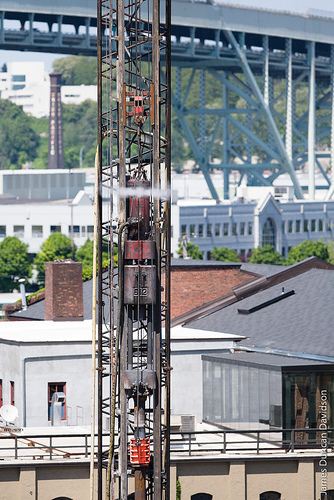
The Internet is a wonderful place to read about all the things you have either done or been connected to that which others dislike, as we noted in our last posting. Now, in addition to what’s here, our companion site‘s subject–pile driving equipment, and specifically Vulcan pile driving equipment–has found its way onto the blog of a Portland, Oregon based photographer named James Duncan Davidson.
He has taken some very nice shots of a Vulcan 512 driving pipe piles in central Portland, Oregon. But the noise is neither to his taste nor that of his friends. Perhaps some of the following information may shed some light on these comments:
- The noise study cited was part of an effort to develop some noise abatement accessories for the hammer. The most notable of these was the Decelflo exhaust muffler, which was successfully tested down the coast in Oakland, CA, amongst other places. Unfortunately there wasn’t enough interest at the time to continue producing these mufflers.
- The 512 driving pipe piles is, in some way, the noisiest combination you could want. The 5′ stroke hammers have a shorter, more intense impact pulse which translates into sound, and the pipe piles are obviously steel. Concrete piles are driven with a wood pile cushion that protects the pile but also reduces the noise. Wood piles are their own cushion.
- Other hammers have shrouds available, as I discuss in Pile Driving by Pile Buck. Most of the push for these has come from Europe, where piles are more often driven in urban areas than in the U.S. Thus the European manufacturers have been more proactive in this regard. The major objection to shrouds with air/steam hammers is that you can’t see the hammer in operation, which is important in monitoring the hammer’s performance.
- The Vulcan hammers started out as steam hammers, but (except offshore) are usually driven by compressed air today.
A short time after this was posted, Duncan’s website experienced a crash. The photos referred to are reproduced below.

-
Sanctifusion: A Blog to Check Out
While making this blog a stench in the nostrils of many at TitusOneNine, I’m pleased to announce a new blog worth looking at: Sanctifusion.
With the things that divide Christians into this "tradition" and that, it’s good to see something that blurs some of our boundaries. Sanctifusion does that. Take a look.
-
At the Inlet: October, Part 2 (An examination and a conversion)
Table of Contents and Overview for At the Inlet | Information and ordering instructions for all of our fiction
As the enormity of the tasks and the shortness of the time sunk into everyone involved, preparations for both Terry’s ordination and wedding got going in earnest. With Terry becoming a minister, her clerical duties with Darlene were at an end; in any case, they were current with the applications and they were starting to transfer some of the new ones to the bureaucracy.
Annette formed a committee to work on both of these projects. Her first member was of course Darlene, but Priscilla’s departure created a major gap in their help. This was filled by Shu-Yi and Jasmine, who proved to be a hard working pair, even though Shu-Yi was nearly ninety. The rest of Terry’s family was to cater both of the receptions; this was a major relief, although the Serelians were still getting used to Chinese food. Shu-Yi and Jasmine, with the help of the royal seamstress, were working on her wedding dress as well.
This left the immediate problem of the engagement ring. In a place like Serelia, selections were few; most people of any means went to Alemara to obtain items such as this. In Terry’s case, though, the solution came from an unusual source: Theresa Gant, who came up with the engagement ring of Eugénie Avinet, Edouard’s wife, who was martyred with her family on the beach that bore their name. It was something of an heirloom, although old Beran legend had it that whoever wore the ring would suffer the same fate as Eugénie. Terry for her part was honoured to wear it, although she had some ideas to modify it to her taste later.
The guest list also posed a problem. Although Terry was being treated by the palace as a princess, they knew that the rest of the Island wouldn’t see it that way. On the other hand she had been a head of government in Drahla. In the end they decided to treat it as a state wedding. The biggest problem for an event such as this on the Island, though, was the fact that the Island was so traditionally unstable that royalty was usually careful which or how many of these events they would attend.
One hand they could not count on being on deck for this was Julian’s mother Candace. Desmond’s first stop for his exile was Alemara, and he played for all the sympathy he could get. By the time he was done Candace had concluded that Terry had conspired to get rid of him, so she simply told Julian that she would come for the wedding itself but nothing more.
If the wedding proved to be a merely complicated task, her ordination was a voyage into uncharted waters. So many of the things surrounding such an event, usually performed on a man who had spent a lifetime in the Church of Serelia and having a year’s diaconate on him, were out the window for a Pentecostal novice who also happened to be a woman. One of those was her cassock and other vestments; Annette put those working on her wedding dress in charge of this. Their idea was to come up with a cassock that would meet with the Church’s requirements and at the same make for suitable everyday wear, and they pursued these two goals with enthusiasm.
Julian’s first concern was to get Terry up to speed on all of the “in’s and out’s” of Anglican ceremonies; he spent as much time as he could with her in the Cathedral showing her how things were supposed to be done. Once again their time together was filled with the things of God as opposed to more mundane matters.
Nevertheless Julian wasn’t the only one in the church interested in preparing her for ordination; they received a summons to appear in the Bishop’s Palace towards the end of the week, and to there they went.
When Julian and Terry arrived, they entered the Bishop’s office. Already there was the Bishop, of course, and the Reverend R. Algernon Dillman, Devin’s brother and up until then the rector at St. Matthew’s. Dillman, a little more than ten years the Bishop’s junior, was an old favourite of his, and the word on the street was that, with Desmond’s fall, he would be made Bishop Co-Adjutor at the next Convention. They all sat down and were served tea, and then the Bishop began.
“Thank you all very much for coming,” the Bishop said. “In all my years of serving this Church, I would have never thought that we would have a meeting like this on this topic. But these are extraordinary times we live in, and so it is our responsibility to rise to the occasion.” He turned to Terry. “Frankly, Miss Marlowe, my opposition to your ordination has not changed, but our dread Sovereign has decreed it and it will be done. I have asked Reverend Dillman—now Canon Dillman, as he is to be the Dean of the Cathedral—to assist me with this process, not only with your ordination but also with all of the other transitional matters that are taking place at the Cathedral. But our focus today is on the ordination, and so I would like Canon Dillman to summarise our position in this matter.”
“Thank you, Bishop,” Algernon said. Addressing Terry, he said, “Let me start by saying frankly that I too am opposed in principle to your ordination, irrespective of its performance under a waiver of canon law rather than its change. Our province has, under the leadership of our current bishop and with the support of the King, has held steadfast to the doctrines and ceremonies that have defined our church since our Prayer Book was finalised in 1931. We have scrupulously avoided making many of the changes that other provinces in the Communion have gone forward with because, in our view, such changes are against the Holy Scriptures and the fundamental precepts of God. One of our concerns with your ordination is that others will perceive that we have changed our position when in fact we have not.
“However, our immediate concern is the impact your ordination may have on our own clergy and laity. Unfortunately, the time frame that we have been given is rather short, which prevents a more detailed examination of this situation. Nevertheless, I have been in contact with all of our rectors, in addition to some discussions with our counterparts in Drahla and Alemara, and some of the Senior and Junior Wardens as well. The following is a summary of my dialogues.
“Frankly we did not find the hostility towards your ordination we expected. Based on what our ministers and laity have told us, we do not believe there is general support for the ordination of women in this province or in the Alemaran one; however, most of our rectors tend to look at your situation as a special case. They do so for two reasons. First, they feel this way because you are being ordained for the purpose of acting as a chaplain to the royal family, which they instinctively feel is a prerogative of the sovereign. They are aware of the potential of your being assigned to other duties, but at this stage don’t feel concern that this is a realistic possibility. Second, your ordination only adds to the consternation in the Pentecostal churches that has resulted from your strained relations pursuant to your resignation of ordination from the Drahlan Fellowship. The rise of Pentecostal churches in this region—especially during and after our recent war—has created a lot of anxiety amongst our clergy and laity. In some ways, I get the feeling that they consider you a prize for Julian, which helps you as well since he is both one of the most respected ministers and church musicians in the entire Island.”
“I’m glad to be his ‘prize,’” Terry said, snuggling up to her fiancé.
“I have a question,” Julian said, attempting to get past this line of thinking. “Is there any fear that she will introduce Pentecostal practices into our churches?”
“I didn’t centre on this question, but I did touch on it with many,” Algernon replied. “The answers were all over the lot on that one. Some are very fearful of this; others, especially the younger ones, are either curious or realise that the Pentecostal churches, in spite of their lack of material resources, have produced a creditable organisation, and that Miss Marlowe has been a central figure in that. They feel that she may be able to help them with her experience.”
“I certainly think so, and have expressed that opinion when I had the chance,” Julian said.
“That’s sweet of you,” Terry said. She turned to Algernon and asked, “Did the responses from the Drahlan churches vary significantly from those here in Serelia.”
“The Drahlan rectors and laity seem to be happier with your ordination than ours,” Algernon replied. “First, it’s not their province. Second, in spite of your problems, both political and religious, you are still highly thought of in Drahla. They also seem to look at your ordination as a real slap in the face of the Pentecostal churches, which has buoyed the mater more than many, I think, will verbalise.”
“One concern that is not directly related to our present situation,” Algernon continued, “is the legal status of churches other than the Church of Serelia here. There is a concern amongst all of our people that, due to your influence with the royal family, that they will permit other churches to be chartered to operate in this realm, which at present they are not. Many of our people feel it is only a matter of time before this happens, and some are fearful of this taking place.”
“I have spent some time with both the Queen and Princess Darlene on this subject, although none with the King,” Terry replied. “There are two major obstacles to that happening. The first is the whole issue of allowing churches with their controlling authority outside of the country. That is a sensitive issue almost everywhere on this Island but especially here. The second is that allowing churches other than this one would bring up the explosive issue of the reinstitution of the Lodge, and as long as the Lodge on this Island remains a political institution rather than merely a fraternal one I cannot see that happening in this country.”
“That’s rather informative,” Algernon admitted.
“I think we have discussed everyone’s opinions enough,” the Bishop said. “I think it is time to address what we expect from Miss Marlowe as a minister in the Church of Serelia.”
“Oh, yes,” Algernon said. Turning to Terry again, he resumed. “First, we expect canonical obedience from our ministers to both our Bishop and to their immediate superiors. Your situation is a bit special because you are attached to the palace, and technically not an integral part of the Cathedral staff. Nevertheless we expect you to obey both the canon law of our church and the directives of our Bishop, and I ask as Dean that you give me your cooperation to the extent that it does not conflict with your duties to the royal family.”
“I have always attempted to submit myself to those over me in the Lord, and will continue to do so,” Terry responded.
“Excellent. Second, as part of that, we expect that you will be supportive of the institution of the Church of Serelia to the exclusion of all others. We realise that you have many friends and associates in other churches, but your first loyalty now must be to us and not to them.”
“What about outside of the country?” Terry asked.
“We would hope that your primary focus would extend to all Anglican churches on this Island,” Algernon replied. “However, in meeting with the Chancellor this week, he expressed the opinion that your special relationship with the Aloxan Pentecostals is a matter of state.” The Bishop perked up a bit at the comment. “How do you think your Serelian ordination will affect your relations with them?”
“They love me one way or the other,” Terry answered. “They offered me credentials in their own church. I don’t think they really care. I need to run another revival and conduct Bible training classes as I did before.”
“I believe part of our honeymoon will be there,” Julian observed.
“You certainly won’t be conducting services then,” Algernon said.
“That’s what you think,” Terry replied. Algernon and the Bishop looked at each other in astonishment. “‘Proclaim the Message, be ready in season and out of season, convince, rebuke, encourage, never failing to instruct with forbearance.’ That’s what I used to tell my students in Bible school. That’s what I’ve been doing for the last fifteen years. The last time I preached in Aloxa, I had been riding in a boat, evading the Verecundans, for ten hours before that with His and Her Highness.”
“I think that had quite an effect on them,” Julian noted.
“Third, the Bishop has asked me to administer the necessary, if abbreviated, examination so that the Church can be satisfied that you are suitable for this office. I realise that Julian has laid some excellent groundwork in his catechisation, but I can assure you that mine will have a different—how shall we say it—flavour to it altogether.”
“Ours was quite a journey for both of us,” Julian said.
“Finally,” Algernon resumed, “in spite of my reservations on your ordination, I want you know to know, Miss Marlowe—soon to be the Very Reverend Lewis—that I am looking forward to serving with both you and Julian at the Cathedral. Your visitation of my mother and father shows me that you have a desire to do God’s work, and that’s something that’s sadly lacking in some of our own clergy. My parents been faithful to come to the Cathedral ever since, and personally I am gratified that I will be able to be their Rector, perhaps for the last time. I also want you to know that you are marrying one of the finest men of the cloth this church has ever had, and it is my hope that God’s best will be on your life together.”
With that sentiment the meeting was at an end; as they were leaving, they discussed some of the practical aspects, such as the date of the ordination, her cassock and other vestments, and other such issues. After leaving, Julian and Terry went to the Cathedral to continue Terry’s training as a minister.
“Even I’m surprised you’re planning to preach when you’re in Aloxa,” Julian remarked.
“Don’t be silly, Julian,” she replied, “they won’t take no for an answer.”
Terry’s examination for ordination nearly took all morning. After that she had lunch with Julian at the Cathedral, then went to the palace to spend some time on the wedding preparations. The Queen was tied up on other matters so she got a chance to spend some time alone with Darlene.
“How did your examination go with Reverend Dillman?” Darlene asked.
“It was awful,” Terry replied. “He challenged me on all of the points that Julian was kind about. I think I cried too much, too…I’m not sure I’m cut out for this Church. Whose idea was this to have me ordained here anyway?”
Darlene sighed and said, “It was mine, Terry. After the way your old church treated you, I was mad. But it wasn’t until after we started investigating Desmond that I went to the Queen with the idea. I didn’t go to George because I didn’t want to tip my hand regarding Desmond. The Queen got excited about the whole idea, which surprised me. But I thought for sure the King wouldn’t go along, but he did, and so did George, so here we are.”
Terry looked at her friend with a touch of sadness. “You didn’t have to do that. I don’t know I’m up to this or not.”
Darlene grabbed both of Terry’s hands and held on tight. “You’ve got to go through with this, Terry. You’re a minister. God called you to be one. You can’t back down just because people don’t like you, or because our Island politics are so screwed up. I need you here as a minister, Terry. So does George. So does everybody else. We can’t have another Desmond Lewis waltz in here and con everybody. This church needs what you have. This country needs what you have. They may not know it and they may not like it but I know it. You’re going to have a great husband who’s going to be there for you. You’ll do fine. And the best part is that you’ll get to spend eternity with a lot of people whom you wouldn’t have otherwise. Don’t give up now, please.”
They looked at each other intently. “I’ll keep going, Darlene. I needed to hear that.” They hugged for a long time. After a little Darlene asked another question.
“Do you and Julian go visiting any more?”
“Not since our engagement,” Terry said, “we don’t have time. Before that, we did when we could.”
Darlene looked out the window for what seemed like an eternity, and they turned to her friend. “There’s somebody that needs a visit really badly. It’s almost a family obligation.”
“Who’s that?”
“Barton Caldwell—he was Ronald’s adjutant during the war—oh, I’m sorry, you really might not want to see him.”
“I want to see him,” Terry said. “But why now?”
“He used to work on our estate when not in the army. He could fix anything. But he had a leg blown off at South Barlin. He can’t work anymore and he lives alone somewhere between West Serelia and Amherst. I kind of think my father abandoned him. I haven’t seen him since I married. I think I need to go.”
“When can we do it?”
“Let me do some checking to see where he’s at and I’ll let you know.”
Algernon went to see the Bishop the afternoon after his interview with Terry. The Bishop was eager to learn of the results.
“So how did it go?” the Bishop asked.
“It was a very difficult examination, probably the most difficult one I have ever conducted.”
“Oh? How so?”
“For one thing, she’s very emotional. Even Julian, who was with us for it, found it difficult to keep his wits about him.”
“What do you expect? She’s a woman. Now you know why we shouldn’t be ordaining them.”
“I think there’s more to it than that,” Algernon replied. “She’s very passionate about her beliefs and about her relationship with God. She even believes that Our Lord Himself appeared to her—I think I remember Desmond mentioning that. That experience changed her life.”
“We can’t have that kind of thing in this Church!” the Bishop exclaimed. “We are the guardians of the via media. Going that route will lead to insanity and error!”
“We’ve already got both without her,” Algernon responded. He looked at the Bishop intently. “You and I are old friends—I appreciate everything that you’ve done for me in my ministry and the confidence you’ve placed in me. Part of that confidence is that I have conduced all of these types of examinations for the last six years. They all come in, they all know the right answers, and you get the feeling that, under all of this gaudy rhetoric, they’re concealing their doubts, heresies and probably their moral failures too. With her, it’s different. Here you have someone whose life is pretty much known by everyone—good, bad or indifferent. Our Prayer Book talks about ministers living and teaching according to the rule of the Scriptures, but she’s the only one I’ve interviewed of which I have no doubt has actually done it as she understood them, even in the middle of a rebellion and a political career. If we had a half dozen more like her—preferably men—we wouldn’t be having the problems with sects we’re having now, or a lot else.”
“So what are you trying to tell me? That we should turn our Church upside down for her benefit?”
“I’m telling you we need what she brings to us. I am prepared to help ‘smooth out the rough edges’ and I know Julian is too, but I’m looking forward to having her at the Cathedral, at least part time.”
The Bishop started in disbelief at his old friend. “Then you will have your wish,” the Bishop replied at last. “May God have mercy on us both if you’re wrong.”
Algernon’s upbeat assessment was too late—and in any case too little—to influence the Bishop’s desires concerning her ordination ceremony and its follow-up. Once Desmond was out of the country, the Bishop had lunched with the King and pressed his two central demands. The first was that her ordination be private, held on a Saturday. Serelian custom was that their ministers were ordained in the Cathedral in a public ceremony on Sunday, but the Bishop, trying to minimise the publicity, wanted a private one. The King, sensitive to the unhappiness his Bishop was experiencing, gave in on that one. He also gave in on the Bishop’s second request: that the first communion service which she celebrated be on Sunday evening rather than Sunday morning.
The King passed this along to George, who was incensed. George took it upon himself to have a few guests for her ordination and a more general audience for her first communion service.
For a long list of reasons, the only time that everyone could work out to go visit Barton Caldwell was on the night before Terry’s ordination. Darlene, Terry and Julian set out just before sunset; it had rained enough to make everything messy.
The trip was long; they had to go through Serelia Beach and, turning right, go back up through West Serelia. About two kilometres out of West Serelia they found a small dirt road; they turned left and went back another 600 metres or so until they reached a small clearing. The house was in disrepair; both the roof and the floor of the front porch were sagging.
The dirt road was in no better shape than the house; for pregnant Darlene, whose borders were enlarging daily, it was an especially painful trip. The chauffeur tried to make it as smooth as possible but it was difficult.
They pulled up in the semi-gravel area in front of the house. They could hear a voice from the house crying, “Who’s’ there?”
“It’s Darlene,” she yelled back.
“Your Highness,” was the reply as the voice emerged from the house. He was gaunt and not very tidy, with literally a peg-leg that went up to just below his right knee. Barton Caldwell’s clothing was as worn out and tattered as his body, but his joy to see Darlene again showed past his condition. “Come on in,” he said. The three emerged from the car and gingerly stepped up on the porch and into the house, trying to avoid obvious holes and less than obvious soft spots.
They sat down in the front room; Julian actually had to take a crate next to his love. “These are my friends,” Darlene said. “That’s Terry Marlowe, who’s about to become my chaplain, and Reverend Julian Lewis, her fiancé.”
“Know the Reverend well,” Barton responded. “He preached a lot of funerals for our fallen comrades—he’d do it when a lot of other people wouldn’t.”
“So how are you these days?” Darlene asked.
“What you see is what there is,” Barton responded with a sad tone. “You might remember that my wife left me right after I got out of the hospital. She said she couldn’t live with half a man. Last I heard, she was tending bar in Verecunda. My kids come to see me every now and then. With this leg and everything else, there isn’t much I can do.”
“I can remember when you kept everything running,” Darlene said. “You could work on anything.”
“I can still work on some things,” Barton replied, “but no one will hire me in this shape. If it weren’t for the King’s pension, I wouldn’t have anything, and with it I don’t have much. ‘Bout all I do is tend this garden and drink—I tried to stay off of that today, knowing Miss Darlene’s coming.” Barton and Darlene reminisced about old times for a while, then he turned to Terry.
“So, I get to meet the enemy face to face,” Barton said.
“She didn’t seem like an enemy to me,” Julian observed, trying to deflect his words.
Barton grinned at Julian. “There’s more to you than most people around here think. You’re now the only one in Serelia who actually won this war. You’ve caught quite a fish here.”
“Thank you,” Julian responded.
“Yes, I was the enemy,” Terry admitted. “What I’d like to know is how you, as Ronald’s adjutant, got out of Drahla alive at all.”
Barton thought for a second. “You can thank old Ronald and Edward for that. When Ronald realised that he was surrounded by you people on one side and the Alemarans on the other, he turned to me and said, ‘We’re not going to make it, Barton. Get as many men as you can together and get them out of here.’
“‘I’m not leaving you, sir,’ I said.
“‘My orders are final,’ he replied, as only he could. Then he said, ‘Remember to have them put the evergreen on my boat before they light it.’ With that we departed and, gathering as many men as we could, headed for the Barlin river—we figured it was the easier escape route. It would have been for me except that I stepped on a land mine just before I got there.”
“One of the dozen or so we put out,” Terry observed. “We never got very far with them.”
“It was one too many,” Barton continued. “It threw me clear. I told my men to leave me, but they wouldn’t—they picked me up and carried me to the river, then floated me across, then turned north to try to get back here.
“I was in so much pain, I didn’t know where I was going. They slogged through some swamp, then we got to the edge of the orange groves. The going got easier after that. We went for what seemed to be forever—for me, a minute in that kind of pain was forever—and then with twilight coming we got to this little clapboard church right in the middle of the groves.
“I knew we were dead then, as they were armed—mostly the women, if I remember right. But they told us that, if we would put down our weapons, they would give us sanctuary and a hot meal in the church. We gladly did because we were expecting them to kill us. But they took us in.
“They laid me out on one of the pews, tried to dress the wound, and gave me some herbal concoction for the pain. Whether it was the pain or the herbs, I didn’t know half of what was going on. My men told me that we weren’t the only ones there—that about forty or fifty of our men were in that church. They fed us some food, they played a little music, and then their preacher got up and gave us a sermon. I can’t recall his name directly but I remember how he looked—he had a full head of white hair, acted like he was a career military man.”
“I’ll bet it was R.L. Sillender,” Terry interjected.
“That’s his name,” Barton agreed.
“That was my father’s adjutant,” Darlene noted.
“Wasn’t a Sillender involved in your problems with your old church?” Julian asked.
“That was his son,” Terry answered.
“Again, I was in so much pain I couldn’t remember half of what he said. I know a lot of the guys were really moved by what he said, especially one of them that carried me, Tim Mallen’s his name, I hear he preaches out of the law here.”
“Perhaps I can tell you what he said,” Terry calmly asserted. “After his welcome, he told you four things:
“First, he told you that God loves man and wants to have fellowship with him. He probably cited John 3:16, which says, ‘For God so loved the world, that he gave his only Son, that every one who believes in him may not be lost, but have Immortal Life.’”
“That sounds right,” Barton said.
“Then he probably told you that all people have sinned and fallen short of God’s standard, citing Romans 3:23: ‘For all have sinned, and all fall short of God’s glorious ideal.’ He also doubtless said here that God, in his justice, requires the penalty of eternal separation from Him: ‘The wages of Sin are Death, but the gift of God is Immortal Life, through union with Christ Jesus, our Lord.’”
“That’s it,” Barton agreed. Julian and Darlene were very quiet by then.
Terry continued. “After that he surely mentioned that God had made provision for man to have a personal relationship with him: “Him who never knew sin God made to be Sin, on our behalf; so that we, through union with him, might become the Righteousness of God.”
“You act like you were there,” Barton mused.
“Finally, he told you that you had a decision to make to accept what God had provided for you: ‘But to all who did receive him he gave power to become Children of God–to those who believe in his Name.’ He then led all of you in a prayer where you admitted that you were a sinner, that you could not get to heaven on your own, that you accepted Jesus Christ as your personal Lord and Saviour, trusting Him for your eternal life.”
“That’s pretty much it,” Barton agreed. “How did you know all of that?”
“Who do you think taught me?” Terry answered.
“I was in a lot of pain that night—I didn’t track it very well.”
“Barton, you need to make that prayer and commitment yours, because if you don’t, what you will suffer in eternity will make all the pain you’ve endured since the battle seem very, very small.” Terry stated.
Barton looked at Terry intently. While their eyes were riveted at each other, Darlene eased out of her seat and onto the floor, where she was on her knees in front of him. She calmly took both of his hands; with that he shifted his eye contact from Terry to her. Looking down at Darlene, he almost saw her brother, with all of his authority, having come back from the dead, but both the message and the delivery were vastly different.
“Barton, are you ready to pray that prayer with me tonight? Are you ready to accept Jesus as your personal Saviour?” Darlene asked. They looked at each other for a moment that felt and was eternal.
“Yes, Your Highness, I am,” he replied, tears welling up in his eyes.” With Terry’s help, Darlene then led him in the same prayer that Terry had just described.
When that was done, Barton helped Darlene off of the floor, and they embraced. They spent a few minutes talking about what had just happened; Darlene gave him the same Bible that Terry had given her on the way home from the trip. Terry then asked if he would like to pray for his situation, which he was glad for. Julian applied the nard to his forehead and they prayed, but Terry was in for another surprise: Darlene prayed part of the time in tongues.
“You tell Tim Mallen to come see me,” Barton told Terry as they were leaving.
“I’ll do it,” Terry responded. They said a long goodbye and left to return to the palace.
“I didn’t know you had received the baptism in the Holy Spirit, Darlene,” Terry told her as they pulled out into the Old Beran Road.
“It just happened a couple of days ago, while I was praying with the Queen.”
“Did she receive it also.”
“Of course,” Darlene responded.
A little later Julian said, “Terry, now that you are becoming a minister in the Church of Serelia, you should be careful about your Pentecostal contacts. If he is lost to the Church because of this, you could be in serious trouble.”
“His eternity is more important—that’s the risk I have to take,” Terry replied.
“Maybe not,” Darlene mused.
-
The Ten Weeks now at Amazon.com
The Ten Weeks
, our latest novel, is now available at Amazon.com. You can click on the cover image in the right sidebar for more information. This is the first of The Island Chronicles to appear there, and we are excited about it.
-
Who Shall Spread the Good News: Did You Ever Wonder Why?
We continue our podcast series of this album with this week’s selection, Did You Ever Wonder Why?
Sailing the Last Voyage with Newton and Pascal
 Positive Infinity