-
Ted Haggard Gets Back in the Saddle
Pastoring, that is, his new church in Colorado Springs:
Christianity is all about second acts, and disgraced evangelical leader Ted Haggard is the latest conservative Christian to exploit that role to the hilt.
Haggard announced Wednesday that he is starting a new church in the same town — Colorado Springs — that he left in humiliation in 2006 following a gay sex and drugs scandal. And he says this church will be for people like himself, “a church for sinners — for people who have hit rock bottom and people who want to help people who have hit rock bottom. … It is not a gathering for the righteous, except those who are righteous by faith.”
I’ve commented on this situation–and have been criticised for the way I did it–here. But the sad truth is that, like the Episcopal Church, the worst expectations I had are being progressively proven true. To wit:
- His “restoration” was, in reality, unsuccessful.
- He started another church in Colorado Springs, same town as the New Life church he started before.
- He has used the “publicity process” to self-validate his “worthiness” (I used that term advisedly, Christianity teaches that no human is really worthy) rather than that validation coming from somewhere else.
My concerns for this situation are unchanged: I think that is sacrificing Evangelical Christianity for his own careerist ambitions.
-
Illegal Immigration Hits Palm Beach
Security cameras alerted staff of the Sloan’s Curve Condominium at 2000 S. Ocean Blvd. to the presence of several undocumented immigrants who had entered the property early Wednesday morning.
Palm Beach police apprehended 18 people — 13 suspected Chinese nationals and five Haitians — following a call around 4:15 a.m. from the condominium’s security staff.
Sloan’s Curve is on the south end of the island, near Phipps Ocean Park (where we used to go for school outings) and the Palm Beach Par 3 Golf Course. Had they landed further north, at the Bath and Tennis Club, they’d had an entirely different reception?
Why? There’s a story about a dead body which washed ashore at the B&T. The staff altered the manager.
“Was he a member?” the manager asked.
“No, sir,” the staff member replied.
“Then throw him back.”
-
A Nation Behind Bars
 While going through a few things, I stumbled upon this graph showing the growth in the Federal prison population from 1950 to 2005.
That’s just to 2005. And it doesn’t include the state and local prisoners either.
Irrespective of the causes–breakdown of society, too many laws, whatever–the incarceration rate in this country is (or at least should be) a source of shame.
The knee-jerk reaction to this is to pass a law. But passing so many laws is part of the problem. Repeal a few, maybe? Perhaps we can really be the “land of the free” again.
-
If You Want to Win an Election, You've Got to Show Up First
One of the downsides to getting older is that your contemporaries die off with increasing frequency (unless you’re one of the earlier ones out yourself!) You start spending more time in the obituaries (if you’re quick enough to catch them on the net.) It’s a sorry and morbid practice, but it’s part of life while waiting for eternity.
It was in this vein that I noticed the passing of someone who wasn’t quite a Texas A&M classmate but I counted as a friend: Roy F. Moore, a Houston mechanical engineer who worked for an oil company, as do many Aggies. (If we don’t get this BP spill fixed, Ags, we’ll have quite a muster on the deck of whatever barge is on site!) His passing last December brings to mind one of the strangest incidents I ever experienced in my academic career.
Roy and I were in the student chapter of the American Society of Mechanical Engineers together, shared some classes and went on some field trips together. There are several types of engineers out there (mechanical, civil, electrical, nuclear, etc.) and each has its own organisation, along with groups such as the Society of Women Engineers. At A&M, all of these were represented on the Student Engineers Council, an umbrella organisation which put together some activities of interest. Each club’s president was ex officio, and each could elect a senior and junior representative. Roy was our club president.
The leading candidate for the junior representative was someone who was headed to become the undisputed Big Man On Campus: Robert Harvey. Before he received his diploma he was both Student Body President and Commander of the Corps of Cadets (A&M has a long military tradition and a very large ROTC program.) He’s “back in the saddle” as he’s on the board of directors of the Association of Former Students, A&M’s alumni organisation. And I liked him, he’s a very nice guy. But, when the chapter gathered to vote, Bob wasn’t there. Texas A&M has the largest physical campus in the country, and when you’re BMOC, you’ve got a lot of ground to cover.
Evidently Roy was piqued at this state of affairs. I think he asked me first if I’d be willing to serve, which I was. When the junior representative vote came, my name and Bob’s were placed in nomination. From the results the chapter agreed with Roy, because I actually won this election, much to my shock. Losing this may not have shortened Bob’s resumé much, but it was the one and only election to a student group position I won the whole time I was at Texas A&M.
It’s been a long time since this vote took place, but the lesson is clear: no matter who you are or what your name recognition is, if you want to win an election, you’ve got to show up first!
-
National Cathedral Might as Well Dump the Books
National Cathedral’s uninspiring financial situation is leading to desperate measures:
Then news came this week that the cathedral, visited by every U.S. president since Theodore Roosevelt laid its foundation stone in 1907, was considering selling off part of its rare books collection, probably worth millions. Cathedral officials said the potential sale of the books is a separate matter from its ongoing budget difficulties. But they acknowledge that they no longer have the staff and resources to care for such a vast collection, which includes volumes donated by Queen Elizabeth II and Ethiopian emperor Haile Selassie and a Dutch Bible that was the first written in modern language.
The officials are in discussions with the Folger Shakespeare Library, which, with its internationally known conservation department, could possibly better preserve the fragile pages and make the tomes available to scholars.
The cathedral’s chief operating officer, Kathleen Cox, said the possible book sale, as well as measures such as eliminating financial support of a global poverty program, is an attempt to refocus on the cathedral’s core mission as a “church for the nation” and tourist attraction.
The Episcopal Church is experiencing the “perfect storm” in its finances with a soft economy, declining membership (and thus donor base) and enormous litigation costs to hold on to property and keep it from those pesky Anglicans. (If TEC struggles with keeping up its flagship church, how can it expect to do so elsewhere when it wins all of these lawsuits?)
My experience with church finance has led me to one cardinal rule: unless things are desperate, you never sell off fixed or real assets to pay for operating expenses. That tell me the state of National Cathedral. (I should note to my Church of God friends that their budget drop, from $27 million to $13 million, more or less is the same as the estimated remittances of the entire denomination before and after our reallocation of resources. And that’s just one Episcopal church.)
But really, they might as well dump the books. These include the following:
The cathedral, which has not had a rare books librarian since the 1970s, has been talking with the Folger over the past year about a possible sale or donation of about 2,000 of its 8,000 books, mostly rare Bibles, Books of Common Prayer and theological works.
Given TEC’s direction, and their desire to ditch 2,000 years of Christian belief and practice, the books would be better in other hands. They’re certainly not going to take inspiration from them.
One other idea: why doesn’t TEC just empty the library and move “815” (their headquarters) to National Cathedral?
-
Book Review: The Reading and Preaching of the Scriptures in the Worship of the Christian Church, Vol. 2: The Patristic Age
I’ve always been a strong advocate of patristic studies. That’s not an easy advocacy in Evangelical Christianity, but it’s one that needs to be made. It’s not always easy in Roman Catholicism and Orthodoxy either, because the Fathers of the Church–or more precisely those who wrote and, as we learn here, preached, during the Roman Empire and in the years immediately follow–don’t always follow the mould that today’s Catholic and Orthodox would like them to.
Most patristic studies focus on three aspects of their life and work: doctrinal/theological, liturgical and ecclesiastical. In this volume entitled The Reading and Preaching of the Scriptures in the Worship of the Christian Church, Vol. 2: The Patristic Age, the Reformed scholar Hughes Oliphant Old takes on the era from Constantine to Gregory the Great. His idea (which is part of a long series on the subject) is to examine the church fathers (and some others) from the standpoint of their pulpit works. What was their method and style? What kind of training did they have? How did they exposit the Scriptures? And how did changes in the society at large and the church in particular affect the preaching of the Word?
Old’s book is broken down into six basic chapters:
- The School of Alexandria, which includes Cyril of Jerusalem, the Cappadocian Fathers (Basil of Caesarea, Gregory of Nazianzus and Gregory of Nyssa,) Cyril of Jerusalem and Hesychius of Jerusalem.
- The Jerusalem Lectionary in the Fifth Century. His view of the Jerusalem church–a church, whose links with its apostolic roots having been broken by the Roman sacks of the city, was both new in many ways and influential because of the many pilgrims that passed through–is interesting. He spends some time in the development of this and other lectionaries but linking the preaching of the word with liturgical developments is not a strong point of this book. (Some of the sermons he cites, for example, with the plan of salvation in them, sound much like some of the anaphorae current at the time, especially in the East.)
- The School of Antioch, including John Chrysostom, Theodore of Mopsuestia (whom he gives more credit than is usually done,) and Theodoret of Cyrus. His handling of theological differences amongst these and especially the Syriac Fathers is more even-handed than one often sees in Catholic and Orthodox literature.
- The Syriac Church, including Ephrem of Nisbis, Narsai and Philoxenus of Mabbug. The Syrians get the short shrift in most literature on this era, both for doctrinal and ecclesiastical reasons, but their metrical homiletics deserve a wider treatment than they get, and Old gives them a good overview.
- The Latin Fathers, including Ambrose, Jerome, Maximus of Turin, and Augustine. It goes without saying that Old is partial to Augustine, and sometimes he gets carried away with the praise, almost preaching himself in spots.
- The Eternal Gospel in a Dying Culture, featuring Leo the Great, Peter Chrysologus and Gregory the Great.
It is in the last section where he clinches his case regarding the changes in the preaching and the changes in the church during this era. Old spends a good deal of time linking Christian preaching in this era with classical rhetorical training. His idea is that, with the collapse of classical education (especially in the West,) churches leaned more on the liturgy and “canned” sermons (to use a modern phrase) than the oratorical abilities of its priests and bishops. He also notes that the fading of the adult catechumenate and the shift to infant baptism not only ended homiletical series aimed at these people; it also changed the nature of Lent, making it the central season of the Christian year, and shifting the penitential focus from the catechumens to the church at large.
Although his handing of doctrinal variations is reasonable, there are spots where Old struggles. He has a hard time with Cyril of Jerusalem’s mystagogy and Leo the Great’s asceticism. He also has a hard time with the Patristic method of Biblical interpretation in all of its variations, although he acknowledges that, more often than not, the Fathers got to the Gospel message. His narrative style is somewhat looser than one usually finds in this kind of book. That’s probably due to the fact that this is a long series, but it’s also due to the fact that he is a preacher himself. He almost has an Origenistic flow to his narrative without the grammatical complexity of the Alexandrian master; he’s got a lot of ground to cover, he must hurry.
Despite this book’s limitations, it has one strong point: it makes you want to go and read this preaching for yourself. The Reading and Preaching of the Scriptures in the Worship of the Christian Church, Vol. 2: The Patristic Age is an excellent look at a vital if misunderstood era of the history of the church.
-
Month of Sundays: Devotions for Men, and an Announcement
From time to time I’ll promote a book of mine. For many of you, some of these books are, as my Russian math professor used to say, “just too much.” But this one is on the light side: A Month of Sundays. A 31-day devotional book for men, it seeks to break out of the mould for Evangelical devotional books and really challenge men with things they maybe haven’t thought about before.
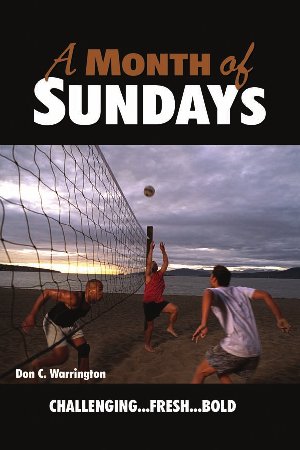 Topics are as follows:
- Happiness
- Asking
- Compassion
- Cost
- Defeat
- Eternity
- Excuses
- Faith
- Finding
- Fruit
- Following
- Foundations
- Light
- Love
- Mercy
- Obedience
- Priority
- Principles
- Provision
- Servanthood
- Sovereignty
- Storms
- Strength
- Suffering
- Temptation
- Time
- Truth
- Unity
- Witness
- Worship
- Worth
Some of the devotions have come from the thirteen year history of this website; others are new. But if you’re tired of the “recycling” that goes on in this field, this is your devotion book.
It’s also significant in that it’s the last book of mine to be published by Church of God Laity Ministries. My position is being phased out as a result of our reallocation of resources, and I asked not to be reappointed. I’ll say more about that in a few weeks, but in the meanwhile stop by here and get your own copy of A Month of Sundays.
-
Trustworthy People Are Scarce: A Christian View
Helen Fealy at the Shiny Sheet observes the following:
Who knew I had so much in common with the iconic Dr. Freud, the Father of Mental Heath and the pioneer of sexuality and gender behaviors.
I share his opinion on humankind and ethics.
To prove his point, we have Tiger Woods, John Edwards, Eliot Spitzer, Mark Sanford, Bill Clinton and many more.
Religions teach the goodness of people, and there are many wonderful caring men and women. But it brings to mind the saying: “Do you believe what I tell you or what you see with your eyes?”
I’m not sure what religion she’s been checking into. (I know what that means, or used to mean, in Palm Beach.) But Christianity has a more complex view of the human heart than either its advocates or opponents care to admit.
One the one hand, we are taught that “I will give thanks to you because I have been so amazingly and miraculously made. Your works are miraculous, and my soul is fully aware of this.” (Psalms 139:14). On the other hand “For all have sinned, and all fall short of God’s glorious ideal” (Romans 3:23). We were intended for good things by our Creator, but we suffer from the blowback of the Fall. And our lives are a fall in and of themselves.
But our lives can be–and have been–redeemed as well. To cite a verse I heard many times during the Holy Communion at Bethesda from the 1928 BCP:
My children, I am writing to you to keep you from sinning; but if any one should sin, we have one who can plead for us with the Father–Jesus Christ, the Righteous– and he is the atoning sacrifice for our sins, and not for ours only, but for those of the whole world besides. (1 John 2:1-2)
I got a lot of Freud growing up in Palm Beach (it was the era more than the town.) But I didn’t need Freud to tell me that people can be, to put it charitably, untrustworthy. As I said in The Tree That Grows in Heaven, “…living in South Florida is a sure cure for universalism, reminding one that, if there’s a default option in eternity, it’s not heaven.”
We are sinners in need of a saviour. That’s cause for both hope and humility.
-
Earthquake Liquefaction: Climate Change Isn't the Only Science with Different Opinions
While most are riveted on BP’s mile deep gusher in the Gulf, my attention was drawn to another type of scientific and technological challenge with possible catastrophic consequences: earthquake engineering. My colleagues in the geotechnical engineering field have drawn my attention to a monograph entitled Technical Review and Comments: 2008 EERI Monograph “Soil Liquefaction During Earthquakes” (by I.M. Idriss and R.W. Boulanger). The writer is one Raymond B. Seed, Professor of Civil Engineering at the University of California at Berkeley (your eyes aren’t deceiving you, right wingers.) It’s a response to a research report co-authored by one Izzat M. Idriss, Professor of Civil Engineering at the University of California at Davis. But some background for the rest of us is in order.
One of the immediate consequences of an earthquake is the liquefaction of soil. A memorable occurrence of that was in San Francisco’s Marina District during the 1989 Loma Prieta Earthquake, when the uncompacted fill under the area liquefied during the quake, damaging many of the structures above it. A more potentially serious consequence is the liquefaction of earthen dams, which can lead to the catastrophic failure of the dam and loss of life and property below. So this is a serious topic, especially in California, which is why we’re looking at a war of UC institutions here.
Geotechnical engineers perform a variety of tests on soils to determine their properties, and extrapolate data from these tests to determine properties related to soil strength, permeability for water flow, and other properties important in the design and construction of structures on and with the soils. The line of research here has been to correlate the results of certain field tests on soils with their tendency to liquefy during an earthquake. Knowledge of this is both valuable and essential in proper design of dams, bridges and other structures that must remain functional and intact during and after an earthquake.
One of the seminal studies on this was published in 1971 by Idriss and H. Bolton Seed, Raymond’s father. The younger Seed’s description of doing engineering computer work at Cal in those days is alone worth his monograph:
In the late 1960’s and through the 1970’s, the U.C. Berkeley campus had a single mainframe computer in the basement of the Mathematics building (next door to the Civil Engineering building.) Performing a single site response analysis (by the equivalent linear method, using SHAKE; Schnabel et al., 1972) required punching a deck of cards and then carrying the box of punched cards to the basement of the Mathematics building and submitting them via the card reader. The next morning, one would retrieve the results from alphabetically arranged shelves upon which the stacks of computer output would be placed. If you were fortunate, you had a large stack. If it was only a few pages, then the second page usually informed you that you had divided by zero somewhere and the job had been aborted. If it was a larger stack, that still did not necessarily mean a successful run; you might simply have divided by zero many times, rapidly. If unsuccessful, you would closely examine the large deck of punched cards, make adjustments, and try again the next night.
Mercifully scientific knowledge and computing power have advanced, and subsequently both Idriss and Bolton Seed made progress together on this subject along with other researchers. But Bolton Seed died of cancer in 1989, and Idriss went on to collaborate with others. During this time experience with the original correlations increased, and that experience has led to new correlations, including the 2008 paper linked at the top.
The younger Seed, for a variety of reasons, has chosen to openly challenge his father’s collaborator in research. Without going into the technical details (you can read them in his monograph) Raymond Seed summarises objections thus:
The work involved in the development of the proposed new SPT-based liquefaction triggering correlation of Idriss and Boulanger (2008) suffers from a lack of transparency; key details and important decisions including processing and addition and deletion (de-selection) of field performance case histories are wholly undocumented, and much of the work simply cannot be properly checked and reviewed in proper detail.
All of these factors–all of them–can be seen in the recent “Climategate” fiasco. Both fields have much in common: they both involve “earth sciences,” they both involve statistical correlation of natural phenomena which are complex and not easily deterministically predictable, they both effect public policy (most dams and bridges are built by the government) and the consequences of failure are potentially dire.
Idriss has not been shy about attacking Seed’s own work as well:
Dr. Idriss has been relentlessly negative over the past decade with regard to the work of our team (Seed et al., 2003; Cetin et al., 2004; Moss et al., 2006), with the interesting result that the work of our team has now arguably been more thoroughly reviewed, and in an adversarial manner, than any previous work on this topic. Dr. Idriss has been unable to identify specific technical shortcomings, and has instead simply “felt” that the correlation developed by Cetin et. al. was too complicated, and too different from previous triggering correlations.
As we say in politics, the only thing worse than bad publicity is no publicity…
My main point in bringing all of this up–in addition to perhaps disseminating knowledge on this important but neglected subject–is to once again attack the whole business of “science as religion” that secularists keep pushing in our society.
Science and engineering are “open” disciplines in that we make hypotheses, test them to the best of our ability against either laboratory or field reality, come to conclusions, and then repeat the cycle down the road with the idea of moving both theory and practice forward. That process doesn’t always move in a straight line, is subject to dispute amongst the scientists and engineers themselves, and is also subject to personal and bureaucratic interests that can obscure and even obstruct technical progress. All of these are present in this dispute (and this kind of dispute has happened before in this field) and are certainly there in climate change.
Nevertheless these realities have not stopped secularists from attempting to represent scientific advancement as a seamless process which produces results unsullied by the kinds of regressive sociological and political factors that they attribute to religious or other fields. It’s true that, in a situation like this, sooner or later the consequences of a defective hypothesis, accepted as fact by the community based on the reputation of the researchers and other factors, will take place, but by then the proponents of the hypothesis may have received both earthly accolades and eternal consequences.
My father used to say that “if” is in the middle of “life.” I cannot bring myself to find my security in the assurances of this life, and problems like this are a major part of that reluctance. Science and engineering have produced great things and will continue to do so, but without the backstop of integrity and eternity from the One who set it into motion, the road to secular paradise will be an endless detour.
-
An Episcopal Church Gets Its Roof Repaired. But Who Will Fix the Confirmation Class?
Well, at least at Bethesda-by-the-Sea in Palm Beach:
Construction is under way to replace part of the roof at the historic Episcopal Church of Bethesda-by-the-Sea.
The roof covers the administrative offices and the choir room overlooking the courtyard and gardens. Advanced Roofing is the contractor.
David Semadeni, a junior warden and a member of the vestry, said $326,000 has been allotted for the project.
It is part of ongoing program of church improvements. Some reroofing work was done last year and refurnishing of the bell tower took place a couple of years ago. Work began a week ago and should be completed in July.
One thing for sure: in a church drained by litigation, Bethesda marches on.
I also noticed the confirmation class behind Southeast Florida Bishop Leo Frade:

I cannot imagine being in a confirmation class defiled by the likes of Leo Frade. I’m glad I was able to get it done by a bishop of whom the worst was said was that his nickname was “Motor Mouth.”
One more thing: I noticed that Bethesda has a Vacation Bible School. Fancy that, I never remember such a thing at Bethesda. Their theme this year is “High Seas Adventure.” Where were we during summers in Palm Beach? Frequently, on a real “high seas adventure!”

Sailing the Last Voyage with Newton and Pascal

 Positive Infinity