-
Crossing the Rainbow Bridge: A Pentecostal Saga
 Back when I was growing up, we’d descend from Palm Beach and venture to the Florida Keys for vacation, navigating waters such as shown at the right. One of the more memorable side trips we took was a visit to a museum where artefacts from sunken Spanish galleons were on display. The Spanish were most interested in precious metals in the New World; they systematically enslaved the Aztecs, Toltecs, Mayas, Incas and other people whom they conquered to dig gold and silver out of the mines for shipment back to Spain, in conditions one shudders to even think about. The Straits of Florida were the main route from Mexico to the Old World, and since the reefs that parallel the Keys were there, some of those galleons never finished the voyage, depositing ship, crew and cargo on the bottom. Some of these had been salvaged and I found the gold and silver coinage on display to be especially fascinating.
A little later in life I was introduced to another story of subaqueous gold: Richard Wagner’s Der Ring des Nibelungen, his epic opera in four parts. In this case it was a less inviting body of water (the Rhine River) where gold was guarded by Rhine maidens and available only to the one who would forsake love. Sure enough, there’s always someone who will do anything for money, in this case dwarf Alberich, who got the gold and forged a ring of power.
In the meanwhile the Teutonic gods decided they needed a new home, so they contracted with the giants Fasolt and Fafner to build their new magnificent Valhalla. Through a long ruse they managed to beat the payment for this out of Alberich, ring included. Alberich curses his lost ring (as if that were necessary,) Wotan and the gods got clear title, and Froh, the god of spring, created a rainbow bridge for the gods to cross into their new home. But the effort was doomed from the start by the way they were forced to pay for it.
Fast forward to the year where the left made its last attempt to defeat George W. Bush electorally. (There’s a political angle to the “rainbow bridge” but I’ll skip it.) My own church, which was my employer, had been engaged in a massive expansion of its central offices (with expense following,) and the process was complete. Amidst one of the sappiest responsorial readings I had ever been a part of, the buildings, which surround an expansive prayer garden, were dedicated, and we crossed our own rainbow bridge.
There were prophets amongst us. One of my colleagues proclaimed that Jesus had turned his back on us. We peered out of the lobby of the building where our new office was (and is, for the moment) and saw truth in his words. And there was the matter of payment.
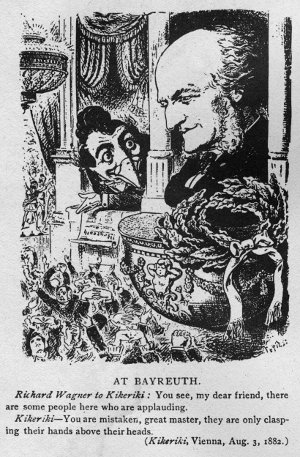 The expanse of Wagner’s musical productions were only matched by the controversy they generated. Their creator had a high view of his operas, but in his time he had detractors. Instead of applause, there were many times when the audience was simply clasping its hands above their heads. Such was also the case with our new Valhalla.
With life faithfully imitating art, it was time for the hero to appear. Somewhere in my preppy education the idea that heroes didn’t come from warm climates bubbled to the top, that only cold, harsh climates could produce such. As a South Floridian, this doesn’t sit well, and my response is here. For once I was right. Not so far from the sunken Spanish gold, where the animals are tame and the people run wild, a hero appeared that would doom Valhalla and many of its inhabitants. It’s taken some time and the process has generated more heat than light, but earlier this year our reorganisation began, I announced that I was taking my leave, and we began the painful process of downsizing that has continued unabated to the present day.
Unfortunately, as was the case in the Ring, the hero’s appearance wasn’t an automatic solution to every problem. The bottom line to our hero’s crusade was that less of the denomination’s cash flow would flow to the centre and more would remain in the field. But, unlike mythology, there are many Valhallas out there, products of a generation whose penchant for grandiosity combined with availability of credit produced a proliferation of economically unsustainable physical plants. (That’s what happens when the church follows the culture rather than the other way around!)
But someone needs to take a lesson from this. It is my prayer that the gold will find its way once again to the bottom, the descendants of those who mined it (and others on the wrong side of slavery and colonialism) will take their rightful place in the church, and that I will never, ever again cross the rainbow bridge.

-
Gregory the Great on Rome (and Perhaps Us) Prepared to Decline
This, from his Homilies on the Gospel 28, is just too much like our own time:
There was long life and health, material prosperity, growth of population and the tranquillity of daily peace, yet while the world was flourishing in itself, in their hearts it had withered away.
Our epitaph also?
Translation from Donald Dudley’s The Civilization of Rome, New York: New American Library, 1962.
-
The Episcopal Church and the Soviet Restaurant
Creedal Christian’s post on the meltdown of the Anglican Communion (HT to Stand Firm) got me thinking about many things. One reaction to this is that the “middle” is AWOL in this discussion. But I think that view overlooks some things that have been at work both in TEC and our society in general.
One of the things that people like about Anglicanism is its “comprehension.” That comprehension was initiated by the fact that the Church of England was a nationalised part of Roman Catholicism with a Reformed theology injected into its episcopal structure and liturgical worship. The result was the much-vaunted via media, but that via was brutally enforced by state power under Good Queen Bess and kicked from wall to wall in the following century, first towards a high church idea under Charles I and Laud and then a replica of Geneva under Cromwell.
What survived was directed to muddle along in an atmosphere where strong belief is discouraged. The broadness of Anglicanism only works if everyone agrees not to get too worked up about the whole business, and that’s the Anglican view that was presented to my ancestors, generation to generation. Enthusiasts like the Wesleyans and the Oxford Movement come along from time to time, but eventually they figure out that the church isn’t going their way and depart, leaving a remnant to carry on at a lower level.
The last century was very hard on religion such as this. In its kind face was thrust a gaggle of “isms:” communism, fascism, feminism, etc., to say nothing about the technological changes that were afoot. Like the bland English cooking that disappeared from the streets of London to make way for every other kind of cuisine, many found a more interesting spiritual (or unspiritual) diet to feed themselves and and to build their lives around.
For those left in Anglican churches, the question that made V.I. Lenin famous arose: what is to be done? The left’s answer was and is simple: we must remould the church to be like the society around us so we can communicate with that society and be relevant to it, irrespective of what we have to jettison in the process. Bringing up Lenin in all of this, however, makes another culinary analogy relevant: the old Soviet restaurant.
Back in the last years of the USSR there was a joke circulating about a man who went into a restaurant and ordered an item off of the menu, only to be told that it wasn’t available and that he should order another dish. The man was indignant: I thought we had choices here, he said. You do, the manager replied: you can order what we want you to or you can get out of this restaurant. (I witnessed something almost this bad at Galatoire’s one time, but I digress…)
That wasn’t far from the truth, either. Soviet restaurants had full menus, but when you’d point to an item you wanted, they’d tell you they didn’t have it. After a while of pointing and disappointment while the waitress giggled, you’d end up ordering the Chicken Kiev and that was it.
But their agenda was no laughing matter for the left in the 1960’s, when it burst on the scene in what was then PECUSA. What they basically told a largely upper middle class, WASP denomination was that they were overmoneyed, racist phonies. And that was just a socio-economic criticism; it went on to attack their antediluvian theology and 1928 BCP. Faced with this assault, it’s little wonder that so much of the membership got the “Soviet restaurant” feeling and departed.
What’s amazing is that the church, to some extent, came back from this, only to get another round this past decade as the left determined that embracing the LGBT community was “the deal” for the church. Those who missed the characterisation as overmoneyed, racist phonies got slapped with the broad brush of bigots and homophobes; racism took a back seat when the Africans arrived on the scene. And this time TEC has a Presiding Bishop who is more forthright in stating the agenda and more ruthless in enforcing it–and making sure that, when the unhappy patrons storm out of the restaurant, they don’t take the silverware and china with them.
It’s little wonder, under these circumstances, that the “middle” is nowhere to be found. This isn’t a game for the feint of heart. And the worst of it is that our political system is pretty much the same.
-
A Really Scary Scenario for the BP Blowout: Obama's Chernobyl
This, from a comment on the Oil Drum:
So you have to ask WHY? Why make it worse?…there really can only be one answer and that answer does not bode well for all of us. It’s really an inescapable conclusion at this point, unless you want to believe that every Oil and Gas professional involved suddenly just forgot everything they know or woke up one morning and drank a few big cups of stupid and got assigned to directing the response to this catastrophe. Nothing makes sense unless you take this into account, but after you do…you will see the “sense” behind what has happened and what is happening. That conclusion is this:
The well bore structure is compromised “Down hole”.
That is something which is a “Worst nightmare” conclusion to reach. While many have been saying this for some time as with any complex disaster of this proportion many have “said” a lot of things with no real sound reasons or evidence for jumping to such conclusions, well this time it appears that they may have jumped into the right place…
Unfortunately, my experience in this business–and I’d be the first to admit I’m not an expert on drilling–makes me think that this makes sense.
The BP blowout isn’t Obama’s 9/11 or Katrina. It’s his Chernobyl.
HT to Naked Capitalism and an anonymous source.
-
Jaques-Bénigne Bossuet: Sermon on the Profession of Mlle. de la Vallière: Second Point
This is the last part of this magnificent sermon. The introduction is here, and the first point is here.
Basically, Christians, in this oblivion of both God and herself into which she is plunged, the great God knows where to find her. He has heard her voice, at his pleasure, amid the noise of the world in its greatest splendour. In the midst of all its pomp, he discovered the foundation, that is to say, the vanity and nothingness. The soul, ashamed of her bondage, had just thought about why she was born. Looking at herself, the remnant of the image of God, she dreams to re-establish herself by reuniting herself to her Author. Touched by this sentiment, she begins to reject external things. O wealth, she says, you only have a misleading name: you come to meet me, but I have an infinite void where you do not enter. My secret desires, which ask for God, cannot be satisfied with all your treasures. I have to enrich myself by something greater and more intimate. So wealth is despised.
The soul, looking at the body to which she is united, sees it clothed with a thousand alien ornaments. She is ashamed, because she sees that these ornaments are a trap both for others and herself. Now she is ready to listen to the words that the Holy Spirit addresses to worldly ladies through the prophet Isaiah: “I saw the daughters of Zion with heads raised, walking with studied countenances, their eyes roving right and left: for them, says the Lord, I will make all of their hair fall off.” (cf Isaish 3:16-17). What kind of revenge! What, was it necessary to hurl lightening bolts from on high to make hair fall off? This great God, who boasts of his breath uprooting the cedars of Lebanon, thunders to fell tree leaves! Is this the worthy purpose of his all-powerful hand? It is shameful for man to be so attached to vain things, but taking them away is torture! That is why the Prophet goes even further. After saying: “I will make their hair fall off, I will destroy,” he goes on, “and necklaces and bracelets, and rings, and perfume boxes, and jackets,” and coats, and ribbons, and embroidery, and these delicate linens, vain covers which hide nothing, and the rest. (cf. vv. 18-24) For the Holy Spirit wanted to get an accurate count of all the ornaments of vanity, to focus his attention, so to speak, and follow by his vengeance all the different fineries as a contrived vain curiosity. To these threats by the Holy Spirit, the soul that felt long attached to these ornaments began to return to itself. “What, Lord,” she said, “you want to destroy all of this pomp? To head off your anger, I begin to shed these things myself.” Let us enter into a state where there is no longer more ornament than virtue.
Here, this soul, is disgusted with the world. She has told herself that these ornaments mark some dignity in men. Coming to consider the honours the world puffs up, she soon understands the bottom. She sees the pride which they inspire, and in that pride discovers disputes, jealousies, and all the evils which follow. She sees at the same time if these honours have something solid, that is that they require to give the world a great example. But one can, in leaving them, give a more useful example, and it is beautiful when we have them, to make such a good use. So away, earthly honours! All your magnificence is poor cover for our weaknesses and faults. He does not hide that we are alone, and makes that known to all others. Alas! “I would rather have the the last place in the house of my God, than to hold the highest rank where sinners live.” (Psalm 84:19). “”
The soul sheds, as you see, external things. She comes back from her bewilderment, and begins to be closer to herself. But does she dare to touch this body so tender, so darling, so cared for? Will there be no mercy on this delicate complexion? Instead it is mainly this body that takes away the soul, as her most dangerous seducer. I have, she said, found a victim; since that body became mortal, it seemed to have become an embarrassment to me, and an attraction which leads me to evil. But penance shows me that I must then put it to better use. Thanks to the divine mercy, in this body I have mended my past mistakes. This thought calls her to give no more to this aspect: she takes away all their pleasures, embraces all the mortifications, and gives the body little pleasant food, and so that nature is satisfied with it, she expects that need makes it bearable. Body so soft on the hard layer, the night’s psalmody and the day’s work there attracted the sleep, light sleep which did not make the spirit heavy, and hardly interrupted the work. Thus all the functions of nature began now to become operations of grace. One declares an eternal and unconditional war at all pleasures; there is nothing so innocent who escapes becoming suspect. Reason, which God gave to the soul as a driver, cried as he saw them approaching: “The serpent deceived me, serpens decepit me.” (Genesis 3:13). Early pleasures that failed us came into our hearts with an innocent look, as an enemy in disguise to get into a place he wants to rebel against the legitimate powers. These desires, that seemed innocent, have gradually moved most violent passions, which put us in chains that we can hardly break.
The soul, freed by these reflections from the captivity of the senses and detached from her body by mortification, is finally coming to herself. She came from afar and seems to have made great progress, but finally having found herself, she found the source of all evils. Thus she is herself again: disappointed by her freedom which she misused, she hopes to constrain all sides; frightful grates, a profound retreat, an impenetrable enclosure, complete obedience, all actions governed, every step counted, a hundred eyes watching you. Yet she found that there is not enough to prevent her from straying. She is placed under the yoke in every direction: she remembers the sad jealousies of the world, and devotes herself wholeheartedly to the sweet jealousy of a beneficent God, who only has the heart to fill her with heavenly candy. For fear of falling back on external objects, and that her freedom does not lead her astray again while searching them, boundaries are set on all sides, but for fear of stopping herself, she abandons her own will. Thus hemmed in on all sides, she can only breathe on the edges of the sky: she gives herself as prey to divine love, she calls back her knowledge and love to their original use. Then we can say with David: “O God, your servant has found his heart for you to pray this prayer” (2 Samuel 7:27). The soul, so long lost in external things, has finally found herself. But this in turn is for her to rise above herself, and give herself completely to God.
There’s nothing newer than this state where the soul, full of God, forgets itself. From this union with God, all virtues soon arise in her. Here is real prudence, because we learn to persevere to the end, that is to say to God, by the only road that leads to him, that is to say by love. There is strength and courage, for there is nothing that one does not suffer for the love of God. Here is found the perfect temperance, for it can no longer taste the pleasures of sense, which hearts and the attention of spirits steal for God. Here we begin to do justice to God, neighbour and oneself: to God, because we give up all to him because we should: to neighbour, because we begin to truly love him, not for himself, but as himself, after we make the effort to abandon ourselves; and finally there is justice to us, because we give all our heart to whom it naturally belongs. But, by giving away, we acquire the greatest of all goods, and we have this marvellous advantage of being happy by the same object which is the happiness of God.
The love of God therefore engenders all virtues, and to make them last forever, it gives humility as a foundation. Ask those who hold some violent passion in their heart, if they retain some pride and haughtiness in the presence of what they love: if you only submit in excess, you’re only too humble. The soul possessed with the love of God, carried away by love beyond itself, does not care to think of it, and consequently does not fill itself with pride, for she sees an object at a price which she counts for nothing, and is so smitten, she prefers it to herself, not only by reason, but by love.
But here is something to humble more deeply. Attached to this divine object, she always sees beneath it two deep gulfs, the nothingness from which she is drawn, and another nothingness more horrible, which is sin, to which she can endlessly fall back. If she draws away from God, she will be forced to leave. She believes that, if she is just, it is God who continuously makes her such. St. Augustine does not want anyone to say that God made us righteous, but he says he makes us righteous at any moment (De Genesi ad litt., VIII, 25.). It is not, he says, like a physician who, having cured his patient, leaves him in a state of health, and the patient no longer needs his assistance. It is like the air that has not been illuminated once and for all, but it is lit continuously by the sun. Thus the soul, attached to God, constantly feels its dependence, and feels that the righteousness given to her does not subsist alone, but that God creates it in her every moment. So she is always careful in this respect, always remaining in the hand of God, still attached to authority like a light beam of his grace. In this state, she knows herself, and no longer afraid to die the way she feared before: she feels she is made for an eternal object, and knows death no more than sin.
Here you must find the last perfection of the love of God. This detached soul must be shown the chaste delights which she has drawn from God, and possessed only by what she discovers in God himself, that is to say his infinite perfections. There we would see the union of soul with a forsaken Jesus; there we would understand the last consummation of divine love in a place of the soul so profound and so removed, that the senses suspect nothing. So it is far from their realm, but to explain this matter must take a language that the world would not understand.
Let us end this speech, therefore, and permit me that, in conclusion, I ask you, gentlemen, if the holy truths that I have announced have excited in your hearts a spark of divine love. The Christian life that I offer is so penitent, so mortified, so detached from senses and from ourselves, appears to you impossible. – Can you live, you say, in this way? Can we give up what we please? – You will hear from up there that one can do something more difficult, since one can embrace all that shocks. – But to do that, you say, we must love God and I do not know if we can know enough to love him as he should. – You will hear from up there that one knows enough to love without bounds. – But can we lead such a life in the world? – Yes, no doubt, because the world itself disabuses you of the world; its charms have enough illusions, its favours have enough inconstancy, its rejections enough bitterness. There is plenty of injustice and perfidy in the workings of men, enough inconsistencies and peculiarities in their inconvenient and vexatious moods, without a doubt it is enough to disgust us. – Hey! You say, I’m disgusted more than enough, everything disgusts me indeed, but nothing touches me, I hate the world, but God is not pleased with me for that. – I know this strange state, unhappy and unbearable, but too common in life. To escape, Christian soul, know that seeking God in good faith never fails to find him, his word is explicit: “For every one that asketh, receiveth: and he that seeketh, findeth: and to him that knocketh, it shall be opened.” (Matthew 7:8). So if you do not find, you are probably not looking. Stir up your heart: the wounds of the heart can be probed to the bottom, provided you have the courage to enter. You will find in this depth a secret pride that makes you despise everything you said and all the sage advice: you will find a spirit of reckless mockery, which arises during the back and forth of conversations. Whoever is possessed by this believes life is only a game: we only want to be entertained, and the face of reason, if I may say so, appears too serious and too peevish.
But where am I going with this? To seek out hidden causes of disgust that would give you piety? There are causes more obvious and palpable: we know that these are the thoughts that generally stop the world. We do not love true piety because, being content with eternal things, it does not leave a high station on the earth, and does not make success of those who follow it. This is the usual objection that men make of God, but he replied in a manner worthy of him by the prophet Malachi: “Your words have been unsufferable to me, saith the Lord. And you have said: What have we spoken against thee? You have said: He laboureth in vain that serveth God, and what profit is it that we have kept his ordinances, and that we have walked sorrowful before the Lord of hosts? Wherefore now we call the proud people happy, for they that work wickedness are built up, for they have tempted God and do their business.” That is the objection of the wicked, set forth in full force by the Holy Spirit. “At these words,” says the prophet, “the fearful people talked secretly to each other.” Nobody on earth dares to try, it seems, to respond to the wicked who attack God with such senseless boldness, but God himself will answer: “He has lent his ear to these things,” said the prophet, “and he heard them; he made a book where it writes the names of those who serve him; and in that day when I act, says the Lord of hosts,” that is to say where I achieve all my works, when I deploy my mercy and righteousness, “in this day,” he says, “good people will be my special possession, I will treat them as a good father treats an obedient son. Then you will return, O wicked,” you will see from afar their happiness, from which you will be excluded for ever, “and you will see what a difference there is between the righteous and the wicked, between him that serves God and one who despises its laws.” This is how God answers the objections of the impious. You would not believe that those who serve me are happy: you do not believe my word, or the experience of others, your experience will convince you, you will see them happy, and you will see yourself miserable: “Haec dicit Dominus faciens haec;” so says the Lord, he must believe: for he himself says so, “it is he who has done it.” (cf. Malachi 3:13-18) Thus he silences the proud and unbelievers.
Will you be happy enough to profit from this advice and to prevent his anger? Come, gentlemen, and think about it. Do not think about the preacher who told you about it, nor whether he said it well or poorly, for it doesn’t matter what a mortal man says! There is an invisible preacher who preaches in the hearts, and both preachers and listeners must listen to him. It is he who speaks to the one who speaks what is inside out, and he is to be heard inside the heart of all those who listen to sacred speech. The preacher who speaks to the outside only has one sermon for a great people, but the preacher who speaks to the inside, I mean the Holy Spirit, preaches as many sermons as there are hearers, because he speaks to each one individually, and applies according to each need the word of eternal life. Listen to him, therefore, Christians, let him move the secret principle of love of God in your hearts.
Holy Spirit, peaceful Spirit, I have prepared the way in preaching your word. My voice was perhaps similar to the impetuous noise which announced your descent; come down now, O invisible fire! and that this fiery rhetoric you will be doing in their hearts will fill them with a heavenly ardour. Let them taste eternal life, which consists in knowing and loving God: give them a preview of vision in the faith; a foretaste of the flood of delights which intoxicate the happy in the heavenly transport of divine love.
And you, my Sister, who have begun to taste the chaste delights, come down, go to the altar, a victim of penance, go to complete your sacrifice: the fire is lit, incense is ready, the sword is drawn: the sword is the word that separates the soul from herself to bond her only to God (cf. Hebrews 4:12). The holy priest awaits you with this mysterious veil that you have asked for. Wrap yourself in the veil: live hidden from yourself, as well as all the world, and known to God. Escape yourself, get out of yourself and take a noble flight where you will find rest only in the essence of the Father, Son and Holy Spirit.
-
Jaques-Bénigne Bossuet: Sermon on the Profession of Mlle. de la Vallière: First Point
The beginning of the sermon, with an introduction and links to the second point, is here.
Man, which you see bonded to himself by his self-esteem, was not created with this defect. In the beginning, God made him in his image, and the name of the image that was proclaimed was not for himself. An image is entirely made for its original. If a portrait could suddenly become animated, one would not see any trait that does not reflect the person whom it represents. It would only live for the original, and would only breathe for the original’s glory. And yet these portraits that we bring to life would be forced to share their love between the originals they represent and the painter who made them. But we are not in this dilemma: we are the image of our Maker, and he who made us also made us in his likeness: and in any case we should be his alone, and to him alone our soul must be bonded.
In effect, although this soul be disfigured, though that image of God be erased by sin, if we seek out all the old features, we acknowledge, despite her corruption, that she still looks like God and that God made her. O soul, you know and love. This is what you hold most important, and that is where you are like your author, who is only knowledge and love. But knowledge is given to hear what is true, as love is given to love what is best. What is more true than that the truth itself, and what is better than him who is goodness itself?
The soul is made for God: to him she was bonded and held, suspended by his knowledge and his love. In this way she is the image of God. God knows himself, he loves himself, and this is his life. The rational soul must also live by knowing and loving. Thus by its natural constitution, the soul was joined to its author, and should make her happiness the joy of a being so perfect and beneficent. In that it constituted its integrity and strength.
In the end this made the soul rich. Because she had nothing of her own resources, the soul had an infinite good by the generosity of its author, that is to say she possessed God himself. She had a manner so assured that the soul only had to love him persistently to possess him forever, since to love such a great good is what ensures its possession or before that makes that possession a reality.
But the soul did not remain long in this state. This soul, which was happy because God had made her in his image, has not wanted just to resemble him, but to be absolutely like him. It was happy knowing and loving him who knows and loves forever, but the soul wanted, like him, to make her own happiness. Alas! She was mistaken and her fall was fatal! The soul fell from God upon herself. How will God punish his defection?
He will give what she asks: seeking herself, she will find herself. But in finding herself, strange confusion! She will soon lose herself. See, she already begins to exercise bad judgement. Carried away by her pride, she said: I am a God, and I made myself. Thus the Prophet makes arrogant souls speak: they put their happiness in their own greatness and excellence (cf. Ezekiel 28:2, Ezekiel 29:9)
Indeed it is true that to say, “I want to be happy with myself and be enough for myself,” one must also say, “I did it myself,” or rather, “I am myself.” Thus the rational soul wants to be like God by an attribute that can not be possessed by any creature: the independence and fullness of being. Released from her original state for trying to be happy apart from God, the soul can not keep her ancient and natural happiness, or to obtain that which she pursues in vain. But as the soul’s pride deceives her, everywhere else the soul goes she must feel her poverty and misery. It is not necessary that she be left for some time to herself; this soul, who was both so loved and long sought, may not be able to bear it.
As soon as the soul is alone, her loneliness becomes a horror; she finds herself in an infinite void that only God can fill. In being separated from God, her inner resources make endless demands: tormented by her poverty, boredom consumes her and grief kills her. It is necessary to look for external amusement. The soul will never rest unless she finds something to kill the pain. So it is true that God punishes the soul by her own disorder and that, for having been sought, she becomes her own instrument of torture. But the soul can not remain in this state, sad as it is. She must fall further, and here is how it happens.
Imagine a man who is born into wealth and has dissipated it by his extravagance: he can not endure his poverty. These bare walls, this unset table, this abandoned house, where we no longer see the crowd of servants, makes him afraid. To hide himself from his misery, he borrows from all sides. In this way somehow he filled the emptiness of his house, and maintains the brilliance of its former abundance. He is blind and miserable who does not realise that anything that dazzles him threatens his freedom and rest! Thus the rational soul, born rich by the goods that her Author had given her, became voluntarily impoverished in her self-search, reduced to narrow and sterile resources. She tries to divert the pain which caused her poverty, and to repair the ruins by borrowing from all sides to fill her void. The soul begins with the body and the senses, because it can not find anything which is closer. This body which is so closely united, but which nevertheless is of a nature so inferior to her own, became the dearest object of her affection. The soul turns all her cares to that side. The slightest ray of beauty that she sees is enough to stop her. The soul is mirrored, so to speak, and sees itself in the body: she sees in the sweetness of those looks and that face, the softness of a peaceful mood; in the delicacy of feature, the delicacy of spirit; in this bearing and uplifted expression, the greatness and nobility of courage. Low and misleading image without doubt, but in the end it feeds the vanity. What are you reduced to, rational soul? You who were born for eternity and as an immortal being, you become enamoured and captivated of a flower which the sun dries up, a vapour which the wind carries away, and, in short, a body which by its mortality has become an obstacle and a burden to the spirit.
The soul is not happier in enjoying the pleasures that the senses give her: to the contrary, it is impoverished in this search, since in pursuing the pleasure she first loses reason. Pleasure is a feeling that we carry, which makes us drunk, which seizes us regardless of reason, and leads us despite its laws. In effect reason is never so weak when pleasure dominates. What marks an eternal conflict between reason and pleasure, it is that while reason asks one thing, pleasure demands another. The soul which becomes captive of pleasure is at the same time the enemy of reason. This is where the soul had fallen when she wanted to borrow enough senses to recoup her losses, however, this is not yet the end of her woes. These senses, of which she borrows, borrow in turn from every direction. They pull in all things they perceive, and therefore engage all of these things outside the soul. Delivered up to the senses, the soul can not have anything by them.
I do not want to talk about all the senses to make you confess their poverty. Consider only sight, to how many external objects it binds us. All that glitters, all that laughs to the eyes, everything that seems big and beautiful, become the object of our desires and our curiosity. The Holy Spirit advised us well when he said these words: “Ne sequantur cogitationes suas et oculos per res varias fornicantes. Do not follow your own thoughts and eyes going astray after divers things,” says the word of the Holy Spirit: “You prostitute yourself to everything in front of you.” (cf. Numbers 15:39) We do everything opposite of what God commands. We move out in all directions; we once needed only God, we begin to need everything. This man thinks he will improve himself with his expanding retinue, with his apartments which he remodels, with his land which he extends. This vain and ambitious woman believes she is worth much when she wears much gold, precious stones and a thousand other vain ornaments. To make it happen, all nature is emptied, all the arts sweat, all industry is consumed. So we amass around us all that is rarer. Our vanity is fed with this false wealth, and thus we senselessly fall into the trap of greed and sad, dark passion, cruel and insatiable.
It is she, St. Augustine says, who, finding the soul dark and empty inside, pushed it outside, divided it into a thousand worries, and consumed it by efforts as vain as they are laboured. She worries as if in a dream: she wants to talk, but the voice does not follow. She wants to make great movements, but feels numb limbs. Thus the soul wants to be filled, but she can not. Her money, which she calls her good, is outside, but it is inside which is empty and poor. She agonises to see her property so detached from herself, so exposed to chance, so subject to the power of others. Meanwhile she sees her evil desires grow with its wealth. “For the desire of money,” says St. Paul, “is the root of all evils, radix enim omnium malorum est cupiditas.” (1 Timothy 6:10). In reality wealth is a means of having almost everything you desire. By wealth, the ambitious may be gorged with honours, the voluptuous, with pleasure. Each one, finally, gets what he asked for. All evil desires arise in a heart that believes that having money is the means to satisfy them. Do not be surprised if the passion for wealth is so violent, because it gathers for itself all of the others. The soul is enslaved! With what a yoke it is charged! And for having sought itself, how is she now become poor and captive!
But perhaps more noble and generous passions will be able to satisfy. Let’s see what glory will produce. There is nothing more striking, nothing that makes so much noise among men, and put together there’s nothing more miserable or poorer. To convince us, let us consider it at its most beautiful and greatest. There is no greater glory than that of conquerors, so let’s choose the most famous of them. When one wants to talk about a great conqueror, everyone thinks of Alexander. If you wish, let it be so: Alexander, who will show us the poverty of conquering kings. What did this great Alexander wish for, to undergo so much work and so much pain which he sufferer, and make others suffer? He wanted to make a noise in the world during his lifetime and after his death. He had everything he asked for, nobody has done so much: in Egypt, in Persia, India, in all the land in East and West for over two thousand years one only speaks of Alexander. He lives in the lips of all men, without which his glory would be erased or diminished over many centuries: Praises for him do not fail, but he fails to praise. He got what he asked for, but has he been more fortunate? Tormented by ambition during his life and now tormented in hell, he carries eternal punishment for having wanted to be worshipped as a God, or by pride, or by politics? The same is true of all his fellows. Those who want the glory, are often given glory. “They have received their reward,” said the Son of God (Matthew 6:2), they were paid according to their merits. These great men, says St. Augustine, celebrated as among the Gentiles, and I might add esteemed too much among Christians, have got what they wanted. They have acquired this glory they wished so hard for, “…and when they have reached this they have reached their reward: vain men, and vain reward. Quœrebant non apud Deum, sed apud homines gloriam … Ad quam pervenientes perceperunt mercedem suam, vani vanam (Augustine, Exhortations on the Book of Psalms, Psalm CXIX (CXVIII), 38).
You see, gentlemen, the rational soul fallen from its original dignity, because she leaves God and God leaves her; led from captivity to captivity, captive herself, her body captive, captive of the senses and pleasures, captive of all the things that surround her. St. Paul says all in one word when he speaks thus: Man, he says, is “sold under sin, venundatus sub peccato.” (Romans 7:14). Delivered to sin, captive under its laws, overwhelmed with this shameful yoke like a sold slave. What price is the sin that he bought? He bought all the false goods that he has been given. Driven by all these false goods and enslaved by all the things he believes he possesses, he can not breathe, or look at the heavens from which it came. Thus he has lost God, and all the while the unhappy one he can not get around it, for at the bottom of our heart there is a secret desire that constantly asks for more.
The idea of him who created us is imprinted deeply within us. But, oh, unbelievable woe and lamentable blindness! nothing is etched deeper into the heart of man, and nothing is used less in his conduct. Religious sentiments are the last thing that disappear in man and the last that man consults. Nothing excites greater turmoil among men, nothing stirs up more and nothing at the same time stirs up less. Like to see proof? Now I’m sitting in the pulpit of Jesus Christ and the apostles, you listen carefully. If I go, (ah! sooner death!) if I go teach you some error, I would see all my audience revolt against me. I am preaching the most important truths of religion: what will they do? O God, then what is man? Is he a prodigy? Is he a monster composed of incompatible things? Or is he an unexplainable riddle?
No, gentlemen, we explained the riddle. What is so great in man is a remnant of his first institution: what is so low and that seems so ill-suited with his first principles, is the unfortunate effect of his fall. It looks like a ruined building, which in its skeleton state still retains something of the beauty and grandeur of its first plan. Founded at the start on the knowledge of God and his love, by his depraved will he has fallen into ruin. The roof has fallen on the walls, and the walls on the foundation. But when one stirs these ruins, one will find in the remainder of this toppled building the traces of its foundations, the idea of its first design and the mark of the architect. The impression of God is still so strong in man that he can not lose it, and all together it is so weak that it cannot follow: it only remains to convince her of her fault, and make her feel her loss. Thus it is true that he has lost God, but we have said, and it is true, that after that he could not avoid getting himself lost as well.
The soul that has moved away from the source of her being no longer knows what she is. “She was embarrassed,” says St. Augustine (On the Trinity, X, 7) “in everything she loves,” and hence in losing those things she soon believes that she is lost. ‘My house is burned,’ there is torment, and they say, ‘I am lost, my reputation is injured, my fortune is ruined, I am lost.’ But above all when the body is attacked, that’s when one cries more than ever: ‘I’m lost.’ A man believes himself attacked to the core of his being, without wanting to think about what he’s saying: ‘I am lost.’ It is not the body, because the body itself has no feeling. The soul which says that it is lost, feels nothing else than the future loss she understands, so she feels lost in losing. Ah! Ah! if she had not forgotten God, if she had always thought she was his image, she would have held him as the sole support of her being. Attached to a principle so high, she would not have believed she would perish, seeing this fall is so far down. But, as St. Augustine says (On the Trinity, X, 11), “having committed herself entirely to her body and material things, wound up and wrapped among the things she loves and is completely focused on, she can no longer unravel herself,” she no longer knows what she is. She says: ‘I’m a vapour, I’m a breath, I am thin air, or a subtle fire; doubtless a vapour that loves God, a fire that knows God, an air in his own image. O soul, that is the height of your pain: in seeking you’ve lost yourself, and you don’t understand yourself. In this sad and unhappy state, listen to the word of God through his prophet: “convertimini sicut in profundum recesseratis filii Israhel.” (Isaiah 31:6). O soul, come back to God from the depths where you were so deeply withdrawn.
-
Jaques-Bénigne Bossuet: Sermon on the Profession of Mlle. de la Vallière: Introduction
There is simply no preacher of the Word who has the stature in English literature that Jaques-Bénigne Bossuet (1627-1704) has in French. Although he is best known for his funeral orations and some of his polemical works, IMHO his best works are his devotional books such as Elevations on the Mysteries and the magnificent Meditations on the Gospel and, when it comes to sermons, the Sermon on the Profession of Mlle. de la Vallière is the best. But some background is in order.
Louise de la Vallière (1644-1710) was a French duchess who ended up as King Louis’ XIV mistress. Never entirely enthusiastic on the project, her attempts to get out of the relationship were a struggle. Her first attempt to enter a convent ended when she was forcibly returned to Court. She finally was able to make her escape into religious life as a Carmelite nun. That transition, both spiritually and politically, was facilitated by Bossuet himself, who had been tutor to the Crown Prince and a renowned preacher at Court. Her final profession to the religious life took place on 4 June 1675 (325 years ago this month,) at the Carmelite convent. Bossuet had the task of preaching the sermon for this event, which the Queen (“Madame”) attended, probably to make sure it took place.
As presented on this blog, the sermon is divided into three parts:
- Introduction (this page)
- First Point
- Second Point
Bossuet’s task was, to put it mildly, delicate. He could have taken what we would call the “tabloid” option, detailing the sordid aspects of the affair. But he instead chose to turn his listeners thoughts upward, so that de la Vallière’s journey would be profitable for more than just her. In doing so he produced a memorable oration.
The Sermon on the Profession of Mlle. de la Vallière is, in my estimation, the highest and best expression of the transformation of life in Jesus Christ that exists in Roman Catholicism. The sermon was preached on the Tuesday after Pentecost, which allowed him to refer again and again to the Holy Spirit. His Augustinian emphasis serves him well in this case, and his conclusion is an “altar call” in both the Evangelical and Catholic sense of the phrase. His eloquence–which I struggle to bring out in this translation–is stunning, which is why the French continue to read him even when they do not share his orthodox Catholicism. The only thing that disappoints is his typically Catholic equation of the religious life with a real walk with God, but given the circumstances of the situation the conclusion was probably the best that one could expect.
One interesting trompe d’oreille (aural illusion) that Bossuet engages in throughout the sermon concerns the word “soul.” In both French and Latin, the word for soul is feminine, and thus in the original he refers to the soul as “she.” He takes advantage of this: is he referring to the soul in general, de la Valliére in particular, or both? I’ve followed his example; it sounds odd to Anglophone ears to start with, but the alternative spoilt an important aspect of the sermon.
My French text for this is Bossuet: Sermons, Philippe Sellier, ed. Paris: Librairie Larousse, 1975.
“…et dixit qui sedebat in throno: ecce nova facio omnia. And he that sat on the throne, said: Behold, I make all things new. (Revelation 21:5)
Madame,
Without a doubt it will be a great spectacle when he who sits on the throne, from whence arises the whole universe, and to whom it costs no more to do than say, because he does whatever he pleases by his word alone, will at the end of time decree from the height of this throne that he will renew all things. At the same time we will see all nature changed to make a new world appear for the elect. To prepare us for these surprising innovations of the future age, he works secretly by his Holy Spirit in our hearts to change them, to renew them, and to stir them to their core. He inspires them to previously unknown desires. This change is neither less new nor less admirable. And certainly, Christians, there is nothing more wonderful than these changes. What have we seen, and what do we see? What was our state then and what is our state now? I do not need to elaborate, these things speak enough for themselves.
Madame, here is a subject worthy of the presence eyes of a pious queen. Because of your station in life you have a considerable part of the grander things of this world. Your Majesty however did not come here to bring worldly vanities into solitude: your humility calls you to take part in the humbling aspects of religious life. In coming here, it is fitting that you take part in ceremonies which one learns to disparage. Therefore look favourably with us these great changes from the hand of God. There is nothing here of what was before; on the outside everything is different. On the inside it is even more transformed; and I, to celebrate these holy novelties, break a silence of several years. I hear a voice that the flesh does not know.
So, therefore, since everything is new in this pious ceremony, O God, give me again the new style of the Holy Spirit, who begins to make his almighty power felt in the mouths of the apostles. May I preach like a St. Peter the glory of Jesus Christ crucified, that I may show an ungrateful world how he still crucifies wickedness every day. In turn may I crucify the world. May I erase all of the habits and glory that I buried, that I be buried with Jesus Christ. Finally may I see that everything is dead, and only Jesus Christ lives.
My Sisters, ask for me this grace. The listeners become the preachers, and God gives by his ministers teachings suitable for holy provisions to those who listen. Therefore make, by your prayers, the discourse which must instruct you, and obtain for me the light of the Holy Spirit through the intercession of the Blessed Virgin: Ave Maria.
We should not be curious to know in detail the marvellous innovations of the age to come. As God made them without us, we should entrust ourselves to his power and wisdom. But it is not the same with the holy innovations that work at the bottom of our hearts. It is written, “And I will give you a new heart,” (Ezekiel 36:26) and “…make to yourselves a new heart…” (Ezekiel 18:31). The new heart given to us is also the one we need to make. As we should gravitate in that direction with the motion of our wills, it is necessary that this motion be preceded by knowledge.
Therefore let us consider, Christians, what is this newness of hearts, and what is the state from whence the Holy Spirit draws us. What is older than love itself, and what is newer than being one’s own persecutor? But he who persecutes himself must have seen something he loves more than himself, so that there are two loves which motivate everything. St. Augustine explains it by these words: Amor sui usque ad contemptum Dei amor Dei usque ad contemptum sui. (City of God, Book XIV, Chapter 28) One is the “love of self, even to the contempt of God.” This is what makes the old life and the life of the world. The other is “the love of God, even to the contempt of self.” This is what makes the new life of Christianity, and that is brought to its perfection in the religious life. These two opposite loves will be the whole subject of this address.
But be careful, gentlemen, that we must observe more than ever the precept given to us in Ecclesiasticus: “A man of sense will praise,” he said, “every wise word he shall hear, and will apply it to himself.” (Sir. 21:18) He does not look right and left to find someone to apply it to. He applies it to himself, and profits. My Sister, one of the things I have to say is that you will sort out what pertains specifically to you. Do the same, Christians; follow with me the love of self in all its excesses, and see how far it has conquered you by its dangerous pleasures. Consider then a soul which, after having strayed, begins to retrace its steps. Little by little it abandons all which it loved. At last leaving all behind, it only gives its all to God. Follow all the steps it takes to come back to him, and see if you have made any progress in this direction: this is what you have to consider. Let us delve into the depths of our subject; I do not want to keep you long in suspense.
-
What Palestine Would Look Like Under Turkish Rule
Or, more accurately, what it did look like…

I’ve posted this before, but in view of recent events (i.e., the sea fight between the Israelis and the Turks/Palestinians) it bears repeating.
I think it’s fair to say that the recent changes in Turkey have as their long-term objective the recapturing of Ottoman glory, caliphate included. This map shows the Ottoman provinces in Palestine and what used to be called the “Trans-Jordan” before World War I, when the Ottoman Empire was dismembered.
If we look at the sweep of Islamic history, one lesson emerges: if there’s enduring unity of any kind to be had, it doesn’t come from the Arabs, from whence the religion originated. The Turks are the most successful Islamic rulers in this regard, and what we’ve seen in Turkey in recent years is not only a revival of “Islamic fundamentalism” but also of Turkish nationalism and the days when the Ottoman Empire ruled from Budapest to Mecca.
The last point is significant because the Turks were the last people to rule all of the Islamic holy cities at the same time: Mecca, Medina, Jerusalem, and the Shi’ite places in Iraq such as Karbala. In turn, the “Arab Revolt” during World War I wasn’t against the Europeans (the British, via T.E. Lawrence, actually helped to incite it) but the Ottoman Turks. That fact isn’t lost on the Saudis, who came out of that revolt, nor their Arab allies in the Gulf or the Egyptians. They view Turkey’s volte-face vs. Israel as nervously as they do in Jerusalem. (Turkey’s rapprochement with Iran is an alliance of convenience buttressed by popular opinion against the West; if the Turks actually make progress in their advance to the south, it will crumble.)
The U.S. could be benefiting from this, because the best way to deal with Islamicists is to encourage (or simply give free rein to) their internal divisions, divisions encouraged by the Middle East’s power holder/power challenger political system. But we’ve vacillated between Bush’s “democracy in the Middle East” mirage and Obama’s attempt to be the great healer between the West and Islam, and thus squandered an opportunity to enhance our national security at someone else’s expense. We’ve traded managed conflict for unmanaged conflict, and the Middle East will respond by taking instability and danger to a new level.

Sailing the Last Voyage with Newton and Pascal
 Positive Infinity