-
The High Price of Anti-Semitism
I’ve put off writing this piece for a long time. The subject is sensitive for a number of reasons. But given the things going on both here, in Europe and the Middle East these days, perhaps it’s time to visit this subject, although I’d be the first to admit the example I’m presenting isn’t the most profound.
My parents, after their divorce, both lived in Boynton Beach, Florida. My father lived the last fifteen years or so of his life in very poor health. When my wife and I would come to see him, sometimes after spending time he wouldn’t feel like going out to eat and would need a rest. So we were on our own.
We’d cast about in the phone book (this before the Internet) for a good place to eat. I spotted a restaurant called Streb’s, which recognised from my days at St. Andrew’s in Boca Raton. It had a location in Boynton Beach, not so far from where my father lived. So we ate there a couple of times.
Streb’s had two dishes which especially caught our taste. The first was an excellent centre-cut pork chop, a dish that’s very difficult to prevent turning into sole (as in shoe). The second was the baked sweet potato; it was the first restaurant we ever saw this at, and my wife, a big fan of sweet potatoes in just about any form, was enthusiastic about this. Sometimes when we’d get there in late afternoon we’d catch the early bird special, which was a good deal (although they included a mandatory tip, something we don’t see back in Tennessee).
When we went down during the spring, we’d see the advertisement for the Passover meal. We didn’t think anything about it; South Florida has a large Jewish population, and in any case we were impressed that such an Old Testament holiday was celebrated.
We finally got my father to go with us one night. He went. Once. And only once. We could not get him to go back. He would not explain why. When my brother spent their last Christmas together on the earth, they went to a restaurant called “The Clock”. I think it was named that because you sat there and struggled to get the food down while watching the time, hoping it would pass quickly and you’d get out of there.
My father passed away and my mother, brother, wife and I went down for the “final visit”. Again the question of eating came up and I suggested Streb’s. We went there and my mother immediately picked up on why my father didn’t like the place: it was a “Jewish restaurant”. My mother philosophically observed that it was really good to go and eat where the Jews did; they had no tolerance for poor food or bad service, so you were guaranteed a good meal if you ate with them.
I find it sad that my father would forego a decent meal because of an attitude like this. But he was raised in a WASP world where there were Gentiles and there were Jews and n’er the twain met. That kind of social segregation was the rule in Palm Beach when I grew up (and still is to a large degree). Fortunately the schools, public and private (including St. Andrew’s) were not, so I had Jewish friends.
My mother’s more “philosophical” attitude was conditioned by the fact that she was a Southerner. More to the point she was raised in a Baptist home where the Bible was taken literally and seriously. The Jews were and are “God’s Chosen People”. God did not choose the WASP or the Scots-Irish in this way. When Judah Benjamin (later to become the first Jewish person to hold a cabinet level position in North America, in the Confederacy) was attacked by a Kentucky colleague for his religion, he replied that, while his ancestors (or one of them) were on the mountain receiving the law of God, his attacker’s were in the remote fastness of Northern Europe, raising pigs. His attacker had to back down, not only because he knew the Bible, but because his own constituents were still doing the same thing!
Traditionally Christians have embraced what is called “replacement theology”, i.e. the concept that Christianity has basically replaced Judaism as God’s operating covenant. Much of the hostility that Christians have had towards Jews has been justified by this and other ideas. But, while the Jews (and many Christians) weren’t paying attention, people like J.N. Darby were positing from Scriptures that God’s purpose for the Jews hadn’t run out and that we should regard them more favourably.
Now with the Iranians pursuing nuclear weapons, the Egyptians governed by the Muslim Brotherhood, the Wahhabis still enthroned (literally) in Saudi Arabia and the West (especially the Europeans) in fear of these people, anti-Semitism, made odious by the Holocaust, is making a comeback, and becoming fashionable again. But our memories are short.
We have forgotten that the Jews have survived the destruction of their nation and their Temple under the Romans, plus the endless persecutions of Christian and Muslim alike over the centuries. Blaise Pascal noted that the continuation of the Jews was a divine act, and he was right. But we have also forgotten all the Nobel Prizes awarded to Jews for all kinds of accomplishments, and that Palestine was a sparsely populated Ottoman backwater when the British established the Mandate after World War I. Today Israel is a (maybe the) leader in technology, even courting the Russians, who have been unenthusiastic about Israel, to say the least.
The Jews have awoken to the fact that, in the Evangelicals, they have a reliable ally. Same has a memory of some of the same things my mother had from the Bible, that supremely Jewish book. They remember the mighty heroes they learned about in Sunday School–Abraham, Isaac, Jacob, Moses, David and at the end Jesus Christ–were all Jews. They remember that Paul, for all the differences he had with his fellow Israelites, proclaimed that they were still at the centre of God’s plan. So they have become the darlings of the State of Israel (well, at least the Tourism ministry).
Many Jewish people find this astonishing, even disturbing. Many are sceptical to the point of atheism; being affirmed on the earth because of a literal interpretation of the Scriptures is hard to take. But why? The Jews, masters at appreciating and laughing at the ironic and nonsensical in life, should be the first to catch the drift of this strange turn of events.
But it’s those Scriptures, and the living witness of those who are descended from the people who walked their pages (or scrolls), which confirm the Jews and Judaism. God’s promises are still true, and it’s not good–and that includes eating bad food at a restaurant–not to live in them.
They will come from far away. They will come from the north and from the west, and they will come from the land of Sinim. Sing with joy, you heavens! Rejoice, you earth! Break into shouts of joy, you mountains! The LORD has comforted his people and will have compassion on his humble people. But Zion said, “The LORD has abandoned me. My Lord has forgotten me.” Can a woman forget her nursing child? Will she have no compassion on the child from her womb? Although mothers may forget, I will not forget you. I have engraved you on the palms of my hands. Your walls are always in my presence. Your children will hurry back. Those who destroyed you and laid waste to you will leave you. Look up, look around, and watch! All of your children are gathering together and returning to you. “I solemnly swear as I live,” declares the LORD, “you will wear all of them like jewels and display them on yourself as a bride would.” (Isaiah 49:12-18)
-
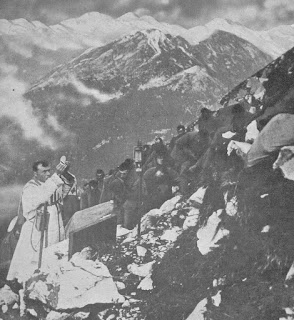
Cassock and Surplice Anglicanism's Finest Hour…
…or at least one of them: the burial of Manfred von Richthofen, the “Red Baron”, on 22 April 1918, at Bertangles, France.
He was buried by the Australians, as is clear from the uniforms. I don’t know whether the chaplain, doubtless holding the 1662 BCP, was English or Australian, but the Anglican Church in Australia was not autocephalous until many years later.
I doubt wearers of the alb in the AC will match this any time soon…
-
The Reformation and Missions: Theology and Doctrine
From J. Herbert Kane’s A Concise History of the Christian World Mission:
One would naturally expect that the spiritual forces released by the Reformation would have prompted the Protestant churches of Europe to take the gospel to the ends of the earth during the period of world exploration and colonisation which began about 1500. But such was not the case. The Roman Catholic Church between 1500 and 1700 won more converts in the pagan world than it lost to Protestantism in Europe. Why did the Protestant churches take so long to inaugurate their missionary program? What were some of the contributing factors?
The first, and perhaps the most potent, factor was the theology of the reformers. They taught that the Great Commission pertained only to the original apostles; that the apostles fulfilled the Great Commission by taking the gospel to the ends of the then known world; that if later generations were without the gospel, it was their own fault–a judgement of God on their unbelief; that the apostolate, with its immediate call, peculiar functions and miraculous powers, having ceased, the church in later ages had neither the authority nor the responsibility to send missionaries to the ends of the earth…
Moreover there were the Predestinarians, whose preoccupation with the sovereignty of God all but precluded the responsibility of man. If God wills the conversion of the heathen, they will be saved without human instrumentality. If God does not will the salvation of the heathen, it is both foolish and futile for man to intervene. Calvin wrote: “We are taught that the kingdom of Christ is neither to be advanced nor maintained by the industry of men, but this is the work of God alone”.
Added to this was the apocalypticism which anticipated, with some dismay, the rapidly approaching end of the age. Luther particularly took a dim view of the future. In his Table Talks he wrote: “Another hundred years and all will be over. God’s World will disappear for want of any to preach it”.
-
Watchman Nee on the Inspiration of the New Testament
In perusing much Evangelical and Charismatic literature, one gets the impression that the “mantic” theory of the inspiration of the Scriptures is the “correct” theory and anything else is the product of “liberals”.
I dealt with this in the book I co-authored with Leonard Albert, Apologetics for the Rest of Us. A very cogent presentation of a “non-mantic” concept of inspiration which retains the centrally authoritative and accurate nature of the Scriptures while at the same time deals with the human element comes from the Chinese teacher and preacher Watchman Nee in his book The Ministry of God’s Word.
Nee’s concept of inspiration of the Scriptures is of a piece with this concept of the inspiration of ministers, and is more “incarnational” that what we’re used to seeing in Protestant Christianity.
The passage below comes from the 1971 printing by CFP (I throw that in because there have been accusations that there are variant versions of the work, produced the year before the Communists came to power in China and drove most of Chinese Christianity underground).
It is a mistake to assume that there is no human element in God’s revelation or that the first necessarily destroys the second. The revelation of God does indeed contain the human element, for God’s word is manifested in it. Even with respect to Old Testament prophetic ministry, however small a place the human element occupies, we cannot say there is absolutely none of it present, since the word of God at least needs to be uttered by man’s mouth. In incarnation, the Word has become flesh, and so the entire human element of Christ is now the word of God. Today God desires that His word, delivered through New Testament ministers, should be blended with human elements.
In carefully perusing the New Testament we discover that certain words are constantly employed by Paul which were never employed by Peter or John or Matthew. Likewise, Luke has his favourite words, and so has Mark. In their writings, each maintains his peculiarity. The Gospel of Matthew is different from that of Mark, Mark from Luke, and Luke from John. Paul’s writings have their own definite tone; Peter’s are in another strain. But the Gospel of John and John’s Epistles share the same subject and are continuous in nature. For instance, the Gospel of John commences with “In the beginning…”, and his First Epistle opens with “What was from the beginning…” One refers to the very beginning, the other starts from that beginning and proceeds onward. And his Revelation joins these two together, using the same style of writing.
Pursuing this matter further, we find that each writer of the Bible possesses his own idiosyncrasies. As a physician Luke invokes certain medical terms with which to describe various sicknesses, while the other three Evangelists employ common words. Again, because the Book of Acts is also written by Luke, medical words once more appear. Each Gospel possesses its special phraseology and has its particular topics. In Mark, “immediately” is frequently found; in Matthew, “the kingdom of heaven”; in Luke, “the kingdom of God.” On each book the writer leaves his indelible mark; yet all are the word of God.
The New Testament is full of human elements; still, it is God’s word. Each writer maintains his emphasis, uses his special phrases, and retains his characteristics. Through these, God’s word is delivered without suffering any loss. Having man’s marks and possessing human characteristics, but nonetheless remaining God’s word—such is the New Testament ministry. God’s word is entrusted to man and is conveyed through that man’s elements. God does not turn man into a tape recorder-first recording every word and subsequently sending them out verbatim. He does not wish it so. Since the Lord Jesus has already come and the Holy Spirit has now entered into the believing man, God will work in man until his human elements do not damage God’s word. This is the basis of New Testament ministry. The Holy Spirit so operates in man, so controls and disciplines him, that the latter’s own elements can exist without impairing God’s word; on the contrary, they fulfil it. Were no human element involved, man would become a tape recorder. Today the human element is in God’s word, and the word is fulfilled by man.
Do we know why Paul does not stress that all believers must speak in tongues in the meeting? Yet are not tongues a gift of God? The explanation is because, in the speaking in tongues, man’s thought is not involved. In other words, human thought is not included. This makes it more like the Old Testament ministry than that of the New; because this is God putting unknown tongues on the lips of man. God’s emphasis in New Testament ministry is in bringing into play the human element in the word. Under the discipline, control and work of the Holy Spirit, all human elements can be properly engaged by God. The word of God is to be released through man. It is God’s word, yet it also involves human elements.
Let us use an illustration. Suppose a musician is capable of playing piano, organ, and violin. He may perform the same music on different instruments. Since each musical instrument possesses its unique characteristics, the sounds are distinctly unique. The various characteristics of these musical instruments help to express the feeling of the music. The ministries of the New Testament word somewhat resemble these musical instruments. Some are like pianos, others like organs or violins. The same music played produces a distinct sound according to the different instruments employed. From one minister the word of God comes through with his particular human element; from another there is a different sort of human element. Each and every one of those who are used by God has his own human element implanted in the word. Under the discipline, government and education of the Holy Spirit, this personal element of man no longer hinders the coming forth of God’s word but on the contrary renders its manifestation more glorious.
-
Going to the Mat with the Town of Palm Beach for Religious Freedom
In an Aug. 10 letter to lead code enforcement officer Rob Walton, attorney Marvin Rosen – a past president of the synagogue – stated: “any attempt by the town to limit, through its zoning code, the number of worshippers that can be accommodated in a house of worship would constitute an impermissible infringement of religious freedom that is strictly protected under the First Amendment to the United States Constitution and under Article 1, Section 3 of the Florida Constitution.
“Accordingly, regardless of when and what numbers of seats were approved or not approved by the town, the town’s ability to approve, reject or limit the number of seats in the temple’s sanctuary was not legal, and for that reason, the Code Enforcement Board has not right, power or authority to sanction or punish the temple for not obtaining the town’s approval (if, in fact, that approval was not obtained).
This dispute was the subject of a blog post in July, which you can read here. At the time I advised the following:
I trust that Christians will express their support to the Temple in defending their position. And it is my fervent hope that God’s Chosen People, having retained suitable counsel, will let the Town have it on this one.
They fulfilled their end of the bargain; they retained suitable counsel, and he has thrown the First Amendment at the Town. They have also passed the first hurdle re operating their gift shop. I trust that we Christians will continue to express our support for the Temple and pray for their success.
-
Calvinism, Perseverance and Assurance: Some Further Analysis
My parting attempt at humour notwithstanding, the long and involved debate with Anglican Ablaze’s Robin Jordan isn’t as “over” as one would like. For his part he has sounded the trumpet against the monstrous regiment of Charles Finney. For mine, I’d like to take this another direction, because, as I said, I don’t think the serious issues got the treatment they deserved, and I also think that some education is in order.
Some of that education stems from the fact that, for the years I worked for the Church of God, I worked in the Lay Ministries Department. One of our tasks was to train people in personal evangelism. My boss, Leonard Albert, is still doing that and blogging here. In order to share the gospel, you must know the gospel, and that’s part of the education. It’s true that Calvinists have made a major impact in how we present the gospel to people. (If it’s any comfort to Jordan, Finney’s presentation on the subject in Revivals of Religion is weak by current standards). But looking at the problem from a lay standpoint, where people start by accepting Christ (and that’s problematic in a strictly Reformed context) and move up vs. starting with doctrine and moving down, the problem looks different. Hopefully the following isn’t too circuitous to show what I’m talking about.
Let’s start with Martin Luther himself. Religious though he was, Luther couldn’t shake the gnawing feeling that he wasn’t right with God. No amount of sacramental participation, or good works, or even going to Rome made things better. (Going to the HQ of any church can have uninspiring results). Finally, after searching the Scriptures, he realised that, by faith, he was justified, not by his own works, and that he could have the assurance that he was right with God. That, at the core, is the basis of the Reformed faith.
Cast in an Augustinian context, Luther saw that as done by immutable predestination. Calvin and his followers, also in an Augustinian context, took matters further.
We also have here the idea that, once a believer is in Christ, they have unconditional perseverance, i.e., they cannot fall away. That is a necessary result of Calvinism’s insistence that the elect are the only ones to receive the grace of salvation; if a person falls, he or she wasn’t elect to start with. Pentecostals and others, however, will recognise this as “once saved/always saved” which their Baptist friends believe. The difference between the traditional Southern Baptist and the Calvinist, however, is that while the Calvinist will stress God’s choice and the fact that man is too far gone to make a choice, the Baptist will posit that this perseverance is a benefit of the choice of the person to be saved. Unconditional perseverance has serious problems, but at least the Calvinist is more consistent in his or her idea of where the perseverance comes from.
Let me pause here and present what is, with some changes, the type of gospel presentation we used to teach (and with the Scripture references some of you have looked for):
The Calvinist will say that, once a person knows this to be so, they know they are unconditionally elect. As part of Reformed theology, they can have assurance of this salvation, as opposed to, say, Roman Catholicism or Islam, where one’s status with God is essentially uncertain.
Or can they? At one point in our debate I brought up the issue of assurance, and Jordan responded with this, from the Westminster Confession:
“…infallible assurance doth not so belong to the essence of faith but that a true believer may wait long and conflict with many difficulties before he be partaker of it: yet, being enabled by the Spirit to know the things which are freely given him of God, he may, without extraordinary revelation, in the right use of ordinary means, attain thereunto. And therefore it is the duty of everyone to give all diligence to make his calling and election sure; that thereby his heart may be enlarged in peace and joy in the Holy Ghost, in love and thankfulness to God, and in strength and cheerfulness in the duties of obedience, the proper fruits of this assurance…”
This immediately struck me as the same kind of back-pedalling we see in Roman Catholicism: wise, perhaps, but a far cry from the iron-clad assurance we thought was the product of the Reformation. Moreover the other side of Calvinism–unconditional perseverance–seems unreasonable when we consider that people who profess to be Christians do things which do not match that profession or storm out of the faith altogether. If we keep saying that they weren’t saved to start with, pretty soon they come to the idea that salvation is not for them. That may suit the Calvinist who believes that Christ only came for the elect; for me, starting with something as basic as John 3:16, that’s unsatisfactory.
So where does that leave us? Let’s start from an Anglican perspective with Article XVII, which deals with serious sins after baptism. I can’t see a real Calvinist going along with such a thing, and indeed some in the Church of England didn’t. But I believe that God, who has given us the grace for eternal life, can bring such a person back, even when they have consciously walked out on him. To cite a couple of well-known passages:
My children, I am writing to you to keep you from sinning; but if any one should sin, we have one who can plead for us with the Father–Jesus Christ, the Righteous– and he is the atoning sacrifice for our sins, and not for ours only, but for those of the whole world besides. (1 John 2:1-2)
Seeing then that we have a great high priest, that is passed into the heavens, Jesus the Son of God, let us hold fast our profession. For we have not an high priest which cannot be touched with the feeling of our infirmities; but was in all points tempted like as we are, yet without sin. Let us therefore come boldly unto the throne of grace, that we may obtain mercy, and find grace to help in time of need. (Hebrews 4:14-16)
If we do not insist on unconditional perseverance, then the other side of salvation–assurance–becomes much easier, because the effects of a possible mistake are not permanent, and the cautions cited in the Westminster Confession, for example, are sensible without becoming waffling.
I have come to believe and be convinced of many things in the years since I was an Episcopalian, but unconditional perseverance isn’t one of them. It is a doctrine I have come to dislike, although most of my life I’ve confronted it via à vis the Baptists and not the Calvinists. Anglicanism provided for a way out of this, but such is lost if we follow those who should cross the Tweed if their convictions are located there.
-
Going Downhill with Anglicans Ablaze's Robin Jordan
Those of you who have followed my recent posts on Calvinism (this and this) and even my exposition on Origen and the literal sense of Scripture know that these have elicited a vigorous rejoinder by Robin Jordan of Anglicans Ablaze. With the responses from same and now his own blog post on the “slippery slope” it’s time for yet another extended response.
Let me start with some “close to home” factual issues from his blog post:
On Positive Affinity Don C. Warrington, a former Pentecostal, now with the Church of God…
In addition to messing up the blog name, his unfamiliarity with certain parts of Christianity comes through. Perusal of both my own odyssey and the Church of God’s Declaration of Faith should make it clear that he has made a distinction without a difference. (Note to myself: if my novel At the Inlet is ever made into a movie, I should attempt to retain Jordan as a technical advisor for the role of the Anglican bishop, especially for scenes like this, if the link doesn’t take you halfway down the page, scroll to the horizontal rule).
Turning back to his responses on this blog, I have responded to some of these but not all. So let’s take a look at three important topics, starting with the matter of Charles Finney:
Charles Finney has been roundly criticized for asserting that humankind did not need the help of God’s grace to be saved. Indeed he has been described as the father of easy decisionism…A correction–I meant easy believism, not easy decisionism. Finney’s revivalism would produce “converts” whose “conversion” lasted little longer than the revival at which in midst of the excitement that typically accompanied such gatherings they made “a decision for Christ.”
Believism? Maybe. Easy? Hardly! The best way to see this in action on a long-term basis is to look at the churches which are the direct heirs of his revivalistic tradition, the Wesleyan Holiness and Pentecostal churches. Until fairly recently, these have been strict and demanding of their members. The whole business of “go down, shake the preacher’s hand and join the church” without any significant examination of converts is a later change.
The reason Finney ends up on many Reformed dartboards is because he a) succeeded where “traditional” churches did not and b) he upended Reformed theology in the process. One of the major gaps between European and American Protestanism is the Americans implicitly or explicitly rejected a purely predestination-driven dynamic of salvation.
As a matter of opinion, I think that Augustinianism’s (and all Reformed theology is a part of this) noblest attack on “easy believism” was the Jansenists conflict with the Jesuits. It’s hard to get Anglophone Reformed people to go along with this because the Jansenists had the bad taste to be a) French and b) Roman Catholic.
Now let’s go to the issue of Patristics:
Archbishop Thomas Cranmer, while well acquainted with the Patristic writers, preferred to defend his views from Scripture. Bishop John Jewel in his handling of the Patristic writers followed these guidelines:
- He cited only an opinion of the Patristic writers on a matter where several Patristic writers were in agreement. He never cited the isolated opinion of a single Patristic writer.
- He then cited their opinion if he himself from his own reading and study of Scripture was convinced that their opinion was agreeable to Scripture. It could be clearly read out of Scripture and was consistent with the plain and natural sense of the text.
- He never cited what a later Patristic writer’s opinion of what an earlier Patristic writer believed, only what that earlier Patristic writer himself had written.
- He recognized the views of the Patristic writers for what they are–opinions. He did not credit them with an special inspiration, as did the Roman Catholics and subsequently the Anglo-Catholics..
- He gave greater weight to the opinions of the earlier Patristic writers than to the latter ones, particularly to those who wrote in the first three to five centuries of Christianity.
First: the reason I went though Origen’s exposition on the allegorical interpretation is because his development of the concept was extremely influential for the later Church Fathers (including Augustine) and through the Middle Ages, and needs to be considered when evaluating the Fathers’ weight to the literal senses. It was the Reformers within Christianity (the Jews had a running start on this) which turned away from it, and I’m surprised that a Reformed stalwart like Jordan missed that.
Nevertheless the Anglican which discounts the Patristic witness does so at his or her own peril, because the Anglican enterprise is a complete waste of time without it. Why? The basic reasons are two: the monarchial episcopate and liturgical worship. Neither of these has direct sanction in the New Testament; without some regard for development during the Patristic era, their existence cannot be justified. In that respect the Scots (and guess where they got their theology and ecclesiology from)? are more consistent; perhaps that is what Jordan would like to end up with.
Jenny Geddes would be proud…
Finally let’s take a look at yet another attack at the universalism issue:
Are you extrapolating to outside North America what you are asserting happened in North America? If so, on what basis? Have you considered the other factors that contributed to the development of universalist thought in North America such as Socianism?
As an engineer, I understand the dangers of extrapolation. No, I’m not trying to extrapolate anything. Neither am I trying to say that Calvinism is the only way people become universalists. What I’ve tried to say is that Calvinism’s view of election is a weakness in the system that makes universalism an easy solution to those who are uneasy with its implications. I, as Morey noted for many Evangelicals, believe that Finney’s solution is the best way out of this dilemma, as distasteful as it is to Reformed theology advocates.
Readers who are interested in more of my rationale re Reformed theology in an Anglican context can find it here.
-
Calvinism and Universalism: A Follow-Up
As a follow-up to my earlier post on Calvinism—and a partial response to Anglicans Ablaze’s Robin Jordan—I wanted to supply more details on my contention that Calvinism “…is the fastest road to universalism in Christianity.”
Following is a part of Robert Morey’s Death and the Afterlife, where he discusses and ultimately refutes universalism. I heartily recommend this book for its discussion of the subject its title indicates; it is a classic in that regard.
Turning to Universalism and Calvinism, the following part (pp. 225-227) discusses Charles Finney’s refutation of Universalism, which, as Morey notes, forced Finney (and many who have come after him) to reject the Reformed view of the atonement. By doing this, Finney not only refuted Universalism, but undermined Calvinism as well.
In this context, Universalism is a “hack” to Calvinism, or more elegantly turning Calvinism on its head, just as Marx turned Hegel on his. It is only possible to withstand this in a Calvinistic framework if one is willing to accept the consequences of those essentially chosen to be lost. That takes some stern stuff—maybe too stern of stuff—but then again you can’t accuse serious Calvinists of being made of anything else.
The Universalist movement grew as more and more people abandoned their Calvinistic heritage. Chancy’s The Salvation of All Men (1784) sparked a debate which produced over seventy-five books and articles before it ran its course. Not even Jonathan Edwards and Timothy Dwight were able to stop the tide of Universalist theology.
The evangelist Charles G. Finney was forced to debate Universalists on several occasions. His answer, which many evangelicals today still think to be the best defence, was to reject the Reformed concept that Christ actually accomplished atonement on the cross by infallibly securing salvation for the elect, and to posit in its place the idea that Christ made salvation “possible.” Christ did not secure salvation for “the elect,” as the Calvinists claimed, or for “all men,” as the Universalists claimed. Finney saw that Universalism made use of the Reformed view of the nature of the atonement as its own basis. By attacking the Calvinistic concept of the atonement, Universalism was refuted. Finney relates one such incident in his memoirs where he was asked to refute Universalism.
In this state of things, Mr. Gale, together with some of the elders of his church, desired me to address the people on the subject, and see if I could not reply to the arguments of the Universalist. The great effort of the Universalist was of course to show that sin did not deserve endless punishment. He inveighed against the doctrine of endless punishment as unjust, infinitely cruel and absurd. God was love; and how could a God of love punish men endlessly?
I arose in one of our evening meetings and said, “This Universalist preacher holds forth doctrines that are new to me, and I do not believe they are taught in the Bible. But I am going to examine the subject, and if I cannot show that his views are false, I will become a Universalist myself.” I then appointed a meeting the next week, at which time I proposed to deliver a lecture in opposition to his views. The Christian people were rather startled at my boldness in saying that I would be a Universalist if I could not prove that his doctrines were false. However, I felt sure that I could.
When the evening came for my lecture, the house was crowded. I took up the question of the justice of endless punishment, and discussed it through that and the next evening. There was general satisfaction with the presentation.
The Universalist himself found that the people were convinced that he was wrong, and he took another tack. Mr. Gale, together with his school of theology, maintained that the atonement of Christ was the literal payment of the debt of the elect, a suffering of just what they deserved to suffer; so that the elect were saved upon principles of exact justice; Christ, so far as they were concerned, having fully answered the demands of the law. The Universalist seized upon this view, assuming that this was the real nature of the atonement. He had only to prove that the atonement was made for all men, and then he could show that all men would be saved; because the debt of all mankind had been literally paid by the Lord Jesus Christ, and Universalism would follow on the very ground of justice; for God could not justly punish those whose debt was paid.
I saw, and the people saw-those who understood Mr. Gale’s position-that the Universalist had gotten him into a tight place. For it was easy to prove that the atonement was made for all mankind; and if the nature and value of the atonement were as Mr. Gale held, universal salvation was an inevitable result.
I then appointed to lecture on the Universalist’s argument founded on the Gospel. I delivered two lectures on the atonement. In these I think I fully succeeded in showing that the atonement did not consist in the literal payment of the debt of sinners, in the sense which the Universalist maintained; that it simply rendered the salvation of all men possible, and did not of itself lay God under obligation to save anybody; that it was not true that Christ suffered just what those for whom He died deserved to suffer; that no such thing as that was taught in the Bible, and no such thing was true; that, on the contrary, Christ died simply to remove an insurmountable obstacle out of the way of Cod’s forgiving sinners, so as to render it possible for him to proclaim a universal amnesty, inviting all men to repent, to believe in Christ, and to accept salvation; that instead of having satisfied retributive justice, and borne just what sinners deserve, Christ had only satisfied public justice, by honouring the law, both in his obedience and death, thus rendering it safe for God to pardon sin, to pardon the sins of any man and of all men who would repent and believe in Him. I maintained that Christ, in His atonement, merely did that which was necessary as a condition of the forgiveness of sin; and not that which cancelled sin, in the sense of literally paying the indebtedness of sinners.
This answered the Universalist, and put a stop to any further proceedings or excitement on that subject.
Note: the passage from Finney was taken from his autobiography.


explaining the purchases.