-
Forty Years Ago, I Left. Today, the Diocese of South Carolina Leaves.
Through this year, I have posted from time to time about my journey forty years ago from the Episcopal Church to the Roman Catholic Church. Today is the fortieth anniversary of that transition. On a very nice South Florida November afternoon, I took my baby blue Pinto on the very short drive to St. Thomas More Parish and, with just me and Fr. Connolly there, I took the profession of faith as a Roman Catholic. These days, both churches like to do stuff like this in big public ceremonies but, as was the case with my baptism seven years before, it was in private.
My family wasn’t happy with the decision, and my liberal Episcopal school chaplain wasn’t either, although I probably spiked the football harder about it than I should have. But for a senior in high school in a church which careened between no answers and silly ones, there weren’t many viable alternatives at that point other than the one I took.
I’ve said before that my years as a Roman Catholic were the spiritual adventure of a lifetime. Today, of course, we have another Episcopal Church departure of far greater import that also promises to be an adventure of another kind: the decision of the Diocese of South Carolina to exit the church, with the central office already preparing a faux diocese complete with Potemkin bishop from here in East Tennessee. The confluence of the two, although not comparable in scope, leads to some reflections.
The current Presiding Bishop likes to say the people can leave TEC but churches and dioceses cannot. Rubbish like this notwithstanding, I have come to realise that conservatives departing individually is an expected result. One Anglo-Catholic bishop told me many years ago that liberals, in fact, want conservatives to leave, and for many on the left that’s probably the case. The current church-wide triumph of the “revisionist wing” was facilitated by the massive departures of conservative Episcopalians for other church homes. By the time the LGBT community upped the ante with V.G. Robinson’s enthronement in 2003, there weren’t enough conservative prelates/dioceses/parishes/lay people left to organise a successful resistance on a church-wide basis. That’s something that was obvious to some of us at the time; others have had to learn this in great pain. That’s the situation that the DioSC finds itself in.
The problem with parishes and dioceses leaving, however, isn’t people but property. I’ve said this before, but I’m still amazed that people as ostensibly socialistic as those on the Episcopal left have made such an expensive stand with the property. In the 1960’s we were told that we needed to get out of our pews overlooked by stained glass and get real; in the 2000’s TEC has bankrupted itself keeping both. There are two basic reasons for this volte-face, although they are not flattering to the mind changers in TEC.
The first is that TEC, for all the changes, still fancies itself as the church of the upper reaches of society. What has changed is the composition of that upper class. Before the revolution we had industrialists like my family and professionals such as attorneys and physicians. Now we still have the latter but we now have the noblesse de robe from the government and academia. These still like to liturgise in the same nice surroundings as those departed did. The historical property is still a major draw for the church, and thus is fought over. But that’s a long way from the radical vision that helped to kick off the revolution in the first place.
The second is simply…because they can. Overall, the success rate of TEC in our judicial system is pretty good. That’s in part because our courts have traditionally been reluctant to interfere with the operations of religious bodies, although that reluctance is becoming selective, as the flap over Obamacare’s contraceptive mandate indicates. But more profoundly the judiciary is made up with the same élite style of mind that permeates TEC, and in many cases the two are one in the same. They find a church’s reluctance to apply the same “equality” standard that is being imposed on society highly distasteful, and so take that aversion out on the conservatives in the litigation.
The Diocese of South Carolina is both the early bird and the latecomer to the war transferred to the court system. They made their missteps early but have learned from their mistakes and those of others. Whether their plans are successful remains to be seen. The U.S. used to have a predictable rule of law, but the more complex our laws have become and the more “outcome-based” our judiciary is the less predictability exists. That bodes ill for us as a country and not just for DioSC.
It is my prayer that the Diocese of South Carolina will prevail and join the orthodox Anglican world on a formal basis. It is also my prayer that in its own way their departure, like mine, will be the spiritual adventure of a lifetime, because once we have split we must then build, not only for this life but also for the life to come.
-
Veni, Venite, or Coming to Terms with Proper Latin Pronunciation at Christmas
One of the significant changes that has come to this blog in the year fast ending is the incorporation of proper WordPress statistics for the webmaster to contemplate. This gives me a better idea of where my readers are coming from and what interests them (better than Google Analytics, I might add).
This blog (and all of my sites are pretty much the same way) doesn’t live primarily off of the new content, although the visits do get a kick from time to time from popular pieces of the moment. It’s more centred on content of perennial interest, like this. That’s because my general instinct is towards education, and real education is sorely needed these days.
That in turn leads me to a place where some further instruction is in order. Two years ago I posted Gloria in excelsis Deo. Now Let’s Get That Pronunciation Right! which set forth the proper pronunciation of the Latin words that creep into our Christmas carols. Evidently I’m not the only one who thinks something is amiss with our Advent repertoire because the interest in that piece is pretty steady.
With that time of year, when choirmasters and music ministers alike prepare to butcher the language of Cicero and Tertullian, it’s time to issue a reminder that you don’t have to be wrong about this. In the earlier piece I focused on “Angels We Have Heard on High” but this time I’d like to remind readers of the following:
I think it’s time that we pitch this so-called “ecclesiastical” pronunciation of Latin which plagues such classics as “Veni, Veni, Emmanuel,” (O Come, O Come, Emmanuel) “Adeste Fideles,” (O Come, All Ye Faithful)…and pronounce the language the way the Romans did when Our Lord actually laid in the manger in swaddling clothes.
In the case of these two classics (both of which started out in Latin) the most egregious problem is the way the various forms of the Latin verb venire (to come) are pronounced. The proper way to do this, as set forth by the source for the original piece, is to pronounce the “v” like a “w” (yes, we know the Germans do it this way…)
It’s time to “come to the party” on this issue, and I don’t mean the one where the eggnog is served. I’m also aware that the nature of the eggnog is in dispute as well, but, as I like to say, that’s another post.
-
Taking the Last Voyage with Newton and Pascal
He’s not widely known outside of the fields he specialised in, but Adhémar Jean Claude Barré de Saint-Venant (1797-1886, usually known in the Anglophone world as simply Saint-Venant) was one of the premier scientists, engineers and mathematicians of the nineteenth century. His accomplishments were many and include the following:
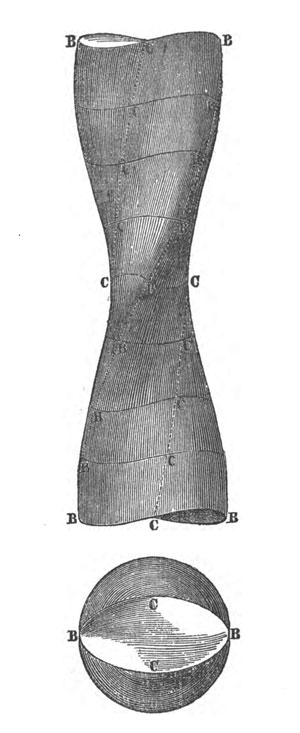 Successful derivation of the Navier-Stokes Equations for a viscous flow before Stokes; these equations are the basis of computational fluid dynamics and the analysis of things that fly.
- Systematisation and development of methods in the theory of elasticity of solids, including his semi-inverse methods for torsion, important in things such as automobile crank shafts.
- Methods for the analysis of wave mechanics in bars, which we see in many places, from musical instruments to driven foundation piles.
Saint-Venant was born into a royalist, aristocratic, traditionally Roman Catholic family at a time when it was not safe to be any of these: the French Revolution, at that point stumbling from the Reign of Terror to control of France–and most of Europe–by Napoleon Bonaparte. It was about the latter where Saint-Venant made a statement about himself that got him into trouble with the “new” Europe. As described in S. Timoshenko’s History of Strength of Materials:
The political events of 1814 had a great effect on Saint-Venant’s career. In March of that year, the armies of the allies were approaching Paris and the students of the École Polytechnique were mobilized. On March 30, 1814, they were moving their guns to the Paris fortification when Saint-Venant, who was the first sargeant of the detachment, stepped out from the ranks with the exclamation: “My conscience forbids me to fight for an usurper…” His schoolmates resented that action very much and Saint-Venant was proclaimed a deserter and never allowed to resume his study at the École Polytechnique.
Saint-Venant’s statement of conscience was at once a political and religious statement, and “progressives” of his day didn’t miss either. The French, then and now innocent of anti-discrimination legislation or sentiments, made his life miserable. The École Polytechnique was and is France’s premier technical institute of higher learning; getting kicked out of it was the equivalent of, say, being expelled from Princeton or MIT. He worked in the powder industry for nine years, then was admitted to the École des Ponts et Chausées, where his fellow students shunned him. He graduated first in his class anyway and began his illustrious career in technical things both theoretical and practical.
In spite of his difficulties within France, his reputation outside of her was another matter. When François Napoleon Moigno wrote his book on statics, he discovered the following:
He (Moigno) wanted the portion on the statics of elastic bodies to be written by an expert in the theory of elasticity, but every time he asked for the collaboration of an English or a German scientist, he was given the same answer: “You have there, close to you, the authority par excellence, M. de Saint-Venant, consult him, listen to him, follow him.” One of them, M. Ettingshausen, added: “Your Academy of Sciences makes a mistake, a great mistake when it does not open its doors to a mathematician who is so highly placed in the opinion of the most competent judges.” In conclusion Moigno observes: “Fatally belittled in France of which he is the purest mathematical glory, M. de Saint-Venant enjoys a reputation in foreign countries which we dare to call grandiose.”
The French finally broke down and admitted Saint-Venant into the Academy of Sciences in 1868. He continued his work, much of it from his home, up until the time of his death. When the President of the Academy announced that passing, he made the following statement:
Old age was kind to our great colleague. He died, advanced in years, without infirmities, occupied up to the last hour with problems which were dear to him and supported in the great passage by the hopes which had supported Pascal and Newton.
Europeans of the time would not have missed the import of the last statement: Pascal and Newton were Christians, and Saint-Venant was being identified with them as one also. It was also a statement that Saint-Venant, for all of his achievements and interests which have enriched the world, also had an eternal goal as well.
There’s no evidence that Saint-Venant was ostentatious in his faith walk; descriptions of his life show the contrary. And–shock to today’s atheist–there’s no evidence that it ever impeded the progress of his research or his thought. As the statistician and eugenicist Karl Pearson, no friend of Christianity, noted:
The more I studied Saint-Venant’s work, the more new directions it seemed to me to open up for original investigation of the most valuable kind. It suggested innumerable unsolved problems in atomic physics, in impact, in plasticity and in a variety of other branches of elasticity, which do not seem beyond solution, and the solution of which if obtained would be of extreme importance. I felt convinced that a study of Saint-Venant’s researches would be a most valuable directive to the several young scientists, whose recent memoirs shew their interest in elasticity as well as their mathematical capacity. Many of the problems raised by Saint-Venant’s suggestive memoirs were quite beyond my powers of analysis, and I recognised that the most useful task I could undertake, was by a careful account of the memoirs themselves to lead the more competent on to their solution.

The biggest impediment he had to face was the blowback from his stand at the École Polytechnique, and that came from his secularist colleagues. But, when the end came, all of his colleagues knew where he stood, in this life and the next one.
I spend a lot of time on this site and others talking about sea (and sometimes air) voyages. And I’ve spent most of my career (and all the academic part of same) in the applied sciences. But when I take my last voyage into eternity, I want to do it in the same hope of Newton and Pascal–and Saint-Venant and Euler for that matter–namely that which comes from following Jesus Christ out of the grave and into eternal life.
Note: my main source for this article was S. Timoshenko’s History of Strength of Materials. Other sources were as follows:
- Pearson, Karl. The Elastical Researches of Barré de Saint-Venant. Cambridge: University Press, 1889.
- Thurston, Herbert. “Saint Bénézet and his Biographer.” Catholic World, Vol. 86, No. 517, December 1907.
-
Passing Up Making Lemonade on Civil Marriage
Hundreds of Israeli evangelical couples have traveled out of the country in order to get married because the Jewish government does not officially recognize their faith. Church leaders are escalating efforts to change that.
The Council of Evangelical Churches in Israel (CECI), which includes 51 churches and organizations such as Campus Crusade and the Bible Society, formally requested in August 2011 that Israel recognize four denominations on behalf of nearly 5,000 followers. More than a year later, Prime Minister Benjamin Netanyahu—who must approve the request—has yet to respond, says Michael Decker, chief counsel for the Jerusalem Institute of Justice (JIJ).
“Not being recognized leads to practical problems,” said Botrus Mansour, director of Nazareth Baptist School, regarding marriage, divorce, and education matters. “We hope a lawsuit will [help].”
Israel doesn’t have civil marriage as we know it, but recognises various religious bodies to perform marriages which then have acknowledgement by the state. Evangelicals, popular neither in Israel or here, have troubles getting their plethora of churches (maybe we need to discuss this problem first) recognised. (Perhaps if Barack Obama realised how Evangelicals are viewed by the Israeli government, US-Israel relations would improve). So Evangelical couples go abroad for a civil marriage.
IMHO, these churches are passing up an opportunity their American counterparts can’t get their head around either: marriage performed by a church but unrecognised by the state. Evangelical pastors love to trumpet their “scriptural authority” (I wonder if Israeli pastors are as triumphalistic as their American counterparts, somehow I doubt it) but they can’t seem to find it when it comes to really putting their seal on “what God joins together”. AFAIK, Israel doesn’t have laws against “unlawful conjugal relations” unlike the Muslim countries that surround it, and any Western-style country like Israel deals regularly with couples not joined in state-recognised marriage or civil union.
But I’m not holding my breath…

Sailing the Last Voyage with Newton and Pascal
 Positive Infinity