-
Sebastian Temple: Sing! People of God, Sing!
St. Francis SFPS-2 (1967)
Up to now the early post-Vatican II albums have come from the U.S. But there was activity in this field in the U.K. also, and probably the best known artist/song writer to get things started was Sebastian Temple.
Born in South Africa, he emigrated to the UK, where he spent many years active in Catholic work and writing. A secular Franciscan, he’s best known for his song “Make Me a Channel of Your Peace”, based on the Prayer of St. Francis, which was a favourite in the 1960’s and 1970’s and sung at Princess Diana’s funeral in 1997. That was also the year that Temple passed away himself.
His music is simple and upbeat; his wish was for people to be happy while singing his songs, and he certainly succeeds in that regard. This album is a good example of his work but, like so much of the era, it has been forgotten, even with the fame its composer and performer achieved in his lifetime.
Personal note: it was my intention to post this album soon after Sister Germaine’s, but I ended up in a Catholic hospital for a couple of days were I was able to view the election of Francis I as Pope. Temple was a Franciscan whose most popular song is based on St. Francis’ prayer. Now we have a Pope (and a Jesuit no less!) who takes Francis’ name as his own. Divine providence? I’d like to think so…

The songs:
- Sing! People of God, Sing! (Sing! Sing! Sing!)
- Follow Christ (And Love The World As He Did)
- Your Will Be Done (If You would have me…)
- The Blessed Sacrament (Come, Let’s Share In The Banquet Of The Lord)
- Thank You Jesus
- All That I Am (All That I Do)
- Glorious God (King Of Creation)
- (Sing Praises To) The Living God (Glory Hallelujah)
- Take My Hands (And Make Them As Your Own)
- If We Eat Of The Lord (And We Drink Of The Lord)
- We Are One (In Jesus, All Of Us Are One)
- Prayer For Peace (Lord We Pray For Golden Peace, Peace All Over The Land)
- How Great Is Your Name
- The Mass Is Ended (All Go In Peace)
-
Sister Germaine: Songs of Salvation
FEL 810F-6242 (1966)
One of the early “sensations” of the post-Vatican II Catholic music world was the young nun Sister Germaine Habjan, who produced this album of songs and narrative (Episcopal ministers Ian Mitchell and Frederick Gere also included narrative) based on Scripture and other sources. By later standards it’s a plain album, but it’s well performed.
Sister Germaine’s later history is, in some ways, more interesting than the album. She and her fellow religious, moving rapidly in a changing church, were too progressive for their bishop. She eventually left her order and married. Her daughter’s account of how the posting of the album proved very useful is one of the most heartwarming things to ever appear on this blog.

The songs:
- All Of My Life
- Osee
- You Are My People
- The Father Had But One Son
- From Among The Branches
- Song Of Trust
- Jerusalem, How Often Would I Gather You
- Love One Another
- Resurrection
- The Wind Is Blowin’
- Who Is This Man?
- Come, Lord Jesus
- Fear Not
- My Lord Is Long A-Comin’
- I’ll Never Contented Be
- Sing Out
-
Truro, Baucum, Johnston and the Occupational Hazard of Anglicanism
As we march through this Lenten season, complete with the silliness over the sequester and the post-modern version of the Great Refusal, we come to yet another saga in the Anglican/Episcopal world–the volte-face that has taken place by the Truro Anglican Church and its rector, Tory Baucum, vis-à-vis the Episcopal Bishop of Virginia, Shannon Johnston. It’s amazing, after the public acrimony, cost and litigation that has taken place, that we have so soon an attempt at “reconciliation”, but we’ve got one. It’s even inspiring the new occupant of Lambeth Palace in his quest for same reconciliation on a broader scale. The obvious dumb question is why.
Let me begin by stipulating that, as is usually the case with politics of any kind, there are untransparent complexities at work here. There are always things going on behind the scenes that move situations in one direction or another that really don’t have much to do with the principle issues at hand, but are the product of the organisational situation on the ground. In a metropolitan area like Washington with three state/district jurisdictions and Episcopal dioceses to match, both secular and ecclesiastical politics get murky quickly.
The fact that it’s in the capital region, however, is a good place to start in our attempt to pinpoint the underlying problem. It’s as old as the Episcopal Church itself in this country, but now driven by the change in our country’s power structure and the values held by that power structure.
If we go back to colonial times, the Church of England was the official state church in the colonies south of the Potomac, and thus the preferred church of people of property. The ones without it, or the ones with property in remote areas, often preferred to go somewhere else. That, of course, was illegal, and those on the wrong end of things helped to fuel the disestablishment of same Church of England after the American Revolution.
When the remnants of the old Church of England picked themselves off of the floor and pulled themselves together to form the Protestant Episcopal Church, the intent was not to be the people of property at prayer, but that’s how it turned out. The effect was mutual: the Episcopal Church both shaped the ethic of the upper reaches of society and in turn was shaped by those reaches. After World War II it became part of the church’s marketing strategy for an upwardly obsessed society, which produced a spectacular roller coaster ride in terms of membership numbers: straight up through the 1950’s and 1960’s, straight down in the 1970’s.
The left lurch of the Episcopal Church is well documented, although many in Round II (in the 2000’s) weren’t around for Round I (in the 1960’s and 1970’s). The big difference between I and II was that the latter actually resulted in a meaningful secession. That secession has left some loose ends, and evidently they’re no looser than in the shadow of our nation’s capital. I suspect that it’s not an accident that this first serious threat to the unity of the ACNA is coming from there.
To start with, a church which appeals to the upper reaches best does so with an appeal to tradition, an appeal that needs to be more aesthetic than one of conviction. That’s at the core of the property disputes: both sides know that much of the pastiche of Episcopal religion is tied up in its historic properties. Although the left has grossly overplayed (and overpayed) their hand on this one, they know that the appearance of continuity can mask the lack of real continuance of belief. The other side, believing they have both, struggle to get the property so that they may present the appeal to the truth through the appeal of tradition. Losing that advantage is the key setback of losing the property litigation.
Turning to the issue that detonated Round II, the LGBT has become to the American élite left what the Communist Party was to the proletariat: its vanguard. A church which is started in opposition to same is bound to put itself in the crosshairs of the toughest, most tenacious force in the American political and social scene today. It’s not a formula for popularity, especially with those who are at the heights.
And being in the capital region makes an élite appeal unavoidable, especially for a church somewhere in the Anglican/Episcopal world. Beyond their bouncing from one moral crusade for “justice” to another, our elites’ dream is to make the U.S. like Europe, where the wealth of the nation is sucked into the capital, which takes a generous cut of the proceeds and redistributes the rest back out as it sees fit. Under these conditions, we really don’t have a left-right divide: we have an us-them divide, which explains, among other things, why our media is so deep in the tank for Barack Obama. Under these circumstances, presenting the Gospel to “us” is challenging: “us” takes one look at it and sees a competitor to “our” control, which is the underlying reason “us” are going secular.
My guess is that Baucum and his parishioners are beaten down on the one side by an Episcopal Church which manages one property victory after another (whether they can replicate this in SC is a whole different subject) and on the other by a mission field which has turned blue. They’re looking for relief, and coming from a tradition where the emphasis is on comity, the idea of burying the hatchet with the likes of Shannon Johnston is a major temptation.
Baucum–and indeed the ACNA in general–must realise, however, that seeking such accommodation defeats the reason for the ACNA and the Anglican revolt. What was the point of secession, of the cost of litigation and for most of the losers relocation, when you’re just going to throw in the towel? And, to get back to the key issue, what’s the purpose of a church whose beliefs are little different from the world around it?
In such a hostile environment, presenting and living the life that Jesus Christ offers us will need an entirely different way of doing things than conventional, open-society church. First, however, we must, like the song from India, decide to follow Jesus and not turn back. We must understand that such a choice is not going to be popular, especially in a place where Our Lord’s proclamation that all power is given to him and not to the mission field’s paymaster.
The higher one goes in society, the greater the temptation for Christianity to attempt to strike a nice accommodation with the world around it. That’s the occupational hazard of churches in general, but of the Anglican/Episcopal world in particular, given its “target demographic” on this continent. The price to live for Our Lord is high, but the price of caving has been even higher. What makes anyone believe that the latter will get any lower?
-
Peter Scholtes: They’ll Know We Are Christians By Our Love
FEL S-252 (1968)
Anyone who has rummaged (physically or virtually) through the discography of the “Jesus Music” era usually has strong ideas about which albums and artists affected them personally, and which ones changed the course of the life of the church. For Evangelicals, artists such as Larry Norman, Phil Keaggy or the Second Chapter of Acts come to mind. In the Roman Catholic world, there are candidates, but for lasting influence this album is in a league of its own.
In many ways it’s an unlikely candidate. It has a homemade sound to it. It’s more of a collage of songs and Masses than a well thought out work of art or liturgy. It’s an inner city production with mostly black artists in a church that was becoming very middle class. But few who lived through the era will forget the title track or the “Missa Bossa Nova”. And it’s a testament to the power of music to inspire both the people who make it and those who take part in it. One can feel the fun the performers were having recording it.
Peter Scholtes was a South Side Chicago priest when he put together this album. That evokes a long radical tradition that is very much a part of our lives these days. But Scholtes preferred to leave much of the political activity to others, as he explained in this interview. Ultimately Scholtes and his parishioners were making more than music with this album: they were making history.
 The songs:
- They’ll Know We Are Christians
- Take My Hand
- Choose Life
- There Once Was A Man
- Lord Have Mercy – Missa Bossa Nova
- Glory To God – Missa Bossa Nova
- Holy, Holy – Missa Bossa Nova
- Our Father – Missa Bossa Nova
- Lamb Of God – Missa Bossa Nova
- Open Up The Boxes
- The Lord Bless You
- Glory Be To Israel
- Shout And Clap Your Hands
- We Gather Together
- Lord Have Mercy – Mass of 67th Street
- Holy, Holy – Mass of 67th Street
- Lamb Of God – Mass Of 67th Street
-
The 10:15: Making Tracks
no label 2345 (1970)
Some people will find the connection between “folk music” and “the Bronx” akin to salsa coming from New York City, but here it is anyway. This album, produced right about the time the Novus Ordo Missae was made official, is a rambling folk album whose style is, in many ways, more natural than one generally gets with Roman Catholic works. There is some very outstanding instrumental work (which is in general a cut above a lot of what got played during Mass in those days) and the vocals are reasonable. The only real drawback is that the theology is dicey in spots, even by the standards of the immediate post-Vatican II era.
One of the artists was T. Shawn Tracy, O.S.A., who went on to have a successful career both as an Augustinian priest and a composer and performer of Catholic music. What Augustine would have thought of this album is an interesting topic, but while we’re thinking about that…
The songs:
- Come to the table of the lord
- Peace i give to you
- Blessed are you
- We are the people of the lord
- We came
- Come to me I’ve come to you
- The long song
- Joe’s acclamation
- Revelation
- Just a closer walk with thee
-
Wendy Vickers: Sow a Seed
Epoch VII WV01 (1974)
Most people associate post-Vatican II Catholic music with the folk Mass type music that’s featured regularly on this blog. But there were some exceptions, and this album–and artist–was one of them. This is a very good, straightforward folk album, more like (as Ken Scott points out in Archivist) Maranatha artists Karen Lafferty (of “Seek Ye First the Kingdom of God” fame) and Becky Ugartechea. Her rendering of “Were You There” is especially memorable. There is also some liturgical music here.
It was nominated for a Grammy when it came out, but its later history is another story. Epoch was acquired by North American Liturgy Resources, who featured the title track on their Family Album. They in turn ended up in OCP. But the last, more enamoured with the likes of Marty Haugen and David Haas, allowed their strong female vocalists like Vickers, Juliana Garza and Angle Tucciarone to lapse in the line-up, which should tell you a lot about the state of Catholic music.
Update (October 2016): Wendy Vickers’ music is available here on CD Baby. Also, as she notes in her comment, OCP is planning to re-release the album for download, so perhaps things are moving there too.

In the meanwhile, the songs:
- Get on Board
- Were You There
- Glory to God
- Let Me do it with Love
- Sow a Seed
- High Time
- The Lord Gave Me a Song
- Holy, Holy
- Keep the Faith on Movin’
- Come to My Table
- Go in Peace

-
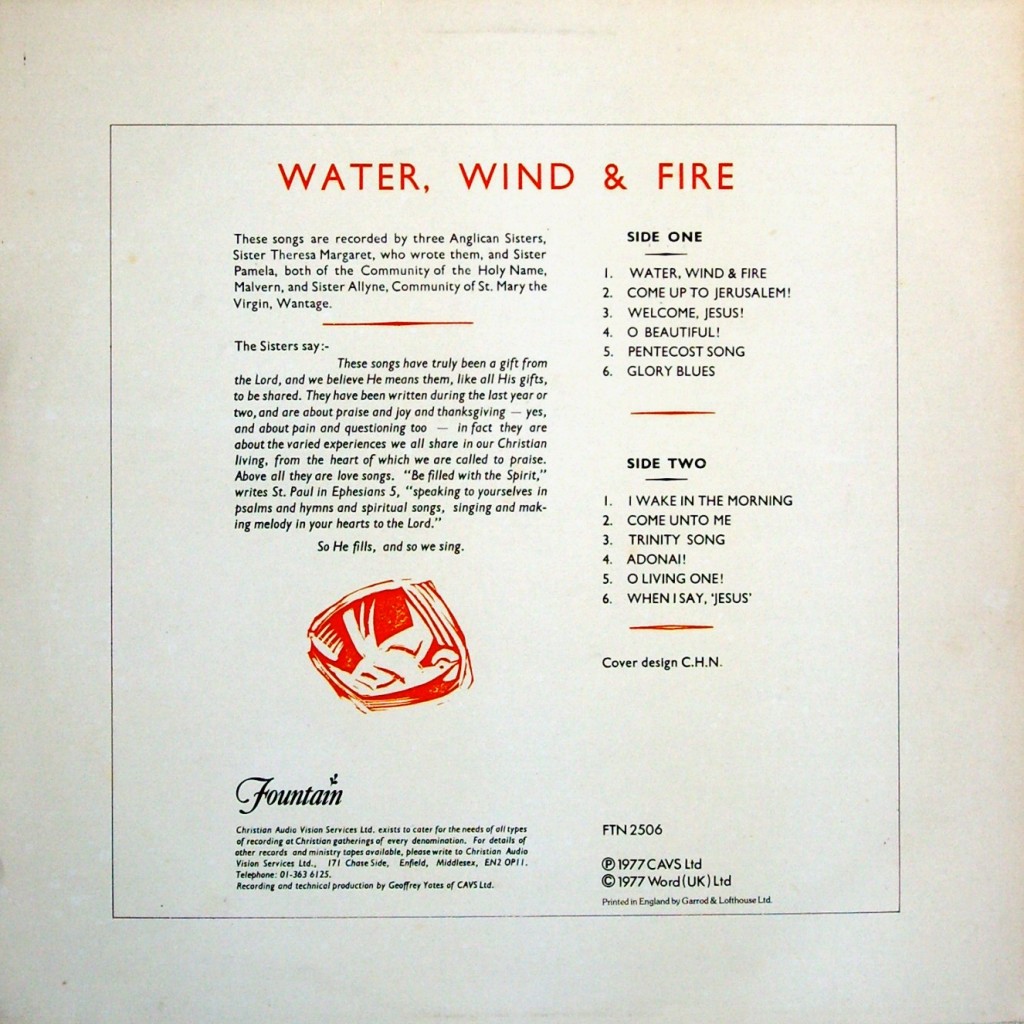
Water, Wind and Fire: Songs By Sisters
CAVS/Fountain FTN 2506 (1977)
Folk albums by nuns were fairly common in the 1960’s and 1970’s; this site features Roman Catholic religious such as Juliana Garza and the School Sisters of Notre Dame. This one, however, is different in one important respect: the sisters are Anglican. Two of them were of the Community of the Holy Name in Malvern, England, and one was of the Community of St. Mary the Virgin in Wantage, England.
The album has a melismatic quality that separates it from many other albums, sometimes having a faint echo of Hildegard von Bingen, although I doubt the performers would make the analogy. The instrumentation is light, the vocals are excellent. It’s definitely worth a listen.

The songs:
- Water, Wind & Fire
- Come Up to Jerusalem!
- Welcome, Jesus!
- O Beautiful!
- Pentecost Song
- Glory Blues
- I Wake in the Morning
- Come Unto Me
- Trinity Song
- Adonai!
- Oh Living One!
- When I Say, ‘Jesus’
-
When Lent Became the "Saddest Season"
It wasn’t always so, at least not as we understand it. In discussing Leo the Great, Hughes Oliphant Old’s The Reading and Preaching of the Scriptures in the Worship of the Christian Church, Vol. 2: The Patristic Age has this to say:
Lent has usually been explained as a period of forty days during which those preparing for baptism at Easter were instructed in the essentials of the faith and, along with the rest of the Church, observed a more intense discipline of prayer and fasting. That those preparing for the sacrament should submit themselves to the disciplines of repentance had been an essential dimension from the beginning. Repentance had been at the heart of the ministry of John the Baptist, and for the ancient Church the baptism of Jesus by John had been the prototype of Christian baptism. While the penitential disciplines of Lent had been directed primarily at catechumens it had been considered appropriate from earliest times that the whole Church join the catechumens in these disciplines. As early as the Didache this principle is clearly expressed. It was a way of supporting the catechumens in these disciplines and of extending to them the bond of fellowship.
It must have been about Leo’s time that the baptism of adults in Rome became more and more infrequent and the baptism of infants became more regular. With this transition to infant baptism the penitential disciplines of Lent would have lost their significance had not the threat of barbarian invasion, at the same time, imbued them with new importance. After all, one could hardly ask infants to fast for forty days. On the other hand, Christians saw in the threat of barbarian invasion a reason to intensify their self-examination and the disciplines of penitential prayer. Surely the importance of penitential preaching in Leo’s pulpit ministry is obvious; in face, it is rather heavily weighted in that direction, which the troubled days in which he preached surely help explain. It was in these days that the liturgical calendar began to develop and take its place as the primary principle for organising worship. As the Dark Ages progressed, Lent soon became the most important liturgical season of all. From very early in its development the liturgical calendar was stamped with a penitential case.
Lent, as liturgical churches generally understand it, was the product of a) the shift in the mode of baptism and b) the collapse of the civilisation.
More on Old’s book is here. As for the “saddest season” that’s from a famous poem by Alexander Pushkin.
-
Homeschoolers Should Play Golf
The Virgina House of Delegates means well…
A BILL THAT would allow Virginia students who are home-schooled to play on public-school sports teams has cleared the state House and is now headed to a Senate committee, where a similar measure died last year.
…but personally I think they should skip the risks to life and limb of team sports (and that, these days, includes cheerleading) and take up something they don’t need the public school for, like golf or tennis. I can just about guarantee that my mother, if we had been homeschooled, would have had me on the course.
Why? Since homeschoolers, as a group, far excel their public school counterparts, it makes sense that they will end up in executive positions, directing public school graduates (and dropouts). Golf is a fine executive sport, and one they can play for a long time. It’s kind of like Spengler observed a long time ago about Chinese piano moms:
One for one, the “Piano Moms” of China are cleverer people and produce smarter offspring. China’s 30 million students of classical piano are one of the two great popular movements in the world today: the other is the House Church movement in Chinese Christianity. Children who play hockey will grow up to get coffee for children who study piano.
Important note: for those of who homeschool your children and take them to piano lessons: if they want to be really good at piano, they don’t have time for public school sports. Over-committing a child to a multitude of activities is a virtual guarantee that he or she won’t be good at any one of them, and that you’re wasting your money in piano lessons.
Although some of this is “tongue in cheek” it always bothers me that Americans are obsessed with having their children succeed “like everyone else” when real success comes when you pull ahead of the pack, or at least around it. Americans have always looked to team sports to build character and leadership, but in an increasingly élite society we need to find another way.
-
Pope Benedict XVI: Another Great Refusal Leads to Another Great Nailbiter
This came as something of a shock:
Pope Benedict XVI announced Monday that he would resign on February 28 — the first pontiff to do so in nearly 600 years — setting the stage for a conclave to elect a new pope before the end of March.
A Vatican official said the Holy See hopes the period between the pope’s resignation and the election of a successor will be “as brief as possible”.
As a long time Dante fan, the first thing that came to mind was the “Great Refusal”, i.e., the resignation of Celestine V in 1294. (And I’m not alone). For same refusal Dante plunked him into the vestibule of hell for indecisiveness.
Although I think that his reasoning is better than Celestine’s, the downside possibilities of the outcome are probably higher now than then. Protestants in general and Evangelicals in particular hate to admit it, but Roman Catholicism’s conservatism–in its own way, obviously–has been an anchor for Christianity in general. The danger with each papal election has always been the elevation of a liberal would cut the line on that anchor, which would put Evangelicals in particular in a vulnerable position.
Fortunately both Benedict and his predecessor, John Paul II, have stacked the College of Cardinals with mostly conservatives. That’s some comfort, but with the opacity of the process (not that our own “open” political system is much of an improvement these days) one never knows. One can only pray. (And, as we all know now, it takes more than someone with the correct idea; it takes someone who can make that idea reality).
One interesting possibility is the election of a pope from the Third World. This is something the Anglicans haven’t managed to pull off even with their skewed numbers. Whether the demands of romanitsia will allow this is a different story altogether.
Sailing the Last Voyage with Newton and Pascal
 Positive Infinity