-
Taking the Middle Ground on the Union of God and Man
From St. Thomas Aquinas’ Summa Theologiae, 3 q. 2 a. 6:
…we must know that two heresies have arisen with regard to the mystery of the union of the two natures in Christ. The first confused the natures, as Eutyches and Dioscorus, who held that from the two natures one nature resulted, so that they confessed Christ to be “from” two natures (which were distinct before the union), but not “in” two natures (the distinction of nature coming to an end after the union). The second was the heresy of Nestorius and Theodore of Mopsuestia, who separated the persons. For they held the Person of the Son of God to be distinct from the Person of the Son of man, and said these were mutually united: first, “by indwelling,” inasmuch as the Word of God dwelt in the man, as in a temple; secondly, “by unity of intention,” inasmuch as the will of the man was always in agreement with the will of the Word of God; thirdly, “by operation,” inasmuch as they said the man was the instrument of the Word of God; fourthly, “by greatness of honour,” inasmuch as all honour shown to the Son of God was equally shown to the Son of man, on account of His union with the Son of God; fifthly, “by equivocation,” i.e. communication of names, inasmuch as we say that this man is God and the Son of God. Now it is plain that these modes imply an accidental union.
But some more recent masters, thinking to avoid these heresies, through ignorance fell into them. For some conceded one person in Christ, but maintained two hypostases, or two supposita, saying that a man, composed of body and soul, was from the beginning of his conception assumed by the Word of God. And this is the first opinion set down by the Master (Sent. iii, D, 6). But others desirous of keeping the unity of person, held that the soul of Christ was not united to the body, but that these two were mutually separate, and were united to the Word accidentally, so that the number of persons might not be increased. And this is the third opinion which the Master sets down (Sent. iii, D, 6).
But both of these opinions fall into the heresy of Nestorius; the first, indeed, because to maintain two hypostases or supposita in Christ is the same as to maintain two persons, as was shown above (Article 3). And if stress is laid on the word “person,” we must have in mind that even Nestorius spoke of unity of person on account of the unity of dignity and honour. Hence the fifth Council (Constantinople II, coll. viii, can. 5) directs an anathema against such a one as holds “one person in dignity, honour and adoration, as Theodore and Nestorius foolishly wrote.” But the other opinion falls into the error of Nestorius by maintaining an accidental union. For there is no difference in saying that the Word of God is united to the Man Christ by indwelling, as in His temple (as Nestorius said), or by putting on man, as a garment, which is the third opinion; rather it says something worse than Nestorius–to wit, that the soul and body are not united.
Now the Catholic faith, holding the mean between the aforesaid positions, does not affirm that the union of God and man took place in the essence or nature, nor yet in something accidental, but midway, in a subsistence or hypostasis. Hence in the fifth Council (Constantinople II, coll. viii, can. 5) we read: “Since the unity may be understood in many ways, those who follow the impiety of Apollinaris and Eutyches, professing the destruction of what came together” (i.e. destroying both natures), “confess a union by mingling; but the followers of Theodore and Nestorius, maintaining division, introduce a union of purpose. But the Holy Church of God, rejecting the impiety of both these treasons, confesses a union of the Word of God with flesh, by composition, which is in subsistence.” Therefore it is plain that the second of the three opinions, mentioned by the Master (Sent. iii, D, 6), which holds one hypostasis of God and man, is not to be called an opinion, but an article of Catholic faith. So likewise the first opinion which holds two hypostases, and the third which holds an accidental union, are not to be styled opinions, but heresies condemned by the Church in Councils.
It can be shown that Islam is, in many ways, Nestorianism taken to its logical conclusion, and in fact the background of Islam has Nestorian influence. So these questions are far from having mere academic significance.
-
To Fund Transportation, We Must Get Past the Shell Game
Yes, a new gas tax can help our transportation system:
The program is the federal Highway Trust Fund, which pays about half the yearly tab to build and maintain the nation’s roads, bridges and rails. At the moment, the loudest advocate for fixing it responsibly is a liberal Democrat, Rep. Earl Blumenauer (Ore.). This month Mr. Blumenauer proposed two bills meant to refill the fund based on the simple, unassailable principle that those who use the roads should pay for them. The measures are backed by a broad coalition of business and labor groups, and they are sensible. That and $3.69 will buy you a gallon of gasoline.
In one sense, I find it strange that conservatives are so dead set against paying for new and upgraded transportation projects–especially roads–with increased revenues from highway use. That comes from a reflexive “it’s a tax, it’s to the government, so it must be bad” mentality. Transportation infrastructure upgrades are essential to the running of a productive economy. It’s not an entitlement, although this kind of spending has been used as one in the past. However, let’s face facts: “pork” projects like Sarah Palin’s “bridge to nowhere” do more to enhance the productive capabilities of the American economy than most of the wealth transfers we see our government doing.
But in another sense people are right to be wary. Much of the problem is a general distrust of government, and some of that is rooted in the government’s habit of playing a shell game with its tax revenues, designating them for one thing while taking the general revenue and shifting it somewhere else. In the past the Highway Trust Fund has suffered from this and worse, such as allowing funds that are supposed to be going there to be diverted to other purposes. The worst abuses have been fixed, but every time Congress gets together strange things can and do happen.
Conservatives would do well to stop being so blindly reflexive on this issue, and work to make sure in the legislative process that the funds designated for transportation infrastructure improvements go where they’re designated. Conservatives should also recognise that many liberals have no use for these for environmental reasons, which should be motivation enough to support them.
One thing that would simplify the situation would be to tax petrol according to its price and not on a per gallon basis. Some states do it that way (Georgia comes to mind) and it would build in inflation in probably the simplest way possible. But it we don’t get moving on this, our country will literally grind to a halt.
-
Sonday
AMC KS-7634 6052N8 (1976)
A collection of classic Catholic folk pieces, most of which were written (and performed) by the Dominican James Marichonda, who is a well-known composer and performer of liturgical music. The album itself is a little uneven; there are some songs which are very good and some which are more ordinary. Nevertheless it’s a nice album, and a reminder of just how far from the folk spontaneity of the 1970’s that Catholic music–folk and otherwise–has gone.
 The songs:
- Come Let Us Sing
- I Can See It From My Window
- Nothing Shall Ever Come Between Us
- Bread and Wine
- All Good Gifts
- The Lord’s Prayer
- Praise the Lord
- I Long For You
- A Psalm of Praise
- I Am Here
- I Know Jesus Christ
For more music click here
-
Merry Christmas from Positive Infinity
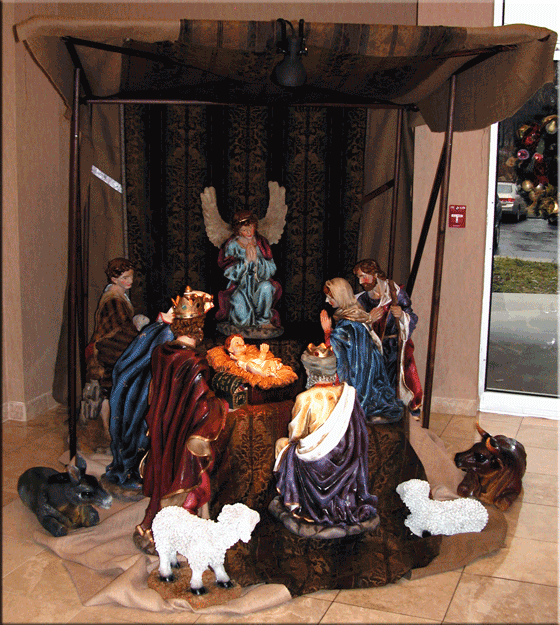 No, the original manger didn’t have a fire alarm; this nativity scene was in the lobby of what was then the Church Ministries building of the International Offices of the Church of God, where I worked at the time. You can read our ministry’s Christmas message at the time here; it’s still very relevant.
 -
My Interview in Pile Buck
Readers of this blog may remember that I did an interview with the legendary Abu Daoud almost two years ago. As is the case with my academic career (I’m both student and faculty at the same time) not only can I dish it out, but I can take it too: the current issue of Pile Buck features an interview of me, along with an extensive article on the history of my family business during its first century.
The magazine itself is one of those Flash “page turning” online magazines, like the pharmacies use. The interview itself starts on Page 18.

-
Bending the Heavens and Descending to Earth: St. John of Damascus on the Incarnation
From The Orthodox Faith, III, 1:
For by the good pleasure of our God and Father, the Only-begotten Son and Word of God and God, Who is in the bosom of the God and Father John 1:18, of like essence with the Father and the Holy Spirit, Who was before the ages, Who is without beginning and was in the beginning, Who is in the presence of the God and Father, and is God and made in the form of God (Philippians 2:6), bent the heavens and descended to earth: that is to say, He humbled without humiliation His lofty station which yet could not be humbled, and condescends to His servants , with a condescension ineffable and incomprehensible: (for that is what the descent signifies). And God being perfect becomes perfect man, and brings to perfection the newest of all new things (Ecclesiastes 1:10), the only new thing under the Sun, through which the boundless might of God is manifested. For what greater thing is there, than that God should become Man? And the Word became flesh without being changed, of the Holy Spirit, and Mary the holy and ever-virgin one, the mother of God. And He acts as mediator between God and man, He the only lover of man conceived in the Virgin’s chaste womb without will or desire, or any connection with man or pleasurable generation, but through the Holy Spirit and the first offspring of Adam. And He becomes obedient to the Father Who is like us, and finds a remedy for our disobedience in what He had assumed from us, and became a pattern of obedience to us without which it is not possible to obtain salvation.
-
Is Bridge Building Really a Ministry?
About a year ago I did a piece on the French scientist and engineer Adhémar Jean Claude Barré de Saint-Venant, whose combination of scientific prowess and Christian conviction made for an interesting career in Revolutionary and post-Revolutionary France. When he died in 1886, Karl Pearson, as well-known an enemy of Christianity as, say, Richard Dawkins is now (albeit with far more class), had this to say about him:
Saint-Venant stood out for the younger mathematicians of the English schools as a link between the past and the present. Intimately related to the great period of French mathematical physics he had continued to produce down to our own day, and we felt him to be as real a personality as Helmholtz and Thomson…He took up elasticity where Poisson left it, a mathematical theory, he leaves it one of the most powerful branches of mathematics applied to physics and practical engineering; not a small amount of this transformation is due to his researches or indirectly to his influence.
Turning to the personal character of the man, we find in him the essential characteristics of the scholar and the student, his truest modesty, the complete absence of self, the single-minded devotion to his study. Saint-Venant, whose researches on elasticity undoubtedly far surpass those of Navier and Clebsch, is yet content to appear as their Editor. But what an editing it is. The original text is hidden and disappears, almost as completely as Peter the Lombard’s Sententiae in a mediaeval commentary–nay, he even praises Clebsch for inventing a term in 1862, which he himself had first proposed in the privately distributed lithographed sheets of 1837. Ever ready with advice and assistance, perfectly free from jealousy, Saint-Venant was a typical scholar.
Part of the “class” Pearson exhibits is an appreciation of the virtue of humility. That virtue has gone out of fashion, replaced by the ubiquitous arrogance we see in so many talking heads in and out of academia. Such an attitude is dangerous in the sciences; today’s absurdity is tomorrow’s reality.
Not all of Saint-Venant’s work product was scientific. One exception was his posthumously published work St. Bénézet, Patron des Ingénieurs. The lives of saints is generally the work of other saints (St. Athanasius’ Life of Anthony is a good example) but Saint-Venant’s work comes from someone whose main claim to fame was in mechanics and not the faith. His choice of saints, however, was definitely tied up in his life’s vocation.
St. Bénézet (the Provençal version of Benedict) was born around 1163. While tending his mother’s sheep, he received a vision from Jesus that he should build a bridge at Avignon. He promptly went to Avignon, where he was met with scorn by the bishop and a receptive audience with the mayor. The bridge construction began according to Bénézet’s specification (and with Bénézet doing part of the work) but he died before its completion, and was buried in the bridge’s chapel. Part of the bridge, the famed “Pont d’Avignon” is still standing, and of course the Popes which lived there during their captivity had use of same. Bénézet’s work was not unique: it was the first of several religious brotherhoods dedicated to the building and maintenance (with the offering plate at the bridge itself) of bridges and other public works.
Saint-Venant, in good Catholic fashion, was devoted to St. Bénézet, a logical patron saint for him. But he had a larger idea. Beyond wanting to promote devotion to the saint, his concept was this:
Our profession, which, by God’s providence, was also his, is not only a glorious profession, but it is something consecrated and holy. It is a work of active charity, embracing travellers and traders and missionaries of every kind; but more than that, benefiting even the sedentary portion of the population, for lack of proper communication breeds famine, and the dearth of excess of water bring in their train loss of life, devastation and impoverishment.
He also expressed the wish that his nation, then and now very secular in emphasis, might come back to its Christian faith.
One of the great political disputes we have these days is whether the state is the best purveyor of public benefit. I draw that broadly; the usual debate centres around what we call these days “entitlements”, and right at the moment the Obamacare fiasco has focused attention on that part of it. But behind direct benefits to people are the indirect ones, and what we call transportation infrastructure is certainly a part of that. As Saint-Venant notes, the lack of such an infrastructure will bring great suffering to the population.
The collapse of the Roman Empire signalled the end of the state’s support for many things. The Church, the only institution broad enough to carry out large-scale projects of any kind, ended up taking over state activities such as civil marriage and public works. Mediaeval Europe, divided feudally, was in no place for these to be carried out by the “civil” authorities in place. Unless the Church got them done, they often were left undone, and that was the case for large-scale public works. Unfortunately there were too few St. Bénézets to carry out the work.
From the Renaissance to the Enlightenment to modern times, the whole history of Europe can be seen as the emerging nation-states wresting the role of God from the Church to themselves, which is a major explanation as to why Europe is so secular now. Infrastructure construction and maintenance became “public works” carried out by the state either centrally, locally or both, with fitful privatisation.
Today we know that the mediaeval Church isn’t the only institution laggard in its support of infrastructure construction and maintenance. The reasons behind this are complex, relating to a falling birthrate and a society too satisfied with its present state and too short-sighted to see that it’s perfectly capable of blowing the lead it has. But for those of us who actually work in the transportation field, we need to ask ourselves the question: is what we do a ministry?
Christians routinely struggle with the concept that their secular work is a vocation, because Protestant, Catholic and Orthodox alike are prone to the concept that the only people really called in a special sense are those who enter the priesthood, religious life or ministry. Without going into the whole business of laity ministries, those of us who are involved in public works are, in fact, doing a ministry in the same sense as those who do relief work. That’s true in spite of the fact that we get paid for it (most of the time; deadbeats are a serious problem in our industry).
That being the case, it’s our duty, not only to our employer and the public but to God, to perform our task, be that design, construction, inspection or maintenance, to the best of our ability and with integrity. That’s not always easy in the complex legal, regulatory and economic environment we work in, but that’s the task in front of us, and with God’s help we can do it.
Saint-Venant himself envisioned that engineers would adopt St. Bénézet as their patron saint (thus the title of his work) and call upon him for intercession. In a passage that echoes Bossuet, he said that “By his (Bénézet’s) intercession we shall obtain from God at the right moment more things and better things than we have ever dared to ask”. The intercession of the saints in heaven is a controversial subject. I am inclined to think that we need to cultivate intercession among the saints on earth to the One who assured us before his Passion, death and Resurrection that “In truth I tell you, he who believes in me will himself do the work that I am doing; and he will do greater work still, because I am going to the Father.” (John 14:12 TCNT)
With all the tight places we find ourselves in during the realisation of transportation infrastructure, we’ll need all the help we can get.
-
The One Percent Prepares for the Worst: Palm Beach Police's Humvee
The Town of Palm Beach has acquired a military-surplus Humvee:
It’s a quiet Saturday afternoon outside the Palm Beach Police Department.
Quiet, that is, until Sgt. Scott Duquette starts up one of the department’s newest acquisitions — a 2001 High Mobility Multipurpose Wheeled Vehicle, commonly known as a Humvee.

Anyone who has any doubts about the militarisation of American police forces should lay those doubts aside. Although hurricane rescue and other humanitarian missions are the ostensible purpose for this vehicle, the riff-raff will think twice before messing with Palm Beach’s finest.
The least they could have done to soften the image is to let Lilly Pulitzer’s people paint it. (All three of her children, BTW, are still on the island and active).
-
The Twilight of the Box Checkers
Timothy Fountain, with some help from Rod Dreher, lays it out:
There are going to be Christians and non-Christians in America. Nominal Christianity has no future now that various cultural props are gone.
Christians will have to be disciples of Jesus, not members of clubs based on old ethnic, neighborhood and family functions.
Which means that along with the intensified pain of all the change and marginalization, we stand to gain the intensified power and joy that come with discipleship.
If someone had told me years ago that an Episcopal minister would lay this out in this stark of terms, I wouldn’t have believed them. But believe it, both what he says and that he said it.
The sad truth is that this has been coming for a long time. A good deal of it stems from the fact that we have turned from a “bottom-up” culture to a “top-down” culture, and our top secularised first. Some attribute that to education, some to science and some to exposure to the world, but personally I think it’s simpler than that. The God that sent his Son (and we’re supposed to be celebrating that about now) is and has been for a long time a competitor to those who “rule the roost” in this society. So those of us who come from places like Palm Beach (as opposed to the likes of Rod Dreher, who moved back to his small town Louisiana roots) have experienced the first assault, and now it’s percolating down the “food chain”.
The roost rulers, IMHO, are about to lay an egg with this country, but getting people to believe that isn’t easy. In the meanwhile those of us who believe that Jesus is Lord but Caesar is not (to use N.T. Wright’s phrase) are going to either be the serious ones or find ourselves on the dark side. The box checkers (to use a Catholic phrase) will disappear from our pews (or chairs).

Sailing the Last Voyage with Newton and Pascal

 Positive Infinity