-
Chesterton on the Carthaginian Sacrifice of Children
The confirmation (against a lot of pushback) that the Carthaginians really, truly did sacrifice their children bring to mind this memorable passage from G.K. Chesterton’s The Everlasting Man:
There was established on the opposite coast of the inland sea a city that bore the name of the New Town. It was already much older, more powerful, and more prosperous than the Italian town; but there still remained about it an atmosphere that made the name not inappropriate. It had been called new because it was a colony like New York or New Zealand. It was an outpost or settlement of the energy and expansion of the great commercial cities of Tyre and Sidon. There was a note of the new countries and colonies about it, a confident and commercial outlook. It was fond of saying things that rang with a certain metallic assurance; as that nobody could wash his hands in the sea without the leave of the New Town. For it depended almost entirely on the greatness of its ships, as did the two great ports and markets from which its people came. It brought from Tyre and Sidon a prodigious talent for trade and considerable experience of travel. It brought other things as well.
In a previous chapter I have hinted at something of the psychology that lies behind a certain type of religion. There was a tendency in those hungry for practical results, apart from poetical results, to call upon spirits of terror and compulsion; to move Acheron in despair of bending the Gods. There is always a sort of dim idea that these darker powers will really do things, with no nonsense about it. In the interior psychology of the Punic peoples this strange sort of pessimistic practicality had grown to great proportions. In the New Town, which the Romans called Carthage, as in the parent cities of Phoenicia, the god who got things done bore the name of Moloch, who was perhaps identical with the other deity whom we know as Baal, the Lord. The Romans did not at first quite know what to call him or what to make of him; they had to go back to the grossest myth of Greek or Roman origins and compare him to Saturn devouring his children. But the worshippers of Moloch were not gross or primitive. They were members of a mature and polished civilisation, abounding in refinements and luxuries; they were probably far more civilised than the Romans. And Moloch was not a myth; or at any rate his meal was not a myth. These highly civilised people really met together to invoke the blessing of heaven on their empire by throwing hundreds of their infants into a large furnace. We can only realise the combination by imagining a number of Manchester merchants with chimney-pot hats and mutton-chop whiskers, going to church every Sunday at eleven o’clock to see a baby roasted alive…
Why do men entertain this queer idea that what is sordid must always overthrow what is magnanimous; that there is some dim connection between brains and brutality, or that it does not matter if a man is dull so long as he is also mean? Why do they vaguely think of all chivalry as sentiment and all sentiment as weakness? They do it because they are, like all men, primarily inspired by religion. For them, as for all men, the first fact is their notion of the nature of things; their idea about what world they are living in. And it is their faith that the only ultimate thing is fear and therefore that the very heart of the world is evil. They believe that death is stronger than life, and therefore dead things must be stronger than living things; whether those dead things are gold and iron and machinery or rocks and rivers and forces of nature. It may sound fanciful to say that men we meet at tea-tables or talk to at garden-parties are secretly worshippers of Baal or Moloch. But this sort of commercial mind has its own cosmic vision and it is the vision of Carthage. It has in it the brutal blunder that was the ruin of Carthage. The Punic power fell because there is in this materialism a mad indifference to real thought. By disbelieving in the soul, it comes to disbelieving in the mind. Being too practical to be moral, it denies what every practical soldier calls the moral of an army. It fancies that money will fight when men will no longer fight. So it was with the Punic merchant princes. Their religion was a religion of despair, even when their practical fortunes were hopeful. How could they understand that the Romans could hope even when their fortunes were hopeless? Their religion was a religion of force and fear; how could they understand that men can still despise fear even when they submit to force? Their philosophy of the world had weariness in its very heart; above all they were weary of warfare; how should they understand those who still wage war even when they are weary of it? In a word, how should they understand the mind of Man, who had so long bowed down before mindless things, money and brute force and gods who had the hearts of beasts? They awoke suddenly to the news that the embers they had disdained too much even to tread out were again breaking everywhere into flames; that Hasdrubal was defeated, that Hannibal was outnumbered, that Scipio had carried the war into Spain; that he had carried it into Africa. Before the very gates of the golden city Hannibal fought his last fight for it and lost; and Carthage fell as nothing has fallen since Satan. The name of the New City remains only as a name. There is no stone of it left upon the sand. Another war was indeed waged before the final destruction: but the destruction was final. Only men digging in its deep foundation centuries after found a heap of hundreds of little skeletons, the holy relics of that religion. For Carthage fell because she was faithful to her own philosophy and had followed out to its logical conclusion her own vision of the universe. Moloch had eaten his children.
Indeed he had and is still doing so. This passage has always stuck with me since I first read it many years ago. Much of what passes as “progressivism” is in reality corporatism in disguise, and they have taken up their own version of this with gusto.
Evangelicals would argue that C.S. Lewis was the twentieth century’s greatest Christian apologist, but personally I think my first parish priest was right about steering me in Chesteron’s direction.
-
My Favourite Preacher: Jaques-Benigne Bossuet
Two summers ago I posted a piece on my favourite pastor, my first parish priest. Protestants in general and Pentecostals in particular like their pastor to be a great pulpiteer to boot. With the advent of Christian (well, part of the time) television, people have an opportunity to follow preachers other than their own pastor on a regular basis, and to support them financially. So the favourite pastor and favourite preacher aren’t the same for many people.
Christian preachers divide themselves in many ways. There are those who are orthodox and those who are not, and I’ve gotten after liberals aplenty on this blog. Turning to the way the Bible and doctrine is preached, there are two types: topical preachers and expository preachers. The last is almost a lost art; neither our ministers nor their congregations have a comprehensive enough knowledge of the Scriptures to either preach the Word in this way or to absorb the exposition. My personal favourite expositor is J. Vernon McGee; although I don’t always agree with his doctrinal approach, his wit and ability to see the bigger issues made me a fan, especially in the late 1970’s when he had such an impact on me and my contemporaries.
With topical preachers, there are many variations. Starting with the Protestants, way too many preach “sermonettes for Christianettes,” as McGee put it. In non-liturgical churches the sermon is the centrepiece of the service, and thus the temptation is to expand the content to fill the time. There are many ways of doing this, from endless stories to doctrinal expositions which generally show why I believe that “Protestant theology” is an oxymoron. On the other end Pentecostal preachers do not have as their goal education but to lead the congregation to an experience with the Spirit; as such, Pentecostal preaching has been until recently something of an art form, as Robert Duvall recognised when he made The Apostle. How this is going to hold up with increasing levels of formal education is one of the challenges with which full-gospel churches wrestle.
The plague of Anglican/Episcopal preaching, beyond the endless problem of liberalism, is Anglican Fudge. The trick with Anglican Fudge is to use a tremendous amount of erudition (or more accurately an “empty parade of learning”, as J.N.D. Kelly used to say about Jerome) to produce an effect of satisfaction in the hearer without really saying anything substantive. In quiet times you can get away with it, but living where the animals are tame and the people run wild I never could find those times.
That leads us to the Roman Catholics. As I have commented elsewhere, the Roman Catholic Church has an unrivalled intellectual tradition. Sometimes Catholic priests overdo it; in my first parish, one Jesuit put it on display for the congregation. When he finished his discourse, he gave me, the lector, a blank look, to which I mouthed, “The Creed! The Creed!” More often than not, however, this heritage never filters down to the parish level, and although there are certainly capable parish priests in the pulpit the tendency is drift into the schmaltzy, especially this time of year when the Blessed Mother or the right to life comes to the forefront.
The background for greatness is there, and it’s probably that which brings me to the person whom I consider my favourite preacher, the French Bishop Jaques-Bénigne Bossuet (1627-1704). His life is well documented elsewhere, so let me give the quick summary. Born in Dijon (the home of the mustard) he was moulded into the priesthood from a very early age. Coming to Paris, he quickly became well-known for his sermons at the Court at Versailles. His sermons successfully competed with the stage entertainment of the day for audiences. Appointed the “preceptor to the Dauphin” (i.e., the tutor of Louis XIV’s son, not the sharpest knife in drawer) he threw himself into the thankless task with energy. In 1681 he was appointed Bishop of Meaux, east of Paris, where he composed many of controversial works and his matchless devotional works Elevations on the Mysteries and Meditations on the Gospel. He died in 1704, active until just before the end.
Why Bossuet? For his fans, the easier question is “why not?” but in brief here are his virtues:
- He is Scriptural. Bossuet is well versed in the Fathers of the Church in general and Augustine in particular, but it is the Bible that is the key book he refers to over and over again in his preaching. As Bossuet explains in Elevations on the Mysteries, “I did not take up the pen to teach you the thoughts of men.” (Elevations, XVI, 3)
- He is literary. There is no English-speaking preacher who has the literary status in this language that Bossuet has in French, and that in a far more secular culture. He is literary not because his style is ornate but because it is direct; there is simply no more eloquent speaker or writer in the French language than Bossuet. Like Pascal and Avvakum, he showed that crisp, direct prose was the way to both show the faith and gain a place in one’s culture to boot.
- He is Catholic without being churchy. Although churchiness isn’t restricted to Roman Catholicism, it is a particular occupational hazard of Catholics, their church being so central to their faith. Bossuet is certainly Catholic in outlook, but his presentation is broader than just going through the sacramental and devotional system that Roman Catholicism offers. One of the best examples of this is his Sermon on the Profession of Mademoiselle de la Vallière (my personal favourite) where he skilfully turns a woman’s final entry into the religious life into an exposition of the journey of every soul that comes back to God.
- His accent is on happiness. In an age of “happy-clappy” preachers, that may seem a liability; in the seventeenth century, a dour time for much of Europe, it’s extraordinary. Bossuet is too aware of the demands of the Gospel and too straightforward to cover them up, but a happy God who is the goal for happy people is a frequent theme for Bossuet. In Elevations on the Mysteries, he puts it this way: “He who is perfect is happy, for he knows his perfection… O God, I rejoice in your eternal happiness!” In the early part of Meditations on the Gospel he says this: “Man’s chief aim in life is to be happy. Our Lord Jesus Christ came into this world in order to give us the means for attaining this happiness. To find happiness where it should be found is the source of all good, and the source of all evil is to find it where it should not be found…Let us also see the goal where happiness is found, and the means to attain it.” Contrast that with the opening of the Westminster Shorter Catechism: “Man’s chief end is to glorify God, and to enjoy him forever.” With Bossuet, the happiness is both starting point and goal.
Let me give a few examples. First, this Augustinian gem from Mlle. de la Vallière’s profession:
Therefore let us consider, Christians, what is this newness of hearts, and what is the state from whence the Holy Spirit draws us. What is older than love itself, and what is newer than being one’s own persecutor? But he who persecutes himself must have seen something he loves more than himself, so that there are two loves which motivate everything. St. Augustine explains it by these words: Amor sui usque ad contemptum Dei amor Dei usque ad contemptum sui. (City of God, Book XIV, Chapter 28) One is the “love of self, even to the contempt of God.” This is what makes the old life and the life of the world. The other is “the love of God, even to the contempt of self.” This is what makes the new life of Christianity, and that is brought to its perfection in the religious life. These two opposite loves will be the whole subject of this address.
On a more “Pentecostal” note, we turn to this “aisle runner” which comes from his exposition of Matthew 21:21 in Meditations on the Gospel:
Behold here the wonder of wonders: man clothed in the omnipotence of God.
Go, said the Saviour, heal the sick, raise the dead, cleanse the lepers, cast out devils: freely have you received, freely give. (Mt. 10:8) Who ever gave such a command?…
Here, therefore, is the greatest miracle of Jesus Christ. Not only is he all-powerful, but here he renders them all-powerful and, if possible, more power than he himself is, constantly performing greater miracles, and all through faith and through prayer: “and all things whatsoever you shall ask in prayer, believing, you shall receive.” Faith, therefore, and prayer are all-powerful, and they clothe man with the omnipotence of God. “If you can believe,” said the Savior, “all is possible to him who believes”.
The performance of miracles, therefore, is not the difficulty. Rather, the difficulty is to believe. “If you can believe.” That is the miracle of miracles to believe absolutely and without hesitation. “I believe, Lord, help my unbelief”…
Thus the great miracle of Jesus Christ is not to make us all-powerful men. Rather, it is to make us courageous and faithful believers who dare to hope all from God, when it is a question of his glory…
Let us dare all things, and no matter how slight our faith may be, let us fear nothing. A small grain of faith, the size of a mustard seed, enables us to undertake anything. Grandeur has not part in it, said the Savior. I ask only for truth and sincerity if it becomes necessary that this small grain grow, God who has given it, will make it grow. Act then with the little you possess, and much will be given to you: “And this grain of mustard seed” and this budding faith “will become a great tree, and the birds of the air will dwell in the branches thereof.” The most sublime virtues will not only come there, but will make their abode therein.
Lastly I’ll include the end of Meditations on the Gospel. Early in the closing discourse Bossuet exhorts Christians to always pray in the name of Jesus Christ, something which is, ahem, lacking in many of our prayers, but then ends it with this:
Let us enter, therefore, with Jesus Christ and in Jesus Christ, into the construction of the entire body of the Church, and rendering thanks with Her through Jesus Christ, for all those who are complete, let us ask for the completion of the entire body of Jesus Christ, and all the society of the saints. Let us ask, at the same time, with confidence, that we may find ourselves placed in the ranks of the blessed, never doubting that this grace will be extended to us, if we persevere in asking for it through mercy and grace; that is, through the merit of the blood which has been shed for us, and of which we have the sacred pledge in the Eucharist.
After this prayer, let us go with Jesus Christ to the sacrifice, and let us advance with Him to the two mountains; that is, to the Mount of Olives, and to that of Calvary. Let us go, I say, to these two mountains, and let us pass from one to the other: from that of the Mount of Olives, which is the one of agony, to that of Calvary, which is that of death; from the Mount of Olives, which is that of combat, to that of Calvary, where, in dying, one triumphs with Jesus Christ; from the Mount of Olives, which is the mountain of resignation, to that of Calvary, which is the mountain of actual sacrifice; and, finally, from the one where we say: Not my will but Thine be done, to the one where we say: Into Thy hands I commend my spirit (Luke xxii. 42; xxiii. 46); that is, from the one where we prepare ourselves for all things, to the one where we die to everything with Jesus Christ, to Whom be rendered honor and glory, with the Father, and the Holy Spirit, for ever and ever. Amen.
Bossuet was involved in many controversies; some with people whom Protestants tend to think highly (Fenelon, Mme. de Guyon) some without such a reputation (Richard Simon) and of course with the Protestants themselves. But French Protestant Huguenots such as Jaques Saurin, in Dutch exile, studied his sermons. His Augustinian outlook was akin to their own Reformed bent, and they knew a good preacher when they saw one. So should we. Until a preacher of the Gospel takes his or her place in Anglophone literature that Bossuet has in French, we would do well to read and emulate the man whose moniker in history is “the Eagle”.
-
Why All Americans Need to Use the 24-Hour Clock
To prevent fiascos like this, which took place earlier today at the University of Tennessee at Chattanooga:
Due to a scheduling error by a staff member in one of our emergency response offices, the test of our system occurred at 12:12 a.m. instead of 12:12 p.m. This was a case of simple human error.
We apologize for the late night interruption.
The test was completed successfully, however, and the test scheduled for this afternoon has been cancelled.
Thank you.
Those of us in the UTC community received this sheepish announcement this morning from Chuck Cantrell, Associate Vice Chancellor, Marketing and Communication.
Had we used the 24-hour clock, the difference between 0012 and 1212 would have been more obvious.
-
A Pile Driver Talks About God
This from Rusty Signor, current President of the Pile Driving Contractors Association and President of TX Pile, LLC, in the current issue of Pile Driver:
In my last message, I ended with a different, more positive view on the news in our current world situation. This time, I am going to do another first: a book review. The book is Seven Men and The Secrets of Their Greatness by Eric Metaxas.
Certainly advice on engineering techniques, safety practices and legal tips are very important for our pile driving business; however, personal character development is also something to consider for most. You may or may not know of all the seven men in this book, but the ones you thought you knew are viewed from a very different standpoint than how you probably learned about them in school. The book focuses on their complete reliance on their spiritual calling. Since this is not a government publication, I can use the word God.
For instance, everyone knows about George Washington and the story of the cherry tree. However, did you know that he was a deeply religious man and that he relied on his faith in helping him make decisions? He prayed on his knees several times a day with a Bible before him. Washington believed that God had a special purpose for his life and that providence saved him from being killed. In one battle alone, three horses were shot out from under him and he had bullet holes through his hat and clothing. He empowered his men with God-filled inspiration and they would follow him anywhere. I bet you never read that in grade school.
Another man mentioned is Jackie Robinson, who broke the color barrier in Major League Baseball. I recently watched the movie about his story, 42. Again, the movie didn’t really focus on Robinson’s critical reliance on his faith in God to be able put up with and finally put down all the Jim Crow nonsense. He had extraordinary athletic talent in basketball, football, baseball, tennis and track and field. Robinson also had a tendency for anger explosions dealing with racial injustices. His mother and preacher led to a deeper faith that controlled his anger and justice allowed would him only to be see won that with the restraint path to and love. The manager for the Brooklyn Dodgers was an extremely religious person who was looking for this sort of man: someone talented in baseball, but who also had a strong, Bible-based character. Everyone knows the rest of the story, but generally not the one centered on God.
In the business world, sometimes we get too caught up in our challenges with competition, problems with equipment, governmental codes, etc. We just need to stop and look up like these men did – to result in your success and happiness.
I’ve been involved in the driven pile industry all of my working life; this is a breath of fresh air.
-
Partying Like It’s 1987: Running WEAP87 and SPILE (and other programs) on DOSBox
It’s been a long time since many computers ran DOS or even Windows 3.1. Given the changes in hardware, it would be difficult to get most any recent PC to run one or both. Yet every time we have a major software upgrade, we lose some of the capabilities we had in the past. It’s something we don’t think about in the advance of computer power, but it’s a fact.
That’s more true in two fields than any other: business and scientific/engineering software. Ever wonder why businesses and medical establishments, for example, still run Windows XP so often? With engineering software, it’s even worse: there are still DOS programs which do things that more recent software either does not do or does very expensively (the “per seat” cost of programs like AutoCad and most commercial finite element software, would shock most people outside of the field).
This article concentrates on two venerable pieces of DOS software: WEAP87, the wave equation program to analyse driven piles during installation, and SPILE, which estimates axial driven pile capacity. As long as XP “ruled the roost” and was capable of running 16-bit software, it was certainly possible to run both and other DOS and Windows 3.1 packages. With the creeping advance of Windows 7 and 8 (Vista wasn’t an advance) and 64-bit software, it’s become impossible to run these programs. So we’re stuck with two choices: either forget about using them or purchase expensive wave equation software. The latter option is OK if you use it all the time, but for occasional use (and when WEAP87 was perfectly adequate for your needs) it doesn’t make sense. But what is to be done?
The solution to the problem for this and other DOS program requirements is DOSBox, an x86 emulator that runs DOS on a variety of platforms, including 32-bit Windows, Mac OS X and Linux. The purpose of this article is to give an overview of DOSBox, some tips about its installation, how to set up WEAP87 and SPILE on DOSBox, and a quick look into Windows 3.1 on DOSBox.
About DOSBox
DOSBox is first an emulator for DOS games. That may look like an odd platform for running a scientific/engineering application with WEAP87, but it actually works well. Games have been a driving force in pushing local computer power forward. Behind the graphics and interaction are some very complex mathematics, and running those in “real-time” has been a challenge of gaming computers from the very start.
DOS gaming for its part is the classic example of taking lemons and making lemonade. Most DOS applications were text-based running on poor graphic standards such as CGA and EGA; it wasn’t until 800 x 600 VGA (or the venerable B&W Hercules standard) when graphics really began to look realistic. The operating system itself came with few integral interfaces other than the screen and keyboard; no common graphical interface like the Mac, no mouse or joystick drivers in the early versions, and the math coprocessor was optional until the “486” processors. It forced DOS gamers to write the visual output directly to the screen. They took up the challenge with zeal and DOS games squeezed every bit of output from the computer it was capable of.
With the advent of Windows 3.0/3.1/3.11 and certainly of 95, many of the routines that had to be written for the software specifically became part of the operating system. Unfortunately that, combined with the system overhead of the OS, slowed down games, which meant that Windows games lagged for a while until the hardware caught up with them. (The system overhead of Windows is still significant, something that anyone who has ventured outside of the Windows world will attest). Thus DOS gaming was something of a “golden age” and DOSBox was designed to recapture that golden age on computers that were no longer capable of running them.
Running Non-Gaming Applications on DOSBox
That having been said, DOSBox’s developers have traditionally discouraged non-gaming applications from DOSBox. For one thing, DOSBox lacks many of the facilities that non-gaming applications often need, such as printing (not an issue with either one of these programs, as they put out text files) and many of the DOS features (which are missing because of patent and copyright issues in many cases). There’s also the issue of emulation; no two computers do digital calculations the same, and that especially applies to an “operating system” which was primarily designed for gaming.
The reason programs like WEAP87 and SPILE can be considered for DOSBox is because they’re batch mode programs. You put data in, you process the data, you get a result out, that’s it. Programs which need long-term interaction with the data may not do so hot in DOSBox. I would also avoid running the programs on non-x86 platforms because of math coprocessor issues.
What You’ll Need
To run WEAP87 and SPILE on DOSBox, you’ll need the following:
- WEAP87 and SPILE themselves, which can be found here.
- The printed manual for WEAP87. Programs in the 1980’s came with printed manuals; online help wasn’t an option except for very basic commands.
- SPILE doesn’t have a printed manual available, but the second volume of the FHWA Soils and Foundations Manual has a good description of the underlying theory behind SPILE and its Windows successor, Driven.
- MCF, a TSR to aid in file management and program running. Especially useful with WEAP87 as you run one program to input/preprocess the data and another to actually run the analysis. Unlike many TSR programs designed for this purpose, MCF is very light on system resources.
- DOSBox, for whatever operating system you’re using.
Basic Setup
Setting up DOSBox (the first step) is pretty simple. Open-source packages are notoriously deficient in understandable documentation, but DOSBox has been around for a long time, and seems better than average. I would strongly urge you to check out their wiki for the information you need on installation and running.
One thing you definitely need to do is to set up a “C” drive. DOSBox starts out with a “Z” drive with its basic programs to run. The process is described here. One big advantage of this over, say, a virtual machine is that you’re using the same file system for the emulator as you are for the host computer. This means that you can open the data results in either a text editor or do a screen grab of the graphics.
Once you’ve done that, the easiest way to get the programs going is to do the following:
- Unpack MCF and put it in the root directory of the C drive (c:\).
- Create a directory c:\WEAP87 and put the WEAP 87 files in it.
- Create a director c:\SPILE and put the SPILE files in it. It’s better to use two separate directories to avoid file name conflicts.
And that’s it.
Running SPILE and WEAP87
If you’ve run these programs on, say, Windows XP, running them on DOSBox–either directly from the command line or from MCF–is a familiar experence. If you used either or both in the DOS era, it’s a trip down memory lane–down to the pace the computer runs the programs. That’s because DOSBox deliberately slows down the pace of execution to simulate a DOS-era computer, and thus (for games where it’s critical) the timing of the game isn’t thrown off by faster execution speeds. For either of these programs, it isn’t a big deal, and in any case DOSBox will “pick up the pace” for really processor intensive programs. But after watching the output of WEAP87 in particular whiz by, seeing it going more slowly brings back memories.

SPILE is pretty straightforward, since there’s only one executable file. The one thing you need to watch for is not to print out the output; just save it to a file. If using the output for WEAP87, many engineers prefer to estimate the pile capacity using a spreadsheet and other methods.

WEAP87 is a little more complicated because the preprocessing file and the file that actually executes the wave equation analysis are different. But other than that there is little difference between using it in DOSBox and elsewhere. The governing data files can be edited either with MCF or with another text editor, and the text output can be done likewise. One thing that comes back in DOSBox is shown above: the graphical bearing graph, in all of its CGA glory. I’m not sure you want to put it into a report, but it’s good to have in any case.
Other DOS Programs
I’ve also tried other DOS engineering programs in DOSBox with success, including finite element analysis. The ability to preserve the graphics using a screen grab program is a big plus. These programs, however, like WEAP87 put their output in a text file, which can then be edited by either a text editor or a word processor. Again a big advantage of DOSBox is that the file system for the program is accessible by the host operating system, which means that you can keep files generated by DOS programs and other data (such as soil boring data, for example, with SPILE and WEAP87) together.
Windows 3.1
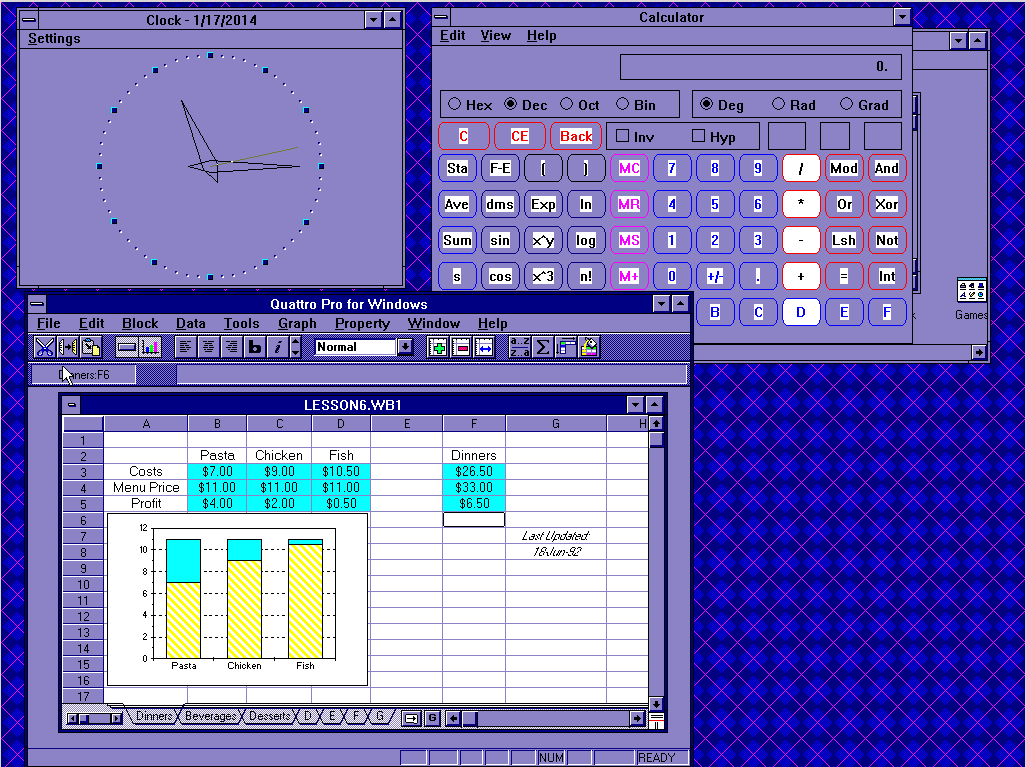
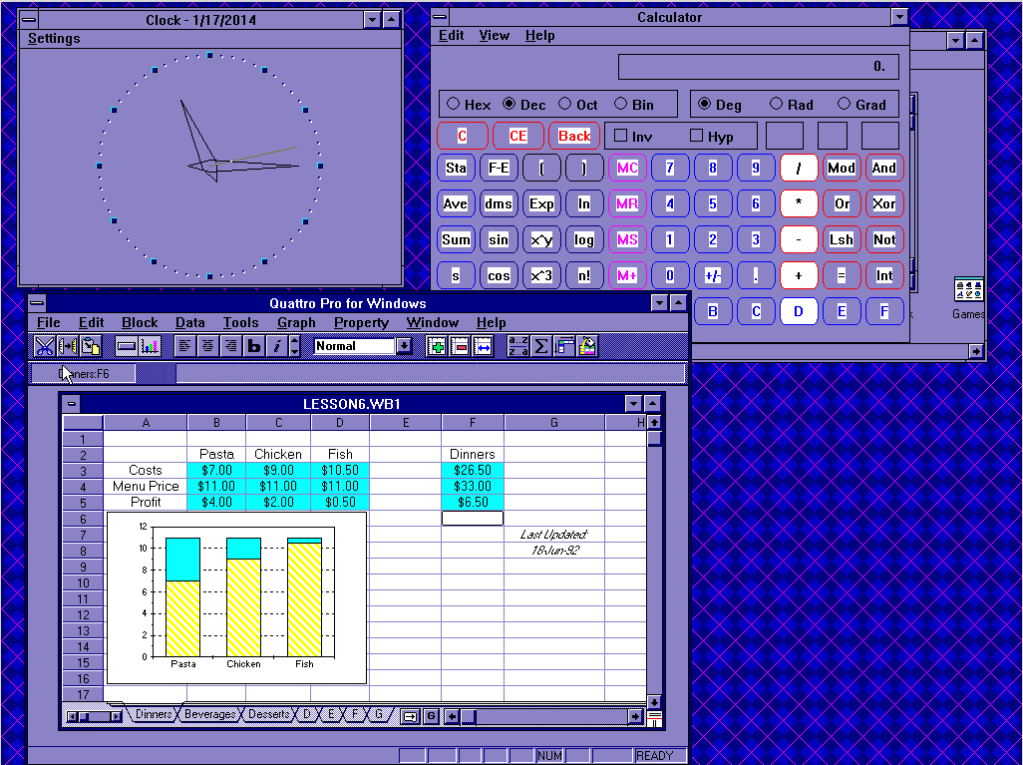 Since Windows 3.1 was basically run on top of DOS, and 16-bit software (including software written for 3.1) is becoming out of bounds for newer Windows machines, the obvious question is, “Can DOSBox run Windows 3.1”? Having a legal copy of Windows 3.11 for Workgroups, I gave it a shot, with tremendous help from this post in DOSBox’s forum vogons.org.
Although I haven’t spent much time with it, the short answer is “to some extent”. DOSBox allocates enough extended and expanded memory to run it. There are some obstacles, however, not the least of which is that DOSBox doesn’t contain a full copy of DOS, but simulates DOS 5.0. It thus lacks the key file for full Windows functionality: SHARE.EXE. If you can get this file and get it running, that will probably change. But I’ve gotten further with this approach than, say, setting up a virtual machine. (Any virtual machine I’ve seen for DOS or Windows 3.1 is challenged in accessing files outside of the virtual machine).
Since I’ve spent time on SPILE, I’ll mention that the version of Driven (the Windows successor to SPILE) I offer for download is a 32-bit version and thus won’t run on Windows 3.1 without the 32-bit upgrade (which, in turn, requires SHARE.EXE). A 16-bit version was developed but at this point I don’t have it available.
The Wrap
DOSBox is a tremendous help in using DOS (and to a lesser extent Windows 3.1) programs on current machines and operating systems. I would strongly urge anyone who wants to try this to “test drive” some of these programs to make sure the results are good.
As West Point professor J. Ledlie Klosky noted about geotechnical knowledge in general, “In this modern information age, it is hard to believe that important knowledge could simply vanish through disuse, but the sad fact is that it happens.” That applies to software too; DOSBox is yet another weapon in our arsenal to prevent the loss of knowledge and once again fight “the creep of ignorance.”
-
On Climate Change, Uncertainty and Truth
Anyone who blogs has persistent commenters. Last year my “top” commenter was one David Lloyd-Jones, a Canadian who took exception to a great deal of what I wrote (although not everything he read). Lloyd-Jones found me via my series of my business dealings in China in the early 1980’s. He himself has had an interesting career, both in the U.S. and Japanese governments and in having brought coin laundries to Japan. The latter should not be gainsaid: for anyone from this continent to head to that part of the world and have success in business wasn’t easy then and isn’t easy now, as the balance of trade shows.
Unfortunately both of us weighed each other in the balance and found the other wanting. For his part my conservative Christianity was never to his taste, he having started out in the ACoC and ended up in orthodox Judaism (although his attitude towards the nature of the Scriptures made me scratch my head about the orthodox part). On my side I was disappointed that someone with his kind of experience outside of this continent would accept the conventional wisdom our elites put out as uncritically as he seemed to do.
The back and forth ran through the summer and early fall. One thing that he was regaled with (and honestly I didn’t time it for his benefit) was the re-serialisation of My Lord and My God, my extended piece on the deity of Christ and the nature of the Godhead. Evidently the experience was just too much, for when I got to the end of it and tackled the issue of subordinationism in Sydney Anglicanism, I got the following comment:
It rather seems to me that if this were a discussion about an objective reality then reasonable people would say “It seems to me that….” and “Your perception of it might differ slightly.” Isn’t that how you handle questions like whether or not there’s oil down some particular well?
It is only if the discussion is about what formulas are allowed inside some club that an insistence upon precision can come to the fore.
Now I’ve seen many arguments against the kind of theism described in My Lord and My God, but the idea that it’s too precise to be true…well, that was a new one. So he and I went back and forth on several fronts, not the least important of which was whether mathematics was a true science or not. (I should have brought up the point that advances in geophysical exploration methods have taken a great deal of uncertainty out of verifying the presence of oil in the earth, but sadly I did not).
I also pointed out the following about uncertainty:
As far as your obsession with margins of error, being (as you correctly assert) in the earth sciences, I am very much aware of the uncertainties of science and engineering. These stem (sorry!) from two things: the complexity of the environment, and our ability (or lack thereof) to process the data we have and project what might happen if things change either from natural causes or our own doing. The former is there; the latter is improving, in part because of the improvements of our ability to simulate the environment around us.
But he stuck to his guns with as much certainty about uncertainty as I had about certainty:
I simply wanted to say that in its concern for a precise exactitude it separated itself from those fields of discourse in which any objective reality is in play. Where there is truth there is doubt; where there is certainty there are arbitrarily adopted rules, it seems to me.
At which point I came up with the following:
But let’s turn things around: consider the topic of the hour, climate change. You say “Where there is truth there is doubt”, and in a backhanded way that was the point I was trying to make here. But if you were to make your same point re climate change, you will be branded as “unscientific” along with other expressions too vile to be expressed on this blog. Why? Because its proponents believe that, in climate change, there is certainty! So are you prepared to make the challenge there?
That not only ended the debate: that ended David Lloyd-Jones’ season as a commenter. As of now, he has not returned.
The truth is that Lloyd-Jones’ logic, such as it is, better suits the subject of climate change than it does theology. But it’s unsurprising that someone who likes to “go along to get along” as he sees it would not want to apply that logic to where it belongs. The fact that rigid certainty has taken over the minds of so many on this subject is indicative of the nature of their belief.
On the other hand, having been raised in the Anglican/Episcopal world where the subject of God cries out for more precision and less Anglican Fudge, getting attacked for that by someone who likewise took his leave from the world of the 39 Articles is really strange.
But that’s what happens when logic and reason are divorced from the other, and that’s all too common in this “scientific” age.
-
Proof of Harten's Lemma re the Convergence of TVNI Finite-Difference Schemes
An academic paper with a rather unusual history is that of the Israeli mathematician Ami Harten’s “High Resolution Schemes for Hyperbolic Conservation Laws.” First published in the Journal of Computation Physics in 1983, it was republished in 1997 in the same journal, and is often cited with the later date.
At the time of republishing Peter Lax, who earlier had saved the computer from the hippie radicals, made the following statement about this paper in an introduction:
This paper was a landmark; it introduced a new design principle—total variation diminishing schemes—that led, in Harten’s hands, and subsequently in the hands of others, to an efficient, robust, highly accurate class of schemes for shock capturing free of oscillations. The citation index lists 429 references to it, not only in journals of numerical analysis and computational fluid dynamics, but also in journals devoted to mechanical engineering, astronautics, astrophysics, geophysics, nuclear science and technology, spacecraft and rockets, plasma physics, sound and vibration, aerothermodynamics, hydraulics, turbo and jet engines, and computer vision and imaging.
One point in the paper was a lemma concerning the convergence of TVNI (total variation nonincreasing) finite difference schemes. Concerning the name of these schemes, Lax points out the following:
Harten originally called his schemes variation diminishing, abbreviated TVD; when Osher pointed out the usual meaning of these initials, the name was switched to total variation nonincreasing (TVNI), but was eventually settled on the more euphonious TVD.
The following is an expansion of Harten’s proof of the lemma.
Schemes which are total variation nonincreasing (TVNI) can be characterized as follows:
We can thus define
and substituting
Consider the general expression
where
We should observe that our ultimate goal is to sum these values from negative infinity to positive infinity; thus, we can shift the index at will. The inequalities will still hold but the specific location in space may change. It is also worth noting that the coefficients may themselves change at different points in space.
Let us consider the next spatial step, to wit
Subtracting the previous spatial step from this yields
Some rearranging yields
Taking the absolute value of both sides, we have
At this point we observe that
We can thus limit the absolute values and write the expression as follows:
Taking the summation for both sides,
Since, as we observed before, we can shift the indices (as the “centre” of the system is arbitrary with infinite boundaries) we can rewrite the above as follows
in which case
Substituting, we have at last
Citation: Harten, A. (1997) “High Resolution Schemes for Hyperbolic Conservation Laws.” Journal of Computational Physics, Vol. 135, pp. 260-278.
-
What Works at the Top Doesn't Always Work at the Bottom
In this case, the legalisation of marijuana, according to Rod Dreher:
Opponents of marijuana among the elites are those who have maintained enough contact with Middle America — David “Bobos in Paradise” Brooks has this all over his résumé! — to realize that the experiences of élite urban Americans can’t be extended to all America without catalyzing a crisis of stoner lethargy.
My regular readers know that, unlike Dreher, I’m a product of a Palm Beach upbringing, and that during the 1960’s and early 1970’s. It was certainly the era of “sex, drugs and rock ‘n roll” and the beautiful people’s children, by and large, pursued it with gusto. (The ugly ones kept up pretty well, too.) The overuse of these produced the destructive effects one would expect; the difference was that their parents (or step-parents or nanny or whatever…) could throw money at the problem in the form of rehab, etc. So, with exceptions, these problems were manageable.
Crossing the Flagler Bridge (currently being replaced) and getting out into the “real world” showed me one thing: people on the other side of the lake (and I’m using that generically; I found people who really lived on the other side of Lake Worth who could throw money like their Palm Beach counterparts could) didn’t have the resources to manage the blow-back as their wealthier counterparts could. They instead turned to God (or at least did it his way more or less) to have the discipline to dodge the disaster that a life awash in sex and drugs would bring.
As Dreher rightly points out, the sexual revolution has taken a serious toll on those in the lower-income strata, making income inequality more unfixable in our society while those at the top whine about the evil and pursue “rights” causes that will do absolutely nothing to make it better. His idea is that legalising marijuana will have the same effect.
While I think he’s right in principle, the reality is that the war on drugs is like the civil war in Syria–there is no real winner no matter which side comes out on top. The ridiculously high incarceration rate is driven by drug related offences more than anything else, and that’s taken its toll on the rest of us. Perhaps the best result is that it ends up like smoking: it’s so regulated and taxed that it’s unattractive to pursue.
Given that our elites are pretty good at getting their way these days, the best response for someone who finds him or herself outside of this higher status in the world is to a) realise that those at the top really don’t care about the rest of us, b) that God does and c) to do it his way as opposed to theirs. Our churches could make gains on that basis, but they would have to ditch the “God and country” approach they’ve taken for many years.
But don’t wait for them–or the elites–to prevent disaster in your life.
Sailing the Last Voyage with Newton and Pascal








 Positive Infinity