-
The Danger of Oversimplifying Extrapolation from the Sciences
This interesting tidbit, from Mechanics
by John C. Slater and Nathaniel Frank (both of whom taught at MIT):
The existence of fundamental laws underlying the behavior or nature has furnished the guiding principle of natural science ever since. It has also formed the basis of most modern thought in philosophy, political science, economics and the social sciences. Newton’s laws, and the mechanical and astronomical phenomena which he explained by them, were fundamentally simple, and this simplicity led nonscientific interpreters of his principles to the erroneous view that the social and political sciences must be equally simple, an error that was widespread in the eighteenth century, and has persisted in some ways even to the present. Newton himself never fell into this error. As an experimental as well as a theoretical physicist, he well knew that there were many properties of nature other than those which he had explained: cohesion and interatomic and intermolecular forces, light with this phenomena of dispersion and interference and diffraction, and many others. But he believed firmly that his laws of motion, as well as his general approach to the problems of physics, would prove to underlie these more complex aspects of nature as well as the simpler things that he was able to explain completely. In this belief he was correct; and it is for that reason that our study of theoretical physics , of the principles underlying the behavior of nature, must begin with Newton.
First note: obviously the theory of relativity should change the authors’ centrality of Newton (and much of Slater’s research was in that theory of relativity.) Newtonian mechanics are a special case of the general theory of relativity, but for the speeds the majority of objects move, Newtonian mechanics still rule. And the advent of computer simulation, which break down systems into small (and often nonlinear) pieces, has vindicated Newton’s belief about the applicability of this theories into complex problems.
The author’s warning on extrapolating Newtonian (or any other physical theories) into the social sciences, especially when oversimplification is involved, is still valid. Oversimplifying our problems is the speciality of democratic systems, and is especially easy–and dangerous–these days with social media. Misusing scientific results is even easier and more dangerous, particularly when the real agenda of the misusers is different from the one they state.
-
Revisiting the Catholicism of "Christ Among Us"
Educating new Christians in the basics of the faith has always been an important task of the Church. A few years back I featured a series on Cyril of Jerusalem’s Catechetical Lectures, which date from the fourth century. Evangelical churches can be very casual about the whole business, their reputation for dogmatism notwithstanding.
With Roman Catholicism, things are a little more involved. Roman Catholic doctrine and thought is enormously complicated; it can be a lot for the novice to absorb. The approach here too has varied.
For many years American Catholics were inculcated using the famous Baltimore Catechism. Vatican II pretty much left this behind. When I first revealed to my parish priest that I was interested in becoming Roman Catholic, he gave me Martin Farrell’s Parish Catechism. You can see an earlier edition of this here; the one he gave me had the obligatory hat tips to Vatican II, but the content was essentially the same. Farrell was succinct and clear: you knew what the Church that followed it expected out of you, and that was fine with me. I reviewed it, told him I was good with it and made the Profession of Faith.
Today, of course, it’s different: we have the RCIA, a multi-year voyage which includes the sprawling Catechism of the Catholic Church. This document is the stuff of legend among conservative Catholics. We have, for example, the spectacle of Al Kresta, who strolls to his talk show microphone with the Catechism of the Catholic Church in one hand and the New York Times in the other. (Let’s hope his helpful staff has put the coffee on his desk in advance.)
Between the two was the stuff of another legend: Anthony Wilhelm’s Christ Among Us
. First published in 1967, when I got involved in the Texas A&M Newman Association, I found it was “all the rage.” One friend had it read at his wedding. Echoes from it can be found in the Catholic folk music of the era. It was used frequently in study and, when I got to Dallas, I found myself using it in my high school CCD class. Since then it’s fallen out of favour. But what was the appeal? And did (and does) it deserve the adulation?
The subtitle of the book is “A Modern Presentation of the Catholic Faith.” Both its strengths and weaknesses stem from that premise.
Its Strong Points
- It makes being Catholic out to an adventure. And, truth be told, in the 1970’s being Roman Catholic (for me at least) was both fun and an adventure, more so than before or since.
- It really is a readable and easy to follow presentation of Catholic theology, doctrine and life.
- It attempts to present the essentials of the faith without making the accretions to Catholic life essential in themselves. To put it another way, it did not make the sacramentals that characterised pre-Vatican II Catholicism a necessity to arrive at the sacraments. This, probably more than anything else, set the traditionalists’ teeth on edge.
- Probably the best part of the book is “Our Christian Presence in the World,” where Confirmation is discussed. Although not a Charismatic book, it actually adopts a “power to witness for Christ” view of the infusion of the Holy Spirit, something I would find again when I worked for the Church of God.
Its Weak Points
- It brings in a rogues gallery of modern Catholic thinkers such as Kung, Schillebeecx, and Teilhard de Chardin. (To its credit it also brings in John McKenzie; it also brought up a name I hadn’t heard in years, namely Michel Quoist.)
- It works under an implied assumption that the supernatural work of God in the past has been superseded by our own work. That’s the defective assumption behind the “Contract on the Episcopalians,” and it doesn’t work any better in Roman Catholicism than it does in the Anglican-Episcopal world. That, of course, leads to its emphasis on social justice work. I’ve discussed the problems of Roman Catholic social teaching in the past; this book doesn’t do anything to solve those. The Charismatic Renewal could have helped to bring the supernatural and the temporal together better, but it got bogged down in authority issues and other problems.
- It frequently implies that the practical magisterium of the church will shift from the bishops to the academics and lay people. That, of course, hasn’t happened, and many of the changes they hoped for haven’t happened either. In Mainline Protestantism, the seminaries have been the main source of trouble, eventually rolling both bishop and lay person alike.
- Its presentation on which sins break the relationship with God and which sins don’t is mushy. It studiously avoids for most of the book the terms “venial” and “mortal” sin, even though these are central to the whole Catholic penitential idea.
Probably the most objectionable point in the book takes place in (where else?) its discussion of sex and marriage:
Some couples feel that they have a deep, mature and permanent commitment t one another before the marriage ceremony–and often it has its consummation in the sexual union–and in the judgement of the couples this is not wrong. Their permanent, unconditional commitment (not the instability of trial or companionate marriage) draws them to a fuller expression of their love. Priests who are counselling couples, while they must present the Church’s ideal regarding this, also realize that what is a beautiful and attainable ideal for one couple may be deeply frustrating and disruptive for another. Each couple, in dialogue with God, will have to do what they are capable of. (p. 323)
So how do we look at Christ Among Us
The traditionalists, buoyed by the pontificate of St. John Paul, had their knives out for Christ Among Us. In 1984, after a two-year letter writing campaign, the future Pope Benedict XVI ordered Newark Archbishop Peter L. Gerety to remove his imprimatur from the book. This move, nearly unprecedented, pushed its publication to a secular house and made its use problematic for parishes. Combined with the release of the Catechism of the Catholic Church later in the decade, the book largely went out of currency in catechetical work.
And as for me? Personally I’m glad my years as a Roman Catholic saw my intellectual formation with the Fathers, Aquinas and writers such as Bossuet and Pascal and not Christ Among Us. I am also glad that my spiritual formation came through not only the influence of this book but of the Charismatic Renewal. Unfortunately the combination created a “new wine in old wineskins” problem with Catholic parishes I was a part of after undergraduate school that lead to the inevitable burst.
Where I teach, one of the Dean’s secretaries was a Third Order Franciscan. She noted that the Catholic parishes in this area had a low view of spiritual formation, with few opportunities for growth. That’s not restricted to this area, sad to say. Christ Among Us was an attempt to do something about that and, although it leaves something to be desired of, so does the current state of spiritual life at the parish level.
-
When the Catholic Faithful Were Not Allowed to Vote
If you listen to Catholic commentators–especially conservative ones–you’ll hear about the obligation of the faithful not only to vote but to vote for the proper person, i.e., one that is pro-life, etc., and that it’s a sin to fail to do so.
But there was a time when the Church had a less roseate view of voting, and in one case wouldn’t allow its people to vote at all. But a little history is in order.
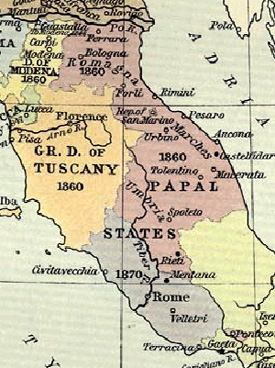 Italy, unlike the UK or France, was relatively recent to unify. Before that time it was a collection of small countries, one of which were the Papal States, under the direct rule of the Vatican. (See map to the right.) They literally cut the Italian peninsula in half. When unification first took place in 1860, most of the Papal States (the pink part on the map) were made a part of Italy, so the bisection problem was solved. But then there was Rome…that was annexed against the will of the newly infallible Pope Pius IX in 1870. He became a “prisoner” in the Vatican.
Needless to say, the Pope (and his successors) were not happy with this situation. One of their responses, as Daniel-Rops points out in A Fight for God, was the following:
What attitude could Catholics adopt to counter this offensive? They might, like the German Zentrum, have joined battle in the parliamentary field; but Pius IX would allow no such course. When asked by some of the faithful what they should do at elections, he stood firm by his principle of completely ignoring the monarchy, and directed the sacred penitentiary to tell them, “it is not fitting” that they should take part therein. This formula, non expedit, imposed upon Italian Catholics a rule of conduct; they most not vote at political elections; and in fact when balloting took place in 1871 more than half of the population of Italy abstained. They were advised, however, to take a hand in municipal and other local elections, in order to sway public opinion. For more than half a century, at least in theory, non expedit remained the rule, imprisoning Catholics in a sullen opposition to all that the government of their country might do. (p. 90)
The problem was eventually solved with the Lateran Treaties in 1929, when the Vatican State became a really small nation.
So when you hear Catholic commentators go on about how the Church expects the faithful to vote, just remember that there was a time and place when it was not fitting for them to do so.
-
Is Reformed Religion Rational?
One of my Pentecostal academic friends directed me towards this piece, “How Christian Rationalism Turned Me Into a Psychopath, or A Biblical Defense of Feelings,” by one Michael Minkoff, Jr.. It summarizes his journey through Reformed religion, how same religion attempted to drill into him the virtues of rationality and the vices of letting your feelings have anything to do with your relationship with God (or anyone else, for that matter).
There’s a lot I don’t agree with in this piece. One thing concerns his Biblical exegesis regarding the mind. I think he should, for example, take a look at Philo and understand that the business of head knowledge wasn’t the same then as it is now. But I think the biggest problem I have with his piece is his assumption that Reformed religion, which he was raised with, is rational and intellectually rigorous. That’s an assumption that needs challenging, not only here but for those in Wesleyan-Pentecostal circles who are drifting in a Reformed direction.
The simplest way to illustrate this is to consider his opening sentence:
The story of my childhood troubles began when the Protestant Reformers inadvertently adopted a form of Christian rationalism as a corrective for the (at least perceived) mystical vagaries, sensory superstitions, material corruptions, and aesthetic deceptions of the Roman Catholic church.
First, I’d drop the “inadvertently”: I think what they did was deliberate. Beyond that, the best rejoinder to that comes from Bossuet’s History of the Variations of the Protestant Churches, and it bears repeating at this point:
This doctrine of Beza was taken from Calvin, who maintains, in express terms, “that Adam could not avoid falling, yet was nevertheless guilty, because he fell voluntarily;” which he undertakes to prove in his Institution, and reduces the whole of his doctrine to two principles: the first, that the will of God causes in all things, even in our wills, without excepting that of Adam, an inevitable necessity; the second, that this necessity is no excuse for sinners. Hereby it is plain, he preserves free will in name only, even in the state of innocence and after this there is no room for disputing whether he makes God the author of sin, since besides his frequently drawing this consequence, it is but too evident, by the principles he lays down, that the will of God is the sole cause of that necessity imposed on all that sin.
Such a system of thought, far from being rigorous, is intellectually metastable, because its fundamental premises are contradictory. It forces its adherents, as I pointed out, to “…spend half the time in their unbending insistence of their idea, and the rest of it back-pedaling from the fatalistic consequences of that idea.” One of those consequences is the lack of need in a purely predestination-driven world for the Christian mission, but if you put that in front of a Reformed person they will go postal, as I found out the hard way.
Assent to a well-defined set of propositions does not a Christian intellectual make nor does it make for real rationality. And it doesn’t make for a Christian either; D. James Kennedy, in Evangelism Explosion, stated that intellectual assent wasn’t enough for eternal life. Christianity is a total commitment, as Our Lord said it was. To obsess with one–especially when our methodology is deficient–at the expense of the other does not do justice to the challenge put before us by the New Testament.
What we need, in a Dantean sense, is a way to God where human reason carries us so far and then hands us off to revelation. For me reading Dante in high school turned into biography in the following years. Finding a church home that allows for both isn’t easy these days.
As far as Mr. Minkoff struggling with being a psychopath, I’ll leave that to him to deal with and discuss. It seems to me, however, that those drilled in Reformed theology are very likely to have a major cognitive dissonance moment, which may be a better explanation why some of his friends have bailed on Reformed theology. But my contention that Reformed theology, for the aforementioned reasons, is the easiest road to universalism, has gotten me into trouble before, so I’d better shut up.
-
Just One Bull Away…
His Holiness has done it again with Amoris Laetitia, his latest encyclical on the family. The traditionalists tell us he’s betrayed basic Roman Catholic Doctrine. The loyalists (to the Church) say it really doesn’t say anything new. And the revisionists fell a “thrill up their leg” while reading it.
Given all of that, I’m reposting my April 2005 piece “Just One Bull Away,” written in the wake of St. John Paul’s death. Although Francis’ encyclicals are mostly long and tedious, the potential for disaster is always there, as this piece noted.
The recent death of Pope John Paul II has brought an extensive–and well deserved–outpouring of grief from around the world. He did attempt to build bridges between Roman Catholicism and the rest of humanity while at the same time persevering the integrity of the Church. He also was instrumental in the collapse of Communism in the old Soviet Union and Eastern Europe, so much so the Soviets attempted to have him assassinated. And his conservative implementation of the Second Vatican Council restored order–especially in North America–to a church which was flirting with anarchy.
But now there is speculation. Who will take his place? How will the course of Roman Catholicism be affected by it? John Paul’s long papacy insured that the cardinals were more to his own bent than those of his predecessors. Ultimately, however, any pope is confronted by two possible courses of carrying the Roman Catholic Church forward, and both of these courses have pitfalls and opportunities for the Church and everyone else.
The first is to continue John Paul’s course of what Pentecostals would call “the church being the church.” His idea was that Roman Catholicism would be at its best when it was itself. This is why he stood against Communism in an era when many people–including those within Roman Catholicism–had bought into the idea that Marx’ concept of “historical determinism” was really true and history was on the Communists’ side. This is also why his “consolidation of power” fell hard on both liberals and Charismatics alike in North America.
From a purely institutional standpoint, this course is probably the best. Protestants will not find this conclusion to their taste–justifiably so–but the 1960’s and 1970’s proved that, when Roman Catholics experiment with ideas from the outside, they may benefit but the church does not. The Achilles heel to this strategy is the celibate priesthood; in this sexually overstimulated age of ours, expecting people to give up intercourse for any reason is an uphill battle. The priesthood is so central to the life of the church that its continuing shortage is a long term drain on Roman Catholicism.
The second would be to attempt to accommodate the “spirit of the age.” This is especially tempting to Europeans and North Americans, fighting as they are the rampant secularism in their societies. Roman Catholicism has always been happiest when it is in concert with the prevailing ethic of a society; if it cannot define that ethic, then it is tempted to try to work out an arrangement with it. The first example of this took place after Christianity was legalised by Constantine; that’s why we have the devotions to Mary and the saints.
Post-Vatican II Catholic history would suggest that such a strategy is short-sighted, especially since the “centre of gravity” is shifting to the “Third World.” It is the strategy that the Episcopal Church has pursued, and they have the membership loss to prove it. This may bring glee to Evangelicals, who see the potential of discouraged and confused Catholics seeking spiritual fulfilment elsewhere, but a conservative Catholic Church brings credibility to traditional values, which in turn extends the time when real Christianity remains legal in a society whose upper reaches are filled by so many sworn enemies.
And this brings us to the ultimate warning. In spite of its rich intellectual tradition, Roman Catholicism is ultimately a religion defined by the church itself. The church is literally one Papal Bull (or encyclical, to use the more current term) away from a non-celibate priesthood, from the abandonment of Jesus Christ as man’s only road to God, from the unlimited acceptance of homosexuality as a way of life, from just about anything. And although left-lurching moves may weaken the church, they may also make it easier for the powers that be to dispatch the rest of us when they get the chance.
The passage of John Paul II is both a challenge and an opportunity for Roman Catholicism. While he is definitely a “hard act to follow,” how he is followed will have consequences both for Catholics and for the rest of us.
-
The Man Who Facilitated My Exit from the Episcopal Church
While searching out the web, I ran across an interesting article in the Lodi (CA) News-Sentinel dated 25 May 1995. The issue at hand was harvesting the organs of anencephalic babies (not fetuses) for their organ parts, by killing the baby first.
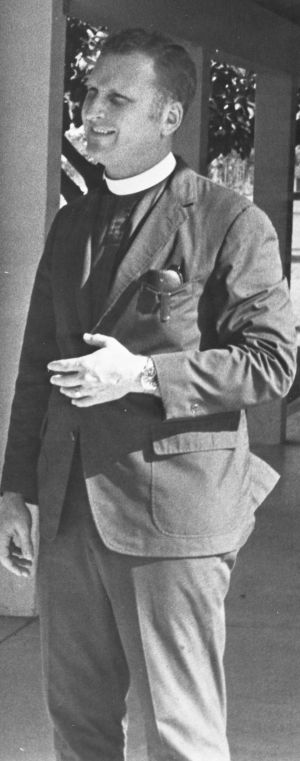
Fr. William A. Sassman, his photo in the 1973 Tartan (St. Andrew’s yearbook.) He was described as “a tireless advocate of Situationalism.” Not unexpectedly, a local Episcopal minister staked out a position on the topic:
Harvesting the organs from the anencephalics is “a loving thing, saving another baby,” said the Rev. William Sassman of St. Francis Episcopal in Fair Oaks, who formerly taught an ethics course at a prep school in Florida.
And the parents of the doomed child “will ease their grief,’ said Sassman. “They will know that their child–who is in the hands of the Lord anyway–will be helping another baby to survive.”
My Anglican readers will roll their eyes at yet another Episcopal cleric taking an edgy left-wing position on yet another social topic. But for me this had a greater impact. About that ethics course:
- The “prep school” referred to was the St. Andrews School in Boca Raton.
- The formal name of the course was “Ethical Bases of Conduct.” His textbook was Joseph Fletcher’s Situation Ethics; his remarks to the newspaper came straight out of that controversial tome.
- The year was 1972 and I was one of his students.
And the Rev. William A. Sassman, the school’s chaplain, was the one person who had more to do than anyone else with me “swimming the Tiber” before graduating from that Episcopal prep school. But, as always, a little background is in order.
St. Andrew’s was (and is) an Episcopal prep school. For my sophomore year there I got elected to the one and only office I ever held in the Episcopal Church: a seat on the student Vestry. That was the year Fr. Sassman came. It was a challenging relationship from the very start. We differed on many things. The Situational Ethics came later: the first thing he tried to do was get people moving on social action.
The best way to describe this is to let him do so in his own words. The homily linked here was one he gave in November 2007; it was pretty much the same message he always gave to us. It’s not a straightforward business to recall the rationale behind my aversion to his idea, but a few things stand out.
The first is that Fr. Sassman always struck me as an optimistic enthusiast about everything he did, and I came up in a world where optimistic enthusiasts were beaten down by the culture. To adopt his way would have, in my estimation, subjected me to more social pain, and especially after my years in Palm Beach (with stuff like this) I had had enough.
The second is that his social action program struck me as inadequate. Evidently I’m not the only one who felt that way; in his homily, he makes the analogy of the man who throws starfish back into the sea. When someone calls his effort out as generally unimportant, his response is that it’s important to the starfish that he saves.
While that’s true, growing up in a culture with a creeping sense of guilt about its own success and material prosperity, just saving “a few starfish” wasn’t going to get the job done. That was especially true for someone who studied history, and recent history where entire ruling classes were swept away in bloody revolutions. To address this would take more serious measures than the ones Fr. Sassman was proposing.
As an aside, I wasn’t the only one there uninspired by his idea. But that may have been a timing issue. Even some of the serious liberals had their doubts. One of them, who had told my parents the previous year that the geniuses commit suicide, noted that much of his agenda was better suited to a college student group and not to a prep school one.
But I think the one message I got from him that the Episcopal Church had no answers to the serious questions of life. It’s fashionable in conservative circles to say that liberals are wrong about many things, and they are. But when you base your idea on the premise that there is no absolute truth–and in many ways Situational Ethics is a “baptised” way to do that–you’re basically empty-handed in helping others sort out the important questions of life. And in many ways that’s worse than being wrong.
After nearly two school years of this, I found Dante and began my journey to “swim the Tiber” and become a Roman Catholic. That brought many of the answers I was looking for, especially with the parish priest I had. I actually made the Profession of Faith towards the end of the ethics course. It also, indirectly, addressed the social issue problem. One thing that was becoming clear–if only in an implicit and visceral way–was that the concept of the Episcopal Church, with its lofty demographics, being an agent for either social change or meaningful charity was a nonstarter. In this case the Marxists were right: the Episcopalians were the problem, something that many social activists like Fr. Sassman (such as Ian Mitchell) didn’t quite grasp. Roman Catholicism, with its broader income level and ethnic diversity, is in a better place to address this problem, although there are issues there.
An even stronger statement in that direction was made with joining a Pentecostal church. No where else is it more clear that the preferential option for the poor and the preferential option of the poor aren’t the same. It’s hard to imagine Fr. Sassman having never encountered that in his time in Puerto Rico and the Caribbean, but evidently he never thought that an option.
Today, of course, the time of social action that Fr. Sassman tried to interest us in is almost a form of forced labour among our elites in school. To a large extent it’s replaced upward social mobility as the goal of the search for significance. In this respect he has won.
But we also have the fact that, in the intervening years, income inequality has grown. In that respect I’ve won: it’s important to come up with a game plan for all the starfish and not just the few. Today we have figures like Donald Trump and Bernie Sanders, whose rise indicates that the many starfish are tired of being left on the beach to die.
And medical ethics, which brought Fr. Sassman to the newspapers? Those battles still rage, and now we have the technology to do both serious benefit and damage to ourselves. It’s interesting that the objection to Fr. Sassman’s situational ethics came not from Christianity but from Judaism:
But Rabbi Lester Frazin of Congregation B’Nai Israel in Sacramento believes that harvesting organs from anencephalic babies while they are alive is cruel and lacks compassion.
Frazin, formerly chaplain at the Dixon (Ill.) State School for Mentally Retarded and Deformed for 13 years, had a child with a neurologically degenerative disease called Tay Sachs. He removed the child from a Chicago hospital when doctors asked to do research on the child’s brain.
“Experimenting or harvesting organs from living human beings just is reminiscent of Nazi Germany experimentation,” said Frazin.
The line between the most loving thing and the expedient one is finer than people like Fr. Sassman may care to admit, and it’s one we’re going to spend a lot of time walking in the years ahead.
Fr. Sassman’s life has had tragedy of its own. His son went to prison for securities fraud; my experience in the Church of God tells me that PK’s (preacher’s kids) are either the best or worst Christianity produces. He experienced divorce and his wife died of cancer.
In his review of my work in his course, he recommended that I take some more logic and philosophy courses in college. While my pursuit of a mechanical engineering degree did not avail me of opportunities that he (and others) would have liked me to pursue in the liberal arts, I did take a course in logic from the Philosophy Department at Texas A&M. It was there that my professor informed me that “you’re not as dumb as you look!“
It’s always something…
-
A Fistful of Yuan, Thirty-Five Years Out
 It’s time to mark another anniversary here, in this case the thirty-fifth one of my family business’ signing our first contract with the Petroleum Corporation of the People’s Republic of China for the sale of pile driving equipment. That may not seem like much today but then we were selling into an economy that was beginning its long march to the powerhouse it is today.
 For a small company like ours to come to that point–and it was repeated two years later–it was an achievement that, really, we had to pinch ourselves to make sure it was real. More than that, going to China was a transformative enrichment and education that altered the way I looked at the world. In many ways, coming to a country that was a time warp after thirty years of socialism (as Cuba is today) it was a look at the shape of things to come.
I trust that you’ll stop by the series developed on that adventure.
-
After the Resurrection, Did Our Lord Need Purification?
Of all of Jesus Christ’s post-resurrection appearances, this one is, in many ways, the most intriguing:
Meanwhile Mary was standing close outside the tomb, weeping. Still weeping, she leant forward into the tomb, And perceived two angels clothed in white sitting there, where the body of Jesus had been lying, one where the head and the other where the feet had been. “Why are you weeping?” asked the angels. “They have taken my Master away,” she answered, “and I do not know where they have laid him.” After saying this, she turned round, and looked at Jesus standing there, but she did not know that it was Jesus. “Why are you weeping? Whom are you seeking?” he asked. Supposing him to be the gardener, Mary answered: “If it was you, Sir, who carried him away, tell me where you have laid him, and I will take him away myself.” “Mary!” said Jesus. She turned round, and exclaimed in Hebrew: “Rabboni!” (or, as we should say, ‘Teacher’). “Do not hold me,” Jesus said; “for I have not yet ascended to the Father. But go to my Brothers, and tell them that I am ascending to him who is my Father and their Father, my God and their God.” (John 20:11-17 TCNT)
There have been many explanations of Jesus’ statement “Do not hold me” to Mary Magdalene; in this piece I’ll look at two of the oldest interpretations, from Origen. Both of these date from the first half of the third century. The first one we’ll look at is probably the earliest, from his Commentary in John, VI, 37:
And having by His passion destroyed His enemies, He who is strong in battle and a mighty Lord required after His mighty deeds a purification which could only be given Him by His Father alone; and this is why He forbids Mary to touch Him, saying, “Touch Me not, for I am not yet ascended to My Father; but go and tell My disciples, I go to My Father and your Father, to My God and your God.”
This is a pretty bold statement about someone who, as we saw last week, was sinless. Origen was given to bold statements, which got him in trouble in life and in death. But Evangelicals routinely blurt out stuff like “Jesus took on our sin,” so how did he get rid of it? That’s a question that most evangelicals, as is often the case, don’t have a good answer for.
Simply put, Origen looks at Jesus’ death, resurrection and victory as a very high form of spiritual warfare, from which Jesus emerged victorious for himself and the rest of us. Some kind of “recovery” after the battle is natural to posit. It was in this situation that he told Mary Magdalene not to touch him.
Later in life he had the chance to discuss this issue again. Origen wasn’t above changing his mind about things (as was the case with the transmigration of souls) and in his Dialogue with Heraclides he states the following:
If the spirit was put into the hands of the Father, he gave the spirit as a deposit. It is one thing to make a gift, another thing to hand over, and another to leave in deposit. He who makes a deposit does so with the intention of receiving back that which he has deposited. Why then had he to give the spirit to the Father as a deposit? The question is beyond me and my powers and my understanding. For I am not endowed with knowledge to enable me to say that, just as the body was not able to go down to Hades, even if this is alleged by those who affirm that the body of Jesus was spiritual, so also neither could the spirit go down to Hades, and therefore he gave the spirit to the Father as a deposit until he should have risen from the dead. . . . After he had entrusted this deposit to the Father, he took it back again. When? Not at the actual moment of the resurrection, but immediately after the resurrection. My witness is the text of the gospel. The Lord Jesus Christ rose again from the dead. Mary met him and he said to her: “Touch me not.” For he wished anyone that touched him to touch him in his entirety, that having touched him in his entirety he might be benefited in body from his body, in soul from his soul, in spirit from his spirit. “For I am not yet ascended to the Father.” He ascends to the Father and comes to the disciples. Accordingly he ascends to the Father. Why? To receive back the deposit.
Allegorists like Origen are criticised for playing “fast and loose” with the literal meaning of scripture. But in reality they often “nit-pick” the scriptures for fine points, and do so better than more “literal” interpreters. That is the case here.
Origen, in common with both the New Testament and Philo, considered human nature in three parts: body, soul and spirit. “Then Jesus, with a loud cry, said: “Father, into thy hands I commit my spirit.” And with these words he expired.” (Luke 23:46 TCNT) Origen doesn’t simply take Jesus’ words as a figure of speech: he states that Our Lord placed his spirit up with his Father on a temporary basis. The body then went to the tomb and the soul, with his divine nature, “…went and preached to the imprisoned spirits, who once were disobedient, at the time when God patiently waited, in the days of Noah, while the ark was being prepared; in which some few lives, eight in all, were saved by means of water.” (1 Peter 3:19-20 TCNT)
But that wasn’t the end of it: “And referred to the resurrection of the Christ when he said that ‘he had not been abandoned to the Place of Death, nor had his body undergone corruption.’” (Acts 2:31 TCNT) The Resurrection was simply the beginning of putting the pieces back together; the body was reunited with the soul, and then the Father returned his spirit to the Son. But in Mary Magdalene’s early encounter, Our Lord had not been reunited just yet.
God is timeless; the Incarnation, like anything else in the material world, took place in time. The fact that the process is not instantaneous should not surprise us. The thing that we should never take for granted is not that it happened in time, but that it happened at all.
Much of this article is based on Crehan, J. H.. (1950) “The “Dialektos” of Origen and John 20:17″ Theological Studies, 11, 368-373.
-
The Meaning of Outside the Camp: A Good Friday Reflection
If I had to pick a favourite Bible verse or passage, it would be this:
The bodies of those animals whose blood is brought by the High Priest into the Sanctuary, as an offering for sin, are burnt outside the camp. And so Jesus, also, to purify the People by his own blood, suffered outside the gate. Therefore let us go out to him ‘outside the camp,’ bearing the same reproaches as he; for here we have no permanent city, but are looking for the City that is to be. (Hebrews 13:11-14 TCNT)
I first picked up on this while working as the webmaster for the Church of God Chaplains Commission; v. 12 was their theme scripture, as it is for Outside the Gates Ministries, the current ministry of Dr. Robert Crick, the Commission’s director for many years.
One use of this passage: the following video, produced for the Commission:
Verses 11, 12 and 13 each take the reader “outside” something. For v. 12 it is outside the gate. That’s pretty straightforward: Jerusalem, like most ancient cities, was walled, and to enter or exit same you went in and out of gates. Jesus Christ was taken through one of those gates outside of the walled city to be crucified and suffer.
But what about “the camp” in vv. 11 and 13? It’s tempting to read that as an analogy for Jerusalem also, but there’s more to it than that. To dig a little deeper we’ll have recourse to Philo Judaeus. The relationship between Philo and the New Testament is subject to some dispute but there’s no question both of them drew to varying degrees from the same well, and no where is that clearer than in the Book of Hebrews.
A little introduction to Philo’s concept of the human person is in order. Drawn from Greek philosophy and psychology, it posits the existence of an immortal, immaterial soul in each of us, joined to a body while on the earth. The baser “passions” of the soul came up from the physical body, with its desires and irrationality. The ideal was for the soul to gain mastery over these passions which, in Philo’s Jewish context, was necessary for us to be oriented Godward. This runs contrary to much of the spirituality/emotionalism nexus that dominates these days, but the result in the society we have speaks for itself.
It is in this context that the following should be understood:
We have, then , in Jesus, the Son of God, a great High Priest who has passed into the highest Heaven; let us, therefore, hold fast to the Faith which we have professed. Our High Priest is not one unable to sympathize with our weaknesses, but one who has in every way been tempted, exactly as we have been, but without sinning. (Hebrews 4:14-15 TCNT)
The idea of Jesus’ sinlessness even while human, expressed more directly here than anywhere else in the New Testament, is one that also bears repeating.
In Allegorical Interpretation III, Philo divides the passions into two types: those of the breast, the “angry passions” which need to be excised completely, and those of the belly, which are related to our embodied state. The latter too need to be excised. But then Philo comes to the obvious question:
Is it then possible for us, who are bound up in our bodies, to avoid complying with the necessities of the body? And if it is possible, how is it possible? But consider, the priest recommends him who is led away by his bodily necessities to indulge in nothing beyond what is strictly necessary. In the first place, says he, “Let there be a place for thee outside of ‘the camp;” (Deut. 23:12) meaning by the camp virtue, in which the soul is encamped and fortified; for prudence and a free indulgence in the necessities of the body cannot abide in the same place. After that he says, “And you shall go out there.” Why so? Because the soul, which is abiding in companionship with prudence and dwelling in the house of wisdom, cannot indulge in any of the delights of the body, for it is at that time nourished on a diviner food in the sciences, in consequence of which it neglects the flesh, for when it has gone forth beyond the sacred thresholds of virtue, then it turns to the material substances, which disarrange and oppress the soul. How then am I to deal with them? “It shall be a peg,” says Moses, “upon thy girdle, and thou shalt dig with it;” (Deut. 23:13) that is to say, reason shall be close to you in the case of the passion, which digs out and equips and clothes it properly; for he desires that we should be girded up in respect of the passions, and not to have them about us in a loose and dissolute state. On which account, at the time of the passage through them, which is called the passover, he enjoins us all “to have our loins girded,” (Exodus 12:11) that is to say, to have our appetites under restraint. Let the peg, therefore, that is to say reason, follow the passion, preventing it from becoming dissolute; for in this way we shall be able to content ourselves with only so much as is necessary, and to abstain from what is superfluous. (Allegorical Interpretation III, LII)
From this we can see the following:
- “Outside the camp” was a nasty place. In addition to burning the sacrifices (Heb. 13:11), Philo reminds us that it was the place where people and their sin was sent for purification of one kind or another.
- Since Jesus had no need for purification (Heb. 4:15), the reason he went “outside the camp” was not just to get outside of Jerusalem proper, but also to both experience our passions (in the Incarnation) and to achieve purification on our behalf as both sacrifice and priest at the same time (in the crucifixion and resurrection.)
- For us to go “outside the camp” does imply a need for purification, which is a process whose perfection is beyond human effort but whose initiation and pursuit involves some decisions and actions on our part.
We tend to make God’s becoming man a commonplace business. Philo and the Greek world, however, did not: God was way up there and we were way down here. The same sharp bifurcation is also very strong is Islam. For God to become one of us is amazing in many ways, we should never take it for granted.
And what about us going “outside the camp?” I think there are two levels we can interpret that.
The first is that, since Jesus bore our sin and the reproaches of being executed as a criminal, we should do likewise in the world, and not just hide “inside the camp.”
The second is that, since we bear the sins caused by our own embodied state, we should seek liberation and purification from same, and do so by sharing in his sufferings. That’s a “penitential” concept of Christianity that’s not fashionable in many circles, but it should be.
As we celebrate the great work of redemption that our God has done for us, let us keep the following in front of us:
Wherefore seeing we also are compassed about with so great a cloud of witnesses, let us lay aside every weight, and the sin which doth so easily beset us, and let us run with patience the race that is set before us, Looking unto Jesus the author and finisher of our faith; who for the joy that was set before him endured the cross, despising the shame, and is set down at the right hand of the throne of God. (Hebrews 12:1-2 KJV)
-
Happy Nowruz to the People of the "King of Kings"
Today is Nowruz, the spring equinox festival of the Iranians. To my Iranian friends, who have meant so much, hope you’ve had a good festival season (it runs about two weeks back in the old country.)
Last November I ran a piece about the Persian origin of the term “King of Kings,” which most Christians are unaware of. Since that time I’ve come to realise something else about the New Testament’s use of the title that I had never thought about, and I dare say most Christians hadn’t either.
Let me repeat the use of the title in Revelation:
From his mouth comes a sharp sword, with which ‘to smite the nations; and he will rule them with an iron rod.’ He ‘treads the grapes in the press’ of the maddening wine of the Wrath of Almighty God; and on his robe and on his thigh he has this name written– ‘KING OF KINGS AND LORD OF LORDS.’ (Revelation 19:15-16 TCNT)
Any inspection of the maps at the back of the Bible will show that most of the action of the New Testament takes place in the eastern half of the Roman Empire. (See below.)

Facing that eastern half was the Persian Empire, first Parthian and later Sassanid. The two sparred for basically the same territory ISIS is fighting for today for about half a millennium, until the rise of Islam.
The Persians called their highest ruler the “King of Kings.” They could use this as a battle cry, as the Roman historian (who actually served in this theatre of war) Ammianus Marcellinus noted at the Battle of Amida in 359:
Our men extolled the prowess of Constantius Caesar, ‘lord of all things and of the world,’ while the Persians hailed Sapor as Saanshah and Peroz, titles which signify ‘king of kings’ and ‘conqueror in war.’ (Res Gestae, 19,2)
Coming back to John the Revelator, he states that Jesus Christ will come back as a conquering king using the title that the enemy in the east used for their ruler. This not only lifted up the lordship of Jesus Christ; it was highly subversive, and John’s readers in the seven churches would have picked up on that.
N.T. Wright emphasises that the early church’s message was that Jesus is Lord and Caesar is not. John’s use of a Persian title for the returning Messiah drove that message home in a way that believers–and those who persecuted them–would not miss.
And as for the Iranians today, it is my prayer that you will know the peace and love that comes from the eternal “King of Kings.”

Sailing the Last Voyage with Newton and Pascal

 Positive Infinity