-
What a Difference a Century Makes
While going through some things, ran across this:
 The drawing is interesting to technology history buffs, but look at the note in the upper right hand corner:
Superseded by new tracing 8/18/15
Just last year? No, just last century…
Note: referring to drawings as “tracings” is very old school, but I can remember that terminology being used in the 1970’s. Drawings like this were usually done on linen with India ink; some of them are real works of art.
-
The Aggie Who Knew How to Get Ahead With a Professor
First: congratulations are in order to my Texas A&M classmate Ray Rothrock, who won this year a Distinguished Alumnus Award from the Association of Former Students. He majored in a good but highly unpopular subject–nuclear engineering–and then turned around and did very well.
Although I didn’t name him at the time, it’s now or never: he was the one who came up with the method to curry favour with my differential equations teacher, which I documented last year in my piece Sometimes it Pays to Give Your Professor a Little Attention.
Another one of those life skills…
-
Those Vanishing Episcopal Parishes
Every so often I begin a reading of the Bible through. I try to vary the translation I use, so I’ve read translations such as the Vulgate, Louis Segond, Reina-Valera, New American Bible, Douay-Rheims, CCD and of course the Positive Infinity New Testament. This time I had a copy of the original TEV New Testament from the American Bible Society, first published in 1966. I liked it so well I went to the used book store to get the whole Bible, and for my Roman Catholic and Orthodox visitors, I mean the whole one: it includes the deuterocanonical and apocryphal books. (It also has the Roman Catholic imprimatur; I’ll bet they’ll think twice before pulling that like they did on Christ Among Us.)
In any case, the previous owner of the book was a woman who lived in northern New Jersey. In the Bible was a postcard with her parish’s Holy Week schedule, probably dating from the 1980’s. A little research revealed that her Episcopal parish was no more; a pretty church, the congregation had folded earlier in this decade and the building was now being used by an independent black church.
Northern New Jersey was, of course, the stomping grounds of John Shelby Spong, its bishop for many years. Spong inspired one of the earliest “posts” of this website, When Church Becomes Pointless, nearly twenty years ago. The following from that piece bears repeating:
So let’s take this a step further; suppose you are sitting in an Episcopal pew listening to John Shelby Spong go on about why the basic truths of Christianity have no basis in reality and that those who teach them are a bunch of morons. Suppose that you finally realize that you think that Spong is right; that all that you’ve said when you’re repeated the Apostles’ or Nicene Creed is false and that the life you have is all you’re expected to get. What should you do? You should first realize that life is short and that, if you’re going to live you’d better hurry. So the sensible thing for you to do is to get up, gather your family, walk out of the church, get into your Lexus or Mercedes, and head to Atlantic City or Las Vegas or South Florida or wherever you need to go to live it up while you still can.
Evidently many in northern New Jersey took that to heart; the Episcopal Church there has bled parishes ever since. Most of those remaining were those who ultimately left via the coffin. TEC’s demographics are consistently elderly, largely made up of those who stick around because they’ve always done it that way. The younger people who really thought he was wrong about Christianity either fled to Evangelical or Charismatic churches, swam the Tiber or the Bosporus, or were the impetus behind the ACNA.
Part of Spong’s problem was that he was a Southerner in a Northern place. He thought that people would always go to church somewhere, no matter how stupid things got. This is a common mistake among our ministers. It simply doesn’t work that way in the Northeast.
Beyond that Spong was an old style radical; he thought that, if we completely changed what Christianity stood for, it would be more acceptable to the modern and post-modern world. That hasn’t worked out either. Today’s liberal, imbued with post-modernism, practices a form of deception (and self-deception) that rivals anything Islam can be accused of. They use words that mean one thing to others but something entirely different to themselves.
An example of this is the controversy over the “bathroom bills” and the Federal government’s attempt to shove “transgender rights” down everyone’s throat in the matter. Does anyone really believe that “rights” are what’s at stake here? What they’re really trying to do is to break down people’s modesty; the whole idea of people not exposing themselves to each other–and refraining from sexual activity–is abhorrent to them. The only solution that will make them happy is the complete integration of bathrooms and locker rooms.
The results of the likes of Spong in the TEC are a harbinger of what’s to come for the Global North, which is why it’s important to study these things. I’ll close with a comment I made to another post about Spong in 2009:
And that leads to the second level. Spong, I think, has the idea that the liberal West will triumph over many of his “traditionalist” enemies, in and out of the church. But a civilisation (?) with the demographic and financial woes ours has is waiting for its own Valhalla to ignite. To take one issue: most of the world doesn’t have the affinity for the LGBT community that Spong exhibits (and did so at length for the Times piece) and his expectations that the rest of the world will follow his idea to victory are sorely misplaced.
When Spong squared off with the Africans at 1998 Lambeth, he was facing the future. But I think he instinctively discounted that future because it wasn’t white. But nonwhite is the future.
The survival of traditional or any other kind of authentic Christianity will be principally resident in non-Western people.
And that can be extended to humanity in general.
“What you think is the right road, may lead to death.” (Proverbs 14:12 TEV)
-
Jesus Christ, the Way Up
From The World of Mathematics
, this quotation from the British mathematician Augustus de Morgan:
I commend my future with hope and confidence to Almighty God; to God the Father of our Lord Jesus Christ, whom I believe in my heart to be the Son of God but whom I have not confessed with my lips, because in my time such confession has always been the way up in the world.
Jesus Christ is still the “way up” in eternity. But de Morgan’s problem of confessing Christianity as a way of worldly advancement has pretty much been solved both here and in the UK. The sooner we come to grips with what that means, the better.
-
If You Can't Do the Math, You Can't Do the Science
And the math is problematic these days:
The average performance of the nation’s high school seniors dropped in math from 2013 to 2015, but held steady in reading, according to results of a biennial test released Wednesday…
“This trend of stagnating scores is worrisome,” said Terry Mazany, the chairman of the governing board for the test. Mr. Mazany is also a former public schools superintendent in California, Michigan and Illinois and is now the president of the Chicago Community Trust, a large foundation.
I always find it amazing how hard it is to convince some people that proficiency in math is a necessary prerequisite for success in science, engineering and technology. But maybe I shouldn’t; the hippie dreamers who run the show these days first came up in an era when science and engineering were in the doghouse, a doghouse of their own making. Personally I think the recent interest in STEM is a seriously delayed “waking up and smelling the coffee” moment; the computer and its variants have forced on them the reality that we live in a technological society. They’re probably also thinking about the uphill battle they’ve had with evolution and global warming, but that connection is more complicated than they realise.
One of the really frustrating things about American primary and secondary education is not just that the results aren’t up to par; a system which spends as much per pupil on education should have more to show that it does. But, when you pack your bureaucracy with administrators the way we do in this country, the money spent per pupil doesn’t really get to the pupils…
-
You Really Can Do Biblical Preaching From a Lectionary
Recently my wife and I ventured to Regent University for me to deliver a paper. While there we got the chance to view one of the University’s new acquisitions, namely a Torah scroll from Yemen.
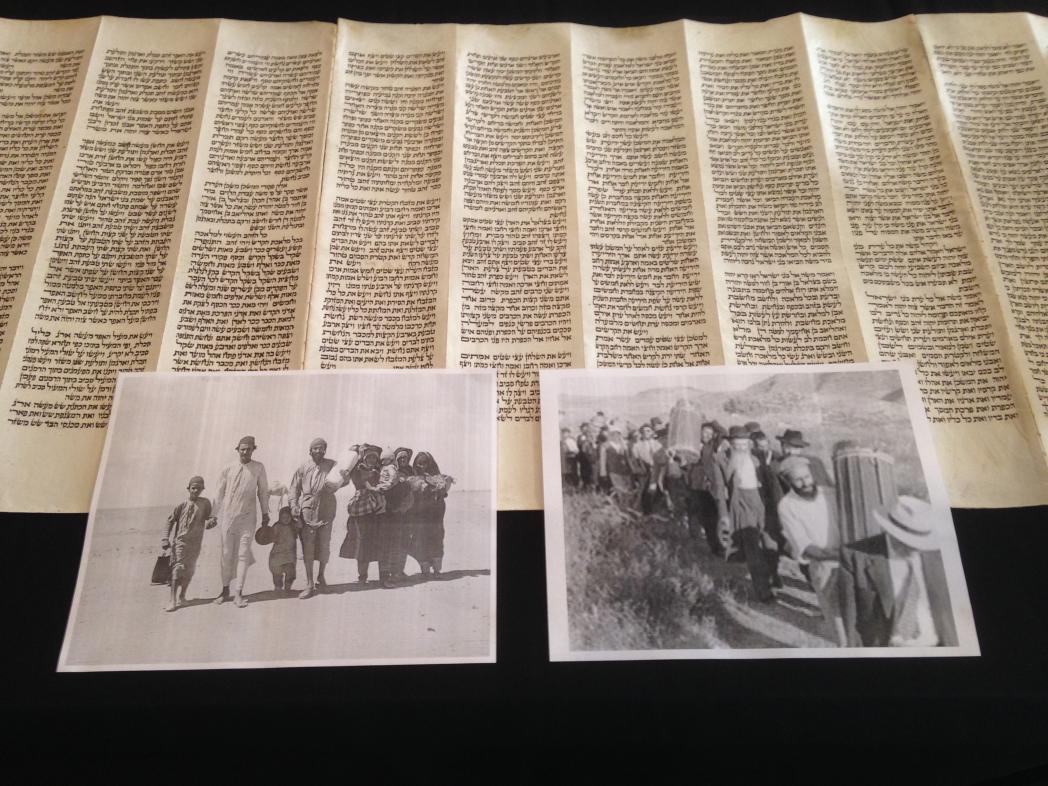 The fact that a Christian university could acquire such a donation is a sign of the times: Evangelicals are about the only reliable Gentile group the Jews have for support, in spite of the attempt by BDS types to worm their way into the system.
A New Testament passage that prominently features a synagogue reading (not from the Torah) is this one:
Coming to Nazareth, where he had been brought up, Jesus, as was his custom, went on the Sabbath into the Synagogue, and stood up to read the Scriptures. The book given him was that of the Prophet Isaiah; and Jesus opened the book and found the place where it says– ‘The Spirit of the Lord is upon me, For he has consecrated me to bring Good News to the poor, He has sent me to proclaim release to captives and restoration of sight to the blind, To set the oppressed at liberty, To proclaim the accepted year of the Lord.’ Then, closing the book and returning it to the attendant, he sat down. The eyes of all in the Synagogue were fixed upon him, And Jesus began: “This very day this passage has been fulfilled in your hearing.” (Luke 4:16-21 TCNT)
The curator noted that, when Jesus was asked to read from the scroll, the reading was not of his immediate choosing, but came from a cycle of readings–a lectionary–that the synagogues employed. He was told what to read, he read it and then interpreted it (not entirely to their liking, I might add…)
Lectionaries are the stock in trade of liturgical churches such as the Roman Catholic Church, Anglican/Episcopal churches, Orthodox churches and the like. But Evangelicals avoid such constraints like the plague. A good example of this came to me when I was in undergraduate school at Texas A&M.
One of the nice things that ministerial associations promote is pulpit exchanges, where ministers from different churches preach in other places. For a Catholic church, this can be problematic, but in the 1970’s things were easier. Our exchange was with a Baptist church; the Baptist pastor and our priest were good friends, shown by their mutually swelling waistlines. (Gluttony, I might point out, was a sin for the Catholic, but a way of life for the Baptist.)
So the time for the Gospel reading came, and the Baptist preacher got up and, ignoring the fancy three-year lectionary cycle introduced by the Novus Ordo Missae, read from John 15. His subsequent sermon on “love one another” was different: he observed that “the Aggies love the Aggies and the Catholics love the Catholics, but the Baptists don’t always love the Baptists.” (Subsequent experience would bear that out.) That alone was probably worth the side trip from the lectionary, but it still was a side trip.
As was the case here, Evangelicals are loath to follow any kind of lectionary or reading pattern for the Scriptures. There are two main arguments against the practice.
First, some will say that it smacks of “formalism,” which is their objection for the liturgical concept. But there’s no evidence that using a lectionary is a more “formal” way of doing things than doing it ad hoc every Sunday.
Second, Pentecostals and Charismatics will argue that it “blocks the move of the Spirit” if they are forced to preach out a set pattern of the Scriptures. However, if it was good enough for Our Lord to not only read from a lectionary but to proclaim the fulfilment of prophecy, are we any better?
The major downside of doing it without a lectionary–assuming, of course, the lectionary is comprehensive in its coverage of the Scriptures–is that our ministers tend to develop a very limited repertoire of scriptures and sermons. And didn’t Our Lord having something to say about repetition?
And, of course, special occasions pretty much demand a lectionary type of choice. The first funeral I ever helped preach was for a former employee down in Georgia. We got to the graveside, and the credentialed minister actually asked me what scripture to use. (The answer can be found in the 1928 Book of Common Prayer.)
So my advice to Evangelicals and Pentecostals is this: don’t disparage those who follow a lectionary, it just might improve what you are doing.
-
Why I Don’t Use Salutations in Emails
Recently one of my academic colleagues posted this piece on her fb page about how students should properly email their professors. One of the recommendations is as follows:
Dear [1] Professor [2] Last-Name [3],…
Right off the bat, here’s where you can establish that you view your relationship with your professor as a professional one. Use “Dear,” or if that feels horrifically formal to you, you can use “Hello” or “Hi.”

Telex machine, very similar to the one used in my family business. But I could never expect my students to use a salutation in an email. Why is this? Because I have never used one, ever since starting with the medium in the mid-1990’s.
The reason? Simple: emails, for me, are a continuation of the telex, and I (and just about anyone else) never used them in the telex.
I have an entire page dedicated to explaining the telex, so you can find the details here. Although salutations are de rigeur for business letters, in the case of the telex they were not used for two reasons.
The first is that they were expensive. Telex was usually charged by the word or letter; a salutation could be costly, especially if they were used with every telex. So we skipped them.
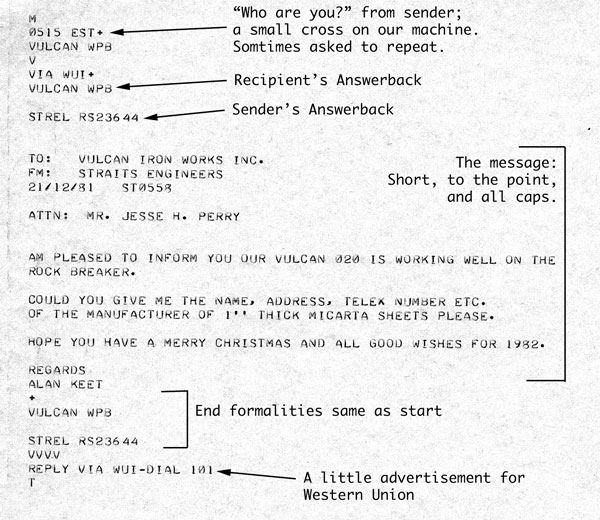
A sample telex, dating from the early 1980’s. The elements to explain the telex are included. The second is that every telex had an answerback, which was an address for the telex (like a phone number.) So it was unnecessary to do a formal address (like a letter.) Since most telex machines were “one to an office” you used an attention line to direct the telex, like you did in a memo. A salutation in that case was redundant.
Telexes also used common abbreviations like we do in texting, but you have to be careful to make sure your recipient is “with it” enough to figure them out. My family business usually spelled things out.
Since I made a fair amount of my living with the telex, it only made sense to continue the success with emails. It is true that emails aren’t charged by length (or usually at all) but all of them have sender and recipient at the top. And an email goes directly to the recipient.
However, there are two things that students (and everyone else) can do with email to make things nicer with the recipient, and to get a meaningful answer.
The first is to really explain what you’re trying to convey. Many times I feel like I’m getting the middle of a conversation in emails (and sometimes blog and fb posts as well) without really understanding what’s going on.
The second is, for those who insist on using salutations, to ditch the wimpy “Dear…” we use in English for something better. The Russians, for example, address their letters using “Esteemed (name)!” Formality increases when we see “Much Esteemed (name)!” and “Deeply Respected (name)!” Since academics tend to be, er, a little conceited, this should boost a student’s standing with his or her professor.
One thing from Telex days I would avoid is all caps. With the telex we understood that’s just the way it was; it shouldn’t be that way now.
So that should simplify things somewhat. Now if students would only read syllabi…

Sailing the Last Voyage with Newton and Pascal
 Positive Infinity