
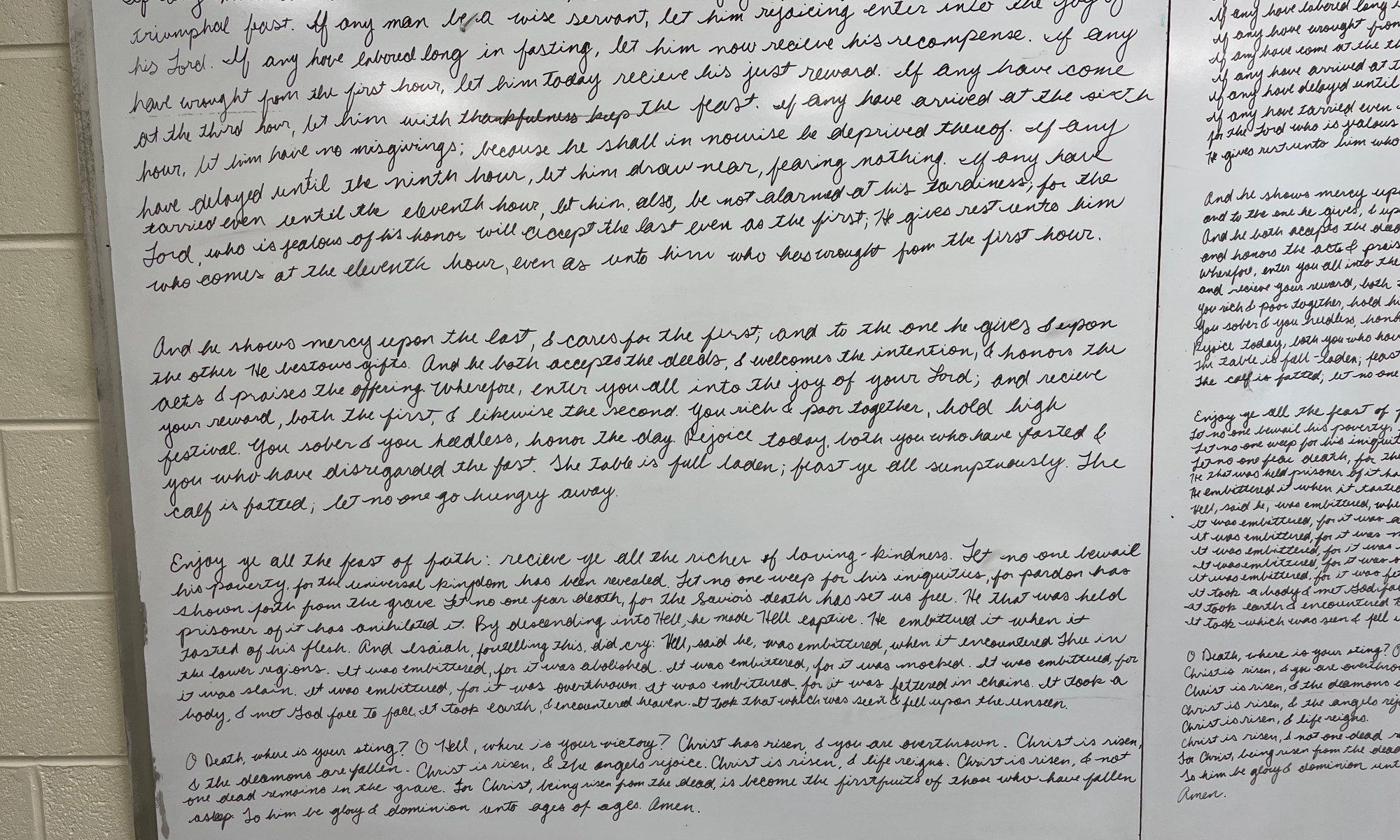
As some of you know, I teach at Lee University in their new Engineering program. Recently I reserved a computer lab to administer a test, and was regaled with the above, from St. John Chrystostom’s Pascal Homily. It was written on the white board (the students were amazed it was in cursive, I guess I should have been, too.) This, mind you, was in the Science and Math Complex.
It’s not every day that a Pentecostal university such as Lee gets to look at one of the Fathers of the Church, but here we are. It’s not a singular event either: Lee gives out student awards, and one of the nominees last year had in her cv the fact that she had translated a work of Lucifer of Cagliari, a name I hadn’t heard in years (yes, I had heard of him through my studies of Jerome, the patron saint of social media.)
Long time readers of this blog know that I am a supporter of Patristic studies and even of the Patristic hermeneutic of the Scriptures. Even without that, it’s becoming evident to more Evangelicals and Evangelical-adjacents that the Patristic witness is crucial to demonstrating the continuity of the faith from New Testament times through the Roman Empire and beyond. The Patristic period, being the closest in time to the New Testament, is a) crucial to understanding what came immediately before and b) does not neatly fit into the various paradigms of Christianity that are competing today.
That last point is the “trout in the milk” for broader acceptance of Patristic studies.
Roman Catholicism, armed as it is with its own concept of being an infallible church lead by an infallible pope, is mostly content these days with relying on these and its own institutional continuity to proclaim its own authority. Its best retort to “we’re trying to get back to a more authentic form of Christianity by going back to the Fathers” is that of Bossuet: where do we draw the line? But as I have observed, “A Roman Catholicism which is more like Bossuet envisions it–conscious of Scripture, independent of the state, Augustinian in theology–would be a better entity to adhere to than the one that he had then and we have now.” That is a way back to a more Patristic view of things.
Reformed types, having turned Augustinianism on its head, have closed the door to the way back and are, as King James’ men would put it, led “…by self-conceited Brethren, who run their own ways, and give liking unto nothing, but what is framed by themselves, and hammered on their anvil…”
The Anglican world has a golden opportunity to step into this void, but is too lost in stuff like this to really take advantage of it.
I’m not sure where the real forward-moving initiative is going to come for this, but I’m grateful to see signs of it at Lee.
 Positive Infinity