
There’s been quite a lot of pushback to the election (?) of Sarah Mullally as Archbishop of Canterbury, much of which concentrates of the fact that she’s a woman (at least that’s defined, no mean feat these days) and this breaks with the rest of the Anglican Communion, with Rome, with Constantinople, Moscow, and many other sees.
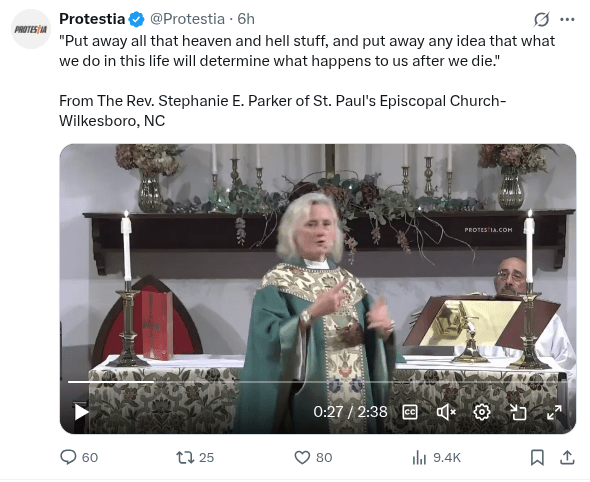
With this I saw the above on X, complete with heretical statements by one Stephanie Parker, Rector of St. Paul’s Episcopal Church in Wilkesboro, NC. As can be expected, there are those who attribute this sorry denial of eternal life to the fact that she’s a woman.
One point I’d like to make before I go passing on is that the apostasy that has overwhelmed much of the Anglican/Episcopal world started long before the Episcopalians, followed by the Church of England and other provinces, started ordaining women to the priesthood (such as it is) and episcopacy. Exhibit A of this is John Shelby Spong, that pseudosophisticate who denied just about everything basic in Christianity. It was for that reason that very early in the history of this site I posted When Church Becomes Pointless, and later with other posts which I link to in John Shelby Spong Goes to Meet God.
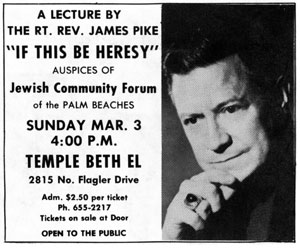
There are others of his ilk (like James Pike and Paul Moore) who propagated much the same kind of thing. (One thing about all of these men is that the Episcopal church awarded them for their unbelief by making them bishops.) Many of these, however, came before there were women in the Episcopal pulpits and cathedral thrones.
That leads to an observation I made before and hope to live long enough to make again: the Anglican/Episcopal world spends too much time fighting over secondary issues rather than tackling the primary ones. The classic example of this was the fight over the 1928 Book of Common Prayer; everyone was up in arms over the changes in the wording and not the doctrinal shifts (such as The Baptismal Covenant: The Contract on the Episcopalians) that ended up being embodied in the dreadful 1979 book. It took the ordination of V. Gene Robinson to finally drive the point home that something was really, badly wrong with the whole Episcopal paradigm (the loss of a large chunk of the membership in the 1960’s and 1970’s didn’t accomplish that either.) Ultimately a church is defined by two very important things:
- What it, to paraphrase Origen, “believes and is convinced” is true.
- How it sees itself relative to God and its laity, or to use the fancy term its ecclesiology.
Everything else stems from both of these. The Prayer Book is an important witness to these but before Cranmer put to pen the words that are still fought over those two things were behind those words.
The problem with so many divines (or anti-divines) in the Anglican/Episcopal world is that the way they look at things is so secular that they import that mentality into their ministry, such as it is. In the case of the women that means feminism, which is not univocal. That last adds confusion to non-Christian thinking. This doesn’t have to be the case, but again many of the men that came before them had the same problem (and many of those still with us carry on the tradition.)
A great driver of all of this I dealt with in Squaring the Circle of Anglican/Episcopal Ministry: the elevated demographics of the parishioners. Now lowering the average AGI of the congregations won’t solve this problem, but it makes it much easier to deal with. The situation the Anglican/Episcopal world in general and the ACNA in particular is unenviable, but until the problems are recognised the solutions will be elusive.
 Positive Infinity
One Reply to “”