
In a recent post by the North American Anglican entitled “The Drama of Confession,” the author goes into a long Anglican description of the importance and benefits of confession, with emphasis (justified) on the Anglican “general confessions” that we see in traditional Anglican prayer books. For all of the detail he goes into, he misses an important point: that the existence of these confessions undermine the whole idea of unconditional perseverance, be it Reformed or Baptistic.
I am in a Bible study class lead by Dr. R. Lamar Vest, former President of the American Bible Society in addition to being former Presiding Bishop of the Church of God and former President of (then) Lee College (now University.) Last night’s session was about the importance of confession, this in a church which, being in the Wesleyan tradition, generally denies unconditional eternal security.
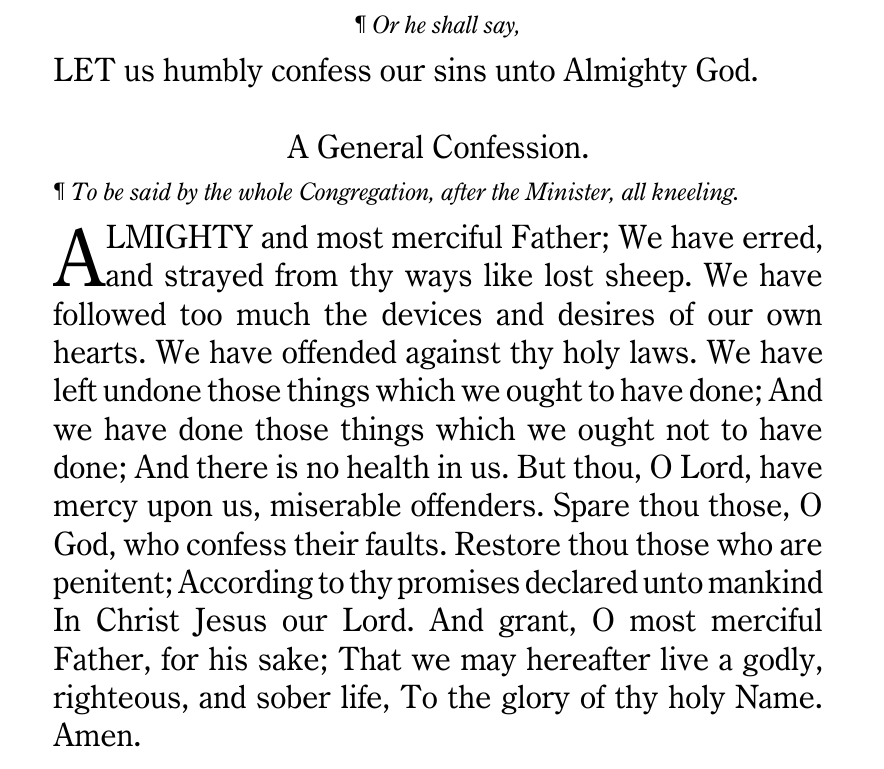
Unfortunately the adoption of basic Baptistic worship structure (if not rigid adherence to same) doesn’t include a mandatory time of confession and repentance of sin. Being a product of Bethesda-by-the-Sea Episcopal Church and remembering What I Learned About Approaching God From the 1928 Book of Common Prayer, I had to say something. So I started by pointing out that, for our Morning Prayer service (Evening Prayer and the Holy Communion are the same in this regard) we had a penitential rite; the one I had in mind and outlined is of course the following:
I pointed out (as is my custom) that, back in old Palm Beach, it was fitting that members of our paid youth choir (and I should have included the acolytes in the bargain) characterise themselves as “miserable offenders.”
Years later My Mother the Exvangelical confessed that she really hoped that I would adopt “once saved always saved,” but, to adapt a good hillbilly expression, that was like closing the barn door after the cattle had made their exit.
I think there are two lessons from this adventure in life, worship and doctrine.
The first is that I don’t see how a TULIP Calvinist (and that is the “reference standard” for Calvinism these days, like it or not) can be an Anglican. I don’t see how one can be Pentecostal either but for a different reason: the whole “saved/sanctified/baptised in the Holy Spirit” progression is just that: a progression. So why is progress needed when you get everything at the start? Jettisoning predestination in election doesn’t help (no, Baptists, it doesn’t) and has uninspiring consequences, as I outline in The Baptists, Their Doctrine and Their Nasty Politics.
The second is that, if we confess and receive forgiveness for our sins on an ongoing basis, we won’t need dramatic events to restore our relationship with God either individually or corporately. That doesn’t mean that such Joel-like events aren’t necessary but that necessity is a product of our neglectfulness.
 Positive Infinity