
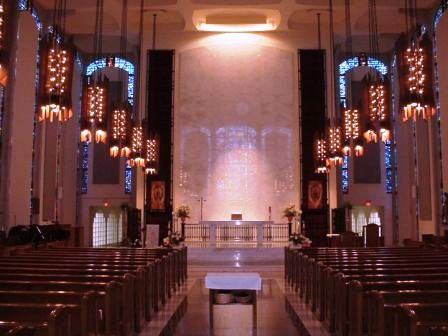
It’s been a while since I’ve been actively posting to this site, and in looking at my stats an old favourite page has been active again: Think Before You Convert. It’s an overview of why you should (or shouldn’t) convert to Roman Catholicism or, if you’re there why you might want to take your leave. As someone who has done both in his lifetime, I’ve always thought this was an important topic; evidently others think so now.
There’s been a lot of speculation as to whether Charlie Kirk was moving towards a Tiber swim, but let’s start with a more relevant example: JD Vance, our current Vice President. I’d like to make a challenge to our ministers in the Church of God, whose core ethnic group is Scots-Irish and which has deep roots in the hills (and mountains) of Virginia, West Virginia, Kentucky and Ohio, where Vance is from. Would one of you like to explain why Vance, a natural for our church and with all of the gifts and anointing that it claims, abandoned that path for Rome?
I can’t answer that for Vance, but I can answer that for myself. My last year in prep school I drove past an Assemblies of God church in Delray Beach every day going to school. At the time I never gave a thought to any Pentecostal or Evangelical church; I had started visiting St. Edward’s (where Jack Kennedy went to Mass when he was in Palm Beach) and continued that when moving to Boynton Beach, a saga I detail in Called Out of the Pews: An Experiential Reflection on the Role of the Laity.
To cut to the chase, Roman Catholicism was better at answering one question that Evangelical and Pentecostal (and really the Episcopal Church) churches were loathe to answer: why?
Most people go through life focused on their own needs and situations, many of which bounce up and down from one week to the next. They don’t see themselves as part of a greater whole, which is one reason why they don’t make an impact on the greater whole. Evangelical and Pentecostal churches have made a career–and a successful one at that–appealing to people of this idea. They’ve been criticised for only furnishing “fire insurance” in eternity, but given the eternal consequences of crossing over without it, it’s a valuable thing to have. In some ways these churches have gotten off track with things like prosperity teaching and its cousin the obsessive search for respectability, but that’s another post.
For others whose interests take them beyond themselves, sooner or later that kind of focus doesn’t cut it. So I swam the Tiber my senior year in prep school. Starting with Dante’s Divine Comedy (Inferno, Purgatorio and Paradiso) many of the “why” questions were answered in a way that made sense and had rooting in history. Many criticised me (especially Episcopalians) at the time because they said that I wasn’t “allowed to think” as a Catholic, but that didn’t make sense with the fire hose of St. Augustine’s City of God and later Aquinas’ Disputed Questions on Truth and the Summa. Besides, authoritarian institutions had been a familiar part of my landscape; I knew how to deal with them.
The big difference between what I see today and what I experienced a half century ago is that today the emphasis is more heavily on authority now than it was then. That’s not just a Catholic thing, that’s across the board in Christianity. It seems that everyone is obsessed in one way or another with human authority–even the Baptists, who upended the whole concept of institutional authority in the church. That’s the leitmotif of the Trads, who are caught between their idea of what is really Catholic and the Church’s insistence on papal infallibility (as opposed to that of the Church at large) when we have Occupants like Francis. I think this is unfortunate because Catholicism does have definite (if sometimes hard to figure out) answers but also has a rationale behind them.
Ultimately however Catholicism’s biggest problem isn’t their theology but their ecclesiology. Their idea is that they are an active intermediary between man and God, and that leads both to their willingness to exercise authority when it suits them and complacency the rest of the time. That became evident in the early years of John Paul II, when we saw things like David Peterman and the Hard Choices of the Catholic Charismatic Renewal and what I went through in an area where the Catholic churches were more concerned with their image than to help fulfil the spiritual needs of their flock. At that point I took my leave and passed into a world with problems of its own but also with the freedom to interact with God in a way that my years as a Catholic had presented to me.
Today we hear of a renewed interest in Roman Catholicism. Unless they solve the core problem of their lackluster pastoral system (a product of the aforementioned ecclesiology) they’re going to continue to experience what we call a “back door” problem, i.e., people leaving the Church in substantial numbers. But their strength in attracting people who are more interested in “fire insurance” or simply prosperity in this life will continue.
And as for the rest of us? Unfortunately our ministers are content with the big crowds (and the revenue stream that comes with them) and are blind to the limitations they have set upon themselves. Some of them think that they can take society through a populist, revivalistic method, but they will never attract and keep the people who can meaningfully interact with the top of society. And they cannot replicate one of Catholicism’s biggest advantages in this country–the ability to put together a church with a broad socio-economic spectrum–or even consider that some groups need a different methodology.
The one group which could actually change things are the Anglicans. They, however, from left to right are too bogged down in their own stuff to make a reasonable shot at it, and they are plagued with the opposite problem of the Evangelicals–they cannot figure out how to attract the lower end of the socio-economic scale, with the perils of top-heaviness that come with that.
So here we are. One of the lessons of the Vietnam War was that the American soldier, no matter how valiant he was, could only control the ground he stood on. That’s true of all of us really, which means that the choice of church is personal first and broader after that. It means that, before all else, you need to Think Before You Convert.
 Positive Infinity