-
The Oyster and the Flying Fish
There are many ways of expressing the idea that you should be content where you’re at, but my favourite is this one, from Kevin Ayers’ 1970 album Shooting at the Moon:
The lyrics are as follows:
An oyster was a’travelling
Along the ocean road
He’d been some time preparing
And now he’d left the foldHe was sick of being oysterized
And he wanted to explode, to explode
Ooh la, ooh la, ooh la, ooh la
La la la la la la la laHe saw a pretty flying fish
And said if I could have one wish
I’d change into a flying fish
And then I would be happy, yes I would
Ooh la, ooh la, ooh la, ooh la
La la la la la la la laThe flying fish came down to see
Just who had made this plea
And seeing the poor oyster
Said this cannot be
An oyster has to stay inside
And a flying fish must flee, all the time
Ooh la, ooh la, ooh la, ooh la
La la la la la la la laAs the oyster turned to go away
The flying fish was heard to say
“If I could find a place to stay
I know I would be happy, yes I would!”
Ooh la, ooh la, ooh la, ooh la
La la la la la la la laGrowing up in South Florida, I remember seeing flying fish paralleling our boat as we went to and from the Bahamas.
-
Catholic and Christian, the Sweet Combination
Evident in the obituary for a Texas A&M classmate (we both were engineering majors) of mine:
Thomas Craig Kohutek, 63, was called home to be with the Lord January 1, 2018…A faithful servant of the Lord, Tom was an active member of St. Catherine of Siena Catholic Church as well as the Knights of Columbus.
I’ve written before about the revolutionising experience my years at Texas A&M and the effect it had on my life. That experience was as a Roman Catholic; you can see a video montage of that here.
Somehow I think that directness of commitment has gotten lost between the obsessive churchianity of #straightouttairondale or the loosey-goosey veneer of faith in liberal Catholicism. To see this and to know some of its roots is refreshing.
But what really tugged at the heartstrings was this, at the end of the obituary:
For this momentary light affliction is producing for us an eternal weight of glory beyond all comparison, as we look not to what is seen but to what is unseen; for what is seen is transitory, but what is unseen is eternal. (2 Cor 4:17)
That sums it up. So what about you?
-
Sometimes Science Takes a Detour
And it’s not the detour we’re told happens, either. Consider this example from J.E. Gordon’s Structures: Or Why Things Don’t Fall Down
, during a discussion of Robert Hooke and the development of the theory of elasticity:
In fact, throughout the eighteenth century, remarkably little real progress was made in the study of elasticity. The reasons for this lack of progress were no doubt complex, but in general it can be said that, while the scientists of the seventeenth century saw their science as interwoven with the progress of technology–a vision of the purpose of science which was then almost new in history–many of the scientists of the eighteenth century thought of themselves as philosophers working on a plane which was altogether superior to the sordid problems of manufacturing and commerce.
It’s worth noting that the eighteenth century is frequently characterised as “the Age of Reason,” when Europeans (at least, along with their cousins on this side of the Atlantic) began to shed their “superstitions” and move into “the Enlightenment.” It’s one thing to say that we’re “enlightened” or “guided by reason” but it’s quite another to actually take all of this reason and put it to the solution of present problems.
Today people insist on us “believing in science” or whatever scientific thing they want us to agree with. The minute we put the question as a subject of belief, we’ve not only missed the whole point; we’ve undermined any claims of our thought processes being guided by reason as well. And if we simply make our goodness a product of our belief, we may feel better about ourselves, but leave the problems at hand unsolved.
-
The Sheep Thief: An Episcopal Story
It’s another year and another opportunity to start it with a “monumental post.” Unfortunately, as the Anglican Curmudgeon points out, there aren’t many good things to report these days. Our political system has gone dangerously stupid, completely in thrall to those who judge the merits of any proposal on who proposed it. The Anglican Communion has come to the realisation that its supposed primus inter pares, Justin Welby, has sold the pass (which I’ve been waiting to happen for a long time.)
With all that, for this post I’m going back to my days at Bethesda (a church very much in the news even now.) During most of my time there, our rector was Hunsdon Cary, whose relatives got caught in Jon Bruno’s bullying in California. My father preferred to characterise him as a vacuous Episcopal divine, but he did manage a couple of durable accomplishments during his time: the founding of the Church Mouse (which was really the work of others) and the Boar’s/Bore’s Head celebration, which is just about the highlight of the year at Bethesda.
Our ministers would like to think that their profound theological musings are the most memorable part of their sermons. In the case of the Anglicans this is especially problematic, but in reality the things that stick are the illustrations, something that you who preach sermons need to keep in mind. I’m almost positive it’s Dr. Cary’s and it’s remained with me until now.
In an old village they raised a lot of sheep, and they are subject to theft. One young man tried to make a livelihood out of it, so he was a sheep thief.
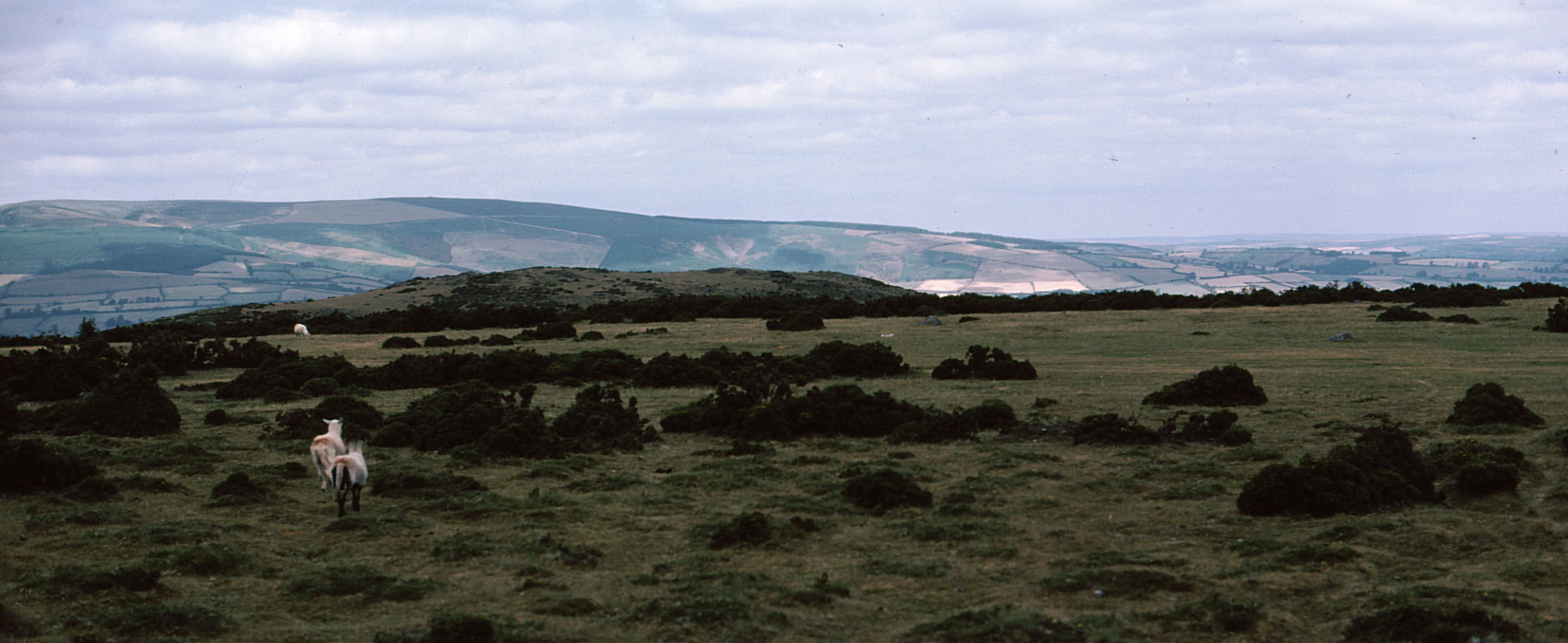
What a sheep thief might have seen in the “old country” while plying his trade, atop Hergest Ridge, 1976. He eventually got caught, and since they didn’t have the budgets for putting people in prison like they have now, they branded his forehead with “ST”, or “Sheep Thief.” In a small village that was punishment enough; you were literally “branded for life” and short of taking off for London or America there weren’t many options.
Well, this sheep thief evidently took the comforting words of the Prayer Book to heart and decided to “truly and earnestly repent you of your sins, and are in love and charity with your neighbours, and intend to lead a new life, following the commandments of God, and walking from henceforth in his holy ways.” He spent the rest of his days doing good deeds for people in the village, and gained a good reputation doing so. When he was very old, while walking about, one young person asked another, “What’s the ‘ST’ on his forehead mean?”
“I don’t know,” was the reply, “I think it means Saint.”
We like to think we live in a “tolerant” time, but the reality is that it’s pretty easy to get your reputation ruined (with the consequences of that following) with one act. In the sheep thief’s case at least he knew his act was illegal when he did it; these days the rules can change and you can get in trouble for stuff that wasn’t illegal (or considered wrong) when you did it. And with digital memories it’s hard to shake something. Human memory may fade but the record doesn’t.
As we start the New Year, the lesson of this illustration–in many ways harder to do now than even when Dr. Cary used it–is that we need to quit flying off at the handle and relying on virtue signalling to show the world that we are “good people.” One of the serious consequences of the de-Christianisation of society is that we no longer know that only God is good and the rest of us need a Saviour. That puts our “goodness” on our own efforts, and given the erratic nature of the human condition that’s an impossible order to fill.
It’s probably too much to ask at this stage in history, but at this point we as Christians need to keep the possibility–really, the imperative–of redemption in front of us, even for those whom we dislike and who hate us. (We don’t need to confuse real reconciliation with just going along to get along, always a temptation in this society.) Life will be a lot sweeter for us–and for others–if we do.
-
The Wrong Side of the Border for Good Tamales
Even the Mexicans know the truth, if they won’t admit it:
We bring tamales by the bagful to holidays gatherings, trading them like baseball cards with friends and cousins—I’ll give you some of my Tía Meme’s pineapple tamales if you hook me up with the potato ones from your Guatemalan sister-in-law. And, once we’ve put on the pounds (the Freshman Fifteen has nothing on the Tamale Ten) and sworn to reform our ways in the new year, we freeze what’s left to extend the holiday cheer.
The truth of the matter is that the Guatemalan Christmas and year-end tamales are far superior to anything produced in Mexico. They are some of the most outstanding holiday food out there, and let’s hope they serve them when they move their embassy back to Jerusalem.
-
Christmas with the Roueché Chorale
A little bit of their recent Christmas program:
The Roueché’s are some of my favourite people. They hosted and led our Catholic Charismatic prayer group for many years, which included youth trips to the University of Steubenville. They did so while resisting the siren song of the covenant community. They are great people and the Chorale has been a blessing to our community for many years.
You can learn more about the Roueché Chorale here. Merry Christmas!
-
Ecce Rex Tuus: St. Thomas Aquinas’ Christmas Sermon
For those of us who owe our theological sanity to marching through St. Thomas Aquinas’ Summa Theologiae and Disputed Question on Truth, his Christmas sermon, which encapsulates his method in a very nice form. Merry Christmas!
The Aquinas Institute would like to give our subscribers and supporters a Christmas gift: Aquinas’s Christmas sermon Ecce Rex Tuus in a fresh translation from the Leonine text by Madison Michieli. To see the Latin text in a parallel column and critical footnotes in the English, visit our online text viewer. Feel free to share.…
via Ecce Rex Tuus—a gift from the Aquinas Institute — Aquinas Institute
Sailing the Last Voyage with Newton and Pascal
 , during a discussion of Robert Hooke and the development of the theory of elasticity:
 Positive Infinity