-
Otto Klink: From Atheism and Socialism to Assemblies of God Evangelist — Flower Pentecostal Heritage Center

This Week in AG History — July 18, 1931 By Ruthie Edgerly Oberg Originally published on AG News, 18 July 2019 Otto J. Klink (1888-1955) was a German-born American Pentecostal evangelist who traveled the United States in the 1930s and 1940s, preaching salvation through Jesus Christ and warning his listeners about the dangers of socialism, […]
-
Why I Prefer Ad Orientem
Since the release of the ANCA 2019 Book of Common Prayer has open the floodgates for consideration of all kinds of controversial topics, it’s time to consider one more: that of ad orientem, i.e., facing the altar during the Sacred Mysteries rather than the people. That’s been the subject of a blog-to-blog volley between one Rev. Ben Jeffries, vicar at The Good Shepherd Anglican Church, Opelika, Alabama, and Robin Jordan of Anglicans Ablaze fame.
Personal note: I’ve sparred with Robin before on the nature of Anglicanism and many other topics. I noted that he opted to expand his own case on his own blog and not in the comments section of Jeffries’. Evidently his encounter with me was educational; I wish he had done this when we went at it, we would have both been better off.
In any case, the topic is of interest because I’ve seen it both ways. First, the altar of my home church, against the wall (and certainly facing east, which was easy to figure out in Palm Beach):
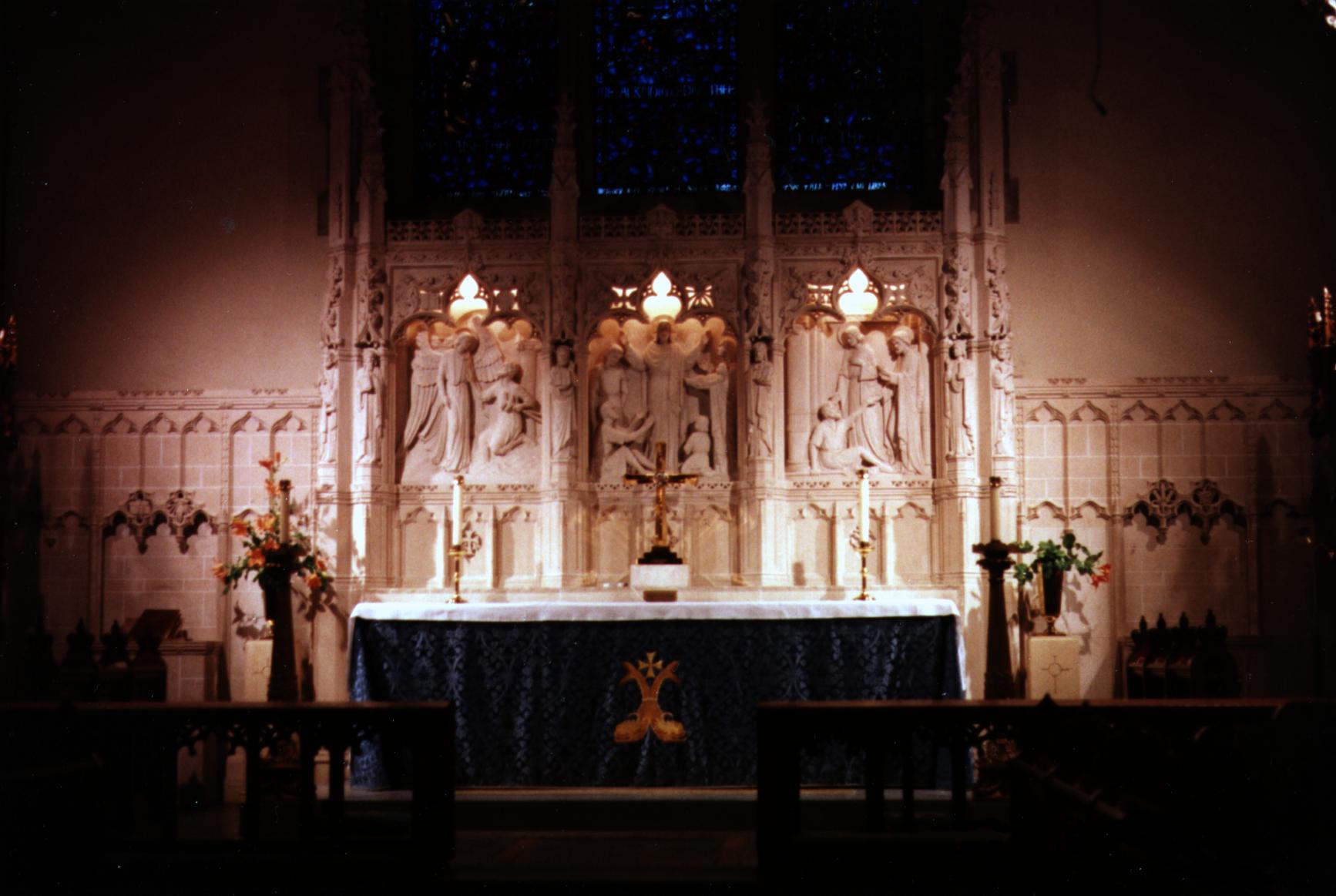
As a Roman Catholic, however, the priest always faced the people with the altar from the wall, for reasons that both Jeffries and Jordan explain in detail.
With Latta Griswold’s rule of “The minister should face the altar when he addresses Almighty God, the congregation when he addresses or reads to them, and the opposite stall during other parts of the service” in mind, the reasons why I think ad orientem is better are threefold:
- It is a strong statement against Bill Clinton’s Eucharistic Theology and its variations. While I am aware that Anglicanism, in common with Lutheranism, does not strictly adhere to this, the Scriptures are clear on this subject.
- It is the best justification for women ministering at the altar. Now that you’ve picked yourself off of the floor, hear me out: true Catholics will tell you that the priest is in the place of Christ and represents him to the people, which is why we can never have women priests. But that kind of priesthood has no real justification in the New Testament, as any true Anglican knows. At the altar the minister represents the congregation to God, and when he or she celebrates the sacred mysteries facing God with the congregation at his or her back, that’s a powerful statement of the reality of the role of the minister. Facing the people implies that the priest, in the place of Christ, is representing God to the people.
- It helps to restore the God-centred nature of our worship, and we need all of that we can get these days.
Now we know that trads and #straightouttairondale types inflexibly associate (or try to) ad orientem with the ornate High Mass. But that wasn’t always the case, and a couple of examples from the days of wine and the Tridentine Mass will suffice.
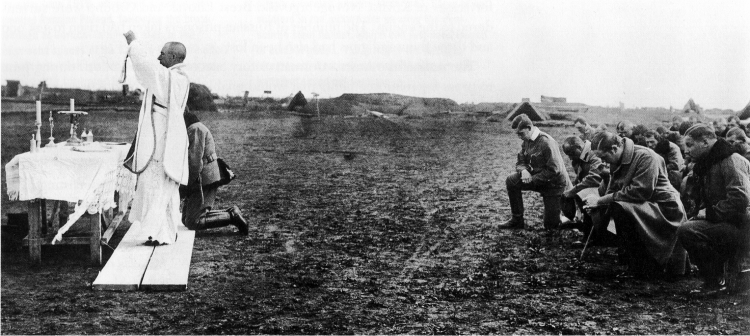
The “field Mass,” a tradition in the Austrian military, being simply celebrated during World War I, in good ad orientem style. It’s interesting to note that Eduard Habsburg, a descendant of the monarch these troops served, is the current Ambassador to the Vatican from Hungary. 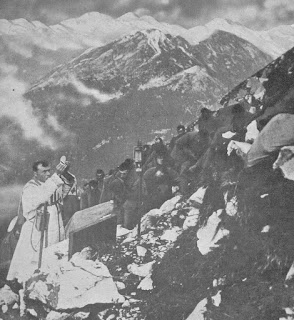
On the Allies side, a priest celebrates Mass ad orientem (or whatever direction he can manage) to Italian Alpine troops during World War I. The Alpine troops were the best on both sides of the conflict; evidently they had the crack priests to go with them. One common criticism of the ad orientem style is that its celebrants “mumble” their prayers. That was certainly the case during pre-Vatican II times, but it doesn’t have to be now. One good wireless microphone (which a celebrant should wear anyway, given all the movement during the Liturgy) should fix that. For parishes with a larger budget, it wouldn’t hurt to set up a camera to the side of the altar and see what it looks like when the celebrant actually faces God.
While I’m at it, I’d like to address one more of Robin’s assertions:
Cardinal Ratzinger as Pope Benedict XVI introduced a series of so-called reforms of the Roman Rite, which represent a retrograde movement in the Roman Catholic Church—a retreat from the reforms of Vatican II. Ratzinger, the writers on the New Liturgical Movement website, and Lang are a part of a movement in the Roman Catholic Church, which seeks to undo the reforms of Vatican II and to revive the Latin Mass and other pre-Vatican II practices. It blames the reforms of Vatican II for the decline in attendance at Mass in the West. Like the nineteenth century Anglo-Catholic movement in the Anglican Church it presents itself as a movement for the renewal of the church.
I was involved in a church plant that had lapsed Roman Catholics as one of ministry target groups. Our work with this ministry target group did not support the contentions of this movement. Among the reasons that the lapsed Roman Catholics with whom we worked gave for having stopped attending Mass was that they had undergone a divorce. They had been physically abused by the Roman Catholic nuns in parochial school as a child. They were concerned about the growing reports of sexual abuse of children by Roman Catholic priests, the failure of the Roman Catholic hierarchy to protect these children, and the safety of their own children. The Roman Catholic Church had not met their pastoral and spiritual needs. They had been baptized, catechized, and confirmed, but had never heard the gospel or had been invited to accept Jesus Christ as their personal Lord and Savior. How the Mass was celebrated was a non-issue.
I’ve discussed the impact of those retrograde innovations here and here. Robin is right up to a point, but the main impact of the whole “trad” movement in Roman Catholicism is to create a core of committed people, something that the Church–with its gradualistic “box checker” mentality and weak pastoral system–has failed to do. That isn’t enough to renew the church but without it Roman Catholicism will experience continual decline. And, in a culture where Christianity is unpopular and its legal status rides from one election cycle to another, having that core is essential to its survival.
But that brings us to Anglicanism in North America and what it’s here to do. As I see it Anglicanism has always been a “niche marketing” project, especially since American Christianity tends to be class stratified. If you want many people, you’ll start a non-denominational or Pentecostal church (especially if you’re not targeting white people.) If you want the “right” people, i.e., those with more education and resources, you’ll start an Anglican church. Paul could claim the following:
To the weak I became weak, to win the weak. I have become all things to all men, so as at all costs to save some. And I do everything for the sake of the Good News, that with them I may share in its blessings. (1 Corinthians 9:22-23 TCNT)
Most of our ministers these days can’t. They should find out, among other things, whom God is calling them to be an apostle to and do it.
-
Jimmy Buffett and the Miserable Offenders of the Book of Common Prayer
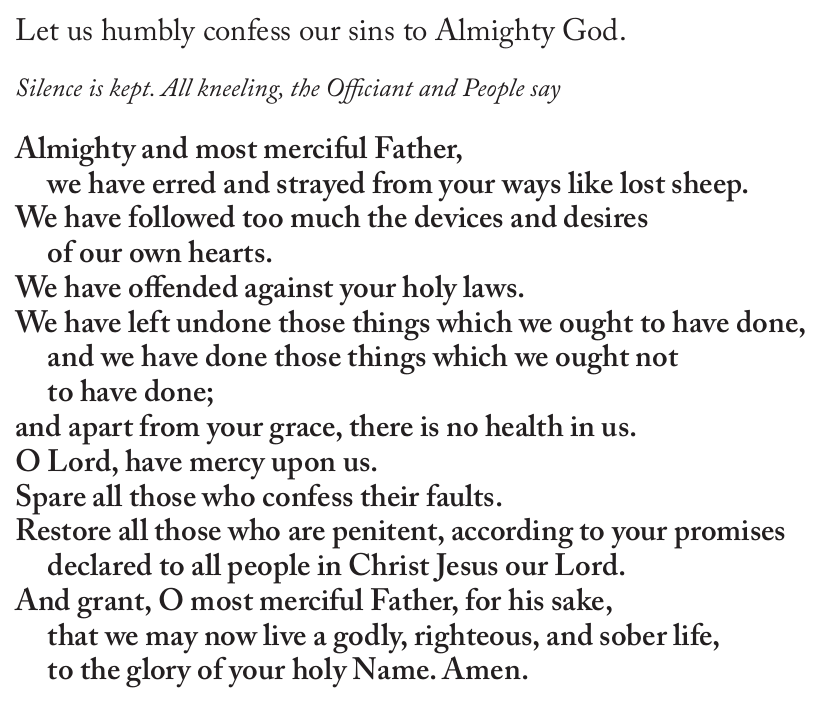
It’s time to look at another bone that’s been picked with the ANCA’s 2019 Book of Common Prayer: the omission of the phrase “miserable offenders” to the General Confession for Morning and Evening Prayer. Let’s start with the 2019 text:
And now from the 1928 BCP:
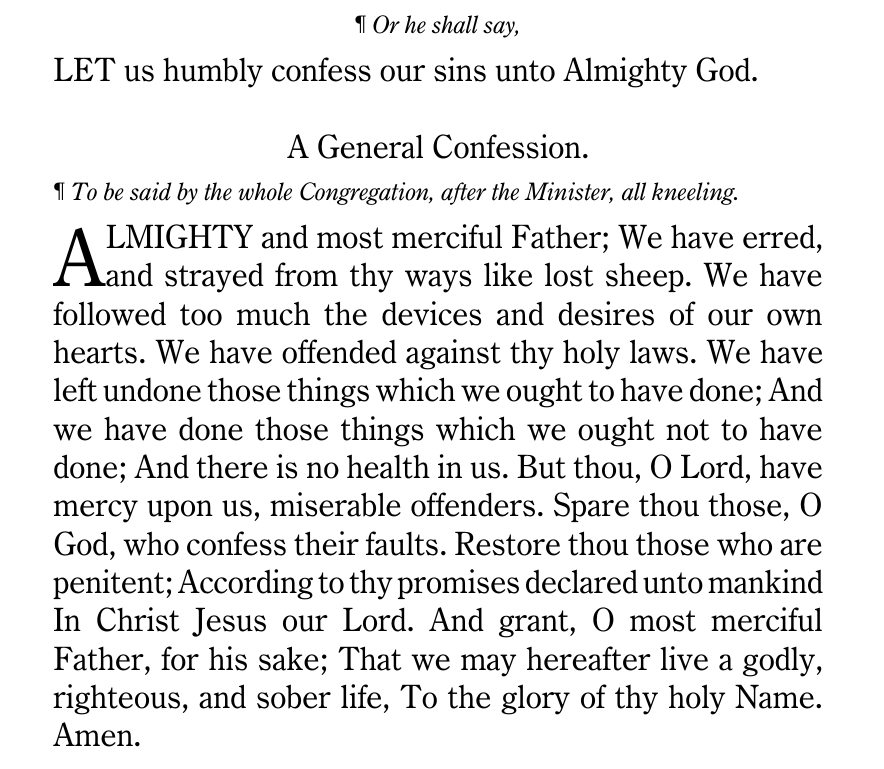
In addition to the modernization of the language, the phrase “miserable offenders” is conspicuously absent from the newer confession.
Modernizing the language is something that, although traditionalists find it offensive, is pretty much a necessity these days; the question is how to do it. It’s the same fight that “King James Only” people have.
But the miserable offenders? As was the case with the Creed, there’s a parallel with the Roman Catholic Novus Ordo Missae, and that’s the omission of the “mea culpa” (with breast beating accompanying) from the original English translation of that liturgy. I did an entire piece on the subject when the “new” translation came out. Note that there was pushback on it at the time from Roman Catholics. My guess is that there’s been similar pushback from Anglicans and the 2019 BCP committees decided that keeping the phrase wasn’t worth it.
But in response to the NOM’s revived “starch in the shirt” about our sins, I invoked Jimmy Buffett:
As far as the sins are concerned, the Roman Catholic Church’s (the Jesuits of Pascal’s days notwithstanding) emphasis on the seriousness of our sins is well founded, and anyone with a Biblical understanding of the subject should know this. Even some whose Biblical understanding falls short know this too. In the same 1970’s when the “old” NOM translation was current in Catholic Churches, Jimmy Buffett, wasting away in Margaritaville, knew all too well whose fault it was. His lyrics, although liturgically inappropriate, were in their own way closer to the NOM Latin original than what was recited every Sunday.
The same observation can be made about omitting the “miserable offenders” from the Anglican General Confession, even though if Buffet’s sentiments were put into the BCP, as Latta Griswold would say, the philistines would blaspheme.
I grew up in Palm Beach reciting the 1928 General Confession. Characterizing a bunch of bratty Palm Beachers as “miserable offenders” is charitable. Right, Jeffrey Epstein?
-
The “I” and the “We” of the Creed
The issuance of the ACNA 2019 Book of Common Prayer has brought back to the forefront many issues that have been “out there” for a long time. One of them is right up front in both the Apostles’ and Nicene Creed: whether either or both should start with “I believe” or “We believe.” This post will attempt to shed a little light on the subject, because this change came from outside the Anglican/Episcopal world in a way that may surprise some people.
It’s certain that the 1662 and 1928 Books of Common Prayer started the creeds with the first person singular “I”. The 1979 BCP changed it to “We” and that’s stuck in the craw of many ever since. For me personally, the change came sooner. When I “swam the Tiber” in 1972, I walked into a church which had instituted the Novus Ordo Missae two years earlier. It was not only in the vernacular but started the Nicene Creed with “We believe.”
As an aside, I had been raised with the Apostles’ Creed being used in Morning Prayer and the Nicene in the Holy Communion. The latter creed was pretty much a fixture at Mass. The first time I heard the Apostles’ Creed used with Mass of any kind was John Michael Talbot’s The Lord’s Supper in 1979, and it finds its way there in situations where time is of the essence.
But I digress. The reasoning given at the time was that the Mass after Vatican II was supposed to be more participatory and community oriented, thus the plural declaration of faith. I think it’s reasonable to say that the Episcopal Church followed the RCC’s lead on this (and many other) liturgical subjects for the 1979 book.
But did the Roman Catholic Church actually change the Creed? The answer is “no.” Unlike the Anglicans, whose primary liturgical language is English (wonder why?) the Novus Ordo Missae, like those that went before it, was promulgated in Latin and translated into the various vernaculars that Roman Catholics find themselves in. The decision to use “We” was that of those who made the original official translation of the NOM into English. You can see this in this little except from a Latin-English missal I picked up in the UK, where “Credo — I believe” clearly appears in the Latin version of the Creed.
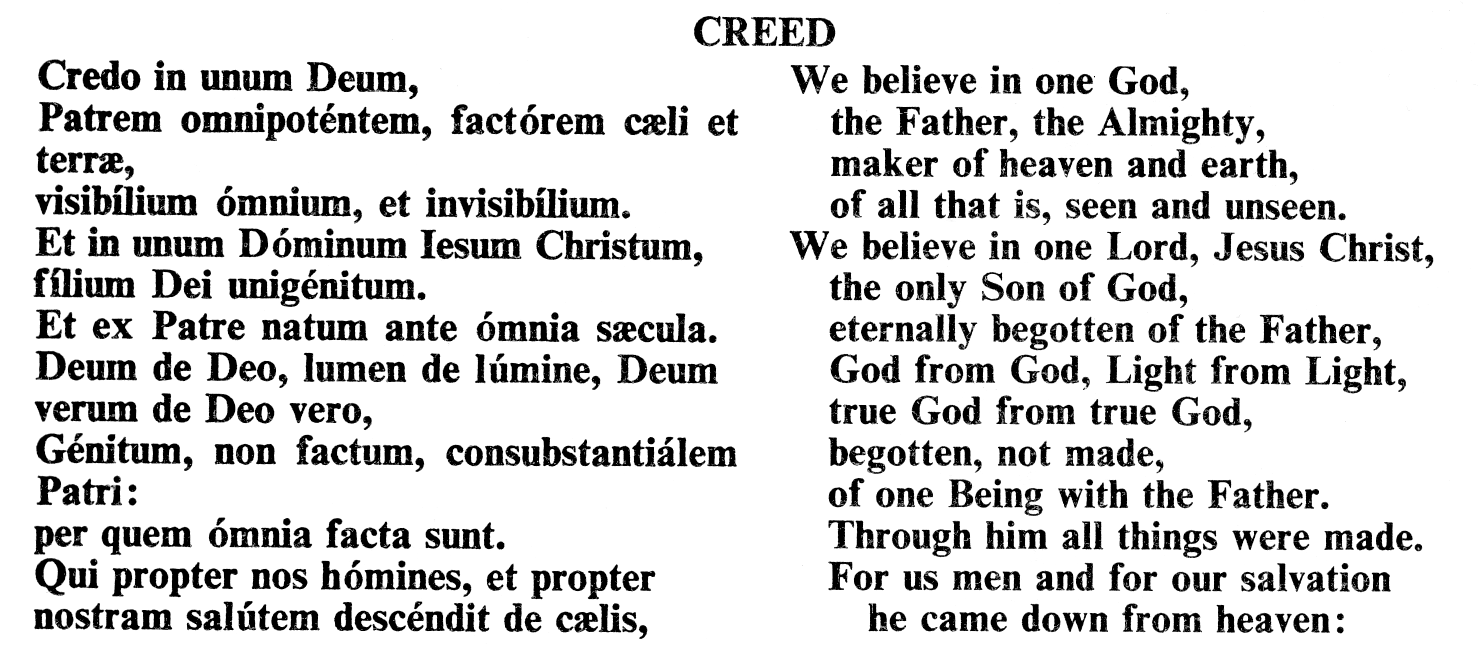
Additionally, towards the end of the Creed, “Confiteor una baptisma” (I confess one baptism,) where the first person singular persists, as is also the case with “expecto resurrectionem” (look forward to the resurrection.)
This decidedly unilingual change was done away with when the NOM’s current translation was made official and began use in Advent 2011, a change instituted by Benedict XVI, who is sadly Emeritus. There are many clumsy, Latinate phrases used in this translation, but in this case it was an improvement. (The same criticism can be made of the Authorised Version vs. Tyndale, but I digress again…)
The ACNA, evidently bowing to two score of 1979 habit, opted to use “We.” Personally I think the first person singular is better; it attempts to force people to make a commitment to their belief, which is lacking these days. The major problem churches such as the RCC and ACNA (TEC gave up a long time go) have is not getting their people to recite the Creed properly but to believe it. There are several variations of this: the modern (“The Creed is just a historical statement which is mostly a fable,”) the post-modern (“The Creed is correct but it doesn’t really mean what it says”) and the sub-modern (“We really don’t care what the Creed says, we’ll believe what we want to.”)
And as for the “filoque” clause, this is my answer and I’m sticking to it.
-
Banning is Not Too Strong of a Word to Use for Quincy’s Action re the 2019 Book of Common Prayer
In my post on the ACNA’s 2019 Book of Common Prayer, I made mention that the Diocese of Quincy had banned its use (as had Anglican Ink.) There has been some push back to that, from VirtueOnline and Robin Jordan, that this is not what they have done.
Although I’ll betray my Thomistic intellectual background in saying this, I think the Diocese’s actions need to be understood in conjunction with the purpose of the 2019 Book or any other Book of Common Prayer. The title page of the 2019 Book (earlier Books are similar) reads as follows:
The Book of Common Prayer
and
Administration of the Sacraments
with
Other Rites and Ceremonies of the Church
According to the Use of the Anglican Church in North America
Together with
the New Coverdale PsalterAlthough the Book can and is used for private devotions, the principal purpose of any Book of Common Prayer is its use in church, when the people of God are gathered together. Using the word “ban” for the prohibition of its use in public worship is not too strong. Anglicanism (on this side of the Atlantic at least) has avoided things like the prohibited books Index of Roman Catholicism; to require that “ban” prohibit its use at all goes beyond what Anglican and Episcopal churches have traditionally required of their parishioners. (And, of course, there are many non-Prayer Book resources for private devotions as well…) It’s worth observing that they have, in effect, banned the use of the 1662 and 1928 Books as well, but no one seems ruffled by this.
As Tertullian used to say, every choice implies a rejection.
Within the ACNA system, the Diocese is completely within its prerogative to ban its use in public worship. Whether this is wise is an different topic altogether; that’s a different debate.
-
Some Thoughts on the 2019 Book of Common Prayer
If I had to pick an event that transformed this site’s focus and viewership more than any other, it was my posting of the 1928 Book of Common Prayer in December 2003. The 1662 Book was posted the following year. Coming as they did at the start of the explosion (and partly in response to that explosion) that ultimately resulted in the Anglican Church in North America, it began a journey for me that has proven rewarding.
It’s only fitting, therefore, that the ACNA’s own stab at the Anglican Prayer Book genre, the 2019 Book of Common Prayer, would find its way to these pages. The term “own stab” may sound insouciant but the ACNA has not mandated the Book’s use in its own churches, and in fact one diocese has already banned it! On the other hand we have
Robin Jordan, who thinks that the book (and indeed the whole drift of the ACNA) is too Catholic.This review isn’t meant to be a comprehensive, blow-by-blow review of the new Book. It’s meant to highlight the issues I’ve had with the various BCP’s and how the 2019 Book resolves them.
- I think the first issue that needs to be addressed is the sheer length of the book: the pdf I offer for download is 812 pages (although the first two are blank, evidently this comes straight from the pdf used to print the book.) That’s admittedly an improvement over the 1979 book, which is 1001 pages long. The 1928 BCP, by comparison, has 611 pages. Some of the shared length is due to the fact that both Books contain the Psalter (more about that later,) but the 2019 Book doesn’t have the full “Collects, Epistles and Gospels” (it obviously has the collects) for the Holy Communion that the 1662 and 1928 books do, which take up 179 pages of the 1928 Book. I think that this reflects the idea that there needs to be a ceremony for just about everything. That bloat started with the 1979 book, but it also reflects the uniformitarian heritage of Anglicanism that started with the “three strikes and your out” Act of Uniformity. The ACNA had the opportunity to prepare a supplement that would move many of these ceremonies elsewhere but passed it up.
- In the Benedictus, we have “In the tender compassion of our God * the dawn from on high shall break upon us, To shine on those who dwell in darkness…” (p.20). No where is that more evident than in the Baptism ceremony, which jettisons the infamous “Baptismal Covenant.” I’ve referred to this as the “Contract on the Episcopalians,” and its excision is a cause for the ringing of church bells from sea to shining sea. Today many would like to turn Christianity into a SJW project, but for once the trend is the other way.
- I see the 2019 Book solves the problem of the Venite which goes back to the early days of both the Episcopal Church and the Republic.
- It was a good thing to see the Comfortable Words (p. 113) in the Holy Communion.
- The spectre of Bill Clinton’s Eucharistic Theology and its opposition hangs over just about any celebration of the Holy Communion, and that’s certainly the case with the insertion of the following into the “Anglican Rite”: “So now, O merciful Father, in your great goodness, we ask you to bless and sanctify, with your Word and Holy Spirit, these gifts of bread and wine, that we, receiving them according to your Son
our Savior Jesus Christ’s holy institution, in remembrance of his death and passion, may be partakers of his most blessed Body and Blood.” (p. 116) Although I see the theological sense in this (I can thank Cipriano Vagaggini for that) I think that, if one reproduces the Scriptural institution of the Eucharist, any form of Bill Clinton’s Eucharistic Theology goes up in smoke. It probably should have been left out. - In the preface we are told that “Eucharistic prayers in particular were influenced by the re-discovery of patristic texts unknown at the Reformation, and often bore little resemblance to what had for centuries been the Anglican norm.” The awareness of those goes back a long way, as evidenced by Luckock’s work. Those informed the Novus Ordo Missae. Unfortunately the follow-up to that in the “Renewed Ancient Text” falls a little flat. Part of the problem, as Robin Jordan rightly points out, is the tendency for Anglican liturgists to excessively lard the ceremonial. Jordan appeals to Cramner, but he could have just as easily appealed to Vatican II, which advocated a straightforward, easy to understand liturgy. I personally think that the ACNA would have been better off modifying a liturgy from the NOM, calling it the “Roman Rite” and been done with it.
- The Holy Communion (I find the term “Holy Eucharist” correct but hard to transition to when speaking about the BCP) isn’t the only place where ceremonial larding is in evidence. The “Ministry to the Dying” (p. 237), although it tells the minister to be flexible, seems to want to lose the race to the last breath. After that we have “The Commendation” (p. 256), which is too long for a graveside service, especially in inclement weather and really at National Cemeteries, where time if of the essence.
- It was nice to see that they retained the Litany prayer “To strengthen those who stand; to encourage the faint-hearted; to raise up those who fall; and finally to beat down Satan under our feet,” (p. 95). I’m sure the Charismatics will make the most of it.
- The Coverdale Psalter has always been a source of fascination in the history of the BCP, being one of the few relics of the pre-Authorised Version English Bible in current use. The ACNA opted to update and retain it in the 2019 Book. Personally I think the inclusion of the Psalter goes back to a time when the Psalter was the principal song and devotion book of Christians, and was frequently printed separately (I have the Psalter from this relative of mine.) That’s not the case these days. I think it should have been dropped from the 2019 Book. As an aside, although I’ll get catcalls from the ‘Trads,” I think the RCC practice of reading/singing the Psalms responsorially is better than the antiphonal or responsive methods, but that’s just me.
- One thing the ACNA really needs to do is to proclaim its own “Authorised Version” of the Scriptures, which would make excision of the Psalter much easier. They do that in a backhanded way by using the English Standard Version. Roman Catholics have done this for years with the New American Bible or the Jerusalem Bible (depending upon the country.) There are commercial possibilities too: the ACNA could have a Bible (print and software) produced as a companion to the 2019 Book, with suitable notes and lectionary. It just might get Anglicans to read the Bible more…
- I don’t get with calling the Sundays between Trinity and Advent “Proper” Sundays. Counting after Trinity or Pentecost is better, and even the Roman Catholics’ use of “Ordinary Time” is better. It’s still a great time in the liturgical year no matter what you call it.
- The use of a three-year lectionary cycle is controversial with some (what isn’t?) Adopting same probably occasioned the excision of the Epistles and Gospels, as was the case with the 1979 book. Having lived under both one- and three-year cycles, I think the latter gives a broader view of the Scriptures, especially since few people come to weekly services. (Twice on Sunday has been out the window for a long time…)
In sum, I think the 2019 Book is a major step in the right direction, its weaknesses notwithstanding. One thing’s for sure: after this, it’s hard to understand why anyone would not ditch the 1979 book once and for all…
-
Gilbert and Sullivan on the English Elites and the Iwerene Mess
Here one has to raise a very serious question viz a viz GAFCON. Why was Andy Lines (also a product of this culture and apparently abused by his mentor, Fletcher) selected and by whom to be chairman of GAFCON UK and missionary bishop? People are critical of the way Bishops in the Church of England are selected, but at least there is a selection process, with representatives, discussion and two names being put forward. Who was consulted in the case of Bishop Andy? Such lack of transparency does little to build confidence and strengthens the perception that the ‘same old same old’ is in operation as in the days of Packer and Stott and of which Dr Lloyd Jones was most critical seeing such a dominance as being detrimental to the evangelical cause.
The appointment of Jonathan Jukes as the President of Oak Hill College appears to be more of the same as further evidence of the Anglican evangelical hegemony. Many are bewildered and bemused as to why someone who has not published anything of a theological nature, or contributed as a national or international speaker and having no advanced theological degree could be appointed? Not least as he was heading up the search committee for the new President! But Mr Jukes does have one thing going for him -the right pedigree: Winchester College, Bash Camp, St Helen’s Bishopsgate and Proclamation Trust. The suspicion invariably grows as to whether here we have another instance of the ‘old school tie’ at work.
Sounds more like this:
The same analogy can be applied to the recent European leadership “elections.”
I think it’s fair to say that, in view of the activities of Jonathan Fletcher and others, the reason why it’s called “Bash Camp” has changed.
-
Bethesda-by-the-Sea Episcopal Church: The Unauthorised Tour
Sailing the Last Voyage with Newton and Pascal
 Positive Infinity