-
Real Presence: Reclaiming the Legacy of Anglo-Catholic Church Planting — Anglican Pastor

When it comes to Anglican church planting, we often think of modern evangelical or charismatic examples such as Holy Trinity Brompton in London. But what about the Anglo-Catholic movement that has its roots in the “Oxford Movement” of the nineteenth century? Are Anglo-Catholic Church Planters a Thing? Let’s be honest, when you hear think of…
via Real Presence: Reclaiming the Legacy of Anglo-Catholic Church Planting — Anglican Pastor
-
Book Review: Trevor Gervase Jalland’s The Church and the Papacy
One of Our Lord’s commands that we have difficulty fulfilling is this one:
But it is not only for them that I am interceding, but also for those who believe in me through their Message, That they all may be one–that as thou, Father, art in union with us–and so the world may believe that thou hast sent me as thy Messenger. (John 17:20-21 TCNT)
No where is that more apparent than the relationship between those who are under the jurisdiction of the Bishop of Rome–the Roman Catholics–and those who are not, whether the latter be Protestant, Orthodox or otherwise. Most Protestants have brushed off any idea of union with–or certainly under–Rome. Unless you figure that Protestant and Orthodox churches will simply roll the Roman Catholics–and in some places like Latin America that’s a possibility–sooner or later some accommodation with the See of Peter needs to be considered, or at least the obstacles to that accommodation need to be dispassionately discussed.
A serious discussion of this is Trevor Gervase Jalland’s The Church and the Papacy. Jalland, Vicar of St. Thomas the Martyr in Oxford and an Anglo-Catholic, delivered the Bampton Lectures at Oxford in 1942. These lectures became the book. As such it presupposes a fairly broad knowledge of the history of the church. Jalland’s main objective is to examine the validity of the claim of the See of Rome to Petrine Primacy, and how that claim has been actualized over the centuries.
The focus of his interest is the period from the New Testament to the end of the sixth century, which takes up most of his narrative. He brings out three important points which become leitmotifs in the history of the Roman Empire church in general and the Roman see in particular.
The first is that the assertion–and the acceptance–of Petrine primacy for the Roman see was relatively early in its history. It should be understood that the church’s structure was “looser” at that time and this primacy didn’t mean then what it means now, but primacy it was all the same.
The second is that the principal objective in bishops of Rome exerting this primacy was to insure that the faith which was handed down by the apostles–the paradosis, to use the transliterated Greek term that Jalland employs frequently–was preserved and maintained. That brought a conservatism to the way Rome responded to the many doctrinal crises that came from the East, a salutary one in most cases.
The third is that this primacy was set in opposition to the Caesero-papism that dominated Eastern church polity. From Constantine I onward Eastern Roman emperors exerted enormous authority over the calling of and presiding over Church councils and the doctrine which they promulgated. The See of Rome did not feel that the state really had any business doing this, although they frequently had to express this opinion very diplomatically. That rivalry was exacerbated by the rise of the see of Constantinople, which had no antiquity (as opposed to that of Rome, Alexandria, Antioch or even Jerusalem) and that rivalry ultimately paved the way to the split between Roman Catholic and Orthodox in 1054.
It’s tempting to observe that, had Rome stuck to the program above, it could have avoided many of the problems that arose later. Jalland doesn’t really come out and say this, but he does show that many of the changes in the nature of the Papacy in the Middle Ages were due to the increasingly politicized nature of the Papacy itself. This manifested itself in two forms. First, the Pope, having sent the Eastern Emperor packing so to speak, felt that he was over the monarchs of the West, and that headship involved political authority. The second was that, by virtue of Papal territory in Central Italy, the Pope became a secular ruler in his own right, with the political role that accompanied that. Both of these created conflict between the Pope and secular rulers, and that conflict helped to fuel the Reformation itself both on the Continent and in Great Britain.
Jalland describes two points in Papal history where a major turn of history took place at a point of weakness in Rome. The first is the Reformation: Jalland describes a Papacy enmeshed in worldly considerations and taking a “deer in headlights” attitude to the oncoming storm in Germany. The second is Vatican I, where Papal infallibility was proclaimed. Jalland opined that the crisis occasioned by the reunification of the country and the progressive disappearance of the Papal States lead Pius IX to seek help from above, first in the proclamation of the Immaculate Conception of the Blessed Virgin in 1854 (a doctrine not well supported in tradition) and his own infallibility in 1870, the promulgation of which provides the “book ends” for the lectures.
Jalland, unusual among Christian historians, has a good grasp on the relationship of doctrine with ecclesiology, and the impact of “church politics” (which includes both politics within the church and its interaction with the state.) He avoids the kinds of artificial constructs and sweeping generalizations that plague debates within the church these days. He has an Anglo-Catholic’s aversion to state control of the church, one seen also in Luckock. That is an appropriate backdrop to one of the most interesting narratives in the book: how Pius VII outlasted Napoleon in spite of the latter’s attempt to use the Papacy for his own purposes, something that Stalin’s successors would have done well to remember.
So now that he has shown the antiquity of Petrine primacy, where did he think things were going with Rome? In the last lecture he makes the following statement:
The latest tragedy of its history seems to lie in this, that the vain attempt to save what had long ceased to be valuable contributed its failure to appreciate the opportunity for fulfilling its world-wide mission as a centre of unity and order for Christian society as a whole under changed conditions, and led only to a comparatively sterile reassertion of its primatial status.
Jalland was unsure of where all of this was going, both for the Roman Catholics and for everyone else. Three quarters of a century after Jalland gave these lectures, we really don’t have a clearer picture. Vatican II had a great deal of promise but its own mandate for change was at once too broad and too narrow, and worse it became the tool of those with a sub-Christian agenda. The current Occupant of the See of Peter, back to the usual agenda of protecting the Vatican’s turf, currying favor with the “gods of this world” and using the authority of an infallible successor to Peter to make this happen, has left many inside and outside the Church in the lurch. As for the Protestant world, the Main Line churches, descendants (in the US) for the most part of the state churches (in Europe) that emerged from the Reformation, have lost center stage to the Evangelicals and Pentecostals, whose propensity to splinter makes putting the pieces back together difficult just by the sheer number of the pieces themselves.
What Christianity needs is leadership which is committed to transmitting the paradosis of the Apostles without expanding it. If the See of Peter ever rediscovers that mission, it will fulfill the final charge which Our Lord gave to Peter:
When breakfast was over, Jesus said to Simon Peter: “Simon, son of John, do you love me more than the others?” “Yes, Master,” he answered, “you know that I am your friend.” “Feed my lambs,” said Jesus. Then, a second time, Jesus asked: “Simon, son of John, do you love me?” “Yes, Master,” he answered, “you know that I am your friend.” “Tend my sheep,” said Jesus. The third time, Jesus said to him: “Simon, son of John, are you my friend?” Peter was hurt at his third question being ‘Are you my friend?’; and exclaimed: “Master, you know everything! You can tell that I am your friend.” “Feed my sheep,” said Jesus. “In truth I tell you,” he continued, “when you were young, you used to put on your own girdle, and walk wherever you wished; but, when you have grown old, you will have to stretch out your hands, while some one else puts on your girdle, and takes you where you do not wish.” (John 21:15-18 TCNT)
-
Communion in the Hand, and Those Pesky Easterners
This, brought to my attention, from Cyril of Jerusalem’s Catechetical Lectures, toward the very end:
Approaching therefore, come not with thy wrists extended, or they fingers open; but make they left hand as if a throne for thy right, which is on the eve of receiving the King. And having hallowed thy palm, receive the Body of Christ, saying after it, Amen. Then after thou hast with carefulness hallowed thy eyes by the touch of the Holy Body, partake thereof; giving heed lest thou lose any of it; for what thou losest, is a loss to thee as it were from one of thine own members. For tell me, if any one gave thee gold dust, wouldest thou not with all precaution keep it fast, being on thy guard against losing any of it, and suffering loss? How much more cautiously then will thou observe that not a crumb falls from thee, of what is more precious than gold and precious stones?
Then after having partaken of the Body of Christ, approach also to the Cup of His Blood; not stretching forth thine hands, but bending and saying in the way of worship and reverence, Amen, be thou hallowed by partaking also of the blood of Christ. And while the moisture is still upon thy lips, touching it with thy hands, hallow both thine eyes and brow and the other senses. Then wait for the prayer, and give thanks unto God, who has accounted thee worthy of so great mysteries. (Mystagogical Cathacheses, V, 21-22)
One of the hills the Trad Catholics die on is reception of the Host on the tongue. But as is the case with many things, the Eastern churches, whose sacramental validity has never been challenged, do many things in liturgical practice that haven’t sat well with their Western counterparts. This is one of them. Many of the “novelties” that are decried by Anglican and Catholic Trad alike are in reality imports from these churches, and as such are a real nuisance to these trads.
I did a series a few years back on Cyril of Jerusalem’s Catechetical Lectures. For me, it was an interesting and informative journey, and I commend it again to my visitors.
-
My Rimsky-Korsakov Moment in Academia — vulcanhammer.net

In 1871, Nikolai Rimsky-Korsakov became a Professor of Practical Composition and Instrumentation at the St. Petersburg Conservatory. In retrospect, given the music he composed, this is not extraordinary. At the time, however, it was amazing. He was still in active service in the Russian Navy. More importantly, although he had had private music lessons and […]
via My Rimsky-Korsakov Moment in Academia — vulcanhammer.net
-
Kissing Josh Harris Goodbye
Joshua Harris has abandoned his Christian faith, news that marks another blow to American conservative evangelicalism.
Harris authored the best-selling I Kissed Dating Goodbye in his early twenties, unleashing unnecessary angst on a generation of evangelical teens. In his early thirties, he served as pastor of a Gaithersburg megachurch. He was also an influential figure in the Young, Restless, and Reformed Movement (YRR). Now, he has denounced his famous book, announced he and his wife are separating, and repudiated Christianity.
I’m not sure that this is the setback that some think it is. It’s tempting to equate this with Bart Campolo’s abandonment of the faith, but the motivation is different. In Campolo’s case, it was the theodicy issue, something with which American evangelicalism has set itself for trouble. (That too entered into Rachel Held Evans’ falling down, although her break wasn’t as clean.) In this case it’s another evangelical disaster. As Trueman notes:
While Harris seems to be making a clean break with his past, the style of his apostasy announcement is oddly consistent with the evangelical Christianity he used to represent. He revealed he was leaving the faith with a social media post, which included a mood photograph of himself contemplating a beautiful lake. The earlier announcement of his divorce used the typical postmodern jargon of “journey” and “story.” And both posts were designed to play to the emotions rather than the mind. Life, it would seem, continues as performance art.
American evangelicalism is a running popularity contest, and Harris hasn’t stopped that part of it, just changed the product he’s selling. And he’s also stuck his finger in the wind to see which way it’s blowing, which is probably behind his apology to the LGBT community. Before that, however, his promotion of the “purity movement” reflected evangelical myopia on how to implement the demands of the Gospel. My biggest problem with the purity movement wasn’t with the principle but with the implementation. For someone who grew up in a part of the country where the Christian sexual ethic was unpopular to say the least, to make such a public show of it struck me as dangerous. It’s hard enough to be a Christian without adding to the social pressure, especially in a society where the opinion leaders and elites live primarily to get laid, high or drunk. Evangelicals think that they have to work at confronting the culture with the Gospel; these days, and earlier for some of us, live it and don’t worry, you’ll have confrontation.
It also doesn’t surprise me that he was Reformed. Reformed theology is, IMHO, a highway to universalism, but some will blow their stack if they hear that.
-
What the 2019 Book of Common Prayer Really Needs
The discussion about this book continues. I get the feeling I’m being shadowboxed in this discussion (and I’m sure others are too.) For the moment I’ll pass along this blog’s take on Cranmer and Lutheran influence. The Porcine is a relatively new Anglican blog and is very nice, I hope its writer keeps it up.
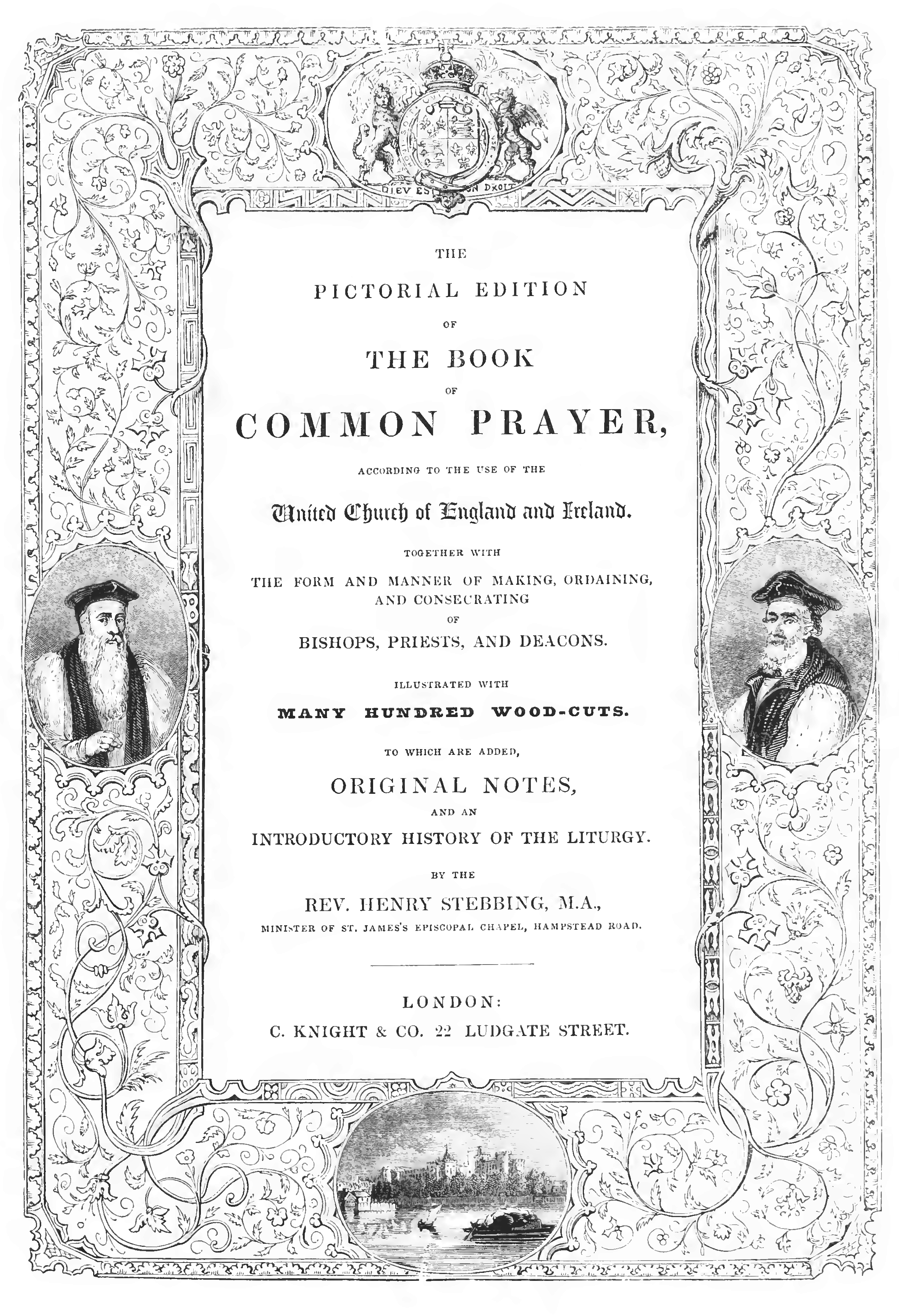
Taking a different tack on this, there are many things the ACNA’s new 2019 Book of Common Prayer needs but I’ll throw one more idea out there: pictures. As a kid growing up in the Episcopal Church I had an illustrated version of part of the 1928 BCP, but there are illustrated versions of at least the 1662 BCP. One of them is the Pictorial Edition of the Book of Common Prayer, and following are selected pages from that book.


-
Does the 2019 BCP Need More Than One Rite?
The back and forth over the new ANCA 2019 Book of Common Prayer continues. This post delves into a question that, in a sense, puts together the whole debate over the theology of the Holy Communion and how it should be represented in the liturgy: do we really need the two rites we have in the 2019 BCP? And what’s this business about the “ancient texts?”
Let’s start with stating a proposition: the fact that the 1979 BCP has two doesn’t justify the 2019 BCP doing the same. I’m sure the committee(s) that put together the 2019 BCP had that discussion. Having more than one rite antedates the 1979 BCP. I know some of my readers find my constant references to Roman Catholicism in these posts irritating at best and heretical at worst, but as an educator I think it’s at least instructive.
It’s worth noting that the Church of England, the Episcopal Church and the Roman Catholic Church had one anaphora (the technical term for the consecration of the elements of Communion) and one rite of the Communion/Eucharist/Mass going into the 1960’s. It’s also worth noting that these liturgies were basically all of sixteenth century vintage. The Anglican liturgy was first set forth in the 1549 BCP and, through the dizzying and deadly changes that the Church of England went through subsequent to that, ended up in a modified form in the 1662 BCP. The Roman Catholic Church formulated (or better normalized) its liturgy around the time of the Council of Trent. Before the term “Traditional Latin Mass” (#TLM) became common with trads, it was customary to refer to this liturgy as the Tridentine Mass.
On both sides of the English Channel there was a great deal of intellectual ferment in the years leading up to the 1960’s. A greater awareness of Patristic and Roman Empire Christianity practice came into being. Anglo-Catholics such as Luckock and Jalland were aware of different liturgical practices in this era, different both from Rome and what was current in the Church of England. Roman Catholics such as Jean Daniélou took a similar scholarly interest.
It’s worth noting that in 2009 this blog featured a series (about the same time the ACNA came into existence) of several of these “ancient text” anaphorae. The complete list with explanation as to their origin is as follows:
- The Anaphora of Hippolytus
- The Early Roman Canon
- The Paleo-Hispanic Anaphora
- The Anaphora of St. Basil
- The Anaphora of Theodore of Mopsuestia
- The Anaphora of St. Mark
Also included were a couple of Roman Catholic “experimental” liturgies (Canon “B” and Canon “C”.) It would be interesting to know if any of these were a resource for the 2019 BCP.
The 1970’s saw the revision of both the Roman Catholic and Episcopal liturgies, the former with the Novus Ordo Missae and the latter with the 1979 BCP. These types of liturgies have been used for around a half century. It is obvious that those who put the 2019 BCP have bowed, in part, to that long usage. They evidently felt that a return to a modernized version of the 1928 or even 1662 BCP with one anaphora (to say nothing of the general structure of the Communion liturgy) was not a real possibility at this point.
So how does the 2019’s “ancient text” stack up? It combines the brevity of the Anaphora of Hippolytus (the oldest of the texts above) with a “history of salvation” that is seen in some of the Eastern liturgies. Overall it’s not really bad. The biggest criticism may be that it’s too brief! I’m sure, however, that a “history of salvation” type of liturgy will go over with some about as well as the first such presentation, that of Stephen (Acts 7:2-60.)
I really think that the revival of these “ancient texts,” when too much violence isn’t done to their own theology, is one of the best things that has happened in liturgical development this half century past. That sentiment is not shared amongst Reformed Anglican or Catholic trad alike. However, the main thing that Anglican and Catholic have in common with the negative response is the vehemence of the opposition.
The impact on Roman Catholicism has been a realization that a great deal of what passed for Catholic “essentials” before Vatican II (and with the trade today) was more like an accumulation of stuff by people who have lived in a house for many years: the house is the same, but the large volume of the stuff has changed the mode of living. Attempts to do some “housecleaning” have been lost with those of a more modern or post-modern style of mind (like that of James Martin SJ or the current Occupant of St. Peter’s.) The trads’ answer is that we should keep all the stuff the way it was, but I don’t think that’s a real solution.
With the Reformed Anglicans (the Anglo-Catholics are another story altogether) the question is more basic: is the Roman Empire Church, which immediately followed Our Lord’s time on earth, closer to his idea than that of the Reformers, who lived 1500 years later? From a historical view, the latter implies this type of concept:
Most evangelicals look at church history in a very specific way; there were first New Testament times, then there was the Reformation, and now there’s us. This results in a gap of about a millennium and a half between significant events; surely something happened in that length of time!
The danger to Reformed types of the inclusion of such a liturgy is that it undercuts their own claim to “pride of place” as the closest to the Scriptures.
Since the Anglicans have gone to the trouble to retain an episcopate (and the episcopate is often a major source of trouble) and a liturgy, it makes sense that the Patristic witness is relevant. That’s a hard sell to many Reformed types, but if they want to be consistent, they should ditch the liturgy and the episcopate and do it Calvin’s way.
-
The Problem of God, Evil, Cancer and My Nurse — The Evangelical Calvinist

It is just over nine years ago now that I was laid up in my hospital bed at OHSU in Portland, OR; I was being treated for an incurable, rare, and highly aggressive cancer known as Desmoplastic Small Round Cell Tumor sarcoma (DSRCT). The prognosis of this particular cancer is almost always imminent death (within […]
I’ve discussed the theodicy issue–which I think may be the most urgent issue American Christianity faces–in pieces such as If I Started the way @BartCampolo Did, I Wouldn’t Believe in God Either and Painting Ourselves into a Corner at “The Shack”. But to use his own dire adversity as an opportunity to share his faith is very moving.
via The Problem of God, Evil, Cancer and My Nurse — The Evangelical Calvinist
-
Remembering the Anti-Moon Luddites — Chet Aero Marine

Today, of course, is the fiftieth anniversary of Neil Armstrong’s first steps on the moon–“one giant leap for mankind,” to be sure. It was a great accomplishment and deserves to be remembered. It’s easy to forget, however, that at the time there were many–especially on the left–who believed that the whole enterprise was a mistake, […]
Sailing the Last Voyage with Newton and Pascal
 Positive Infinity