-
Sanity of Bishops — Ad Orientem
Old Russian joke (as told by an OCA bishop): If a young man has a good voice and good mind they make him a deacon.When he loses his voice they make him priest. And when he loses his mind… (via)
-
Jesus Our Mediator
So Jesus, who is our God, is at the same time our mediator, our almighty intercessor, to whom God does not refuse anything, and there is no other name by which we should be saved. Let us put our trust in Jesus, who is God and mediator together and, even greater and above Moses, as Moses is only God to send temporary wounds, and he is a mediator only to divert them; but Jesus passes by doing good, and healing all the sick. He deploys his power only to show his kindness; and the plagues which he diverts from us are the plagues of the spirit. Let us put ourselves in his salutary hands; he does not ask anything else, except that we let him do it, from then on he will save us, and salvation is his work.
From Bossuet’s Elevations on the Mysteries.
-
The Intellectual Shell Game of Critical Race Theory in the Anglican/Episcopal World
Matt Kennedy’s thoughtful piece on critical race theory lays out many things very succinctly. My purpose here is to take a look at this from another point of view. The way Matt links current critical race theory with the class theory of Marxism connects many dots, dots which have driven many of my life decisions, especially regarding choice of church.
Let’s start with the Marxism. Marxism teaches class warfare, and that when the proletariat achieves their revolutionary destiny we will have their dictatorship, equality, and the end of the state. (My time in both Russia and China showed that the last is a mirage.) In the meanwhile the aristocrats and the bourgeoisie are the exploiters of the proletariat’s surplus value, and are thus evil and worthy of overthrow. (My time in especially Russia showed me that an economic system that doesn’t produce surplus value runs down, as theirs did.)
Before all of this informative travel, there was life in Palm Beach and the Episcopal Church. I looked around me and realized two things. The first is that the people around me were, in Marxist terms (and remember that the Marxists had nuclear weapons pointed at us) part of the problem. The second is that Our Lord’s solution to this problem was for the rich young ruler to sell all and follow him.
The Episcopal Church’s answer to all of this fell seriously flat. First, I was confronted with the “do-gooder approach” by my Episcopal prep school chaplain, which seemed inadequate. Second, the Episcopal Church was in the throes of 1960’s social justice, where the church and its parishioners were exhorted to get into political action to change things. Neither of these seemed much a response to either Marx or Jesus; the political action in particular was an attempt to get someone else (in this case the state) to do the work that Our Lord called us to do. The Episcopalians remained at the “top of the heap,” which meant that the Marxist challenge went unanswered. All of this was part but not all of the reason why I left.
Fast forward to the days of critical race theory. Critical race theory does for Marx what Marx did for Hegel; it turns the older concept on its head. Marx was all about economics. Critical race theory is first an American attempt to create an oppression dialectic without having to deal with the reality of economic and class differences. That’s because Americans have a serious blind spot to both and are too ashamed to admit that they’re on the wrong side of the divide (and it doesn’t matter which side you’re on.)
In any case, the Anglican/Episcopal world in North America is just about as unprepared to deal with critical race theory now as it was with social justice fifty years ago. That’s because the Episcopal Church (and the ACNA isn’t much better) are overwhelmingly white, in TEC’s case more so than the Southern Baptists. It’s really stupid to bring up “white privilege” in churches with the ethnic makeup that most Anglican/Episcopal churches in this country have. If you want to deal with your privilege, whether it be racial, social or economic, you need to first join up with people where your privilege doesn’t mean as much. That doesn’t happen very often.
All of this duplicity has convinced me that critical race theory is a shell game. Like past and present social justice, it gives its adherents an opportunity to virtue signal/feel better about themselves without significantly disturbing the reality they’re in, a reality about which they’re seriously guilty. Just because people virtue signal about something doesn’t mean they’re serious: just look at the college admissions scandal we just went through. That too was an attempt by what we used to call the “beautiful people” to perpetuate their own white privilege by getting their unqualified children into elite institutions.
We need to stop playing games with ourselves on this subject. The change we really need comes from God through Jesus Christ. Once that’s really happened we become a new race with a new blood line; our world and the way we see it and deal with it becomes different. Anything else is a shell game which either seeks to deflect attention away from ourselves and to assuage our guilt for what we are. We don’t need guilt reduction: we need redemption and forgiveness.
-
The Cost of Pastoral Ministry
From Bossuet’s Elevations on the Mysteries, on the early career of Moses:
Pastors, leaders of souls, whoever you are, do not think you can save them without it costing you: admire in Moses the persecutions of Jesus, and drink the chalice of his passion.
-
Francis Chan Bails on Bill Clinton’s Eucharistic Theology
As you see here:
“Bill Clinton’s Eucharistic Theology” is my catty description of Zwinglian theology, which posits that the Holy Communion is a mere symbol. As I noted in my piece entitled Bill Clinton’s Eucharistic Theology: It Depends Upon What Is Is:
Until the Reformation Christianity uniformly confessed that, when Our Lord said “is” he meant “is”, up to and including the concept of transubstantiation, which Aquinas details in the Summa.
With the breakage of the Reformers we start seeing a variety of explanations of how this “is”, something that Bossuet has more fun than a human being ought to have in his History of the Variations of the Protestant Churches. But the biggest variation, one that started with Huldreich Zwingli, basically stated that “is isn’t”; that it’s just bread from start to finish and that the Lord’s Supper is purely symbolic. That “theology” made its way into many Evangelical churches, including the Southern Baptist Convention.
Welcome, Francis Chan.
-
Guatemala, Then and Now — Chet Aero Marine

One of the things I’ve learned in the many years I’ve worked on this site is that my family has a habit of following in the wake of its ancestors, even if the followers were reluctant to admit it. Our trips to the Bahamas were in the wake of Chet’s SPA trips; our moving to […]
-
John Eric Booth-Clibborn: The Assemblies of God Missionary Who Gave His Life for Burkina Faso — Flower Pentecostal Heritage Center

This Week in AG History — January 2, 1926 By Darrin J. Rodgers Originally published on AG News, 2 January 2019 John Eric Booth-Clibborn, a 29-year-old Assemblies of God missionary, laid down his life in the French West African colony of Upper Volta (now Burkina Faso) on July 8, 1924. He died from dysentery and […]
-
On the Prayer Book as Constitution — Ad Orientem
The prayer book controversies, however, are an illustration of one of the banes of the English speaking world: debating substantive issues by arguing over documents. Today in the U.S. we debate many issues in our society, not on their merits, but by their constitutionality. The basic problem with the newer prayer book is that many […]
-
The Year the 1928 Book of Common Prayer Ran Out of Gas
The release of the ACNA’s new prayer book this past year doesn’t change the fact that not everyone is happy with it, even in the ACNA. One competitor in the field–especially amongst churches that most would classify as High Church in one form or another–is the venerable 1928 Book of Common Prayer, kept in front of everyone with the help of the 1928 Prayer Book Alliance.
As mellifluous and delightful as this book is, I think we need to admit that, in one respect at least, it ran out of gas a few years ago. Let’s start by looking at the front matter, pp. lii-liii, reproduced below.
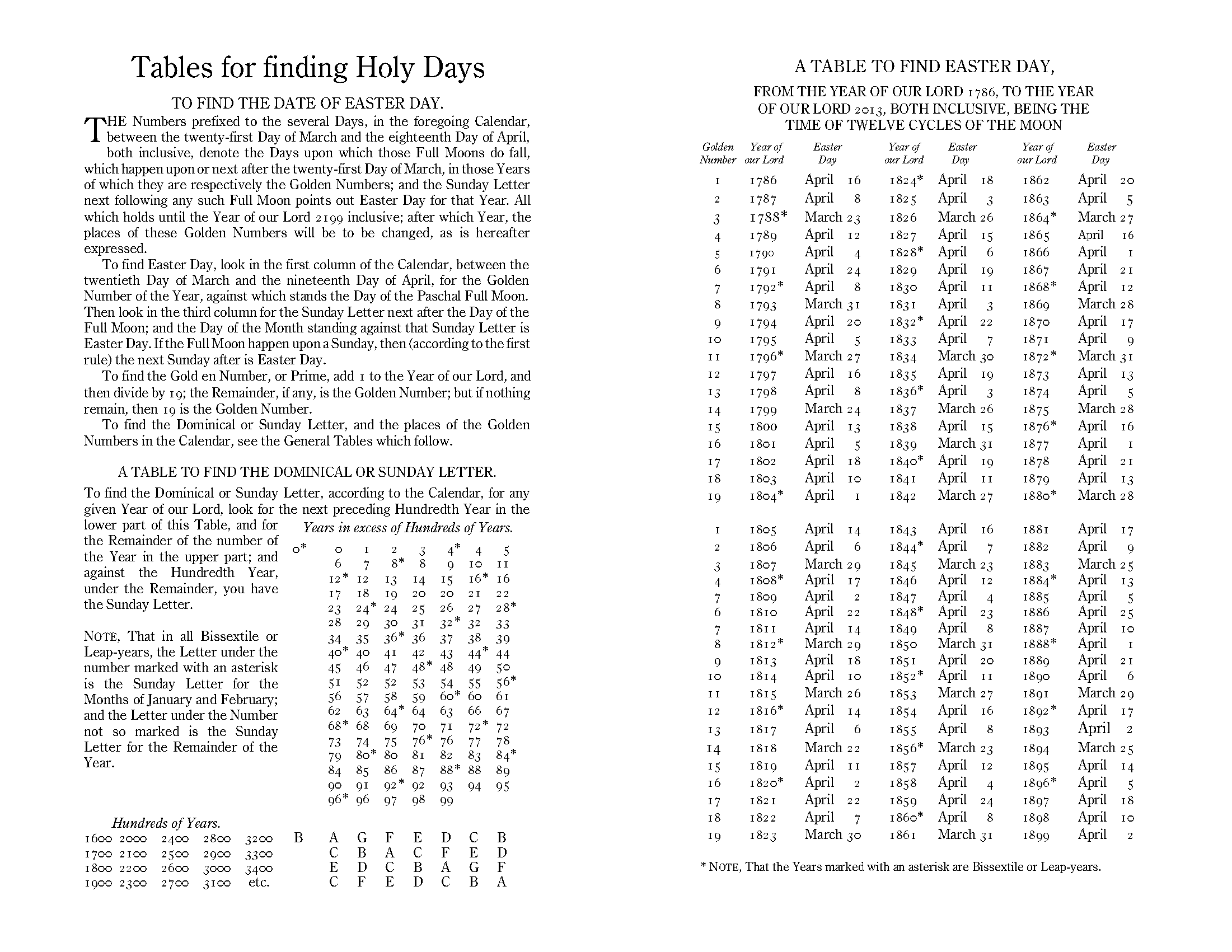
On the left is a method of finding Easter Day. The compilers of the Prayer Book were mindful that most parishioners–to say nothing of the clergy–would not delve into the complexities of computing Easter every year. (Today computer languages such as PHP will do the job for you, the basis of much of the Anglican Calendar Script.) So on the right were Easter days from 1786 (just before our Constitution was ratified and the Episcopal Church was founded) to 1899, when my great-grandfather sailed Lake Michigan.
They continued the table, and added an other one to find the other Holy Days.
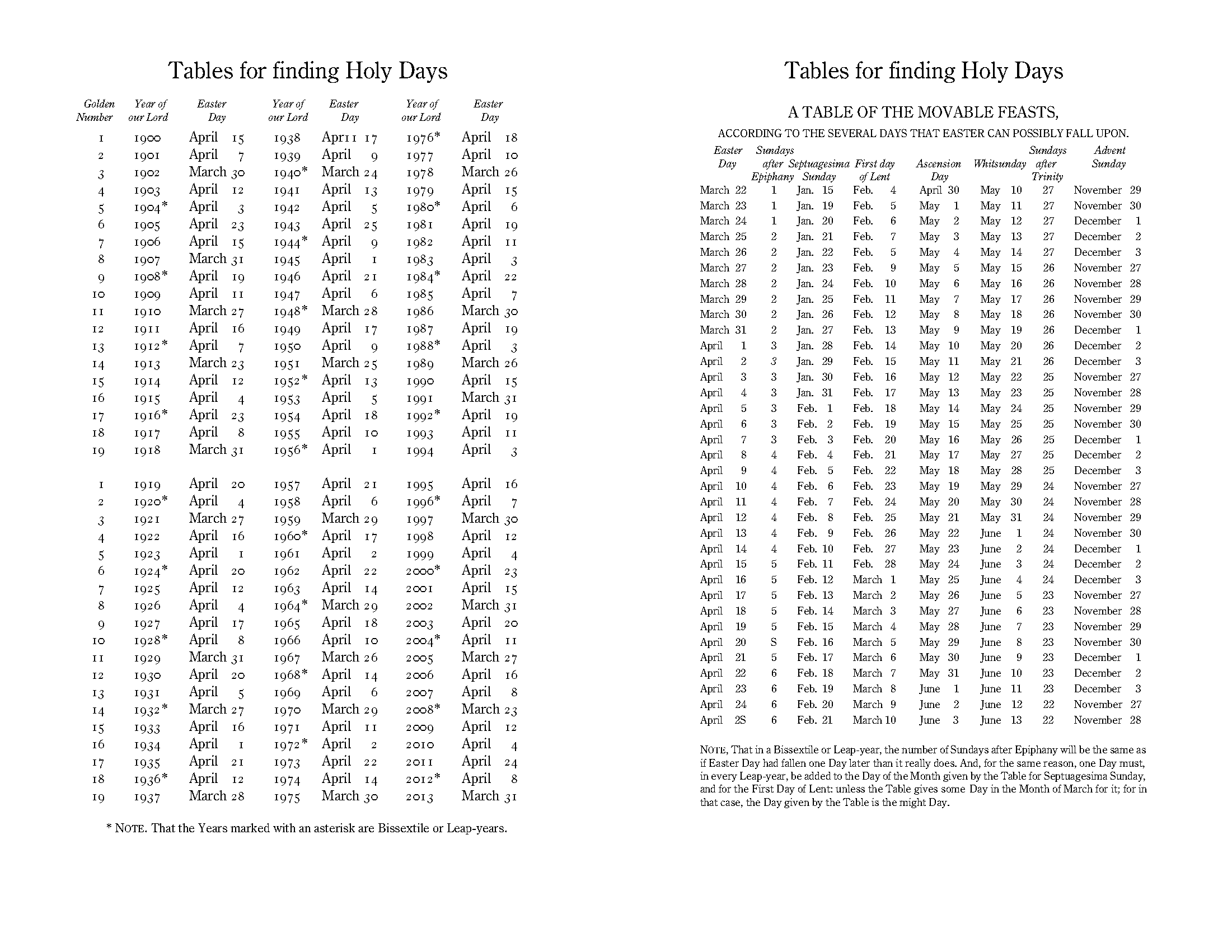
Note carefully in this table and the last that 1800 and 1900, although divisible by four, were not leap years, but 2000 was, another unusual aspect of the beginning of this millennium.
Alas, however, all things must come to an end, and the table ends in 2013. That’s the year that the 1928 BCP, so to speak, runs out of gas.
I doubt seriously that the compilers of the 1928 BCP saw the tumult that was to flow through the years listed on this page, much of which is documented on this site. I also would have been amazed if you had told me when I was growing up on this that I would be working on my PhD in 2013, let alone pursuing a PhD at all!
While were on the subject of this book, let’s consider a couple of covers, at least for this site.
 My “original” concept for this cover, done in the “blue and gold” of Palm Beach Day School, and later the University of Tennessee at Chattanooga, where I currently teach.
 The cover of the 1928 Book of Common Prayer, as it’s been offered on Positive Infinity since it was uploaded in December 2003. The church, of course, is Bethesda-by-the-Sea in Palm Beach, the webmaster’s home church, and a suitable backdrop for this prayer book.
No matter which prayer book you’re using–and I know, Pentecostals, that you’re sneaking to Episcopal and Anglican churches to see what it’s all about–I would like to end with the closing benediction (based on 2 Cor. 13:14) from Morning Prayer:
The grace of our Lord Jesus Christ, and the love of God, and the fellowship of the Holy Ghost, be with us all evermore. Amen.
-
Dodging the Important Questions on Priests and the Holy Communion
Chris Findley’s piece (Why) Are Priests and the Liturgy Necessary for Holy Communion? is an interesting exploration of the topic, but it’s also (for me at least) an illustration of some of the weaknesses of the way Anglicans “do theology.” Perhaps it’s too much to ask in one internet piece (which need to be brief and to the point) but I’d like to point out some of the things that Findley manages to dodge in his presentation.
Why are Priests Really Necessary?
We’ll start with the central question of the piece. He responds as follows:
The short answer is because the charge of conducting the sacraments is an apostolic charge for the care of the Church.
That leaves the serious questions unanswered. We know that Our Lord himself instituted the Holy Communion and Paul is a witness that this was continued in the New Testament church, and Findley underscores that. Although, as Findley notes, the institution was done with the disciples (soon to be apostles, Judas excepted,) does this really restrict its celebration to the priests? Citing the 2019 Book of Common Prayer expresses the way Anglicans are supposed to understand the role without really justifying it.
The problem is that there isn’t a unity in Anglicanism either on whether their bishops are successors to the Apostles or whether their priestly role in the Eucharist is a sacrificing one. You can get Anglicans to blow their stack (and I have) for suggesting that Anglican bishops are successors to the Apostles, and my guess is that Findley would rather avoid that kind of unpleasantness. Those who object to the successor idea generally tie the issue of successors to the issue of the role of the priest. But there’s no reason to do this. In fact, the whole idea of a sacrificing priesthood–one which is borrowed from Roman Catholicism–is patently unBiblical, as I noted here. But again you can get into trouble in some circles for saying that.
Why Do We Have a Liturgy?
One would think that anyone who would “join up” with an Anglican church would accept the liturgy as a given, but that’s not always the case these days. I think the simple answer to this question is “why not?” In other words, why is it superior for some person in skinny jeans (to say nothing of the cheap polyester suits we had to endure in the 1970’s) to get up and ad-lib it to celebrate the sacred mysteries? The advantage of the liturgy is that it insures (if the liturgy is properly constructed) that all of the theological and penitential bases are covered. The liturgy should express what the Holy Communion is all about and how one should prepare oneself to receive it. Some emphasize the aesthetic superiority of liturgical worship, but focusing on that at the expense of theological integrity is a big reason the Anglican/Episcopal world is in the mess it’s in these days.
Why Is It a Sacrament?
In the 1928 Book of Common Prayer, a sacrament is defined as “an outward and visible sign of an inward and spiritual grace.” The whole concept of sacramental theology is controversial in some circles, who believe that grace is infused (if they use that terminology) only when someone received Christ by faith. The Baptists and others like them have traditionally referred to those things that Anglicans call sacraments as ordinances, just to underscore the difference. (Why, in a Reformed context, people who are absolutely elected and persevere need any kind of additional grace is another issue.) However, I think that sacramental theology is justified provided that the necessary preparatory prerequisites are fulfilled, and I’ve discussed this both relating to Baptism and the Holy Communion. Whether the church has the authority to dispense this is another subject that Findley asserts without really showing whether it’s true or not, but that again is tied up with the nature of the church and the apostolic succession.
What is the Holy Communion?
This is the biggest dodge of all; Findley concentrates on the effect of the Eucharist at the expense of its nature. I’ll not bore everyone with my thoughts on this subject; Anglicanism has been all over the map on this subject, it is still the subject of extensive (and sometimes heated) debate. Like the apostolic succession, the nature of the Eucharist brings up too much unpleasantness. Another interesting topic which, Lord willing, I plan to take up down the road is the relationship of the faith of the church to the nature of the Eucharist. But that, people, is another post.

Sailing the Last Voyage with Newton and Pascal
 Positive Infinity