-
Go to Bed With the Dogs, Get Up With Fleas: the Episcopal Church, the ACNA, Social Justice and Race Relations
I find it strange that the Episcopal Church is up in a lather because Donald Trump marched with his entourage to St. John’s Church near the White House and held up a Bible. Why is it strange?
Reason I: it’s a Bible. Episcopalians usually leave the daily Bible reading (or any Bible reading) to the impecunious rednecks across the tracks. But I digress…
Reason II: they’ve had numerous opportunities to give this man–whom most of them despise–the boot. He attends St. John’s occasionally. When he’s in Palm Beach he goes to Bethesda, he married Melania there. I suggested that Michael Curry stand at the door of the latter and bar his entrance, if he wants to be a post-modern left-wing prophet, but he hasn’t. He’s marched around the White House but neither he nor his minions defended his church against the assault from 1600 Pennsylvania Avenue, nor did they bar his pre-inaugural service from the National Cathedral. They’ve had plenty of opportunities to make the Orange Man persona non grata in the church that “welcomes you,” but they’ve passed them up.
We shouldn’t expect otherwise. St. John’s is strategically located near the White House, which is why so many Presidents have visited there. As the impecunious rednecks would say, you go to bed with the dogs, you get up with fleas. They’ve positioned themselves at the centre of power and have no intention giving up their privilege now.
The Episcopal Church is an overwhelmingly white, highly educated and upper income institution (and now a geriatric one too.) Over a half century of its ministers such as Ian Mitchell and my prep school chaplain trying to motivate/shame the laity to social justice hasn’t changed that, neither has it substantially altered the demographics of the church in general. The church which wants to have the preferential option for the poor isn’t the preferential option of the poor. Any efforts it might make in that regard are patronising in every sense of the word.
And now the ACNA has rumbles to make the exact same mistake, starting as it has with very similar demographics and racial makeup. We have the efforts of one Greg Goebel in that regard. Now Goebel is an ex-Pentecostal, and if there’s one thing I’ve found out about Pentecostals, current and former, is that (like Evangelicals) they’re deeper into their own stuff than just about anyone else, and less able to see things from other viewpoints. I’m well aware of the failings of my Scots-Irish ancestors in the race relations field, but I’ve also experienced the failures of the Episcopal Church in trying to be something it cannot. The ACNA will experience the same compromise and decline TEC has if it goes down this road.
Karl Marx said that history repeats itself: the first time as a tragedy, the second as a farce. The Episcopal Church is a tragedy. Will the ACNA, once so full of promise, be the farce?
-
Karl Friston: up to 80% not even susceptible to Covid-19 — UnHerd
Just one month ago, the idea that most people aren’t susceptible to Covid-19 — perhaps the overwhelming majority — was considered dangerous denialism. It was startling when Nobel-prize-winning scientist Michael Levitt argued in UnHerd at the start of May that the growth curves of the disease were never truly exponential, suggesting that some sort of…
via Karl Friston: up to 80% not even susceptible to Covid-19 — UnHerd
-
Traditional Morning Prayer: 4 June 2020
-
My Response to Matt Kennedy on the Ethnicity Issue in the ACNA
I had this exchange with Matt Kennedy re the ethnicity issue in the ACNA:
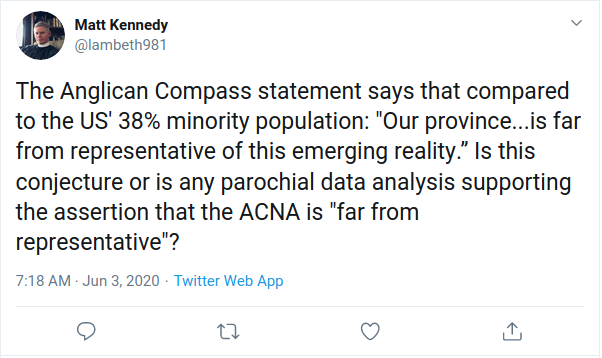
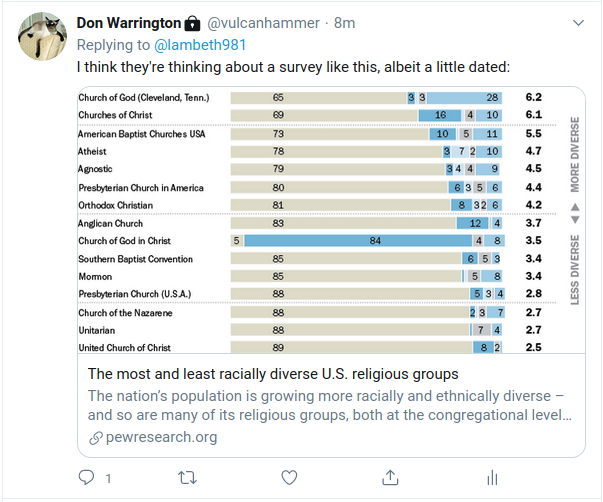
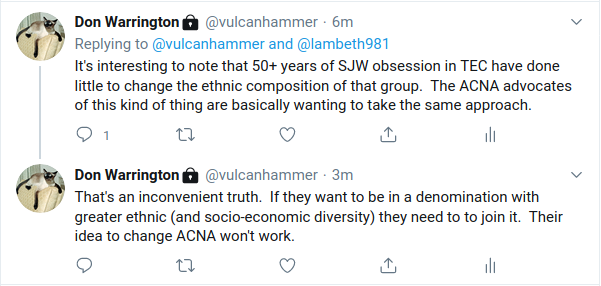
The Pew survey I reference can be found here.
As a personal aside the denomination I’m currently in has ethnic diversity which more or less reflects the general population, although they’re not quite sure how to take best advantage of that.
-
When Churches and Good Causes Are Hijacked — Stand Firm
When I was a callow student at Duke University, the verdicts from the Greensboro Killings state trial came in November 1980. Five Klansmen were acquitted of murdering four Communist Party members and an additional man during a protest a year earlier. I considered the result unjust and therefore joined a campus protest rally.But the speeches…
-
The Spiritual Legacy of Camp Meetings: From the Scottish Covenanters to the Assemblies of God — Flower Pentecostal Heritage Center

This Week in AG History — May 29, 1937 By Ruthie Edgerly Oberg Originally published on AG News, 28 May 2020 If you attended meetings in the years of the early Pentecostal movement, you might remember a summer church event that included sawdust floors, crude benches, tents, and open tabernacles. Those early tents and brush […]
-
The Relationship Between the Giving of the Law and Pentecost
A neglected topic taken up by Bossuet in his Elevations on the Mysteries:
When God wanted to give Moses the law on Mount Sinai, we read four important things. He descended to the sound of thunder and trumpets. The whole mountain seemed on fire, and one could see a flame break out in a cloud of smoke. God engraved the Decalogue on two stone tablets. He pronounced the other articles of the law in an intelligible voice, which was heard by all the people.
To publish the Gospel law, he renewed these four things, but in a much more excellent way. The work began with a great noise: but it was neither the violence of thunder, nor the sound of trumpets, as we hear in a fight; the noise which God sent was like that of an impetuous wind, which represented the Holy Spirit; and who, without being terrible or threatening, filled the whole house, and called all of Jerusalem to the beautiful spectacle which God was going to give them. We saw a fire, but pure and smoke-free, which did not appear from afar to frighten the disciples, but whose innocent flame, without burning them or singeing their hair, rested on their heads. This fire penetrated inside, and by this means the law of the Gospel was gently imprinted, not in insensible stones, but in a heart composed of flesh, and softened by grace. There was a word, which multiplied admirably. In place on Mount Sinai God spoke one language, and one people; in the evangelical publication which was to bring together in one all the peoples of the universe in the faith of Jesus Christ and the knowledge of God, in a single speech we heard all languages, and each people heard their own. So Jesus established his law much differently than Moses. Let us believe, hope, love, and the law will be in our hearts. Let us prepare inner ears for him, simple attention, a gentle fear which ends in love.
The giving of the law as a “figure” of the coming of the Holy Spirit at Pentecost is something that has gotten neglected as the practice of type/antitype has gone out of fashion in Christian circles. It should not: such a hermeneutic shows that the Old Testament and the sacred history of the Jews was the preparation for the coming of Jesus Christ.
-
Traditional Morning Prayer: 28 May 2020
Sailing the Last Voyage with Newton and Pascal
 Positive Infinity